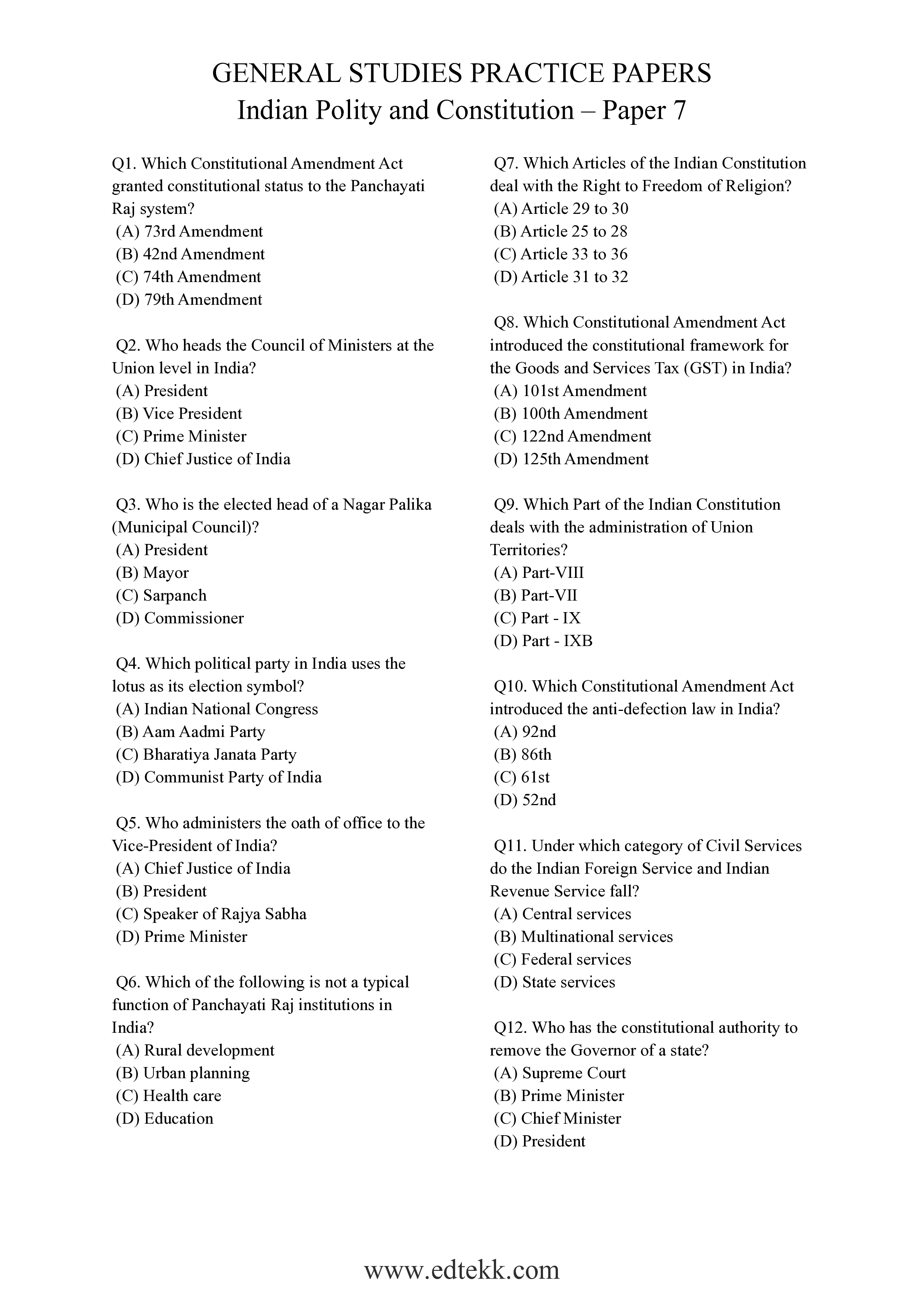
Strengthen your understanding of Indian Polity and constitutional topics with Practice Paper 7. Designed for SSC, Railway, Police Constable and Police SI examinations, this General Studies paper offers 20 objective questions on India’s political and constitutional framework, including correct answers and explanatory solutions.
Test Details
Topic: Indian Polity and Constitution
Total Questions: 20
Question Format: MCQs – Single Correct Answer
Suitable for: SSC exams, Railway exams, Police Constable, Police SI
Download All Papers in This Series (PDF)
Questions and Answers
Q1. Which Constitutional Amendment Act granted constitutional status to the Panchayati Raj system?
(A) 73rd Amendment
(B) 42nd Amendment
(C) 74th Amendment
(D) 79th Amendment
Explanation: The 73rd Constitutional Amendment Act, 1992, granted constitutional recognition to the Panchayati Raj system. It introduced a three-tier structure of rural local self-government comprising Gram Panchayats at the village level, Panchayat Samitis at the intermediate level and Zila Parishads at the district level, subject to constitutional provisions.
Q2. Who heads the Council of Ministers at the Union level in India?
(A) President
(B) Vice President
(C) Prime Minister
(D) Chief Justice of India
Explanation: The Prime Minister is the head of the Council of Ministers at the Union level. The Prime Minister leads the government, coordinates the functioning of various ministries and advises the President on ministerial appointments. Under Article 75(3) of the Constitution, the Council of Ministers is collectively responsible to the Lok Sabha.
Q3. Who is the elected head of a Nagar Palika (Municipal Council)?
(A) President
(B) Mayor
(C) Sarpanch
(D) Commissioner
Explanation: A Nagar Palika, or Municipal Council, is generally headed by an elected President or Chairperson. The designation varies across states. A Mayor usually heads a Municipal Corporation, whereas a Municipal Commissioner generally oversees its executive and administrative functions.
Q4. Which political party in India uses the lotus as its election symbol?
(A) Indian National Congress
(B) Aam Aadmi Party
(C) Bharatiya Janata Party
(D) Communist Party of India
Explanation: The Bharatiya Janata Party (BJP) uses the lotus as its election symbol. The lotus is one of the most recognisable political symbols in India and serves as the party’s principal electoral identifier.
Q5. Who administers the oath of office to the Vice-President of India?
(A) Chief Justice of India
(B) President
(C) Speaker of Rajya Sabha
(D) Prime Minister
Explanation: The Vice-President of India takes an oath or affirmation before the President or a person appointed by the President for this purpose, as prescribed under Article 69 of the Constitution. The oath must be completed before the Vice-President assumes office.
Q6. Which of the following is not a typical function of Panchayati Raj institutions in India?
(A) Rural development
(B) Urban planning
(C) Health care
(D) Education
Explanation: Urban planning is primarily associated with urban local bodies and relevant planning authorities, rather than being a typical core function of Panchayati Raj institutions. Panchayats focus on rural development, including agriculture, drinking water, sanitation, health, education and poverty alleviation, as assigned under applicable state laws.
Q7. Which Articles of the Indian Constitution deal with the Right to Freedom of Religion?
(A) Article 29 to 30
(B) Article 25 to 28
(C) Article 33 to 36
(D) Article 31 to 32
Explanation: Articles 25–28 of the Indian Constitution guarantee the Right to Freedom of Religion. They protect freedom of conscience and the right to profess, practise and propagate religion, subject to constitutional restrictions. These articles also regulate religious denominations, taxation for religious purposes and religious instruction in educational institutions.
Q8. Which Constitutional Amendment Act introduced the constitutional framework for the Goods and Services Tax (GST) in India?
(A) 101st Amendment
(B) 100th Amendment
(C) 122nd Amendment
(D) 125th Amendment
Explanation: The 101st Constitutional Amendment Act, 2016, introduced the constitutional framework for the Goods and Services Tax (GST) in India. It enabled the implementation of a unified indirect tax system by subsuming several central and state indirect taxes and introduced provisions for cooperative fiscal federalism, including the GST Council under Article 279A.
Q9. Which Part of the Indian Constitution deals with the administration of Union Territories?
(A) Part-VIII
(B) Part-VII
(C) Part – IX
(D) Part – IXB
Explanation: Part VIII of the Indian Constitution deals with Union Territories, covering their administration under Articles 239–242, although Article 242 has been repealed. Part VII, which formerly dealt with Part B states, was repealed by the Seventh Constitutional Amendment Act, 1956. Parts IX and IX-B concern Panchayats and cooperative societies, respectively.
Q10. Which Constitutional Amendment Act introduced the anti-defection law in India?
(A) 92nd
(B) 86th
(C) 61st
(D) 52nd
Explanation: The 52nd Constitutional Amendment Act, 1985, introduced the anti-defection provisions by inserting the Tenth Schedule into the Indian Constitution. These provisions provide for the disqualification of members of Parliament and state legislatures in specified circumstances, including voluntarily giving up membership of a political party or voting contrary to party directions, subject to prescribed exceptions.
Q11. Under which category of Civil Services do the Indian Foreign Service and Indian Revenue Service fall?
(A) Central services
(B) Multinational services
(C) Federal services
(D) State services
Explanation: The Indian Foreign Service (IFS) and Indian Revenue Service (IRS) are Central Civil Services functioning under the Union Government. They are distinct from the All India Services, which include the IAS, IPS and Indian Forest Service. Recruitment to these services is primarily conducted through the UPSC Civil Services Examination.
Q12. Who has the constitutional authority to remove the Governor of a state?
(A) Supreme Court
(B) Prime Minister
(C) Chief Minister
(D) President
Explanation: The President can remove a State Governor because Article 156 provides that the Governor holds office during the President’s pleasure. The Governor has no guaranteed five-year tenure and may be removed before completing the normal term. The removal is formally effected by the President under the constitutional framework.
Q13. Which Article of the Indian Constitution deals with the establishment and constitution of the Supreme Court?
(A) Article 32
(B) Article 226
(C) Article 141
(D) Article 124
Explanation: Article 124 of the Indian Constitution deals with the establishment and constitution of the Supreme Court of India. It provides for the Court’s composition, appointment of judges, their qualifications, tenure and removal. Article 32 concerns constitutional remedies, Article 141 deals with binding judicial precedents, and Article 226 concerns the writ jurisdiction of High Courts.
Q14. What is the transfer of decision-making powers from higher levels of government to local governments known as?
(A) Communism
(B) Unitarism
(C) Decentralization
(D) Autonomy
Explanation: Decentralization refers to the transfer of administrative, political and financial decision-making powers from higher levels of government to lower levels, particularly local governments. In India, the 73rd and 74th Constitutional Amendments strengthened democratic decentralisation by granting constitutional recognition to rural and urban local self-government institutions.
Q15. Which political party is historically associated with the clock election symbol?
(A) RJD
(B) TMC
(C) NCP
(D) BJD
Explanation: The Nationalist Congress Party (NCP) is historically associated with the clock (alarm clock) election symbol. Following the party split in 2023, the Election Commission of India recognised the Ajit Pawar-led faction as the NCP and allotted it the clock symbol in February 2024.
Q16. Which Part of the Indian Constitution deals with freedom of trade, commerce and intercourse?
(A) 13
(B) 20
(C) 10
(D) 15
Explanation: Part XIII of the Indian Constitution, comprising Articles 301–307, deals with trade, commerce and intercourse within the territory of India. Article 301 establishes the general principle of freedom of trade, commerce and intercourse throughout India, subject to the constitutional restrictions and exceptions provided in subsequent articles.
Q17. Which Part of the Indian Constitution deals with Fundamental Rights?
(A) Part II
(B) Part III
(C) Part V
(D) Part IV
Explanation: Part III (Articles 12–35) of the Indian Constitution deals with Fundamental Rights. These include the Right to Equality, Right to Freedom, Right against Exploitation, Right to Freedom of Religion, Cultural and Educational Rights, and Right to Constitutional Remedies. These rights are enforceable through courts.
Q18. How many Fundamental Duties are currently provided for under the Indian Constitution?
(A) 10
(B) 5
(C) 11
(D) 20
Explanation: The Indian Constitution provides for 11 Fundamental Duties under Article 51A. Initially, ten duties were introduced through the 42nd Constitutional Amendment Act, 1976. The 86th Constitutional Amendment Act, 2002, added the eleventh duty, requiring parents or guardians to provide educational opportunities to children or wards aged 6–14 years.
Q19. On whose advice does the President appoint ministers to the Union Council of Ministers?
(A) Chief Justice of India
(B) Prime Minister
(C) Speaker of Lok Sabha
(D) Leader of Opposition
Explanation: Under Article 75, the President appoints the Prime Minister, while the other ministers are appointed by the President on the Prime Minister’s advice. The Prime Minister heads the Council of Ministers and plays the principal role in determining its composition.
Q20. Which Fundamental Rights cannot be suspended even during a National Emergency?
(A) Article 20-21
(B) Article 14-15
(C) Article 18-19
(D) Article 16-17
Explanation: Articles 20 and 21 of the Indian Constitution cannot be suspended even during a National Emergency. Article 20 provides protection in respect of conviction for offences, while Article 21 guarantees the protection of life and personal liberty. The 44th Constitutional Amendment Act, 1978, ensured that their enforcement cannot be suspended under Article 359.
Question Paper Images