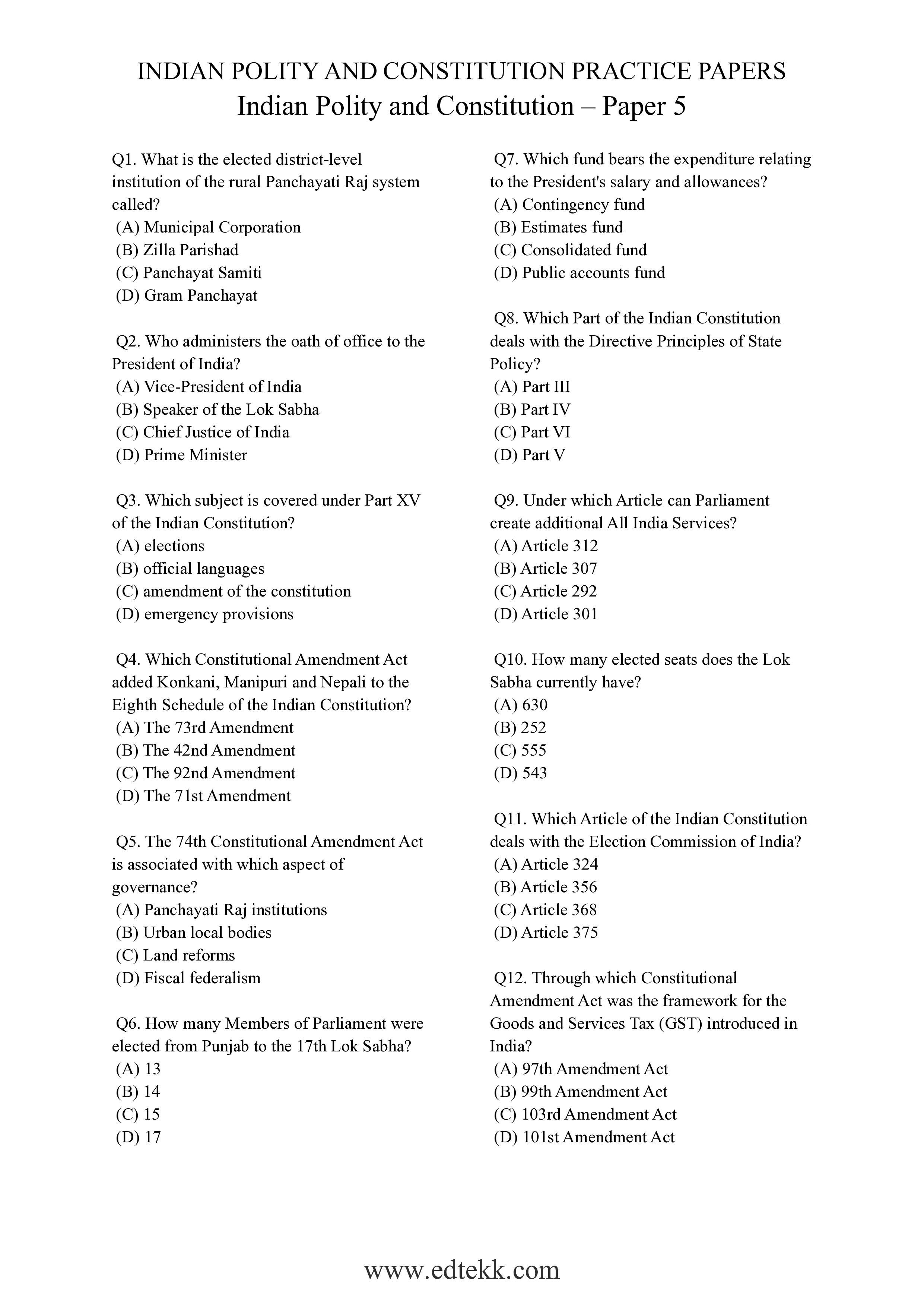
Enhance your competitive-exam preparation with Indian Polity and Constitution Practice Paper 5. Designed for SSC, Railway, Police Constable and Police SI aspirants, this practice set provides objective questions on Indian Polity and constitutional concepts, with answers and explanations to improve subject knowledge, accuracy and confidence.
Test Details
Topic: Indian Polity and Constitution
Total Questions: 20
Question Format: MCQs – Single Correct Answer
Suitable for: SSC exams, Railway exams, Police Constable, Police SI
Download All Papers in This Series (PDF)
Questions and Answers
Q1. What is the elected district-level institution of the rural Panchayati Raj system called?
(A) Municipal Corporation
(B) Zilla Parishad
(C) Panchayat Samiti
(D) Gram Panchayat
Explanation: The Zilla Parishad is the elected district-level institution of the Panchayati Raj system in rural India. It coordinates rural development activities across the district. Municipal Corporations govern urban areas, Gram Panchayats function at the village level, and Panchayat Samitis operate at the intermediate or block level.
Q2. Who administers the oath of office to the President of India?
(A) Vice-President of India
(B) Speaker of the Lok Sabha
(C) Chief Justice of India
(D) Prime Minister
Explanation: The Chief Justice of India administers the oath of office to the President of India under Article 60 of the Constitution. In the Chief Justice’s absence, the senior-most available judge of the Supreme Court administers the oath. The President swears to faithfully execute the office and preserve, protect and defend the Constitution and the law.
Q3. Which subject is covered under Part XV of the Indian Constitution?
(A) elections
(B) official languages
(C) amendment of the constitution
(D) emergency provisions
Explanation: Part XV of the Indian Constitution deals with elections. Articles 324–329 establish the constitutional framework for electoral administration, including the Election Commission of India, electoral rolls, adult suffrage and related matters. Official languages, constitutional amendments and emergency provisions are addressed in other parts of the Constitution.
Q4. Which Constitutional Amendment Act added Konkani, Manipuri and Nepali to the Eighth Schedule of the Indian Constitution?
(A) The 73rd Amendment
(B) The 42nd Amendment
(C) The 92nd Amendment
(D) The 71st Amendment
Explanation: The 71st Constitutional Amendment Act, 1992, added Konkani, Manipuri and Nepali to the Eighth Schedule of the Indian Constitution, increasing the number of recognised scheduled languages from 18 to 21. Subsequently, the 92nd Amendment Act, 2003, added Bodo, Dogri, Maithili and Santhali.
Q5. The 74th Constitutional Amendment Act is associated with which aspect of governance?
(A) Panchayati Raj institutions
(B) Urban local bodies
(C) Land reforms
(D) Fiscal federalism
Explanation: The 74th Constitutional Amendment Act, 1992, granted constitutional recognition to urban local bodies by introducing Part IXA of the Constitution. It established a framework for municipalities, including Municipal Corporations, Municipal Councils and Nagar Panchayats, strengthening urban local self-government.
Q6. How many Members of Parliament were elected from Punjab to the 17th Lok Sabha?
(A) 13
(B) 14
(C) 15
(D) 17
Explanation: Punjab has 13 elected seats in the Lok Sabha. The state elected 13 Members of Parliament to the 17th Lok Sabha following the 2019 general elections. These representatives were elected from the state’s 13 parliamentary constituencies.
Q7. Which fund bears the expenditure relating to the President’s salary and allowances?
(A) Contingency fund
(B) Estimates fund
(C) Consolidated fund
(D) Public accounts fund
Explanation: Under Article 112(3)(a) of the Constitution of India, the emoluments and allowances of the President and other expenditure relating to the office are charged on the Consolidated Fund of India. Such expenditure is not submitted to the vote of Parliament, ensuring the financial independence of the constitutional office.
Q8. Which Part of the Indian Constitution deals with the Directive Principles of State Policy?
(A) Part III
(B) Part IV
(C) Part VI
(D) Part V
Explanation: Part IV (Articles 36–51) of the Indian Constitution deals with the Directive Principles of State Policy (DPSP). These principles guide the State in establishing social and economic justice and promoting public welfare. They are not directly enforceable by courts under Article 37 but are fundamental to the governance of the country.
Q9. Under which Article can Parliament create additional All India Services?
(A) Article 312
(B) Article 307
(C) Article 292
(D) Article 301
Explanation: Article 312 empowers Parliament to create additional All India Services common to the Union and the States. This requires a resolution passed by the Rajya Sabha supported by at least two-thirds of the members present and voting. The Indian Forest Service, established in 1966, is an example of an additional All India Service created under this provision.
Q10. How many elected seats does the Lok Sabha currently have?
(A) 630
(B) 252
(C) 555
(D) 543
Explanation: The Lok Sabha currently has 543 elected seats representing territorial constituencies across India’s states and Union Territories. Members are directly elected by eligible voters through general elections. This figure represents the sanctioned elected strength of the House, not the constitutional maximum of 550 members. Actual membership may temporarily be lower because of vacancies.
Q11. Which Article of the Indian Constitution deals with the Election Commission of India?
(A) Article 324
(B) Article 356
(C) Article 368
(D) Article 375
Explanation: Article 324 of the Indian Constitution deals with the Election Commission of India. It vests the Commission with the superintendence, direction and control of elections to Parliament, State Legislatures, and the offices of the President and Vice-President. It establishes the constitutional framework for independent election administration in India.
Q12. Through which Constitutional Amendment Act was the framework for the Goods and Services Tax (GST) introduced in India?
(A) 97th Amendment Act
(B) 99th Amendment Act
(C) 103rd Amendment Act
(D) 101st Amendment Act
Explanation: The 101st Constitutional Amendment Act, 2016, introduced the constitutional framework for the Goods and Services Tax (GST) in India. It enabled the Union and State governments to levy GST through a coordinated indirect taxation system. GST was implemented nationwide on 1 July 2017, replacing several central and state indirect taxes.
Q13. Who presides over a joint sitting of both Houses of Parliament?
(A) Speaker of Lok Sabha
(B) Prime Minister
(C) Vice President
(D) President
Explanation: Under Article 118(4), the Speaker of the Lok Sabha presides over a joint sitting of Parliament. In the Speaker’s absence, the Deputy Speaker presides; if unavailable, the Deputy Chairman of the Rajya Sabha presides. If these officers are also unavailable, another member determined under the applicable parliamentary rules presides.
Q14. Which body has the authority to remove the Speaker of the Lok Sabha?
(A) Prime Minister
(B) President
(C) Lok Sabha itself
(D) Chief Justice of India
Explanation: Under Article 94(c), the Speaker of the Lok Sabha may be removed by a resolution passed by a majority of all the then members of the House, with at least fourteen days’ notice. Under Article 96, the Speaker cannot preside during consideration of the removal resolution but may participate in proceedings and vote in the first instance.
Q15. To whom must a Supreme Court judge address their resignation letter?
(A) The President of India
(B) The Prime Minister of India
(C) The Chief Justice of India
(D) The law Minister of India
Explanation: Under Article 124(2) of the Constitution, a Supreme Court judge may resign by writing under their hand addressed to the President of India. The President is the designated constitutional authority to receive the resignation. The resignation becomes effective upon receipt by the President.
Q16. Which House of Parliament at the Union level corresponds to the Legislative Assembly of a state?
(A) Rajya Sabha
(B) Lok Sabha
(C) President
(D) Prime Minister
Explanation: The Lok Sabha is the counterpart of a State Legislative Assembly at the Union level. Both are directly elected representative houses responsible for making laws within their respective jurisdictions. The Lok Sabha is the Lower House of Parliament, while the Legislative Assembly is the lower house of a state’s legislature.
Q17. In which Indian state does the National People’s Party (NPP) have its principal political base?
(A) Manipur
(B) Meghalaya
(C) Mizoram
(D) Nagaland
Explanation: The National People’s Party (NPP), founded by P. A. Sangma in 2013, has its principal political base in Meghalaya. It has also been active in other northeastern states. The Election Commission of India recognised it as a national party in June 2019, making it the first national party from northeastern India.
Q18. What is the minimum legal voting age in India?
(A) 21 years
(B) 16 years
(C) 18 years
(D) 25 years
Explanation: The minimum voting age in India is 18 years. It was reduced from 21 to 18 years through the 61st Constitutional Amendment Act, 1988, which came into effect in 1989. Eligible Indian citizens who satisfy the applicable electoral registration requirements can vote in elections to the Lok Sabha and State Legislative Assemblies.
Q19. How many Fundamental Duties were introduced into the Indian Constitution by the 42nd Constitutional Amendment Act, 1976?
(A) 1
(B) 10
(C) 4
(D) 15
Explanation: Ten Fundamental Duties were incorporated into the Indian Constitution through the 42nd Constitutional Amendment Act, 1976. These duties promote responsible citizenship and include respecting national symbols, protecting public property and safeguarding the environment. The 86th Amendment Act, 2002, added an eleventh duty requiring parents or guardians to provide educational opportunities to children aged 6–14 years.
Q20. How many members can the President nominate to the Rajya Sabha?
(A) 14
(B) 11
(C) 13
(D) 12
Explanation: The President nominates 12 members to the Rajya Sabha under Article 80(1)(a) of the Constitution. These members are selected for their special knowledge or practical experience in literature, science, art and social service. Their nomination enables individuals with expertise in these fields to contribute to parliamentary deliberations.
Question Paper Images