Enhance your understanding of Indian Polity with SSC Practice Paper 6. This question set covers federalism, Centre-State relations, constitutional bodies, election-related institutions and important governance mechanisms. Test your knowledge through objective MCQs with answers and explanations designed for SSC CGL, CHSL, CPO, MTS, GD and Selection Post examinations.
Test Details
Topic: Indian Polity and Constitution
Total Questions: 20
Question Format: MCQs – Single Correct Answer
Suitable for: SSC CGL, CHSL, CPO, MTS, GD, Selection Post
Download All Papers in This Series (PDF)
Questions and Answers
Q1. Which Part of the Indian Constitution embodies the concept of a welfare state?
(A) Preamble
(B) Fundamental Duties
(C) Fundamental Rights
(D) Directive Principles of State Policy
Explanation: The Directive Principles of State Policy, contained in Part IV of the Constitution, embody the objective of establishing a welfare state. Articles 36–51 guide the state in promoting social and economic justice, reducing inequalities, improving public health and ensuring a more equitable distribution of resources. These principles are not directly enforceable by courts.
Q2. Which political party in India is associated with the broom election symbol?
(A) Janata Dal (United)
(B) Indian National Congress
(C) Samajwadi Party
(D) Aam Aadmi Party
Explanation: The Aam Aadmi Party (AAP), founded in 2012, uses the broom as its election symbol. The symbol is associated with the party’s emphasis on cleanliness, anti-corruption and political reform, reflecting its stated commitment to transparent governance.
Q3. What is the normal term of the Lok Sabha, unless it is dissolved earlier?
(A) 5 years
(B) 4 years
(C) 6 years
(D) 3 years
Explanation: Under Article 83(2), the Lok Sabha normally continues for five years from the date appointed for its first meeting, unless dissolved earlier. During a National Emergency, Parliament may extend its term by law for up to one year at a time, but not beyond six months after the Emergency ceases.
Q4. On which date did the First Lok Sabha hold its first session?
(A) 26th January, 1950
(B) 15th August. 1947
(C) 13th May, 1952
(D) 15th August, 1951
Explanation: The first session of the First Lok Sabha commenced on 13 May 1952. The First Lok Sabha was constituted following India’s first general elections, conducted between 1951 and 1952. This marked the beginning of the functioning of India’s first directly elected House of Parliament.
Q5. Which of the following is not a typical function of Panchayati Raj institutions in India?
(A) Urban planning
(B) Rural development
(C) Health care
(D) Education
Explanation: Urban planning is primarily associated with urban local bodies and relevant planning authorities, rather than being a typical core function of Panchayati Raj institutions. Panchayats focus on rural development, including agriculture, drinking water, sanitation, health, education and poverty alleviation, as assigned under applicable state laws.
Q6. Which of the following is not a feature of the Indian judicial system?
(A) Rule of law
(B) Independence of the judiciary
(C) Jury trials
(D) Judicial review
Explanation: The Indian judicial system is characterised by the rule of law, independence of the judiciary and judicial review. Jury trials are not a feature of the contemporary Indian criminal justice system, as the jury system was discontinued following concerns about its functioning. Criminal cases are generally decided by judges.
Q7. What is the term of office of the Vice-President of India?
(A) 4 years
(B) 6 years
(C) 5 years
(D) 7 years
Explanation: The Vice President of India holds office for a term of five years from the date of entering office, as provided under Article 67 of the Constitution. However, the Vice President continues in office until the successor assumes charge. The Vice President may resign by submitting a written resignation to the President or be removed through the prescribed parliamentary procedure.
Q8. Who is the elected head of a Nagar Palika (Municipal Council)?
(A) Sarpanch
(B) Mayor
(C) Commissioner
(D) President
Explanation: A Nagar Palika, or Municipal Council, is generally headed by an elected President or Chairperson. The designation varies across states. A Mayor usually heads a Municipal Corporation, whereas a Municipal Commissioner generally oversees its executive and administrative functions.
Q9. During which period did Morarji Desai serve as Deputy Prime Minister of India?
(A) 1966 -1967
(B) 1967 -1969
(C) 1964-1966
(D) 1970 -1971
Explanation: Morarji Desai served as Deputy Prime Minister of India from 1967 to 1969 under Prime Minister Indira Gandhi. He also held the Finance portfolio during this period. He later became India’s Prime Minister in March 1977 and remained in office until July 1979.
Q10. Which Article of the Indian Constitution prohibits the employment of children in factories, mines and other hazardous occupations?
(A) 21
(B) 31
(C) 24
(D) 17
Explanation: Article 24 of the Indian Constitution prohibits the employment of children below fourteen years of age in factories, mines and other hazardous employment. It is a Fundamental Right intended to protect children from exploitation and dangerous working conditions. The broader legal framework also regulates child employment in other occupations.
Q11. Which Article of the Indian Constitution deals with the appointment and tenure of the Prime Minister and other Union Ministers?
(A) Article 74
(B) Article 76
(C) Article 75
(D) Article 77
Explanation: Article 75 of the Indian Constitution deals with the appointment, tenure and other provisions relating to the Union Council of Ministers. The President appoints the Prime Minister, while other ministers are appointed on the Prime Minister’s advice. Ministers hold office during the President’s pleasure, and the Council of Ministers is collectively responsible to the Lok Sabha.
Q12. How many categories of Fundamental Rights were originally provided under the Indian Constitution before the 44th Constitutional Amendment Act, 1978?
(A) 7
(B) 6
(C) 5
(D) 8
Explanation: The original Constitution recognised seven categories of Fundamental Rights, including the Right to Property. The 44th Constitutional Amendment Act, 1978, removed the Right to Property from Part III of the Constitution. Consequently, six categories of Fundamental Rights remain. The Right to Property is now protected as a constitutional right under Article 300A.
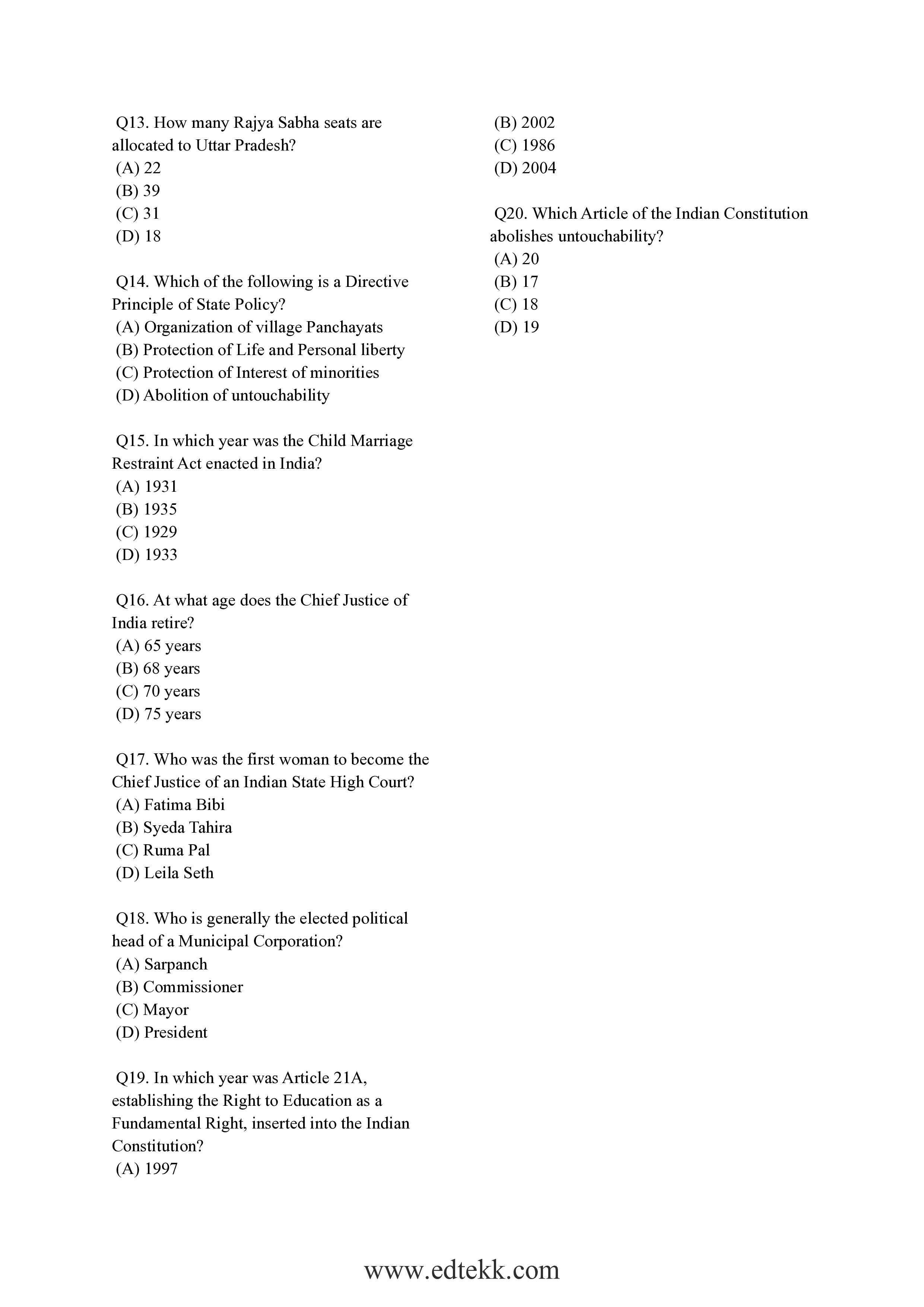
Q13. How many Rajya Sabha seats are allocated to Uttar Pradesh?
(A) 22
(B) 39
(C) 31
(D) 18
Explanation: Uttar Pradesh has 31 seats in the Rajya Sabha, making it the state with the highest representation in the Council of States. Its Rajya Sabha members are elected by elected members of the State Legislative Assembly through proportional representation using the single transferable vote system.
Q14. Which of the following is a Directive Principle of State Policy?
(A) Organization of village Panchayats
(B) Protection of Life and Personal liberty
(C) Protection of Interest of minorities
(D) Abolition of untouchability
Explanation: The organisation of village panchayats is a Directive Principle of State Policy under Article 40 of the Indian Constitution. It directs the State to organise village panchayats and endow them with the necessary powers to function as units of self-government, promoting decentralisation and grassroots democracy.
Q15. In which year was the Child Marriage Restraint Act enacted in India?
(A) 1931
(B) 1935
(C) 1929
(D) 1933
Explanation: The Child Marriage Restraint Act was enacted in 1929 and is commonly known as the Sarda Act, after Harbilas Sarda, who introduced the legislative proposal. It was an early statutory measure to restrain child marriage in India. The Act was subsequently replaced by the Prohibition of Child Marriage Act, 2006.
Q16. At what age does the Chief Justice of India retire?
(A) 65 years
(B) 68 years
(C) 70 years
(D) 75 years
Explanation: The Chief Justice of India retires at the age of 65 years, the same retirement age applicable to all other Supreme Court judges. This is prescribed under Article 124(2) of the Indian Constitution. In contrast, High Court judges retire at 62 years under Article 217(1).
Q17. Who was the first woman to become the Chief Justice of an Indian State High Court?
(A) Fatima Bibi
(B) Syeda Tahira
(C) Ruma Pal
(D) Leila Seth
Explanation: Justice Leila Seth became the first woman Chief Justice of a State High Court in India when she was appointed Chief Justice of the Himachal Pradesh High Court on 5 August 1991. She also became the first woman judge of the Delhi High Court in 1978.
Q18. Who is generally the elected political head of a Municipal Corporation?
(A) Sarpanch
(B) Commissioner
(C) Mayor
(D) President
Explanation: A Mayor is generally the elected political head of a Municipal Corporation. The Mayor presides over meetings and represents the corporation in official and public functions. The Municipal Commissioner, in contrast, is responsible for executive administration and implementing municipal policies and decisions.
Q19. In which year was Article 21A, establishing the Right to Education as a Fundamental Right, inserted into the Indian Constitution?
(A) 1997
(B) 2002
(C) 1986
(D) 2004
Explanation: Article 21A was inserted into the Indian Constitution through the 86th Constitutional Amendment Act, 2002. It guarantees free and compulsory education to children between six and fourteen years of age. The provision came into effect on 1 April 2010, along with the implementation of the Right of Children to Free and Compulsory Education Act, 2009.
Q20. Which Article of the Indian Constitution abolishes untouchability?
(A) 20
(B) 17
(C) 18
(D) 19
Explanation: Article 17 of the Indian Constitution abolishes untouchability and prohibits its practice in any form. It also declares the enforcement of any disability arising from untouchability to be an offence punishable by law. This provision promotes social equality and protects individuals against caste-based discrimination.
Question Paper Images