Prepare for General Awareness sections with these Awards and Honours revision questions – Paper 1. This set covers important national and international awards, their recipients, achievements and associated fields through MCQs with answers and explanations for SSC, Railway, Banking and Police Constable and SI examinations.
Test Details
Topic: Awards and Honours
Total Questions: 20
Question Format: MCQs – Single Correct Answer
Suitable for: SSC exams, Railway exams, Banking exams, Police Constable, Police SI
Download All Papers in This Series (PDF)
Questions and Answers
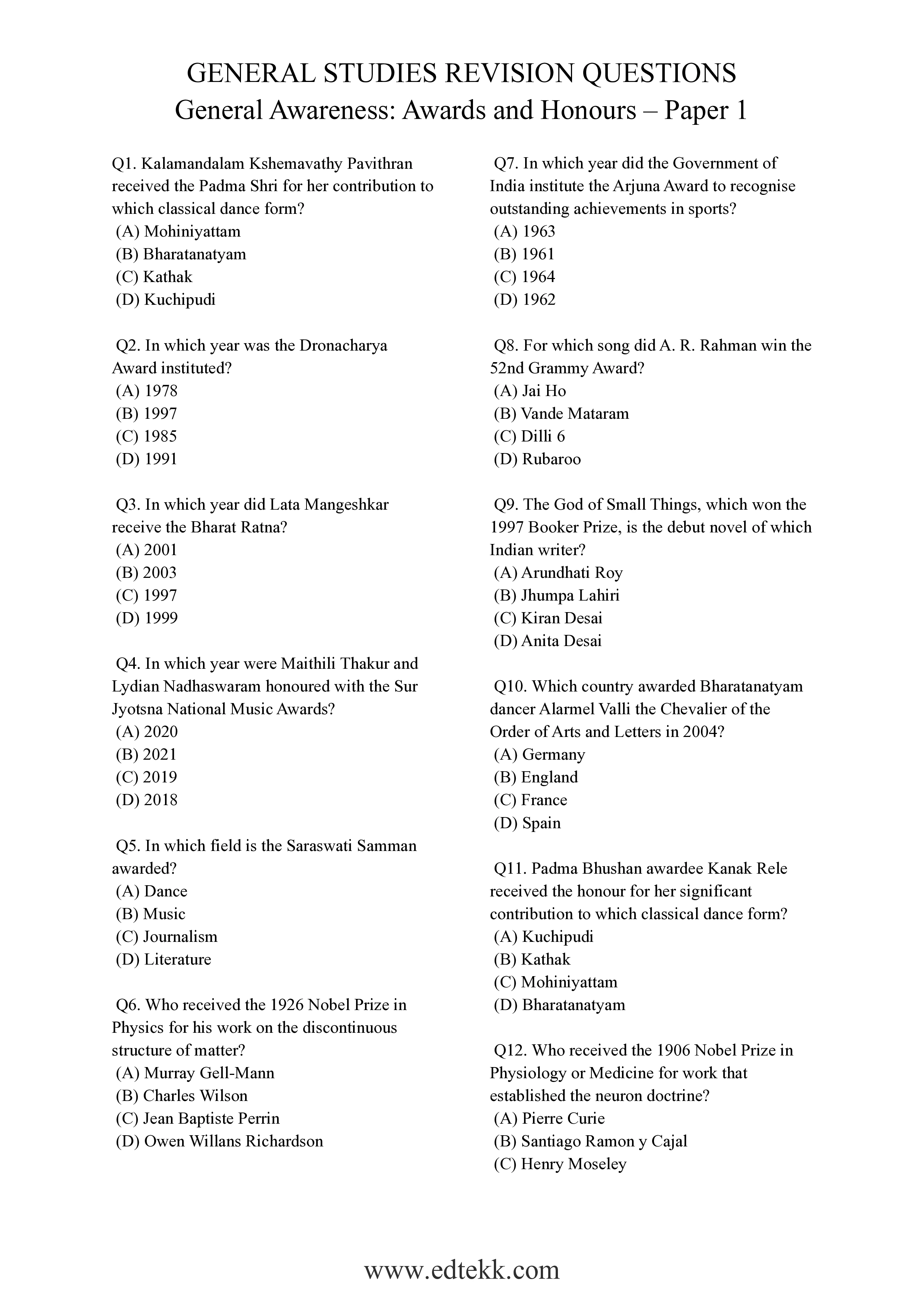
Q1. Kalamandalam Kshemavathy Pavithran received the Padma Shri for her contribution to which classical dance form?
(A) Mohiniyattam
(B) Bharatanatyam
(C) Kathak
(D) Kuchipudi
Explanation: Kalamandalam Kshemavathy Pavithran is a renowned Mohiniyattam exponent and choreographer from Kerala. She received the Padma Shri in recognition of her contribution to Indian classical dance. Mohiniyattam originated in Kerala and is characterised by graceful movements, gentle swaying and expressive storytelling.
Q2. In which year was the Dronacharya Award instituted?
(A) 1978
(B) 1997
(C) 1985
(D) 1991
Explanation: The Dronacharya Award was instituted in 1985 by the Government of India. It recognises outstanding sports coaches who have made significant contributions to the development of sportspersons and their achievements at national and international competitions. The award is named after Dronacharya, the legendary teacher of archery in the Mahabharata.
Q3. In which year did Lata Mangeshkar receive the Bharat Ratna?
(A) 2001
(B) 2003
(C) 1997
(D) 1999
Explanation: Lata Mangeshkar received the Bharat Ratna in 2001 in recognition of her extraordinary contribution to Indian music. One of India’s most celebrated playback singers, she enjoyed a career spanning several decades and recorded songs in numerous Indian languages. The Bharat Ratna is India’s highest civilian honour.
Q4. In which year were Maithili Thakur and Lydian Nadhaswaram honoured with the Sur Jyotsna National Music Awards?
(A) 2020
(B) 2021
(C) 2019
(D) 2018
Explanation: Maithili Thakur and Lydian Nadhaswaram received the Sur Jyotsna National Music Awards in 2021. The awards recognise emerging musical talent and encourage excellence in Indian music. Both recipients gained recognition for their musical abilities and represent different musical traditions and performance styles.
Q5. In which field is the Saraswati Samman awarded?
(A) Dance
(B) Music
(C) Journalism
(D) Literature
Explanation: The Saraswati Samman is a prestigious literary award established by the K. K. Birla Foundation in 1991. It recognises outstanding literary works written in any of the 22 languages listed in the Eighth Schedule of the Indian Constitution. The award is given for exceptional contributions to literature, not music, journalism or dance.
Q6. Who received the 1926 Nobel Prize in Physics for his work on the discontinuous structure of matter?
(A) Murray Gell-Mann
(B) Charles Wilson
(C) Jean Baptiste Perrin
(D) Owen Willans Richardson
Explanation: Jean Baptiste Perrin received the 1926 Nobel Prize in Physics for his work on the discontinuous structure of matter, particularly his discovery of sedimentation equilibrium. His experiments provided important evidence supporting the physical existence of atoms and molecules.
Q7. In which year did the Government of India institute the Arjuna Award to recognise outstanding achievements in sports?
(A) 1963
(B) 1961
(C) 1964
(D) 1962
Explanation: The Arjuna Awards were instituted in 1961 by the Government of India to recognise outstanding achievements in sports. They honour sportspersons for excellence and consistent performance in national and international competitions and are among India’s prominent sporting honours.
Q8. For which song did A. R. Rahman win the 52nd Grammy Award?
(A) Jai Ho
(B) Vande Mataram
(C) Dilli 6
(D) Rubaroo
Explanation: A. R. Rahman won the 52nd Annual Grammy Award in 2010 for Jai Ho, from the film Slumdog Millionaire. The song received the Grammy for Best Song Written for Motion Picture, Television or Other Visual Media. Rahman also won a separate Grammy for the film’s soundtrack album.
Q9. The God of Small Things, which won the 1997 Booker Prize, is the debut novel of which Indian writer?
(A) Arundhati Roy
(B) Jhumpa Lahiri
(C) Kiran Desai
(D) Anita Desai
Explanation: The God of Small Things is the debut novel of Arundhati Roy and won the 1997 Booker Prize. Set in Kerala, the novel explores family relationships, caste discrimination, social inequalities and forbidden love. Its international success established Roy as a prominent contemporary Indian novelist.
Q10. Which country awarded Bharatanatyam dancer Alarmel Valli the Chevalier of the Order of Arts and Letters in 2004?
(A) Germany
(B) England
(C) France
(D) Spain
Explanation: Alarmel Valli received the Chevalier of the Order of Arts and Letters in 2004 from the Government of France. This distinction recognises significant contributions to the arts and literature. She is an internationally acclaimed Bharatanatyam dancer known for her distinctive interpretation of the Pandanallur tradition.
Q11. Padma Bhushan awardee Kanak Rele received the honour for her significant contribution to which classical dance form?
(A) Kuchipudi
(B) Kathak
(C) Mohiniyattam
(D) Bharatanatyam
Explanation: Kanak Rele was a renowned Indian classical dancer, choreographer and academic associated primarily with Mohiniyattam. She received the Padma Bhushan in 2013 for her contributions to Indian classical dance. She established the Nalanda Dance Research Centre and played a significant role in researching, teaching and promoting Mohiniyattam.
Q12. Who received the 1906 Nobel Prize in Physiology or Medicine for work that established the neuron doctrine?
(A) Pierre Curie
(B) Santiago Ramon y Cajal
(C) Henry Moseley
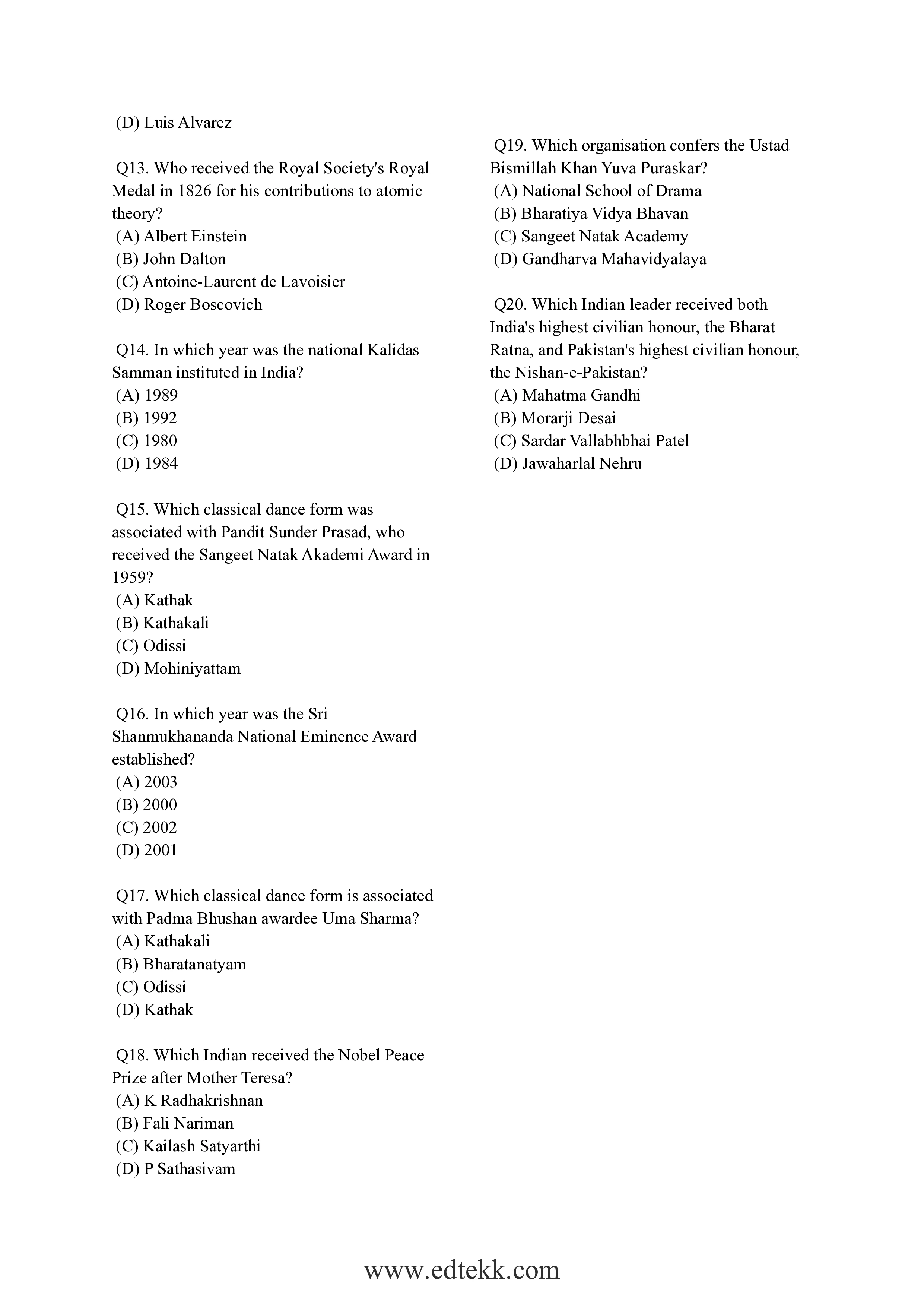
(D) Luis Alvarez
Explanation: Santiago Ramón y Cajal received the 1906 Nobel Prize in Physiology or Medicine jointly with Camillo Golgi for their work on the structure of the nervous system. Cajal’s research established the neuron doctrine, demonstrating that the nervous system consists of individual nerve cells.
Q13. Who received the Royal Society’s Royal Medal in 1826 for his contributions to atomic theory?
(A) Albert Einstein
(B) John Dalton
(C) Antoine-Laurent de Lavoisier
(D) Roger Boscovich
Explanation: John Dalton received the Royal Society’s Royal Medal in 1826 in recognition of his contributions to atomic theory. He proposed that matter consists of indivisible atoms and that atoms of different elements combine in fixed proportions to form chemical compounds. His theory laid the foundation for modern atomic theory.
Q14. In which year was the national Kalidas Samman instituted in India?
(A) 1989
(B) 1992
(C) 1980
(D) 1984
Explanation: The Kalidas Samman was instituted by the Government of Madhya Pradesh in 1980–81. It recognises distinguished contributions to classical music, classical dance, theatre and plastic arts. Named after the Sanskrit poet and playwright Kalidasa, the award honours outstanding artistic achievements.
Q15. Which classical dance form was associated with Pandit Sunder Prasad, who received the Sangeet Natak Akademi Award in 1959?
(A) Kathak
(B) Kathakali
(C) Odissi
(D) Mohiniyattam
Explanation: Pandit Sunder Prasad was a distinguished Kathak dancer and guru associated with the Jaipur gharana. He received the Sangeet Natak Akademi Award in 1959 in recognition of his contribution to Kathak. Through his teaching and performances, he helped preserve and transmit the gharana’s distinctive techniques, rhythmic patterns and repertoire.
Q16. In which year was the Sri Shanmukhananda National Eminence Award established?
(A) 2003
(B) 2000
(C) 2002
(D) 2001
Explanation: The Sri Shanmukhananda National Eminence Award was established in 2002 by the Sri Shanmukhananda Fine Arts and Sangeetha Sabha in Mumbai, according to the commonly cited account. The award recognises distinguished individuals for their achievements and contributions in their respective fields.
Q17. Which classical dance form is associated with Padma Bhushan awardee Uma Sharma?
(A) Kathakali
(B) Bharatanatyam
(C) Odissi
(D) Kathak
Explanation: Uma Sharma is a renowned Indian classical dancer specialising in Kathak. She established the Bharatiya Sangeet Sadan to promote Indian classical dance and music. She received the Padma Bhushan in 2001 in recognition of her contributions to Indian classical dance and cultural preservation.
Q18. Which Indian received the Nobel Peace Prize after Mother Teresa?
(A) K Radhakrishnan
(B) Fali Nariman
(C) Kailash Satyarthi
(D) P Sathasivam
Explanation: Kailash Satyarthi received the Nobel Peace Prize in 2014, jointly with Malala Yousafzai, for their efforts to protect children’s rights and promote education. Mother Teresa received the Nobel Peace Prize in 1979. Satyarthi was therefore the Indian recipient who received this award after Mother Teresa.
Q19. Which organisation confers the Ustad Bismillah Khan Yuva Puraskar?
(A) National School of Drama
(B) Bharatiya Vidya Bhavan
(C) Sangeet Natak Academy
(D) Gandharva Mahavidyalaya
Explanation: The Ustad Bismillah Khan Yuva Puraskar is conferred by the Sangeet Natak Akademi. It recognises outstanding young artists in music, dance, theatre and other performing arts. Named after the celebrated shehnai maestro Ustad Bismillah Khan, the award encourages emerging talent and supports the development of India’s performing arts traditions.
Q20. Which Indian leader received both India’s highest civilian honour, the Bharat Ratna, and Pakistan’s highest civilian honour, the Nishan-e-Pakistan?
(A) Mahatma Gandhi
(B) Morarji Desai
(C) Sardar Vallabhbhai Patel
(D) Jawaharlal Nehru
Explanation: Morarji Desai, India’s fourth Prime Minister, received Pakistan’s Nishan-e-Pakistan in 1990 and India’s Bharat Ratna in 1991. These are the highest civilian honours of Pakistan and India, respectively. He served as Prime Minister from 1977 to 1979 and is recognised for his contributions to public service and India-Pakistan relations.
Question Paper Images