Enhance your competitive-exam preparation with Awards and Honours revision questions – Paper 2. The practice set focuses on significant national and international awards, notable recipients, achievements and award-related facts through MCQs with answers and explanations for SSC, Railway, Banking and Police examinations.
Test Details
Topic: Awards and Honours
Total Questions: 20
Question Format: MCQs – Single Correct Answer
Suitable for: SSC exams, Railway exams, Banking exams, Police Constable, Police SI
Download All Papers in This Series (PDF)
Questions and Answers
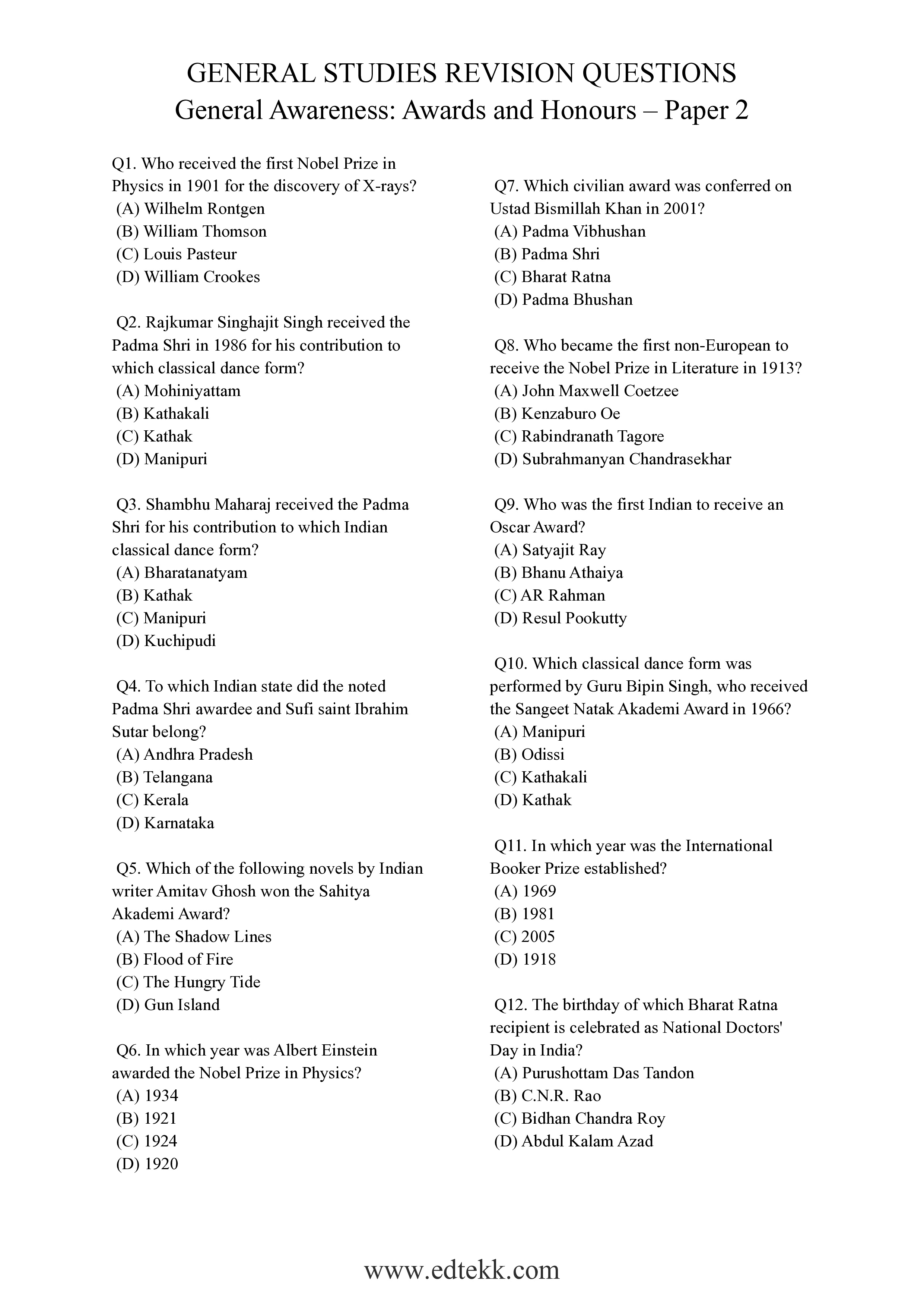
Q1. Who received the first Nobel Prize in Physics in 1901 for the discovery of X-rays?
(A) Wilhelm Rontgen
(B) William Thomson
(C) Louis Pasteur
(D) William Crookes
Explanation: Wilhelm Conrad Röntgen received the first Nobel Prize in Physics in 1901 for his discovery of X-rays. His groundbreaking discovery revolutionised medical diagnosis by enabling doctors to examine the internal structures of the human body without surgical intervention. X-rays subsequently became an essential tool in medical imaging.
Q2. Rajkumar Singhajit Singh received the Padma Shri in 1986 for his contribution to which classical dance form?
(A) Mohiniyattam
(B) Kathakali
(C) Kathak
(D) Manipuri
Explanation: Rajkumar Singhajit Singh received the Padma Shri in 1986 for his contributions to Manipuri dance. He is a distinguished Manipuri dancer, choreographer and teacher who has played an important role in preserving and promoting the traditional dance heritage of Manipur through performances, research and training.
Q3. Shambhu Maharaj received the Padma Shri for his contribution to which Indian classical dance form?
(A) Bharatanatyam
(B) Kathak
(C) Manipuri
(D) Kuchipudi
Explanation: Shambhu Maharaj was a renowned exponent of Kathak, one of India’s major classical dance forms. He belonged to the Lucknow gharana and was celebrated for his expressive facial movements, graceful gestures and mastery of rhythm. He received the Padma Shri in 1955 for his contribution to Indian classical dance.
Q4. To which Indian state did the noted Padma Shri awardee and Sufi saint Ibrahim Sutar belong?
(A) Andhra Pradesh
(B) Telangana
(C) Kerala
(D) Karnataka
Explanation: Ibrahim Sutar belonged to Karnataka. He was a renowned social worker, folk singer and spiritual speaker known for promoting communal harmony through his programmes and discourses. He received the Padma Shri in 2018 in recognition of his contributions to social work.
Q5. Which of the following novels by Indian writer Amitav Ghosh won the Sahitya Akademi Award?
(A) The Shadow Lines
(B) Flood of Fire
(C) The Hungry Tide
(D) Gun Island
Explanation: The Shadow Lines, written by Amitav Ghosh and published in 1988, received the Sahitya Akademi Award in 1989 in the English language category. The novel explores nationalism, identity, memory and the complex relationships between individuals across geographical boundaries. It remains one of Ghosh’s most acclaimed literary works.
Q6. In which year was Albert Einstein awarded the Nobel Prize in Physics?
(A) 1934
(B) 1921
(C) 1924
(D) 1920
Explanation: Albert Einstein was awarded the 1921 Nobel Prize in Physics for his contributions to theoretical physics, particularly his explanation of the photoelectric effect. Although the prize was designated for 1921, it was formally presented to him in 1922.
Q7. Which civilian award was conferred on Ustad Bismillah Khan in 2001?
(A) Padma Vibhushan
(B) Padma Shri
(C) Bharat Ratna
(D) Padma Bhushan
Explanation: Ustad Bismillah Khan received the Bharat Ratna in 2001, India’s highest civilian honour. He was a legendary shehnai player who helped establish the instrument as a prominent concert instrument in Indian classical music. He had previously received the Padma Shri in 1961, the Padma Bhushan in 1968 and the Padma Vibhushan in 1980.
Q8. Who became the first non-European to receive the Nobel Prize in Literature in 1913?
(A) John Maxwell Coetzee
(B) Kenzaburo Oe
(C) Rabindranath Tagore
(D) Subrahmanyan Chandrasekhar
Explanation: Rabindranath Tagore received the Nobel Prize in Literature in 1913, becoming the first non-European to win this award. He was recognised primarily for his English translation of Gitanjali (Song Offerings). Tagore was a Bengali poet, philosopher, composer and educator whose literary contributions gained international recognition.
Q9. Who was the first Indian to receive an Oscar Award?
(A) Satyajit Ray
(B) Bhanu Athaiya
(C) AR Rahman
(D) Resul Pookutty
Explanation: Bhanu Athaiya became the first Indian to win an Academy Award in 1983 for Best Costume Design for the film Gandhi (1982), directed by Richard Attenborough. She shared the award with British costume designer John Mollo. Her achievement marked a significant milestone in the international recognition of Indian cinema.
Q10. Which classical dance form was performed by Guru Bipin Singh, who received the Sangeet Natak Akademi Award in 1966?
(A) Manipuri
(B) Odissi
(C) Kathakali
(D) Kathak
Explanation: Guru Bipin Singh was a distinguished Manipuri dancer, choreographer and teacher. He received the Sangeet Natak Akademi Award in 1966 for his contribution to Manipuri dance. Through choreography, teaching and training, he played an important role in preserving and developing this classical dance tradition and nurturing future generations of performers.
Q11. In which year was the International Booker Prize established?
(A) 1969
(B) 1981
(C) 2005
(D) 1918
Explanation: The International Booker Prize was established in 2005 as the Man Booker International Prize. Initially, it recognised an author’s overall contribution to fiction and was awarded biennially. In 2015, it evolved into an annual award recognising a single work of fiction translated into English. It was renamed the International Booker Prize in 2019.
Q12. The birthday of which Bharat Ratna recipient is celebrated as National Doctors’ Day in India?
(A) Purushottam Das Tandon
(B) C.N.R. Rao
(C) Bidhan Chandra Roy
(D) Abdul Kalam Azad
Explanation: Dr. Bidhan Chandra Roy was a renowned physician, freedom fighter and former Chief Minister of West Bengal. Born on 1 July 1882, his birth anniversary is observed as National Doctors’ Day in India. He received the Bharat Ratna in 1961 in recognition of his outstanding contributions to medicine and public service.
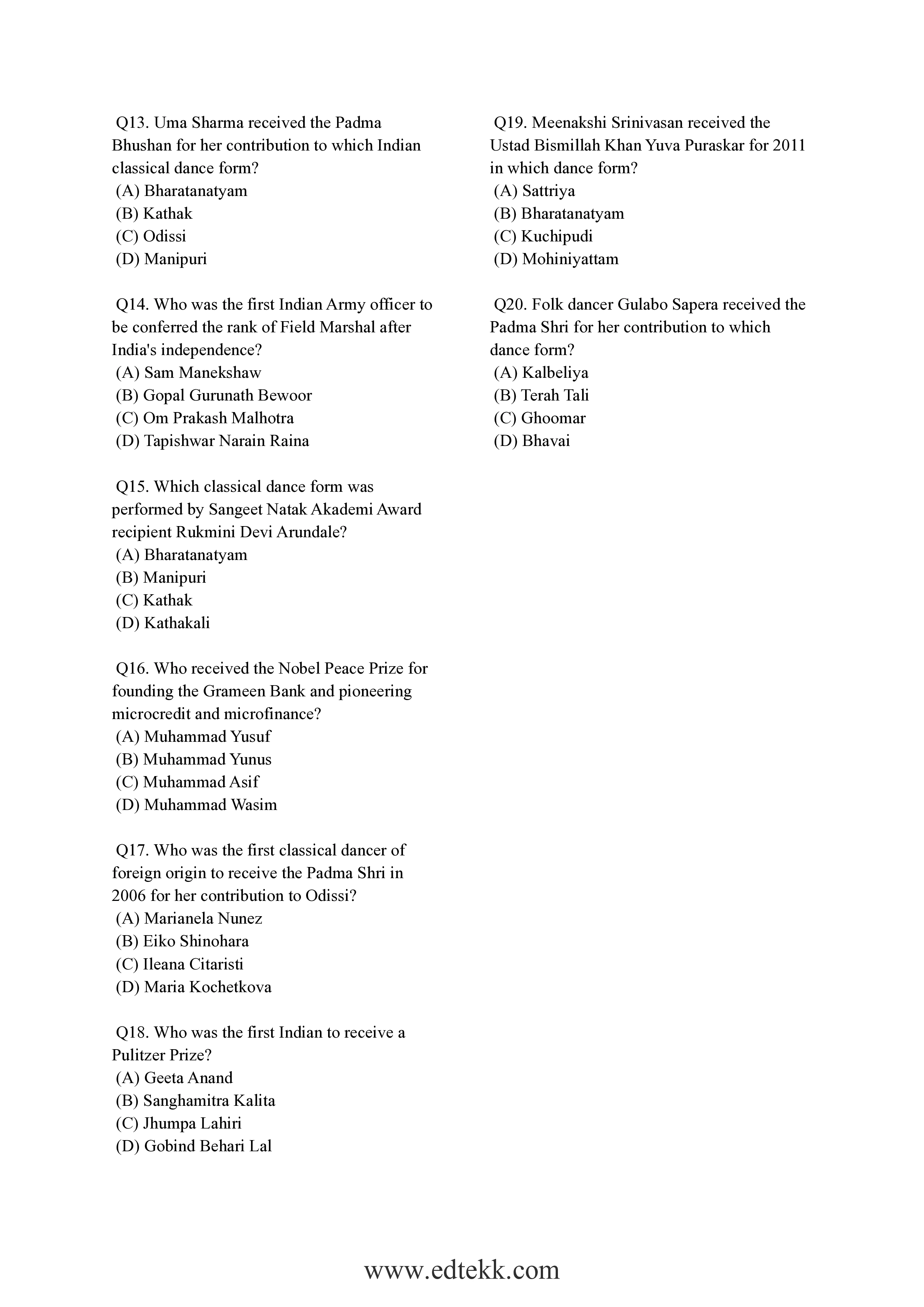
Q13. Uma Sharma received the Padma Bhushan for her contribution to which Indian classical dance form?
(A) Bharatanatyam
(B) Kathak
(C) Odissi
(D) Manipuri
Explanation: Uma Sharma is a distinguished Kathak dancer and choreographer known for her contribution to the preservation and development of this classical dance form. She received the Padma Bhushan in 2001. Through her performances, choreography and educational initiatives, she has helped promote Kathak in India and internationally.
Q14. Who was the first Indian Army officer to be conferred the rank of Field Marshal after India’s independence?
(A) Sam Manekshaw
(B) Gopal Gurunath Bewoor
(C) Om Prakash Malhotra
(D) Tapishwar Narain Raina
Explanation: Sam Hormusji Framji Jamshedji Manekshaw became the first Indian Army officer to attain the rank of Field Marshal on 1 January 1973. He served as Chief of the Army Staff during the 1971 Indo-Pakistani War, which resulted in the creation of Bangladesh. He was popularly known as “Sam Bahadur”.
Q15. Which classical dance form was performed by Sangeet Natak Akademi Award recipient Rukmini Devi Arundale?
(A) Bharatanatyam
(B) Manipuri
(C) Kathak
(D) Kathakali
Explanation: Rukmini Devi Arundale was a renowned Bharatanatyam dancer, choreographer and cultural revivalist. She received the Sangeet Natak Akademi Award in 1957 for her contribution to Indian classical dance. She played a significant role in revitalising Bharatanatyam and founded Kalakshetra in Chennai, an institution dedicated to Indian classical arts and cultural education.
Q16. Who received the Nobel Peace Prize for founding the Grameen Bank and pioneering microcredit and microfinance?
(A) Muhammad Yusuf
(B) Muhammad Yunus
(C) Muhammad Asif
(D) Muhammad Wasim
Explanation: Muhammad Yunus, a Bangladeshi economist and social entrepreneur, received the 2006 Nobel Peace Prize jointly with Grameen Bank. He pioneered microcredit and microfinance by providing small loans to economically disadvantaged individuals, particularly women, without traditional collateral. His initiatives aimed to promote financial inclusion and poverty reduction.
Q17. Who was the first classical dancer of foreign origin to receive the Padma Shri in 2006 for her contribution to Odissi?
(A) Marianela Nunez
(B) Eiko Shinohara
(C) Ileana Citaristi
(D) Maria Kochetkova
Explanation: Ileana Citaristi, an Italian-born classical dancer who settled in India, received the Padma Shri in 2006 for her contributions to Odissi. She is recognised for her dedication to Indian classical dance, her research and performances, and her efforts to promote Odissi internationally.
Q18. Who was the first Indian to receive a Pulitzer Prize?
(A) Geeta Anand
(B) Sanghamitra Kalita
(C) Jhumpa Lahiri
(D) Gobind Behari Lal
Explanation: Gobind Behari Lal was the first Indian to receive a Pulitzer Prize. He received the 1937 Pulitzer Prize in Reporting as part of a group of journalists recognised for their reporting on science. An Indian-American journalist and science writer, he made significant contributions to science journalism.
Q19. Meenakshi Srinivasan received the Ustad Bismillah Khan Yuva Puraskar for 2011 in which dance form?
(A) Sattriya
(B) Bharatanatyam
(C) Kuchipudi
(D) Mohiniyattam
Explanation: Meenakshi Srinivasan received the Ustad Bismillah Khan Yuva Puraskar for 2011 in the Bharatanatyam category. She is an accomplished classical dancer and choreographer associated with the Pandanallur style of Bharatanatyam, known for its emphasis on precise technique, expressive movements and traditional repertoire.
Q20. Folk dancer Gulabo Sapera received the Padma Shri for her contribution to which dance form?
(A) Kalbeliya
(B) Terah Tali
(C) Ghoomar
(D) Bhavai
Explanation: Gulabo Sapera is a renowned Rajasthani folk dancer associated with the Kalbelia dance tradition. She received the Padma Shri in 2016 for her contribution to folk dance. Kalbelia is traditionally associated with Rajasthan’s Kalbelia community and is characterised by flowing movements that imitate the movements of a serpent.
Question Paper Images