Prepare for Police Constable and Police SI examinations with Indian Polity and Constitution Practice Paper 1. This practice set covers important objective-type questions to strengthen your understanding of Indian governance and constitutional concepts, featuring carefully structured MCQs with correct answers and explanations for effective exam preparation.
Test Details
Topic: Indian Polity and Constitution
Total Questions: 20
Question Format: MCQs – Single Correct Answer
Suitable for: Police Constable, Police SI
Download All Papers in This Series (PDF)
Questions and Answers
Q1. Which type of Bill cannot be introduced in the Rajya Sabha?
(A) Both constitutional amendment and ordinary bills
(B) The constitutional amendment bill
(C) The money bill
(D) The ordinary bill
Explanation: A Money Bill can be introduced only in the Lok Sabha and not in the Rajya Sabha, as provided under Article 109 of the Constitution. The Rajya Sabha can make recommendations within 14 days, but the Lok Sabha may accept or reject them. Constitutional Amendment Bills and Ordinary Bills can be introduced in either House.
Q2. In which year did the Kesavananda Bharati judgment establish that the Preamble is part of the Indian Constitution?
(A) 1971
(B) 1968
(C) 1973
(D) 1977
Explanation: In the landmark Kesavananda Bharati v. State of Kerala judgment of 1973, the Supreme Court held that the Preamble is part of the Constitution. The judgment also established the basic-structure doctrine, under which Parliament may amend the Constitution under Article 368 but cannot alter its basic structure.
Q3. Which Article of the Indian Constitution abolishes untouchability?
(A) 20
(B) 18
(C) 17
(D) 19
Explanation: Article 17 of the Indian Constitution abolishes untouchability and prohibits its practice in any form. It also declares the enforcement of any disability arising from untouchability to be an offence punishable by law. This provision promotes social equality and protects individuals against caste-based discrimination.
Q4. Which Article did Dr. B. R. Ambedkar describe as the ‘heart and soul’ of the Indian Constitution?
(A) Article 256
(B) Article 21
(C) Article 24
(D) Article 32
Explanation: Dr. B. R. Ambedkar described Article 32 as the “heart and soul” of the Indian Constitution. It guarantees the right to approach the Supreme Court for the enforcement of Fundamental Rights. The Supreme Court can issue five constitutional writs: habeas corpus, mandamus, prohibition, certiorari and quo warranto.
Q5. Which of the following subjects is specifically addressed by Article 22 of the Indian Constitution?
(A) Protection of life
(B) Protection of personal liberty
(C) Preventive detention
(D) Right to education
Explanation: Article 22 of the Indian Constitution deals with protection against arrest and detention, including preventive detention. It provides safeguards for individuals arrested under ordinary laws and lays down special provisions governing preventive detention.
Q6. Which Article of the Indian Constitution prohibits discrimination on grounds of religion, race, caste, sex and place of birth?
(A) Article 23
(B) Article 15
(C) Article 25
(D) Article19
Explanation: Article 15 prohibits the State from discriminating against any citizen on grounds only of religion, race, caste, sex or place of birth. It also enables the State to introduce special provisions for disadvantaged groups, including women, children, socially and educationally backward classes, Scheduled Castes and Scheduled Tribes.
Q7. Which of the following is not one of the three constitutionally recognised categories of municipalities in India?
(A) Municipal Corporation
(B) Nagar Panchayat
(C) Tehsil Parishad
(D) Municipal Council
Explanation: A Tehsil Parishad is not one of the three principal constitutional categories of urban municipality in India. Article 243Q provides for Municipal Corporations, Municipal Councils and Nagar Panchayats, corresponding broadly to larger urban areas, smaller urban areas and areas transitioning from rural to urban settlements.
Q8. Who among the following served as Prime Minister of India on more than one occasion?
(A) Inder Kumar Gujral
(B) Morarji Desai
(C) Atal Bihari Vajpayee
(D) Rajiv Gandhi
Explanation: Atal Bihari Vajpayee served as Prime Minister of India on three occasions. His first tenure in 1996 lasted 13 days, followed by another tenure from 1998 to 1999 and a third from 1999 to 2004. He is the only person among the given options who served as Prime Minister more than once.
Q9. Under which Article of the Indian Constitution is the District Planning Committee provided for?
(A) Article 243ZD
(B) Article 244ZD
(C) Article 242ZD
(D) Article 243ZE
Explanation: Article 243ZD of the Indian Constitution provides for the constitution of a District Planning Committee in every state at the district level. It consolidates plans prepared by Panchayats and Municipalities within the district and prepares a draft development plan for the district as a whole.
Q10. Under which Article of the Indian Constitution can a Governor promulgate ordinances?
(A) Article 123
(B) Article 213
(C) Article 352
(D) Article 356
Explanation: Article 213 empowers the Governor to promulgate ordinances when the State Legislature is not in session, subject to constitutional conditions and the necessity for immediate action. An ordinance has the force of law but must be laid before the Legislature and ordinarily ceases to operate six weeks after its reassembly unless it expires earlier or is withdrawn.
Q11. Banking falls under which list of the Seventh Schedule of the Indian Constitution?
(A) Concurrent List
(B) Union List
(C) Residual Powers
(D) State List
Explanation: Banking falls under the Union List in the Seventh Schedule, specifically Entry 45. Parliament ordinarily has exclusive authority to legislate on banking, including banking companies and banking regulation. This Union-level legislative framework supports consistent regulation of banking throughout India.
Q12. Who presides over a joint sitting of both Houses of Parliament in India?
(A) Vice President
(B) President
(C) Prime Minister
(D) Speaker of Lok Sabha
Explanation: The Speaker of the Lok Sabha presides over a joint sitting of both Houses of Parliament under Article 118(4) of the Constitution. In the Speaker’s absence, the Deputy Speaker presides, followed by the Deputy Chairman of the Rajya Sabha. If all three are absent, another member may preside as determined by the rules of procedure.
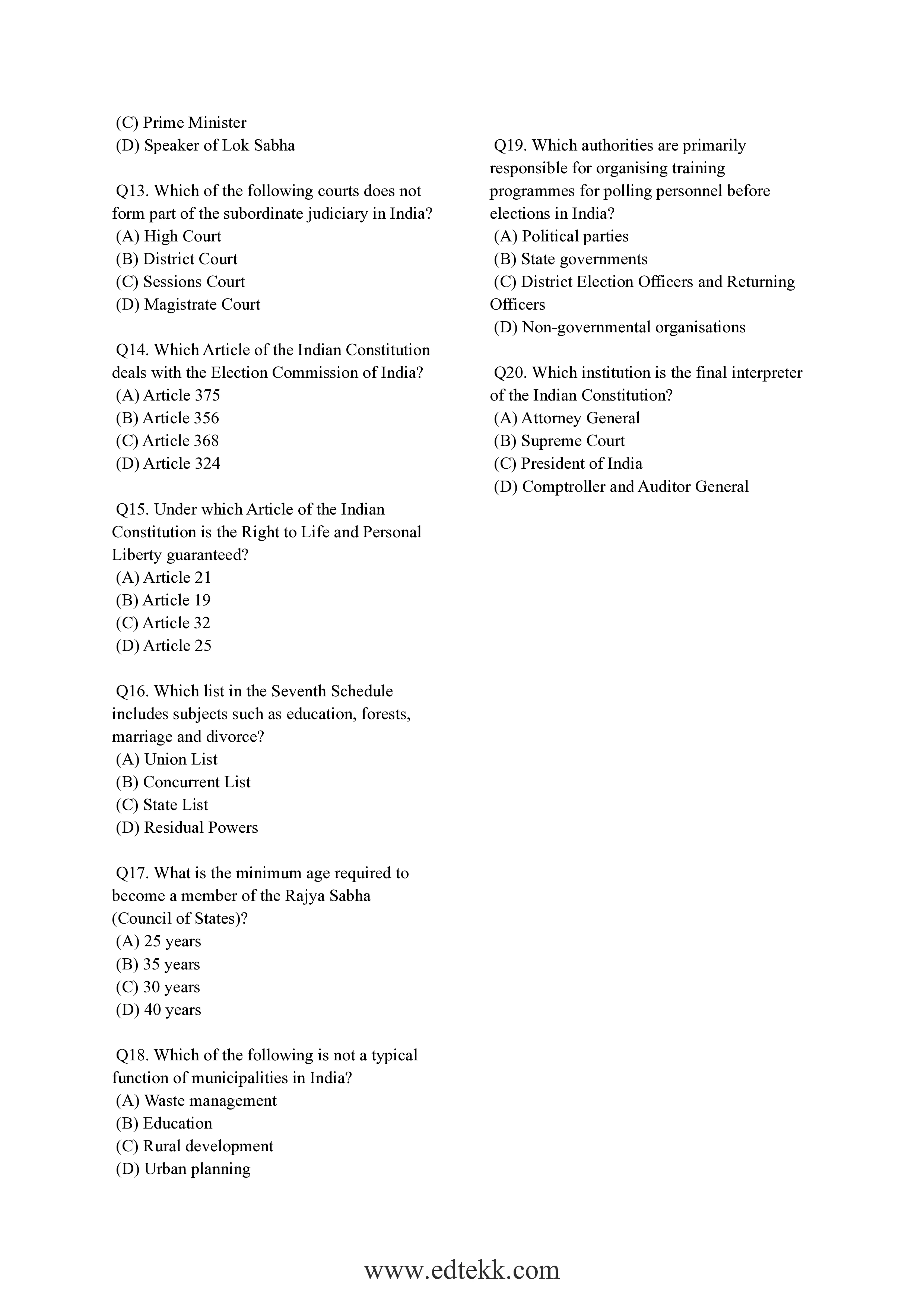
Q13. Which of the following courts does not form part of the subordinate judiciary in India?
(A) High Court
(B) District Court
(C) Sessions Court
(D) Magistrate Court
Explanation: The High Court is not part of the subordinate judiciary in India. It occupies the highest position in the judicial hierarchy of a state or a group of states and Union Territories. District Courts, Sessions Courts and Magistrate Courts form part of the subordinate judicial system and function under the High Court’s supervisory jurisdiction.
Q14. Which Article of the Indian Constitution deals with the Election Commission of India?
(A) Article 375
(B) Article 356
(C) Article 368
(D) Article 324
Explanation: Article 324 of the Indian Constitution deals with the Election Commission of India. It vests the Commission with the superintendence, direction and control of elections to Parliament, State Legislatures, and the offices of the President and Vice-President. It establishes the constitutional framework for independent election administration in India.
Q15. Under which Article of the Indian Constitution is the Right to Life and Personal Liberty guaranteed?
(A) Article 21
(B) Article 19
(C) Article 32
(D) Article 25
Explanation: Article 21 of the Indian Constitution guarantees the Fundamental Right to Life and Personal Liberty. It states that no person shall be deprived of life or personal liberty except according to a procedure established by law. Judicial interpretation has expanded its scope to include various rights essential for living with human dignity.
Q16. Which list in the Seventh Schedule includes subjects such as education, forests, marriage and divorce?
(A) Union List
(B) Concurrent List
(C) State List
(D) Residual Powers
Explanation: The Concurrent List of the Seventh Schedule includes education, forests, marriage and divorce. Both Parliament and State Legislatures can ordinarily legislate on these subjects. In case of a conflict, Union legislation generally prevails under Article 254, subject to the exception for certain State laws receiving Presidential assent.
Q17. What is the minimum age required to become a member of the Rajya Sabha (Council of States)?
(A) 25 years
(B) 35 years
(C) 30 years
(D) 40 years
Explanation: A person must be at least 30 years old to become a member of the Rajya Sabha under Article 84(b) of the Indian Constitution. This minimum age is higher than the 25-year requirement for membership of the Lok Sabha. Candidates must also satisfy the applicable citizenship and other statutory qualifications.
Q18. Which of the following is not a typical function of municipalities in India?
(A) Waste management
(B) Education
(C) Rural development
(D) Urban planning
Explanation: Rural development is primarily associated with Panchayati Raj institutions, which work towards improving infrastructure and welfare in rural areas. Municipalities are urban local bodies responsible for functions such as sanitation, waste management, urban planning, public health and the promotion of educational and cultural activities within their jurisdictions.
Q19. Which authorities are primarily responsible for organising training programmes for polling personnel before elections in India?
(A) Political parties
(B) State governments
(C) District Election Officers and Returning Officers
(D) Non-governmental organisations
Explanation: District Election Officers are primarily responsible for organising training for polling personnel under the Election Commission’s instructions. Returning Officers also coordinate election-related training and preparations within their constituencies. Training familiarises polling personnel with election procedures, voting equipment, statutory requirements and their assigned responsibilities.
Q20. Which institution is the final interpreter of the Indian Constitution?
(A) Attorney General
(B) Supreme Court
(C) President of India
(D) Comptroller and Auditor General
Explanation: The Supreme Court of India is the final interpreter and guardian of the Constitution. It interprets constitutional provisions and examines the validity of legislative and executive actions through judicial review. Its constitutional interpretations and the law declared by it are binding on all courts throughout India under Article 141.
Question Paper Images