Complete another stage of your Police Recruitment preparation with Indian Polity and Constitution Practice Paper 10. Designed for Police Constable and Police SI aspirants, this question set supports comprehensive subject revision and self-assessment through relevant objective-type MCQs, correct answers and explanations to reinforce conceptual understanding.
Test Details
Topic: Indian Polity and Constitution
Total Questions: 20
Question Format: MCQs – Single Correct Answer
Suitable for: Police Constable, Police SI
Download All Papers in This Series (PDF)
Questions and Answers
Q1. Which Constitutional Amendment Act abolished the privy purses of former princely rulers?
(A) 42nd Amendment
(B) 26th Amendment
(C) 28th Amendment
(D) 44th Amendment
Explanation: The 26th Constitutional Amendment Act, 1971, abolished privy purses and ended the official recognition of former princely rulers. It removed their entitlement to privy purses and associated privileges, integrating the former rulers into the constitutional framework applicable to other citizens.
Q2. Which political party in India is associated with the bicycle election symbol?
(A) Samajwadi Party
(B) TMC
(C) NCP
(D) Shiv Sena
Explanation: The Samajwadi Party uses the bicycle as its election symbol. The party is particularly influential in Uttar Pradesh and was founded in 1992 by Mulayam Singh Yadav. The bicycle distinguishes it from the electoral symbols of the TMC, NCP and Shiv Sena.
Q3. What is the normal term of a municipality in India?
(A) 3 years
(B) 2 years
(C) 5 years
(D) 4 years
Explanation: Under Article 243U, every municipality normally continues for five years from the date appointed for its first meeting, unless dissolved earlier. If dissolved prematurely, elections must generally be completed within six months. However, if the remaining term is less than six months, fresh elections for that remaining period are not mandatory.
Q4. Which political party in India is associated with the hand election symbol?
(A) Bahujan Samaj Party
(B) Janata Dal (United)
(C) Rashtriya Janata Dal
(D) Indian National Congress
Explanation: The hand symbol is the reserved election symbol of the Indian National Congress (INC). It is one of the most recognisable political symbols in India and has been associated with the party for several decades.
Q5. What is the total number of Fundamental Duties provided under the Indian Constitution?
(A) 12
(B) 10
(C) 11
(D) 9
Explanation: The Indian Constitution currently provides for 11 Fundamental Duties under Article 51A. Ten duties were introduced by the 42nd Constitutional Amendment Act, 1976, and an additional duty concerning the educational opportunities of children aged six to fourteen years was added by the 86th Constitutional Amendment Act, 2002.
Q6. What is the normal constitutional term of office of the Governor of an Indian state?
(A) Seven
(B) Four
(C) Six
(D) Five
Explanation: Under Article 156, the Governor is appointed by the President and ordinarily holds office for five years from the date of entering office. However, the Governor holds office during the pleasure of the President and may resign by writing to the President. The five-year term does not guarantee tenure for the entire period.
Q7. How many Members of Parliament were elected from Punjab to the 17th Lok Sabha?
(A) 13
(B) 14
(C) 15
(D) 17
Explanation: Punjab has 13 elected seats in the Lok Sabha. The state elected 13 Members of Parliament to the 17th Lok Sabha following the 2019 general elections. These representatives were elected from the state’s 13 parliamentary constituencies.
Q8. Which political party in India uses the lotus as its election symbol?
(A) BSP
(B) SP
(C) BJP
(D) AAP
Explanation: The lotus is the reserved election symbol of the Bharatiya Janata Party (BJP). It has been associated with the party since its establishment in 1980 and is used in elections conducted by the Election Commission of India.
Q9. Who is the highest law officer of India?
(A) Attorney General for India
(B) Vice President of India
(C) Chief Justice of India
(D) Solicitor General of India
Explanation: The Attorney General for India is the highest law officer of the country under Article 76 of the Constitution. The President appoints the Attorney General, who advises the Union Government on legal matters. Under Article 88, the Attorney General has the right to participate in parliamentary proceedings but cannot vote.
Q10. Which House of the Indian Parliament is known as the Council of States?
(A) Rajya Sabha
(B) Lok Sabha
(C) Vidhan Sabha
(D) Lok Ayukta
Explanation: The Rajya Sabha is known as the Council of States and represents the states and eligible Union Territories in the Indian Parliament. It is the Upper House and a permanent body that cannot be dissolved. Its members are elected by the prescribed electoral colleges or nominated by the President according to constitutional provisions.
Q11. What is the minimum age required to be eligible for election as the President of India?
(A) 30 years
(B) 35 years
(C) 40 years
(D) 45 years
Explanation: A person must be at least 35 years old to be eligible for election as President of India under Article 58(1) of the Constitution. The candidate must also be an Indian citizen, be qualified for election as a member of the Lok Sabha and fulfil the other constitutional requirements for presidential eligibility.
Q12. Who is widely regarded as the father of the Panchayati Raj system in India?
(A) Mahatma Gandhi
(B) Balwantrai Mehta
(C) Jawaharlal Nehru
(D) Sardar Patel
Explanation: Balwantrai Mehta is widely regarded as the father of Panchayati Raj in India. His committee, appointed in 1957 to examine the Community Development Programme and National Extension Service, recommended democratic decentralisation through a three-tier structure consisting of Gram Panchayat, Panchayat Samiti and Zilla Parishad.
Q13. Who presides over the sittings of the Rajya Sabha?
(A) Vice President
(B) Prime Minister
(C) President
(D) Chief Justice of India
Explanation: Under Article 64, the Vice President of India serves as the ex officio Chairman of the Rajya Sabha and ordinarily presides over its sittings. The Chairman maintains order, regulates debates and interprets procedural rules. In the Chairman’s absence, the Deputy Chairman or another authorised member presides. The Vice President is not a member of the Rajya Sabha.
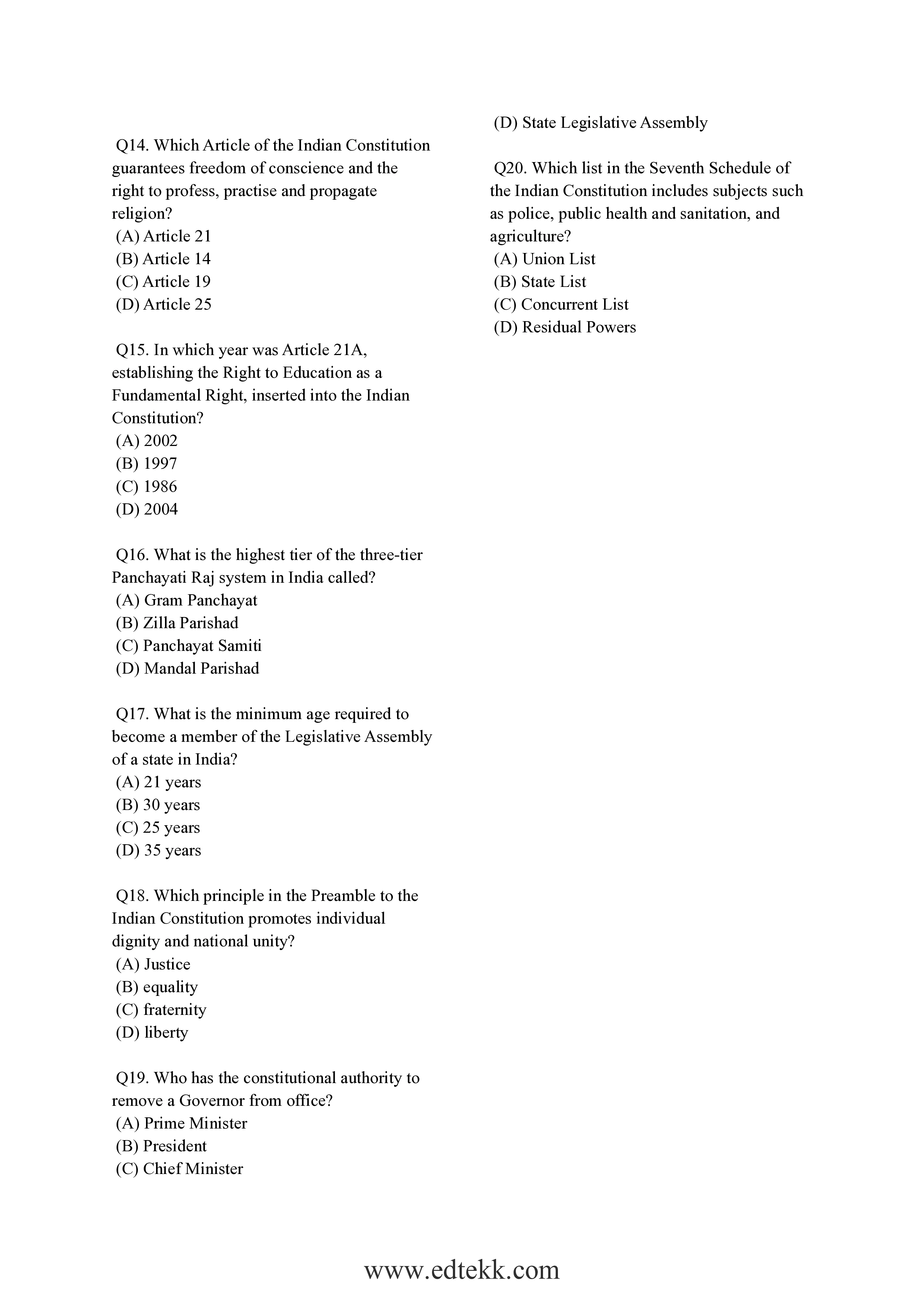
Q14. Which Article of the Indian Constitution guarantees freedom of conscience and the right to profess, practise and propagate religion?
(A) Article 21
(B) Article 14
(C) Article 19
(D) Article 25
Explanation: Article 25 guarantees freedom of conscience and the right to freely profess, practise and propagate religion. This Fundamental Right is available to all persons, subject to public order, morality, health and other constitutional provisions. Under Article 25(2)(a), the State may regulate secular activities associated with religious practices.
Q15. In which year was Article 21A, establishing the Right to Education as a Fundamental Right, inserted into the Indian Constitution?
(A) 2002
(B) 1997
(C) 1986
(D) 2004
Explanation: Article 21A was inserted into the Indian Constitution through the 86th Constitutional Amendment Act, 2002. It guarantees free and compulsory education to children between six and fourteen years of age. The provision came into effect on 1 April 2010, along with the implementation of the Right of Children to Free and Compulsory Education Act, 2009.
Q16. What is the highest tier of the three-tier Panchayati Raj system in India called?
(A) Gram Panchayat
(B) Zilla Parishad
(C) Panchayat Samiti
(D) Mandal Parishad
Explanation: The Zilla Parishad is generally the highest tier of the three-tier Panchayati Raj system and operates at the district level. The Gram Panchayat functions at the village level, while the Panchayat Samiti generally operates at the intermediate or block level. The exact structure may vary by state.
Q17. What is the minimum age required to become a member of the Legislative Assembly of a state in India?
(A) 21 years
(B) 30 years
(C) 25 years
(D) 35 years
Explanation: A person must be at least 25 years old to become a member of the Legislative Assembly of a State under Article 173(b) of the Constitution. The candidate must also be an Indian citizen and fulfil the prescribed electoral and other statutory qualifications under the Representation of the People Act, 1951.
Q18. Which principle in the Preamble to the Indian Constitution promotes individual dignity and national unity?
(A) Justice
(B) equality
(C) fraternity
(D) liberty
Explanation: Fraternity in the Preamble seeks to assure the dignity of the individual and promote the unity and integrity of the nation. The Preamble separately identifies justice, liberty and equality as constitutional objectives. The word “integrity” was added to the Preamble by the 42nd Constitutional Amendment Act, 1976.
Q19. Who has the constitutional authority to remove a Governor from office?
(A) Prime Minister
(B) President
(C) Chief Minister
(D) State Legislative Assembly
Explanation: The President can remove a Governor under Article 156 because the Governor holds office during the President’s pleasure. Although the normal term is five years, it does not confer an absolute right to remain in office for that period.
Q20. Which list in the Seventh Schedule of the Indian Constitution includes subjects such as police, public health and sanitation, and agriculture?
(A) Union List
(B) State List
(C) Concurrent List
(D) Residual Powers
Explanation: The State List, contained in the Seventh Schedule of the Indian Constitution, includes subjects such as police, public health, sanitation and agriculture. State Legislatures generally have exclusive authority to legislate on these subjects, subject to constitutional provisions that permit Parliament to legislate on State List matters in specified circumstances.
Question Paper Images