Get ready for Police Constable and Police SI recruitment examinations with Computer and IT Revision Questions Paper 6. This practice set includes objective questions on important computer and information technology concepts, providing answers and explanations to help candidates strengthen their fundamentals and improve exam preparation.
Test Details
Topic: Computer and IT
Total Questions: 20
Question Format: MCQs – Single Correct Answer
Suitable for: Police Constable, Police SI
Download All Papers in This Series (PDF)
Questions and Answers
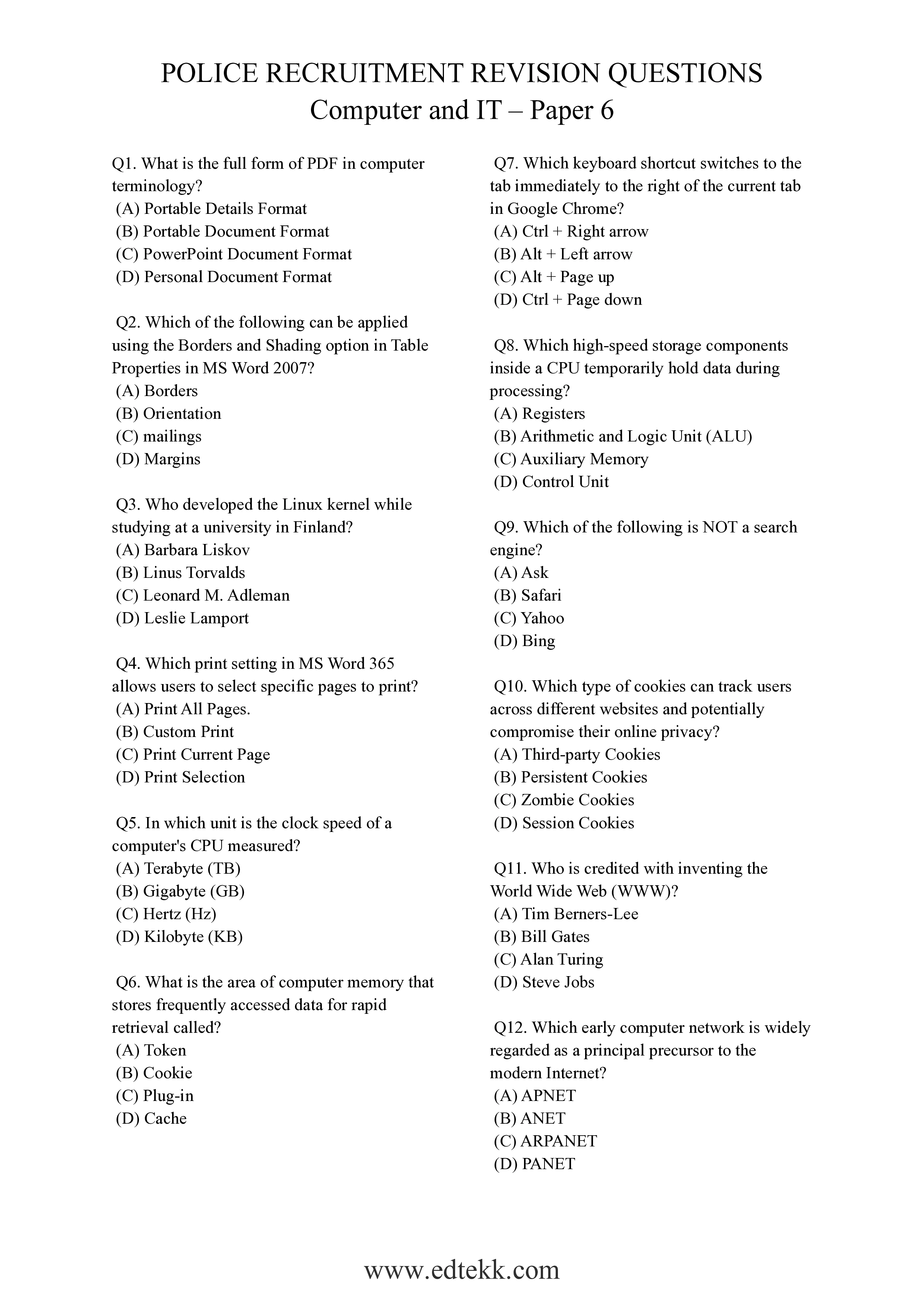
Q1. What is the full form of PDF in computer terminology?
(A) Portable Details Format
(B) Portable Document Format
(C) PowerPoint Document Format
(D) Personal Document Format
Explanation: PDF stands for Portable Document Format. Developed by Adobe, it is a file format designed to present documents consistently across different operating systems, devices and software applications. It preserves document layouts, fonts, images and formatting, making it suitable for sharing, printing and archiving.
Q2. Which of the following can be applied using the Borders and Shading option in Table Properties in MS Word 2007?
(A) Borders
(B) Orientation
(C) mailings
(D) Margins
Explanation: The Borders and Shading option in Microsoft Word 2007 allows users to apply borders and shading to table cells, rows, columns or entire tables. It controls the appearance of table boundaries and cell backgrounds. Orientation, Mailings and Margins are unrelated to this function.
Q3. Who developed the Linux kernel while studying at a university in Finland?
(A) Barbara Liskov
(B) Linus Torvalds
(C) Leonard M. Adleman
(D) Leslie Lamport
Explanation: Linus Torvalds began developing the Linux kernel in 1991 while studying at the University of Helsinki in Finland. He initially created it as a personal project inspired by Unix-like operating systems. The Linux kernel subsequently became a central component of numerous open-source operating systems. Linux-based systems are now widely used in servers, smartphones, supercomputers, and embedded devices.
Q4. Which print setting in MS Word 365 allows users to select specific pages to print?
(A) Print All Pages.
(B) Custom Print
(C) Print Current Page
(D) Print Selection
Explanation: The custom page-range facility in Microsoft Word 365 allows users to print specific pages or page ranges instead of the entire document. For example, users can enter individual page numbers or ranges such as 2, 4–6 and 9 in the Pages field under Print settings.
Q5. In which unit is the clock speed of a computer’s CPU measured?
(A) Terabyte (TB)
(B) Gigabyte (GB)
(C) Hertz (Hz)
(D) Kilobyte (KB)
Explanation: CPU clock speed is measured in hertz (Hz), which represents the number of clock cycles per second. Modern processors commonly operate at frequencies measured in gigahertz (GHz). However, clock speed alone does not determine overall performance, which also depends on processor architecture, core count and other factors.
Q6. What is the area of computer memory that stores frequently accessed data for rapid retrieval called?
(A) Token
(B) Cookie
(C) Plug-in
(D) Cache
Explanation: A cache is a high-speed storage area that temporarily stores frequently accessed data or instructions for faster retrieval. Processors use cache memory to reduce access time compared with main memory. Cookies store website-related information, plug-ins extend application functionality, and tokens serve identification or authentication purposes.
Q7. Which keyboard shortcut switches to the tab immediately to the right of the current tab in Google Chrome?
(A) Ctrl + Right arrow
(B) Alt + Left arrow
(C) Alt + Page up
(D) Ctrl + Page down
Explanation: In Google Chrome on Windows and Linux, Ctrl + Page Down switches to the next tab on the right. Ctrl + Page Up switches to the previous tab on the left. These shortcuts allow users to navigate efficiently between open browser tabs without using the mouse. Ctrl + Tab is another commonly supported shortcut for moving to the next tab.
Q8. Which high-speed storage components inside a CPU temporarily hold data during processing?
(A) Registers
(B) Arithmetic and Logic Unit (ALU)
(C) Auxiliary Memory
(D) Control Unit
Explanation: Registers are small, high-speed storage locations inside the CPU that temporarily hold data, instructions, memory addresses and intermediate results during processing. They enable the processor to access essential information quickly. The ALU performs arithmetic and logical operations, the Control Unit coordinates execution, and auxiliary memory provides additional storage.
Q9. Which of the following is NOT a search engine?
(A) Ask
(B) Safari
(C) Yahoo
(D) Bing
Explanation: Safari is a web browser developed by Apple, not a search engine. Ask, Yahoo and Bing are search engine services that help users find information on the Internet. Safari enables users to access websites and supports different search engines for processing search queries.
Q10. Which type of cookies can track users across different websites and potentially compromise their online privacy?
(A) Third-party Cookies
(B) Persistent Cookies
(C) Zombie Cookies
(D) Session Cookies
Explanation: Third-party cookies are created by domains other than the website directly visited by a user. They can track browsing activity across multiple websites, enabling cross-site profiling and targeted advertising. Their use raises privacy concerns because they may collect information about users without their direct awareness. However, modern browsers increasingly restrict third-party cookies.
Q11. Who is credited with inventing the World Wide Web (WWW)?
(A) Tim Berners-Lee
(B) Bill Gates
(C) Alan Turing
(D) Steve Jobs
Explanation: Tim Berners-Lee invented the World Wide Web (WWW) in 1989 while working at CERN. He developed its fundamental technologies, including HTML, HTTP and URLs. The World Wide Web enables users to access interconnected documents and resources through the Internet.
Q12. Which early computer network is widely regarded as a principal precursor to the modern Internet?
(A) APNET
(B) ANET
(C) ARPANET
(D) PANET
Explanation: ARPANET (Advanced Research Projects Agency Network) was developed in the United States under the Advanced Research Projects Agency (ARPA) in the late 1960s. It was an early packet-switching network and is widely regarded as a principal precursor to the modern Internet.
Q13. Which of the following is NOT an example of mass communication?
(A) Television
(B) Films
(C) door to door campaign
(D) Radio
Explanation: Mass communication involves transmitting information to a large audience through media such as television, films and radio. A door-to-door campaign involves direct, personal communication with individuals or households rather than broadcasting information to a mass audience.
Q14. Which of the following is NOT an Internet service?
(A) Ethernet
(B) E-mail
(C) World Wide web
(D) FTP
Explanation: Ethernet is a networking technology commonly used to connect devices within local area networks (LANs). It is not itself an Internet service. Email, the World Wide Web, and FTP are services or applications that can operate over Internet-connected networks.
Q15. Which keyboard shortcut is used to centre-align a paragraph in MS Word?
(A) Alt + C
(B) Ctrl + J
(C) Ctrl + C
(D) Ctrl + E
Explanation: Ctrl + E is the keyboard shortcut for centre-aligning a paragraph in Microsoft Word. It positions the paragraph centrally between the left and right margins. Other alignment shortcuts include Ctrl + L for left alignment, Ctrl + R for right alignment and Ctrl + J for justified alignment.
Q16. Which interface was traditionally used as a dedicated mouse port on personal computers?
(A) Video Graphics Array (VGA)
(B) PS/2
(C) High-Definition Multimedia Interface (HDMI)
(D) FireWire
Explanation: PS/2 was a traditional interface for connecting keyboards and mice to personal computers. It uses a six-pin mini-DIN connector and was common on desktop computers before USB became widespread. VGA and HDMI are display interfaces, while FireWire was used for high-speed data transfer.
Q17. What is the full form of POP, the email retrieval protocol?
(A) Post Office Progress
(B) Partial Order Program
(C) Post Office Protocol
(D) Partial Order Protocol
Explanation: POP stands for Post Office Protocol. It is an email retrieval protocol that allows an email client to download messages from a mail server. POP3 is the commonly used version. Unlike IMAP, POP traditionally focuses on downloading emails for local access rather than synchronising mailbox contents across multiple devices.
Q18. Which email field indicates the topic or purpose of a message?
(A) To
(B) Subject
(C) Bcc
(D) From
Explanation: The Subject field provides a brief description of the topic or purpose of an email. It helps recipients understand the message’s content before opening it. The To field identifies the recipients, From identifies the sender, and Bcc conceals recipients’ addresses from other recipients.
Q19. How many dots separate the four octets in an IPv4 dotted-decimal address?
(A) four
(B) two
(C) three
(D) five
Explanation: An IPv4 address consists of 32 bits divided into four 8-bit sections called octets. In dotted-decimal notation, these four numbers are separated by exactly three dots. For example, 192.168.1.1 is a valid IPv4 address.
Q20. Which of the following displays both the application name and the spreadsheet name in MS Excel?
(A) Task bar
(B) Toolbar
(C) Title bar
(D) Menu bar
Explanation: The title bar displays the name of the application and the name of the currently open spreadsheet or workbook. In Microsoft Excel, it appears at the top of the application window and helps users identify the active application and file.
Question Paper Images