Test your General Awareness knowledge with 20 revision questions on Awards and Honours – Paper 1. This set covers important national and international awards, award recipients, honours and their associated fields. Practise objective questions with answers and explanations to prepare effectively for Police Constable and Police SI examinations.
Test Details
Topic: Awards and Honours
Total Questions: 20
Question Format: MCQs – Single Correct Answer
Suitable for: Police Constable, Police SI
Download All Papers in This Series (PDF)
Questions and Answers
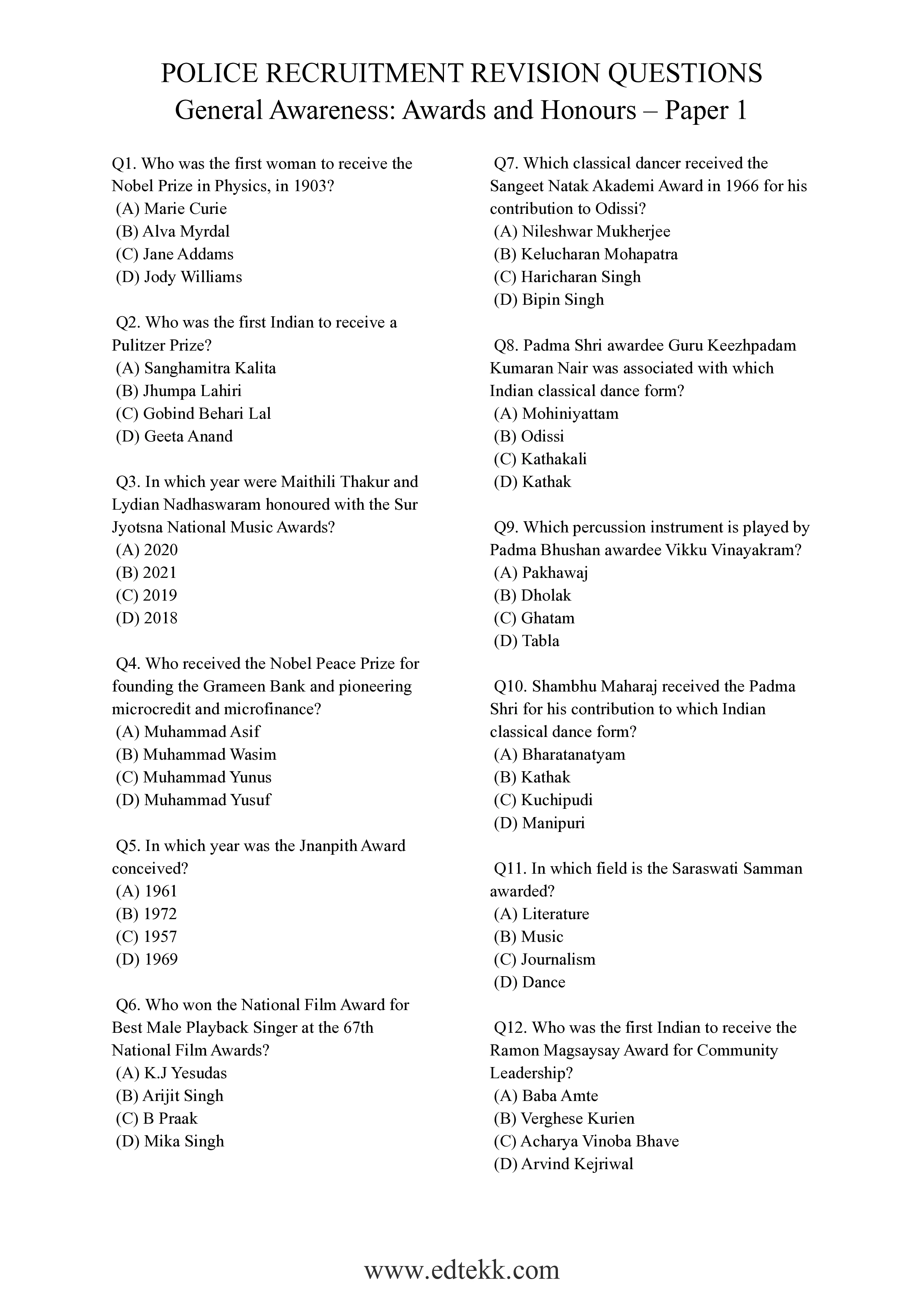
Q1. Who was the first woman to receive the Nobel Prize in Physics, in 1903?
(A) Marie Curie
(B) Alva Myrdal
(C) Jane Addams
(D) Jody Williams
Explanation: Marie Curie became the first woman to receive the Nobel Prize in Physics in 1903. She shared the award with Pierre Curie and Henri Becquerel for their pioneering investigations into radiation phenomena. She subsequently received the Nobel Prize in Chemistry in 1911, becoming the first person to win Nobel Prizes in two different scientific fields.
Q2. Who was the first Indian to receive a Pulitzer Prize?
(A) Sanghamitra Kalita
(B) Jhumpa Lahiri
(C) Gobind Behari Lal
(D) Geeta Anand
Explanation: Gobind Behari Lal was the first Indian to receive a Pulitzer Prize. He received the 1937 Pulitzer Prize in Reporting as part of a group of journalists recognised for their reporting on science. An Indian-American journalist and science writer, he made significant contributions to science journalism.
Q3. In which year were Maithili Thakur and Lydian Nadhaswaram honoured with the Sur Jyotsna National Music Awards?
(A) 2020
(B) 2021
(C) 2019
(D) 2018
Explanation: Maithili Thakur and Lydian Nadhaswaram received the Sur Jyotsna National Music Awards in 2021. The awards recognise emerging musical talent and encourage excellence in Indian music. Both recipients gained recognition for their musical abilities and represent different musical traditions and performance styles.
Q4. Who received the Nobel Peace Prize for founding the Grameen Bank and pioneering microcredit and microfinance?
(A) Muhammad Asif
(B) Muhammad Wasim
(C) Muhammad Yunus
(D) Muhammad Yusuf
Explanation: Muhammad Yunus, a Bangladeshi economist and social entrepreneur, received the 2006 Nobel Peace Prize jointly with Grameen Bank. He pioneered microcredit and microfinance by providing small loans to economically disadvantaged individuals, particularly women, without traditional collateral. His initiatives aimed to promote financial inclusion and poverty reduction.
Q5. In which year was the Jnanpith Award conceived?
(A) 1961
(B) 1972
(C) 1957
(D) 1969
Explanation: The Jnanpith Award was conceived and established in 1961 by the Bharatiya Jnanpith organisation. It recognises outstanding contributions to Indian literature in recognised Indian languages. The first award was presented in 1965 to Malayalam writer G. Sankara Kurup for his literary work Odakkuzhal.
Q6. Who won the National Film Award for Best Male Playback Singer at the 67th National Film Awards?
(A) K.J Yesudas
(B) Arijit Singh
(C) B Praak
(D) Mika Singh
Explanation: B. Praak won the National Film Award for Best Male Playback Singer at the 67th National Film Awards for the song Teri Mitti from the Hindi film Kesari. His performance was recognised for its emotional expression and contribution to the film’s soundtrack. The award related to the 2019 film award year.
Q7. Which classical dancer received the Sangeet Natak Akademi Award in 1966 for his contribution to Odissi?
(A) Nileshwar Mukherjee
(B) Kelucharan Mohapatra
(C) Haricharan Singh
(D) Bipin Singh
Explanation: Kelucharan Mohapatra was a legendary exponent of Odissi, the classical dance form originating in Odisha. He received the Sangeet Natak Akademi Award in 1966 for his contribution to the dance form. He played a crucial role in reviving, developing and popularising Odissi as a recognised Indian classical dance tradition.
Q8. Padma Shri awardee Guru Keezhpadam Kumaran Nair was associated with which Indian classical dance form?
(A) Mohiniyattam
(B) Odissi
(C) Kathakali
(D) Kathak
Explanation: Guru Keezhpadam Kumaran Nair was a distinguished Kathakali artist and teacher from Kerala. He received the Padma Shri for his contributions to this classical dance-drama tradition. Kathakali is characterised by elaborate costumes, stylised gestures, expressive facial movements and dramatic storytelling, often depicting episodes from Indian epics.
Q9. Which percussion instrument is played by Padma Bhushan awardee Vikku Vinayakram?
(A) Pakhawaj
(B) Dholak
(C) Ghatam
(D) Tabla
Explanation: Vikku Vinayakram is a renowned Indian percussionist specialising in the ghatam, a traditional clay-pot percussion instrument used in Carnatic music. He is celebrated for his rhythmic precision and innovative performance style. He received the Padma Bhushan in 2014 in recognition of his outstanding contributions to Indian classical music.
Q10. Shambhu Maharaj received the Padma Shri for his contribution to which Indian classical dance form?
(A) Bharatanatyam
(B) Kathak
(C) Kuchipudi
(D) Manipuri
Explanation: Shambhu Maharaj was a renowned exponent of Kathak, one of India’s major classical dance forms. He belonged to the Lucknow gharana and was celebrated for his expressive facial movements, graceful gestures and mastery of rhythm. He received the Padma Shri in 1955 for his contribution to Indian classical dance.
Q11. In which field is the Saraswati Samman awarded?
(A) Literature
(B) Music
(C) Journalism
(D) Dance
Explanation: The Saraswati Samman is a prestigious literary award established by the K. K. Birla Foundation in 1991. It recognises outstanding literary works written in any of the 22 languages listed in the Eighth Schedule of the Indian Constitution. The award is given for exceptional contributions to literature, not music, journalism or dance.
Q12. Who was the first Indian to receive the Ramon Magsaysay Award for Community Leadership?
(A) Baba Amte
(B) Verghese Kurien
(C) Acharya Vinoba Bhave
(D) Arvind Kejriwal
Explanation: Acharya Vinoba Bhave received the Ramon Magsaysay Award for Community Leadership in 1958. He was a prominent Indian social reformer and leader of the Bhoodan Movement, which encouraged landowners to voluntarily donate land to landless people. He was the first Indian recipient of the award in this category.
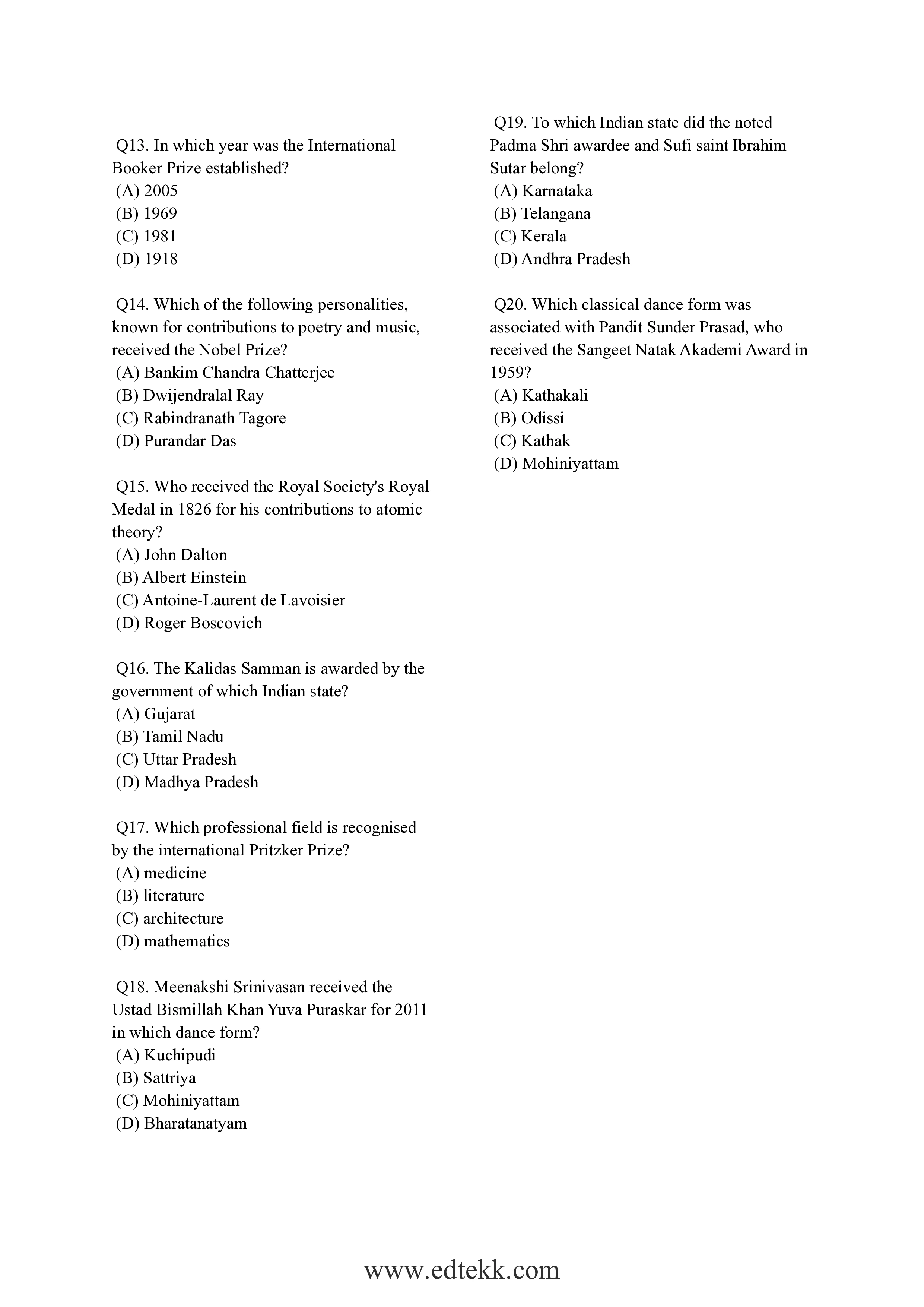
Q13. In which year was the International Booker Prize established?
(A) 2005
(B) 1969
(C) 1981
(D) 1918
Explanation: The International Booker Prize was established in 2005 as the Man Booker International Prize. Initially, it recognised an author’s overall contribution to fiction and was awarded biennially. In 2015, it evolved into an annual award recognising a single work of fiction translated into English. It was renamed the International Booker Prize in 2019.
Q14. Which of the following personalities, known for contributions to poetry and music, received the Nobel Prize?
(A) Bankim Chandra Chatterjee
(B) Dwijendralal Ray
(C) Rabindranath Tagore
(D) Purandar Das
Explanation: Rabindranath Tagore received the Nobel Prize in Literature in 1913 for his literary work, particularly the English translation of Gitanjali. He became the first Asian Nobel laureate. Besides being a celebrated poet, he was also a composer, playwright, novelist and philosopher who made lasting contributions to Indian literature and music.
Q15. Who received the Royal Society’s Royal Medal in 1826 for his contributions to atomic theory?
(A) John Dalton
(B) Albert Einstein
(C) Antoine-Laurent de Lavoisier
(D) Roger Boscovich
Explanation: John Dalton received the Royal Society’s Royal Medal in 1826 in recognition of his contributions to atomic theory. He proposed that matter consists of indivisible atoms and that atoms of different elements combine in fixed proportions to form chemical compounds. His theory laid the foundation for modern atomic theory.
Q16. The Kalidas Samman is awarded by the government of which Indian state?
(A) Gujarat
(B) Tamil Nadu
(C) Uttar Pradesh
(D) Madhya Pradesh
Explanation: The Kalidas Samman is conferred by the Government of Madhya Pradesh. Instituted in 1980, it recognises distinguished contributions to classical music, classical dance, theatre and visual arts. The award is named after Kalidasa, the renowned classical Sanskrit poet and playwright, whose literary works are an important part of India’s cultural heritage.
Q17. Which professional field is recognised by the international Pritzker Prize?
(A) medicine
(B) literature
(C) architecture
(D) mathematics
Explanation: The Pritzker Architecture Prize is an internationally recognised award established in 1979 by the Pritzker family. It is awarded annually to living architects whose work demonstrates exceptional talent, vision and commitment to architecture. It is widely regarded as one of the highest honours in the architectural profession.
Q18. Meenakshi Srinivasan received the Ustad Bismillah Khan Yuva Puraskar for 2011 in which dance form?
(A) Kuchipudi
(B) Sattriya
(C) Mohiniyattam
(D) Bharatanatyam
Explanation: Meenakshi Srinivasan received the Ustad Bismillah Khan Yuva Puraskar for 2011 in the Bharatanatyam category. She is an accomplished classical dancer and choreographer associated with the Pandanallur style of Bharatanatyam, known for its emphasis on precise technique, expressive movements and traditional repertoire.
Q19. To which Indian state did the noted Padma Shri awardee and Sufi saint Ibrahim Sutar belong?
(A) Karnataka
(B) Telangana
(C) Kerala
(D) Andhra Pradesh
Explanation: Ibrahim Sutar belonged to Karnataka. He was a renowned social worker, folk singer and spiritual speaker known for promoting communal harmony through his programmes and discourses. He received the Padma Shri in 2018 in recognition of his contributions to social work.
Q20. Which classical dance form was associated with Pandit Sunder Prasad, who received the Sangeet Natak Akademi Award in 1959?
(A) Kathakali
(B) Odissi
(C) Kathak
(D) Mohiniyattam
Explanation: Pandit Sunder Prasad was a distinguished Kathak dancer and guru associated with the Jaipur gharana. He received the Sangeet Natak Akademi Award in 1959 in recognition of his contribution to Kathak. Through his teaching and performances, he helped preserve and transmit the gharana’s distinctive techniques, rhythmic patterns and repertoire.
Question Paper Images