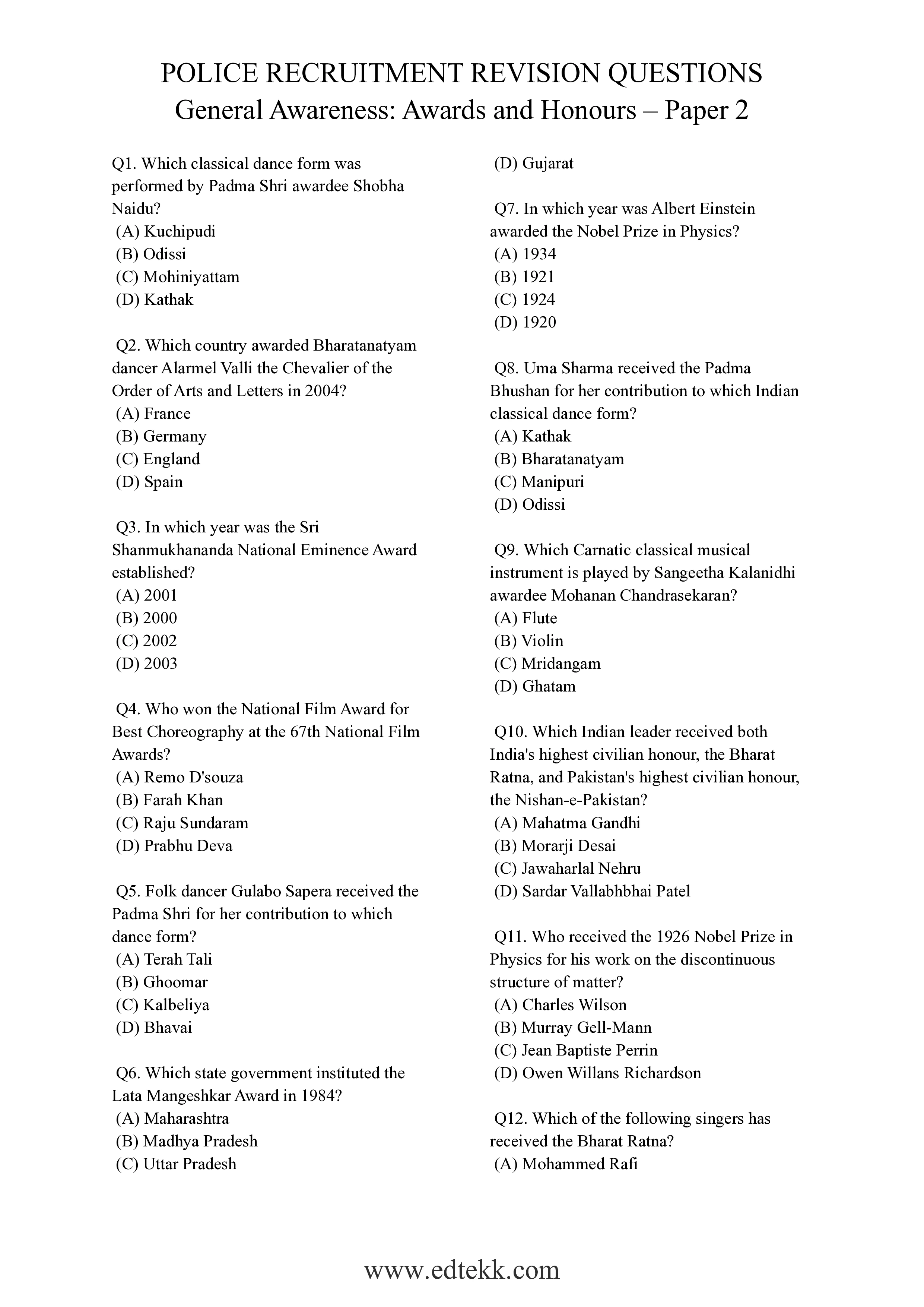
Enhance your General Awareness preparation with 20 revision questions on Awards and Honours – Paper 2. The practice set focuses on notable national and international awards, distinguished personalities, award-winning achievements and related facts. It includes MCQs, correct answers and explanations for Police Constable and Police SI aspirants.
Test Details
Topic: Awards and Honours
Total Questions: 20
Question Format: MCQs – Single Correct Answer
Suitable for: Police Constable, Police SI
Download All Papers in This Series (PDF)
Questions and Answers
Q1. Which classical dance form was performed by Padma Shri awardee Shobha Naidu?
(A) Kuchipudi
(B) Odissi
(C) Mohiniyattam
(D) Kathak
Explanation: Shobha Naidu was a celebrated Kuchipudi dancer and choreographer. She received the Padma Shri in 2001 in recognition of her contributions to Indian classical dance. She was particularly renowned for her expressive performances and portrayals of mythological characters and played an important role in promoting Kuchipudi through teaching and stage performances.
Q2. Which country awarded Bharatanatyam dancer Alarmel Valli the Chevalier of the Order of Arts and Letters in 2004?
(A) France
(B) Germany
(C) England
(D) Spain
Explanation: Alarmel Valli received the Chevalier of the Order of Arts and Letters in 2004 from the Government of France. This distinction recognises significant contributions to the arts and literature. She is an internationally acclaimed Bharatanatyam dancer known for her distinctive interpretation of the Pandanallur tradition.
Q3. In which year was the Sri Shanmukhananda National Eminence Award established?
(A) 2001
(B) 2000
(C) 2002
(D) 2003
Explanation: The Sri Shanmukhananda National Eminence Award was established in 2002 by the Sri Shanmukhananda Fine Arts and Sangeetha Sabha in Mumbai, according to the commonly cited account. The award recognises distinguished individuals for their achievements and contributions in their respective fields.
Q4. Who won the National Film Award for Best Choreography at the 67th National Film Awards?
(A) Remo D’souza
(B) Farah Khan
(C) Raju Sundaram
(D) Prabhu Deva
Explanation: Raju Sundaram won the National Film Award for Best Choreography at the 67th National Film Awards for his work in the Telugu film Maharshi. The award was announced in 2021 for films belonging to the 2019 award year, recognising his contribution to the film’s choreography.
Q5. Folk dancer Gulabo Sapera received the Padma Shri for her contribution to which dance form?
(A) Terah Tali
(B) Ghoomar
(C) Kalbeliya
(D) Bhavai
Explanation: Gulabo Sapera is a renowned Rajasthani folk dancer associated with the Kalbelia dance tradition. She received the Padma Shri in 2016 for her contribution to folk dance. Kalbelia is traditionally associated with Rajasthan’s Kalbelia community and is characterised by flowing movements that imitate the movements of a serpent.
Q6. Which state government instituted the Lata Mangeshkar Award in 1984?
(A) Maharashtra
(B) Madhya Pradesh
(C) Uttar Pradesh
(D) Gujarat
Explanation: The Government of Madhya Pradesh instituted the Lata Mangeshkar Award in 1984 to recognise outstanding contributions to music. Named after the legendary playback singer Lata Mangeshkar, the award honours distinguished achievements in the field of Indian music and celebrates excellence in musical performance and composition.
Q7. In which year was Albert Einstein awarded the Nobel Prize in Physics?
(A) 1934
(B) 1921
(C) 1924
(D) 1920
Explanation: Albert Einstein was awarded the 1921 Nobel Prize in Physics for his contributions to theoretical physics, particularly his explanation of the photoelectric effect. Although the prize was designated for 1921, it was formally presented to him in 1922.
Q8. Uma Sharma received the Padma Bhushan for her contribution to which Indian classical dance form?
(A) Kathak
(B) Bharatanatyam
(C) Manipuri
(D) Odissi
Explanation: Uma Sharma is a distinguished Kathak dancer and choreographer known for her contribution to the preservation and development of this classical dance form. She received the Padma Bhushan in 2001. Through her performances, choreography and educational initiatives, she has helped promote Kathak in India and internationally.
Q9. Which Carnatic classical musical instrument is played by Sangeetha Kalanidhi awardee Mohanan Chandrasekaran?
(A) Flute
(B) Violin
(C) Mridangam
(D) Ghatam
Explanation: Mohanan Chandrasekaran is a distinguished Carnatic classical violinist. He received the Sangeetha Kalanidhi award from the Madras Music Academy in 2005 in recognition of his contribution to Carnatic music. The violin is an important accompanying and solo instrument in this tradition, capable of reproducing the melodic nuances and expressive techniques of vocal music.
Q10. Which Indian leader received both India’s highest civilian honour, the Bharat Ratna, and Pakistan’s highest civilian honour, the Nishan-e-Pakistan?
(A) Mahatma Gandhi
(B) Morarji Desai
(C) Jawaharlal Nehru
(D) Sardar Vallabhbhai Patel
Explanation: Morarji Desai, India’s fourth Prime Minister, received Pakistan’s Nishan-e-Pakistan in 1990 and India’s Bharat Ratna in 1991. These are the highest civilian honours of Pakistan and India, respectively. He served as Prime Minister from 1977 to 1979 and is recognised for his contributions to public service and India-Pakistan relations.
Q11. Who received the 1926 Nobel Prize in Physics for his work on the discontinuous structure of matter?
(A) Charles Wilson
(B) Murray Gell-Mann
(C) Jean Baptiste Perrin
(D) Owen Willans Richardson
Explanation: Jean Baptiste Perrin received the 1926 Nobel Prize in Physics for his work on the discontinuous structure of matter, particularly his discovery of sedimentation equilibrium. His experiments provided important evidence supporting the physical existence of atoms and molecules.
Q12. Which of the following singers has received the Bharat Ratna?
(A) Mohammed Rafi
(B) Mukesh
(C) Lata Mangeshkar
(D) Asha Bhonsle
Explanation: Lata Mangeshkar received the Bharat Ratna in 2001 for her exceptional contribution to Indian music. One of India’s most celebrated playback singers, she recorded thousands of songs across several decades and numerous Indian languages. The Bharat Ratna is the country’s highest civilian award.
Q13. Who was the first musician to receive the prestigious Bharat Ratna, India’s highest civilian honour?
(A) Pt Hari Prasad Chaurasia
(B) Pt Ravi Shankar
(C) MS Subbulakshmi
(D) Begum Akhtar
Explanation: M. S. Subbulakshmi was the first musician to receive the Bharat Ratna, India’s highest civilian honour. She received it in 1998 in recognition of her exceptional contributions to Carnatic music. Her distinguished career brought Indian classical music international recognition, making her one of India’s most celebrated vocalists.
Q14. Who was the first Indian musician to win the Oscar for Best Original Score?
(A) A.R. Rahman
(B) Bhanu Athaiya
(C) Resul Pookutty
(D) Mehboob Khan
Explanation: A. R. Rahman became the first Indian to win the Academy Award for Best Original Score for Slumdog Millionaire in 2009. He also won the Academy Award for Best Original Song for Jai Ho, sharing the award with lyricist Gulzar. His achievements brought international recognition to Indian film music.
Q15. For which album did Indian musician Ricky Kej win the 57th Grammy Award?
(A) Divine Tides
(B) Mountain Dreams
(C) Winds of Samsara
(D) Mystic Mountains
Explanation: Ricky Kej won the 57th Annual Grammy Award in 2015 for the album Winds of Samsara, created in collaboration with South African flautist Wouter Kellerman. The album received the Grammy Award for Best New Age Album, bringing international recognition to Kej’s musical achievements.
Q16. Which organisation confers the Ustad Bismillah Khan Yuva Puraskar?
(A) Sangeet Natak Academy
(B) National School of Drama
(C) Bharatiya Vidya Bhavan
(D) Gandharva Mahavidyalaya
Explanation: The Ustad Bismillah Khan Yuva Puraskar is conferred by the Sangeet Natak Akademi. It recognises outstanding young artists in music, dance, theatre and other performing arts. Named after the celebrated shehnai maestro Ustad Bismillah Khan, the award encourages emerging talent and supports the development of India’s performing arts traditions.
Q17. Which Indian received the Nobel Peace Prize after Mother Teresa?
(A) K Radhakrishnan
(B) Fali Nariman
(C) Kailash Satyarthi
(D) P Sathasivam
Explanation: Kailash Satyarthi received the Nobel Peace Prize in 2014, jointly with Malala Yousafzai, for their efforts to protect children’s rights and promote education. Mother Teresa received the Nobel Peace Prize in 1979. Satyarthi was therefore the Indian recipient who received this award after Mother Teresa.
Q18. Which Indian musician won two Grammy Awards in 2010 for his work on Danny Boyle’s film Slumdog Millionaire?
(A) Vishal Bharadwaj
(B) AR Rahman
(C) Bappi Lahiri
(D) Pritam Chakraborty
Explanation: A. R. Rahman won two Grammy Awards in 2010 for his work on Slumdog Millionaire. He received awards for Best Compilation Soundtrack Album for a Motion Picture, Television or Other Visual Media and Best Song Written for Motion Picture, Television or Other Visual Media for Jai Ho.
Q19. Who was the first sportsperson to receive the Padma Vibhushan?
(A) Viswanathan Anand
(B) Sachin Tendulkar
(C) Michael Ferreira
(D) Pankaj Advani
Explanation: Viswanathan Anand became the first sportsperson to receive the Padma Vibhushan, India’s second-highest civilian award. He received the honour in 2007 for his outstanding achievements in chess. A five-time World Chess Champion, Anand is one of India’s most celebrated chess players.
Q20. In which year did Lata Mangeshkar receive the Bharat Ratna?
(A) 2003
(B) 1997
(C) 2001
(D) 1999
Explanation: Lata Mangeshkar received the Bharat Ratna in 2001 in recognition of her extraordinary contribution to Indian music. One of India’s most celebrated playback singers, she enjoyed a career spanning several decades and recorded songs in numerous Indian languages. The Bharat Ratna is India’s highest civilian honour.
Question Paper Images