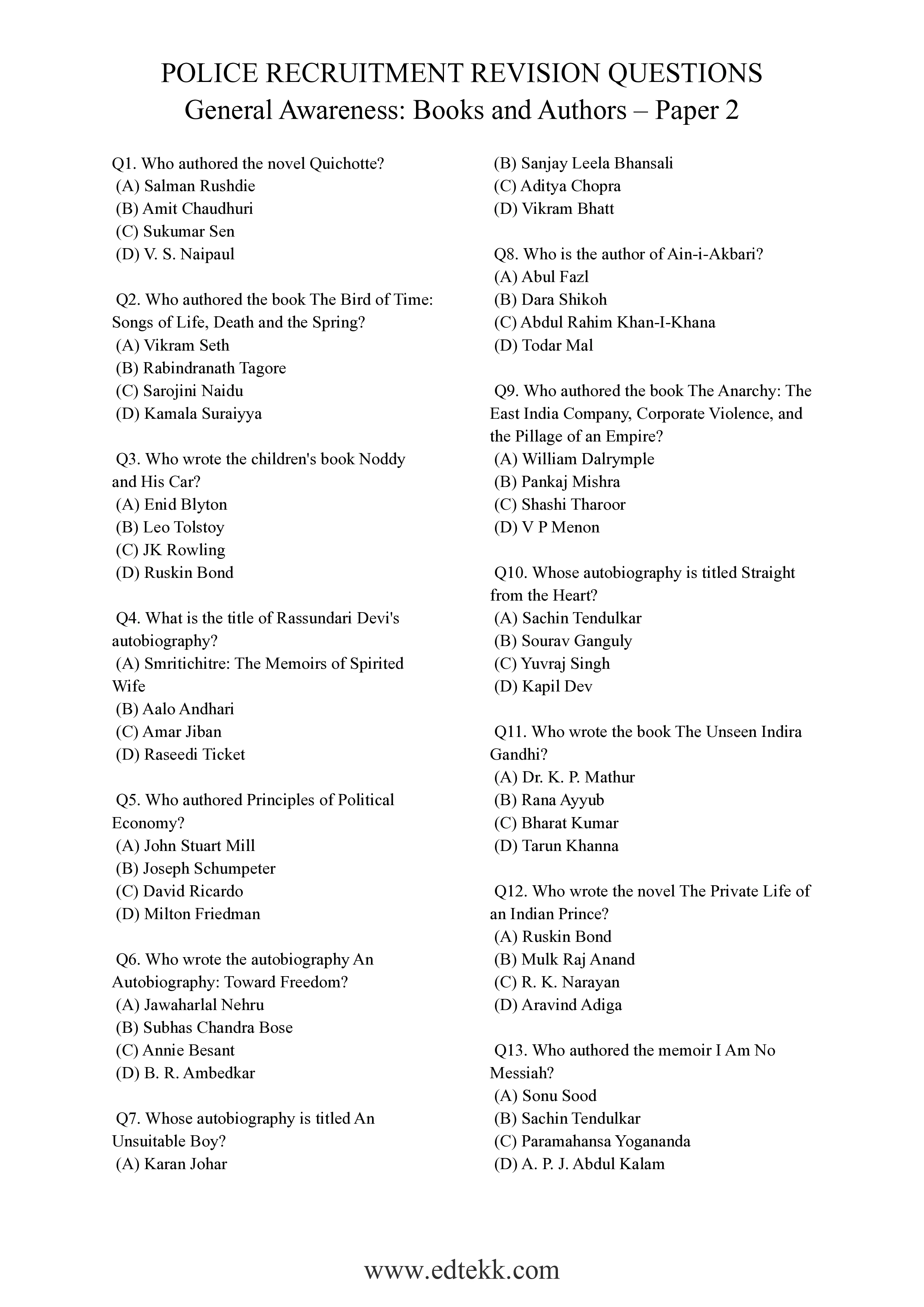
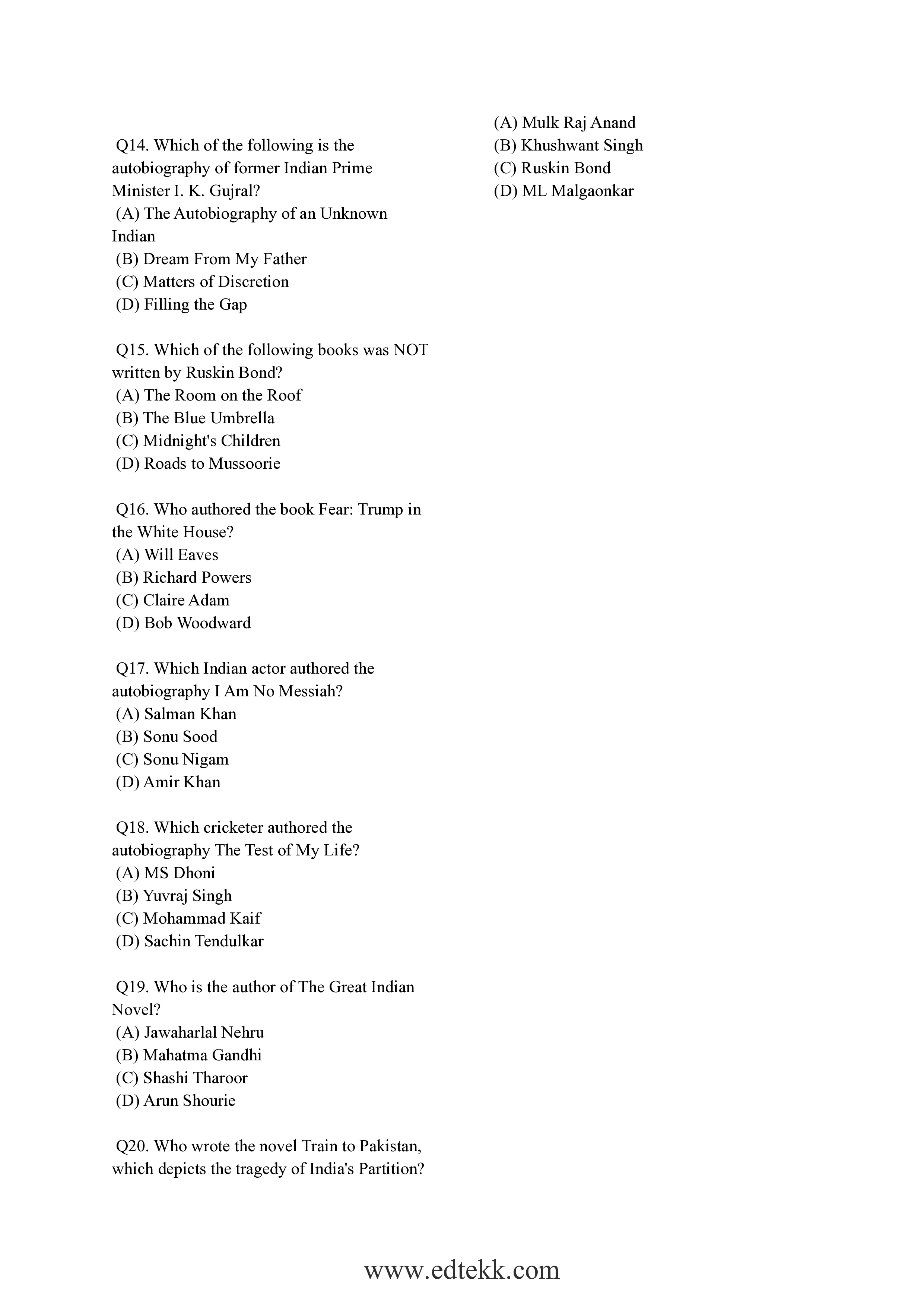
Prepare for Police Recruitment examinations with 20 General Awareness revision questions on Books and Authors – Paper 2. This practice set includes famous literary works, authors, Indian and international publications and important writing-related facts. Test your knowledge through MCQs with answers and explanations for Police Constable and Police SI exams.
Test Details
Topic: Books and Authors
Total Questions: 20
Question Format: MCQs – Single Correct Answer
Suitable for: Police Constable, Police SI
Download All Papers in This Series (PDF)
Questions and Answers
Q1. Who authored the novel Quichotte?
(A) Salman Rushdie
(B) Amit Chaudhuri
(C) Sukumar Sen
(D) V. S. Naipaul
Explanation: Quichotte is a novel written by Salman Rushdie and published in 2019. Inspired by Miguel de Cervantes’ classic novel Don Quixote, it follows a travelling salesman who becomes obsessed with television and falls in love with a fictional celebrity. The novel was shortlisted for the 2019 Booker Prize.
Q2. Who authored the book The Bird of Time: Songs of Life, Death and the Spring?
(A) Vikram Seth
(B) Rabindranath Tagore
(C) Sarojini Naidu
(D) Kamala Suraiyya
Explanation: The Bird of Time: Songs of Life, Death and the Spring is a collection of poems by Sarojini Naidu, first published in 1912. The collection explores themes of love, nature, Indian culture, mortality and the passage of time. Sarojini Naidu is popularly known as the Nightingale of India.
Q3. Who wrote the children’s book Noddy and His Car?
(A) Enid Blyton
(B) Leo Tolstoy
(C) JK Rowling
(D) Ruskin Bond
Explanation: Noddy and His Car was written by Enid Blyton, a prolific British children’s author. It features Noddy, a fictional children’s character who lives in Toyland and drives a small car. Blyton is also well known for popular children’s series such as The Famous Five and The Secret Seven.
Q4. What is the title of Rassundari Devi’s autobiography?
(A) Smritichitre: The Memoirs of Spirited Wife
(B) Aalo Andhari
(C) Amar Jiban
(D) Raseedi Ticket
Explanation: Amar Jiban (My Life) is the autobiography of Rassundari Devi, published in 1876. It is regarded as the first full-length autobiography written by an Indian woman in Bengali. The book describes her family life, personal struggles and journey towards literacy in nineteenth-century Bengal.
Q5. Who authored Principles of Political Economy?
(A) John Stuart Mill
(B) Joseph Schumpeter
(C) David Ricardo
(D) Milton Friedman
Explanation: John Stuart Mill authored Principles of Political Economy, first published in 1848. The book discusses major economic concepts, including production, distribution, economic value, wages, profits and international trade. It became one of the influential works of classical economics and significantly shaped nineteenth-century economic thought.
Q6. Who wrote the autobiography An Autobiography: Toward Freedom?
(A) Jawaharlal Nehru
(B) Subhas Chandra Bose
(C) Annie Besant
(D) B. R. Ambedkar
Explanation: Jawaharlal Nehru wrote An Autobiography, also known as Toward Freedom. First published in 1936, it recounts his personal experiences, political activities, imprisonment and participation in India’s freedom struggle. Much of the work was written during his imprisonment under British rule.
Q7. Whose autobiography is titled An Unsuitable Boy?
(A) Karan Johar
(B) Sanjay Leela Bhansali
(C) Aditya Chopra
(D) Vikram Bhatt
Explanation: An Unsuitable Boy is the autobiography of Indian filmmaker Karan Johar, written in collaboration with Poonam Saxena. Published in 2017, it discusses his childhood, filmmaking career, professional relationships and personal experiences in the Indian film industry.
Q8. Who is the author of Ain-i-Akbari?
(A) Abul Fazl
(B) Dara Shikoh
(C) Abdul Rahim Khan-I-Khana
(D) Todar Mal
Explanation: Abu’l-Fazl ibn Mubarak authored Ain-i-Akbari, a detailed account of Emperor Akbar’s administration, economy, military organisation and society. It constitutes the third volume of the Akbarnama, the official chronicle of Akbar’s reign. The work is an important historical source for understanding Mughal administration in sixteenth-century India.
Q9. Who authored the book The Anarchy: The East India Company, Corporate Violence, and the Pillage of an Empire?
(A) William Dalrymple
(B) Pankaj Mishra
(C) Shashi Tharoor
(D) V P Menon
Explanation: William Dalrymple, a Scottish historian and writer, authored The Anarchy: The East India Company, Corporate Violence, and the Pillage of an Empire, published in 2019. The book examines the East India Company’s rise to political power in India and the exploitation and violence associated with its expansion.
Q10. Whose autobiography is titled Straight from the Heart?
(A) Sachin Tendulkar
(B) Sourav Ganguly
(C) Yuvraj Singh
(D) Kapil Dev
Explanation: Straight from the Heart is the autobiography of former Indian cricket captain Kapil Dev, published in 1985. It recounts his cricketing journey, achievements and experiences in international cricket. He captained India to its historic first Cricket World Cup victory in 1983.
Q11. Who wrote the book The Unseen Indira Gandhi?
(A) Dr. K. P. Mathur
(B) Rana Ayyub
(C) Bharat Kumar
(D) Tarun Khanna
Explanation: The Unseen Indira Gandhi was written by Dr. K. P. Mathur, who served as Indira Gandhi’s personal physician. The book offers insights into her personality, lifestyle, health and private life, based on his professional association with the former Prime Minister of India.
Q12. Who wrote the novel The Private Life of an Indian Prince?
(A) Ruskin Bond
(B) Mulk Raj Anand
(C) R. K. Narayan
(D) Aravind Adiga
Explanation: Mulk Raj Anand authored The Private Life of an Indian Prince, a novel published in 1953. It explores the political and personal circumstances surrounding an Indian prince during the integration of princely states after independence. Anand was an influential Indian English novelist known for portraying social inequalities, poverty and marginalised communities.
Q13. Who authored the memoir I Am No Messiah?
(A) Sonu Sood
(B) Sachin Tendulkar
(C) Paramahansa Yogananda
(D) A. P. J. Abdul Kalam
Explanation: I Am No Messiah is the memoir of Indian actor Sonu Sood, published in December 2020. Written with journalist Meena K. Iyer, it describes his personal journey, acting career and humanitarian initiatives, particularly his efforts to assist stranded migrant workers during the COVID-19 pandemic.
Q14. Which of the following is the autobiography of former Indian Prime Minister I. K. Gujral?
(A) The Autobiography of an Unknown Indian
(B) Dream From My Father
(C) Matters of Discretion
(D) Filling the Gap
Explanation: Matters of Discretion: An Autobiography is the autobiography of Inder Kumar Gujral, former Prime Minister of India. Published in 2011, it recounts his personal experiences, political journey and diplomatic career. He served as India’s Prime Minister from 1997 to 1998.
Q15. Which of the following books was NOT written by Ruskin Bond?
(A) The Room on the Roof
(B) The Blue Umbrella
(C) Midnight’s Children
(D) Roads to Mussoorie
Explanation: Midnight’s Children was written by Salman Rushdie and published in 1981. The novel follows Saleem Sinai, whose life becomes connected with India’s independence and subsequent political history. Ruskin Bond authored the other three listed works: The Room on the Roof, The Blue Umbrella and Roads to Mussoorie.
Q16. Who authored the book Fear: Trump in the White House?
(A) Will Eaves
(B) Richard Powers
(C) Claire Adam
(D) Bob Woodward
Explanation: Fear: Trump in the White House was authored by Bob Woodward and published in 2018. The book examines Donald Trump’s administration, drawing on interviews with individuals close to the administration. It describes internal decision-making, political developments and the functioning of the White House during Trump’s presidency.
Q17. Which Indian actor authored the autobiography I Am No Messiah?
(A) Salman Khan
(B) Sonu Sood
(C) Sonu Nigam
(D) Amir Khan
Explanation: I Am No Messiah is the autobiography of Indian actor and philanthropist Sonu Sood, written in collaboration with Meena Iyer. Published in 2020, it describes his experiences helping migrant workers and vulnerable people during the COVID-19 pandemic.
Q18. Which cricketer authored the autobiography The Test of My Life?
(A) MS Dhoni
(B) Yuvraj Singh
(C) Mohammad Kaif
(D) Sachin Tendulkar
Explanation: The Test of My Life: From Cricket to Cancer and Back is the autobiography of former Indian cricketer Yuvraj Singh. Published in 2013, the book describes his cricketing career, battle with cancer and return to professional cricket after treatment.
Q19. Who is the author of The Great Indian Novel?
(A) Jawaharlal Nehru
(B) Mahatma Gandhi
(C) Shashi Tharoor
(D) Arun Shourie
Explanation: Shashi Tharoor wrote The Great Indian Novel, published in 1989. It is a satirical reinterpretation of India’s independence movement and post-independence politics, structured around characters and events inspired by the ancient Indian epic Mahabharata. The novel combines mythology, historical events and political satire.
Q20. Who wrote the novel Train to Pakistan, which depicts the tragedy of India’s Partition?
(A) Mulk Raj Anand
(B) Khushwant Singh
(C) Ruskin Bond
(D) ML Malgaonkar
Explanation: Khushwant Singh wrote Train to Pakistan, a celebrated novel published in 1956. Set in the fictional village of Mano Majra on the India-Pakistan border, it depicts the communal violence, displacement and human tragedy associated with the Partition of India in 1947.
Question Paper Images