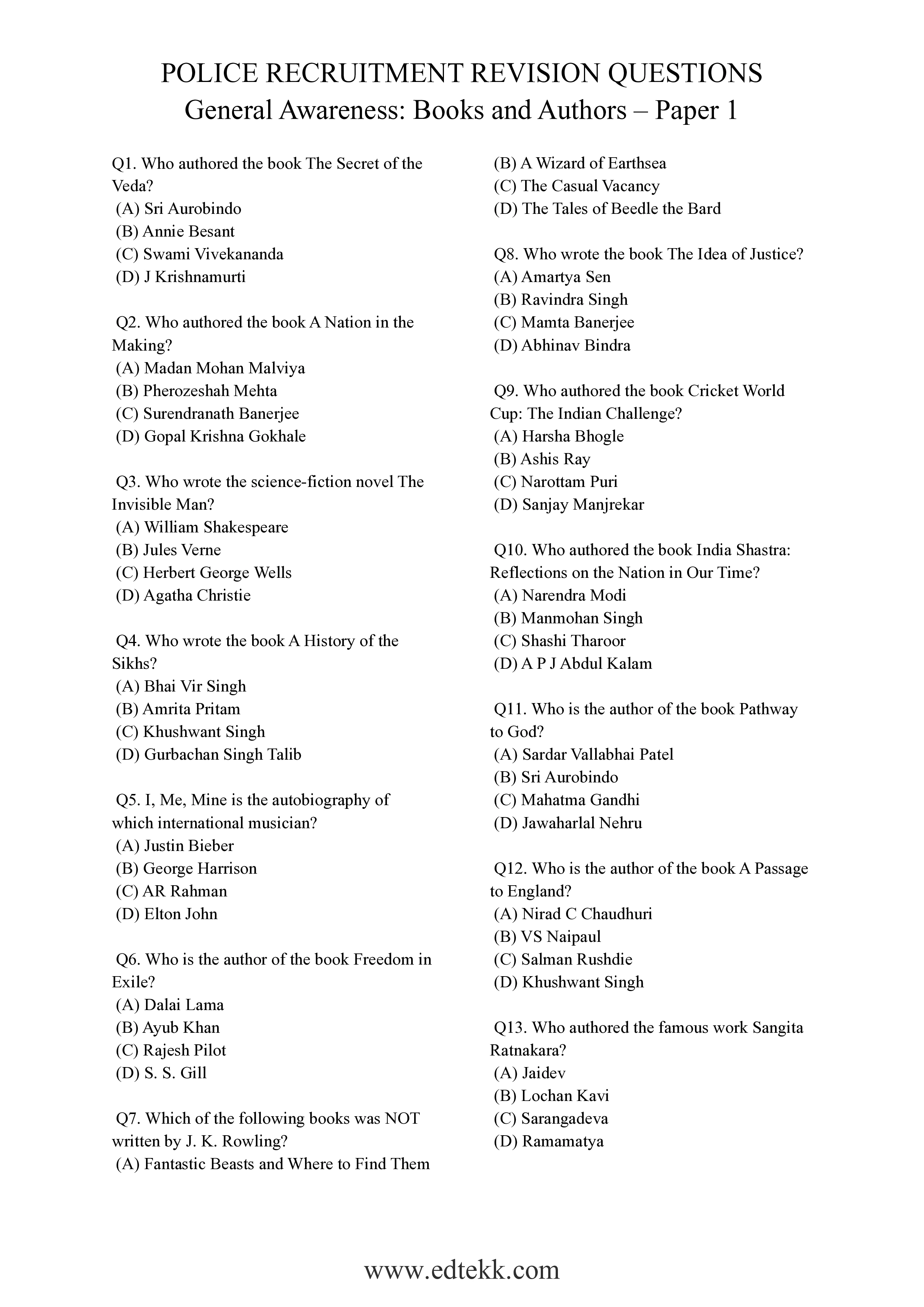
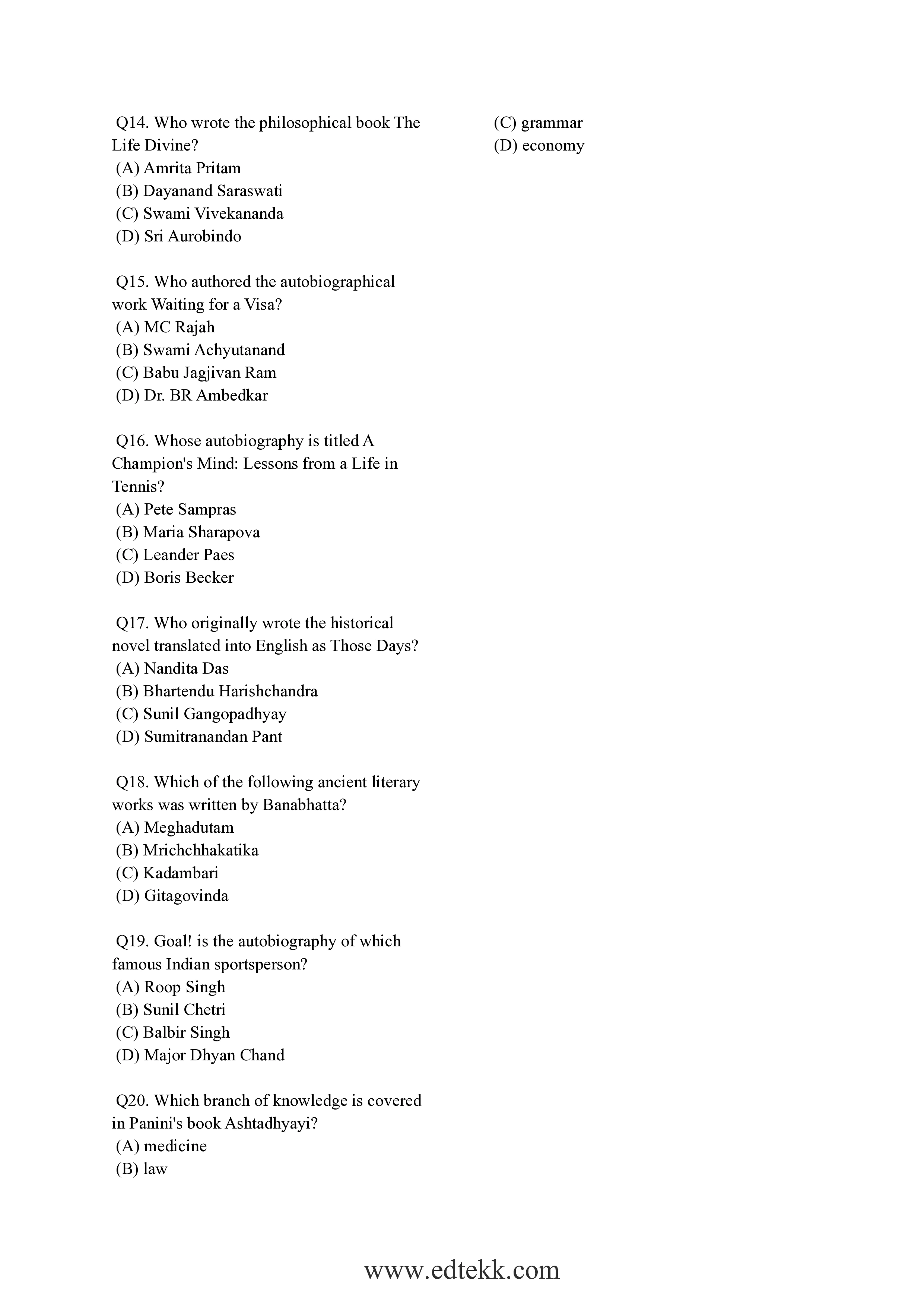
Improve your General Awareness preparation with 20 revision questions on Books and Authors – Paper 1. This set covers famous books, their authors, literary works, Indian writers and notable publications. Practise MCQs with answers and explanations to build subject knowledge for Police Constable and Police SI examinations.
Test Details
Topic: Books and Authors
Total Questions: 20
Question Format: MCQs – Single Correct Answer
Suitable for: Police Constable, Police SI
Download All Papers in This Series (PDF)
Questions and Answers
Q1. Who authored the book The Secret of the Veda?
(A) Sri Aurobindo
(B) Annie Besant
(C) Swami Vivekananda
(D) J Krishnamurti
Explanation: Sri Aurobindo authored The Secret of the Veda, a philosophical and spiritual interpretation of ancient Vedic texts. In this work, he examines the symbolic and psychological significance of Vedic hymns and presents his interpretation of their deeper spiritual meaning.
Q2. Who authored the book A Nation in the Making?
(A) Madan Mohan Malviya
(B) Pherozeshah Mehta
(C) Surendranath Banerjee
(D) Gopal Krishna Gokhale
Explanation: Surendranath Banerjee authored A Nation in the Making, published in 1925. The autobiography provides an account of his political activities, public life and contribution to Indian nationalism. He was one of the prominent early leaders of the Indian National Congress and advocated constitutional reforms.
Q3. Who wrote the science-fiction novel The Invisible Man?
(A) William Shakespeare
(B) Jules Verne
(C) Herbert George Wells
(D) Agatha Christie
Explanation: H. G. Wells, whose full name was Herbert George Wells, wrote the science-fiction novel The Invisible Man, published in 1897. It tells the story of Griffin, a scientist who discovers a method of becoming invisible and faces the consequences of his experiment. Wells is regarded as a pioneer of modern science fiction.
Q4. Who wrote the book A History of the Sikhs?
(A) Bhai Vir Singh
(B) Amrita Pritam
(C) Khushwant Singh
(D) Gurbachan Singh Talib
Explanation: A History of the Sikhs was written by Khushwant Singh. This two-volume historical work examines Sikhism, the lives and teachings of the Sikh Gurus, the emergence of Sikh political power and the historical development of the Sikh community.
Q5. I, Me, Mine is the autobiography of which international musician?
(A) Justin Bieber
(B) George Harrison
(C) AR Rahman
(D) Elton John
Explanation: I, Me, Mine is an autobiographical memoir by George Harrison, the English musician and lead guitarist of The Beatles. Originally published in 1980, it contains his reflections, song lyrics and explanations of their meanings, offering insights into his musical career and spiritual interests.
Q6. Who is the author of the book Freedom in Exile?
(A) Dalai Lama
(B) Ayub Khan
(C) Rajesh Pilot
(D) S. S. Gill
Explanation: Freedom in Exile is the autobiography of the 14th Dalai Lama, Tenzin Gyatso, published in 1990. It describes his childhood in Tibet, spiritual training, the Chinese occupation of Tibet and his subsequent exile in India.
Q7. Which of the following books was NOT written by J. K. Rowling?
(A) Fantastic Beasts and Where to Find Them
(B) A Wizard of Earthsea
(C) The Casual Vacancy
(D) The Tales of Beedle the Bard
Explanation: A Wizard of Earthsea was written by Ursula K. Le Guin, not J. K. Rowling. Published in 1968, it is a fantasy novel centred on a young wizard named Ged. The other three options—Fantastic Beasts and Where to Find Them, The Casual Vacancy and The Tales of Beedle the Bard—were written by J. K. Rowling.
Q8. Who wrote the book The Idea of Justice?
(A) Amartya Sen
(B) Ravindra Singh
(C) Mamta Banerjee
(D) Abhinav Bindra
Explanation: The Idea of Justice was written by Nobel Prize-winning economist Amartya Sen and published in 2009. It examines justice, inequality, freedom and social choice. Sen emphasises reducing actual injustices and improving people’s lives rather than relying solely on ideal institutional arrangements.
Q9. Who authored the book Cricket World Cup: The Indian Challenge?
(A) Harsha Bhogle
(B) Ashis Ray
(C) Narottam Puri
(D) Sanjay Manjrekar
Explanation: Cricket World Cup: The Indian Challenge was written by Ashis Ray, an Indian cricket journalist and commentator. The book documents India’s journey in Cricket World Cup tournaments, covering significant matches, performances and milestones in Indian cricket history.
Q10. Who authored the book India Shastra: Reflections on the Nation in Our Time?
(A) Narendra Modi
(B) Manmohan Singh
(C) Shashi Tharoor
(D) A P J Abdul Kalam
Explanation: India Shastra: Reflections on the Nation in Our Time was written by Shashi Tharoor and published in 2015. It is a collection of essays examining India’s politics, society, foreign policy, culture and contemporary challenges, including democratic institutions, national identity and India’s position in the international order.
Q11. Who is the author of the book Pathway to God?
(A) Sardar Vallabhai Patel
(B) Sri Aurobindo
(C) Mahatma Gandhi
(D) Jawaharlal Nehru
Explanation: Mahatma Gandhi is the author of Pathway to God, a compilation of his writings and speeches edited and compiled by M. S. Deshpande. First published in 1971 by Navajivan Publishing House, the book discusses Gandhi’s spiritual philosophy, truth, non-violence, selfless service and the pursuit of God.
Q12. Who is the author of the book A Passage to England?
(A) Nirad C Chaudhuri
(B) VS Naipaul
(C) Salman Rushdie
(D) Khushwant Singh
Explanation: A Passage to England was written by Nirad C. Chaudhuri and published in 1959. The book records his observations and impressions of England and British society, reflecting on cultural differences, historical relationships and his experiences during his visit.
Q13. Who authored the famous work Sangita Ratnakara?
(A) Jaidev
(B) Lochan Kavi
(C) Sarangadeva
(D) Ramamatya
Explanation: Sarangadeva, a thirteenth-century Indian musicologist, authored Sangita Ratnakara, an influential Sanskrit treatise on Indian classical music and dance. It discusses musical theory, ragas, talas and performance practices. The work is particularly significant as an important link in the historical development of Hindustani and Carnatic musical traditions.
Q14. Who wrote the philosophical book The Life Divine?
(A) Amrita Pritam
(B) Dayanand Saraswati
(C) Swami Vivekananda
(D) Sri Aurobindo
Explanation: The Life Divine is a major philosophical and spiritual work by Sri Aurobindo. It was originally published serially in the journal Arya and later in book form. It develops his ideas on consciousness, human evolution, integral yoga and spiritual transformation.
Q15. Who authored the autobiographical work Waiting for a Visa?
(A) MC Rajah
(B) Swami Achyutanand
(C) Babu Jagjivan Ram
(D) Dr. BR Ambedkar
Explanation: Waiting for a Visa is an autobiographical account written by Dr. B. R. Ambedkar. It describes his personal experiences of caste discrimination and untouchability in Indian society, illustrating the social exclusion and humiliation faced by marginalised communities.
Q16. Whose autobiography is titled A Champion’s Mind: Lessons from a Life in Tennis?
(A) Pete Sampras
(B) Maria Sharapova
(C) Leander Paes
(D) Boris Becker
Explanation: A Champion’s Mind: Lessons from a Life in Tennis is the autobiography of former American tennis player Pete Sampras. The book discusses his professional career, competitive experiences, achievements and the mental approach that contributed to his success in tennis.
Q17. Who originally wrote the historical novel translated into English as Those Days?
(A) Nandita Das
(B) Bhartendu Harishchandra
(C) Sunil Gangopadhyay
(D) Sumitranandan Pant
Explanation: Those Days is the English translation of Sei Somoy, a Bengali historical novel by Sunil Gangopadhyay. The original won the Sahitya Akademi Award in Bengali in 1985. It depicts nineteenth-century Bengal and its major social, cultural and intellectual transformations.
Q18. Which of the following ancient literary works was written by Banabhatta?
(A) Meghadutam
(B) Mrichchhakatika
(C) Kadambari
(D) Gitagovinda
Explanation: Kadambari is a classical Sanskrit prose romance attributed to Banabhatta, a prominent writer in the court of King Harshavardhana during the seventh century CE. Banabhatta began the work, which was completed by his son Bhushanabhatta. He also authored Harshacharita, a biography of Harshavardhana.
Q19. Goal! is the autobiography of which famous Indian sportsperson?
(A) Roop Singh
(B) Sunil Chetri
(C) Balbir Singh
(D) Major Dhyan Chand
Explanation: Goal! is the autobiography of Major Dhyan Chand, the legendary Indian hockey player. He played a significant role in India’s Olympic gold medal victories in 1928, 1932 and 1936 and is widely regarded as one of the greatest hockey players in history.
Q20. Which branch of knowledge is covered in Panini’s book Ashtadhyayi?
(A) medicine
(B) law
(C) grammar
(D) economy
Explanation: Ashtadhyayi, composed by the ancient Sanskrit grammarian Panini, is a foundational work on grammar. Its eight chapters contain about 4,000 concise grammatical rules dealing with Sanskrit phonetics, word formation, morphology and syntax. It is one of the most influential works in linguistic history.
Question Paper Images