Strengthen your General Awareness revision with 20 questions on Awards and Honours – Paper 3. This practice set covers significant Indian and international honours, notable recipients, achievements and award-related general knowledge. Prepare with objective MCQs, answers and explanations designed for Police Constable and Police SI examinations.
Test Details
Topic: Awards and Honours
Total Questions: 20
Question Format: MCQs – Single Correct Answer
Suitable for: Police Constable, Police SI
Download All Papers in This Series (PDF)
Questions and Answers
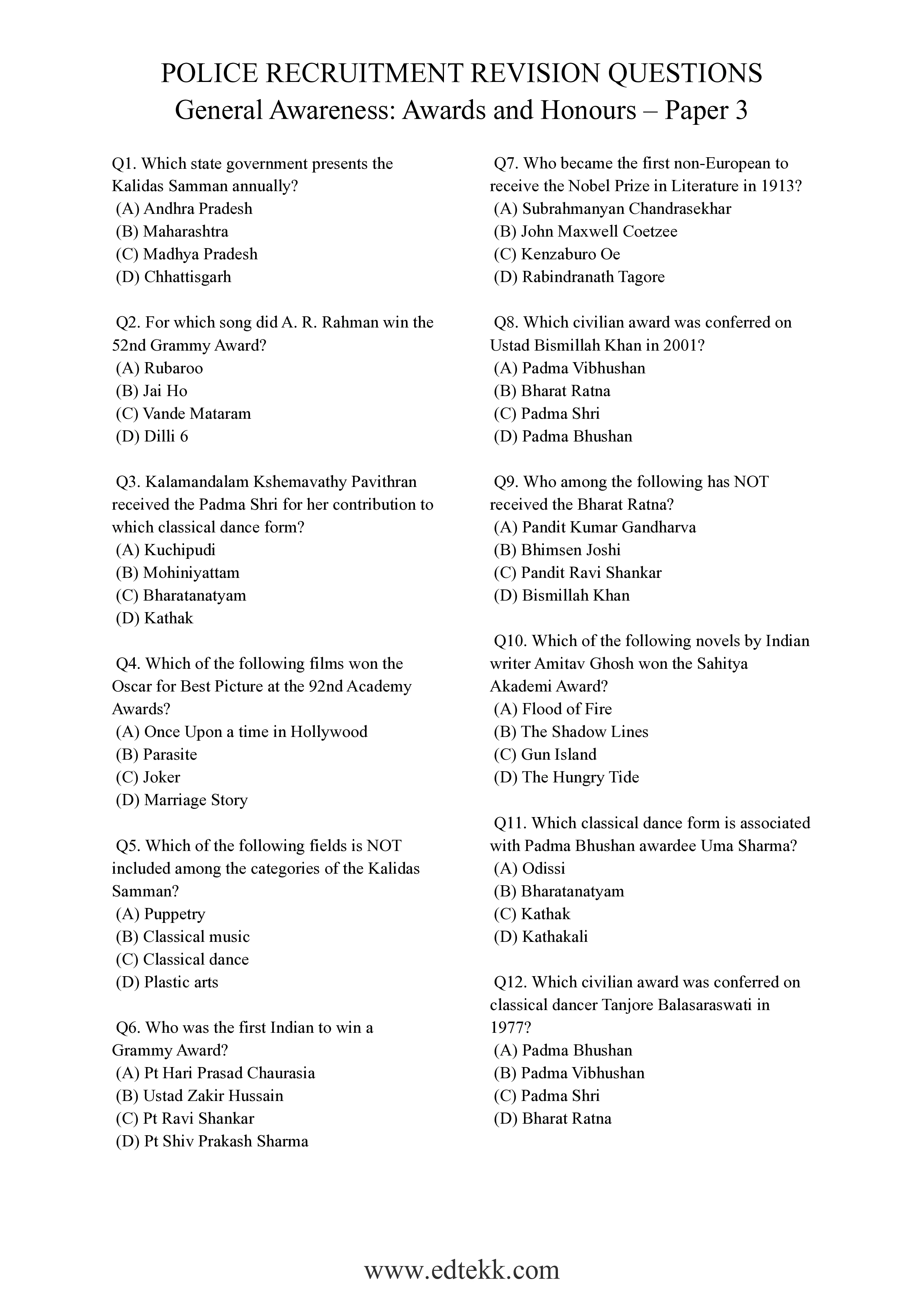
Q1. Which state government presents the Kalidas Samman annually?
(A) Andhra Pradesh
(B) Maharashtra
(C) Madhya Pradesh
(D) Chhattisgarh
Explanation: The Kalidas Samman is an award instituted by the Government of Madhya Pradesh in 1980–81. It recognises outstanding contributions to classical music, classical dance, theatre and plastic arts. Named after the celebrated Sanskrit poet and playwright Kalidasa, the award honours excellence in Indian artistic traditions.
Q2. For which song did A. R. Rahman win the 52nd Grammy Award?
(A) Rubaroo
(B) Jai Ho
(C) Vande Mataram
(D) Dilli 6
Explanation: A. R. Rahman won the 52nd Annual Grammy Award in 2010 for Jai Ho, from the film Slumdog Millionaire. The song received the Grammy for Best Song Written for Motion Picture, Television or Other Visual Media. Rahman also won a separate Grammy for the film’s soundtrack album.
Q3. Kalamandalam Kshemavathy Pavithran received the Padma Shri for her contribution to which classical dance form?
(A) Kuchipudi
(B) Mohiniyattam
(C) Bharatanatyam
(D) Kathak
Explanation: Kalamandalam Kshemavathy Pavithran is a renowned Mohiniyattam exponent and choreographer from Kerala. She received the Padma Shri in recognition of her contribution to Indian classical dance. Mohiniyattam originated in Kerala and is characterised by graceful movements, gentle swaying and expressive storytelling.
Q4. Which of the following films won the Oscar for Best Picture at the 92nd Academy Awards?
(A) Once Upon a time in Hollywood
(B) Parasite
(C) Joker
(D) Marriage Story
Explanation: The South Korean film Parasite, directed by Bong Joon-ho, won Best Picture at the 92nd Academy Awards held in February 2020. It became the first non-English-language film to win this award. The film also received Oscars for Best Director, Best Original Screenplay and Best International Feature Film, winning four awards in total.
Q5. Which of the following fields is NOT included among the categories of the Kalidas Samman?
(A) Puppetry
(B) Classical music
(C) Classical dance
(D) Plastic arts
Explanation: The Kalidas Samman was instituted by the Government of Madhya Pradesh in 1980–81. It recognises outstanding contributions to classical music, classical dance, theatre and plastic arts. Puppetry is not a designated category among the four options listed, making it the correct answer.
Q6. Who was the first Indian to win a Grammy Award?
(A) Pt Hari Prasad Chaurasia
(B) Ustad Zakir Hussain
(C) Pt Ravi Shankar
(D) Pt Shiv Prakash Sharma
Explanation: Pandit Ravi Shankar was the first Indian musician to win a Grammy Award. He received the award for Best Chamber Music Performance in 1967 for West Meets East, recorded with violinist Yehudi Menuhin. An internationally celebrated sitar maestro, he played a major role in introducing Indian classical music to global audiences.
Q7. Who became the first non-European to receive the Nobel Prize in Literature in 1913?
(A) Subrahmanyan Chandrasekhar
(B) John Maxwell Coetzee
(C) Kenzaburo Oe
(D) Rabindranath Tagore
Explanation: Rabindranath Tagore received the Nobel Prize in Literature in 1913, becoming the first non-European to win this award. He was recognised primarily for his English translation of Gitanjali (Song Offerings). Tagore was a Bengali poet, philosopher, composer and educator whose literary contributions gained international recognition.
Q8. Which civilian award was conferred on Ustad Bismillah Khan in 2001?
(A) Padma Vibhushan
(B) Bharat Ratna
(C) Padma Shri
(D) Padma Bhushan
Explanation: Ustad Bismillah Khan received the Bharat Ratna in 2001, India’s highest civilian honour. He was a legendary shehnai player who helped establish the instrument as a prominent concert instrument in Indian classical music. He had previously received the Padma Shri in 1961, the Padma Bhushan in 1968 and the Padma Vibhushan in 1980.
Q9. Who among the following has NOT received the Bharat Ratna?
(A) Pandit Kumar Gandharva
(B) Bhimsen Joshi
(C) Pandit Ravi Shankar
(D) Bismillah Khan
Explanation: Pandit Kumar Gandharva was a celebrated Hindustani classical vocalist who did not receive the Bharat Ratna. Bhimsen Joshi received the award in 2008, Pandit Ravi Shankar in 1999 and Ustad Bismillah Khan in 2001. Kumar Gandharva was, however, honoured with several other prestigious awards for his contributions to Indian classical music.
Q10. Which of the following novels by Indian writer Amitav Ghosh won the Sahitya Akademi Award?
(A) Flood of Fire
(B) The Shadow Lines
(C) Gun Island
(D) The Hungry Tide
Explanation: The Shadow Lines, written by Amitav Ghosh and published in 1988, received the Sahitya Akademi Award in 1989 in the English language category. The novel explores nationalism, identity, memory and the complex relationships between individuals across geographical boundaries. It remains one of Ghosh’s most acclaimed literary works.
Q11. Which classical dance form is associated with Padma Bhushan awardee Uma Sharma?
(A) Odissi
(B) Bharatanatyam
(C) Kathak
(D) Kathakali
Explanation: Uma Sharma is a renowned Indian classical dancer specialising in Kathak. She established the Bharatiya Sangeet Sadan to promote Indian classical dance and music. She received the Padma Bhushan in 2001 in recognition of her contributions to Indian classical dance and cultural preservation.
Q12. Which civilian award was conferred on classical dancer Tanjore Balasaraswati in 1977?
(A) Padma Bhushan
(B) Padma Vibhushan
(C) Padma Shri
(D) Bharat Ratna
Explanation: Tanjore Balasaraswati was an eminent Bharatanatyam dancer renowned for her mastery of abhinaya and the traditional dance repertoire. She received the Padma Vibhushan in 1977 in recognition of her contribution to Indian classical dance. Her performances and teaching helped preserve the expressive depth and traditional techniques of Bharatanatyam.
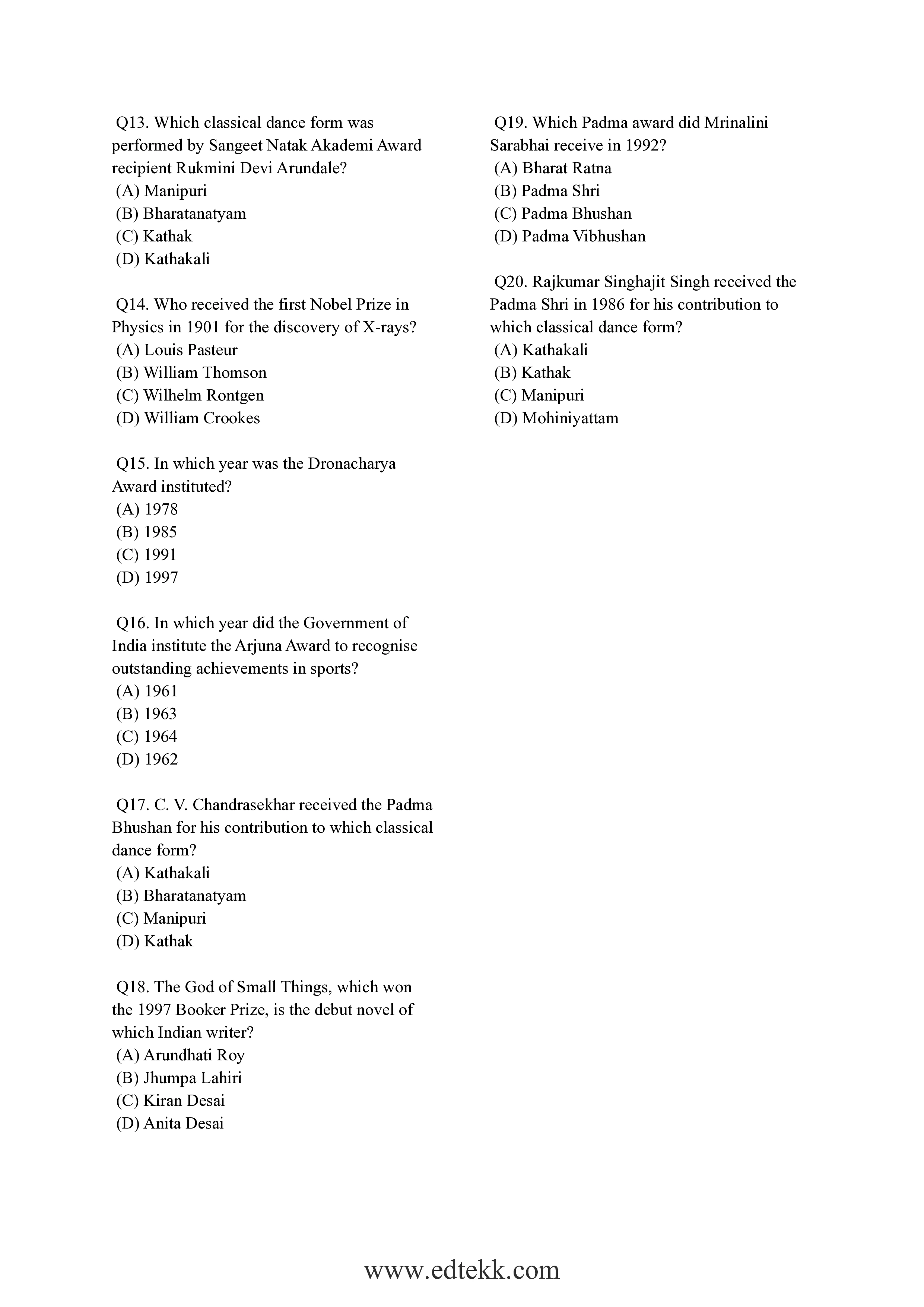
Q13. Which classical dance form was performed by Sangeet Natak Akademi Award recipient Rukmini Devi Arundale?
(A) Manipuri
(B) Bharatanatyam
(C) Kathak
(D) Kathakali
Explanation: Rukmini Devi Arundale was a renowned Bharatanatyam dancer, choreographer and cultural revivalist. She received the Sangeet Natak Akademi Award in 1957 for her contribution to Indian classical dance. She played a significant role in revitalising Bharatanatyam and founded Kalakshetra in Chennai, an institution dedicated to Indian classical arts and cultural education.
Q14. Who received the first Nobel Prize in Physics in 1901 for the discovery of X-rays?
(A) Louis Pasteur
(B) William Thomson
(C) Wilhelm Rontgen
(D) William Crookes
Explanation: Wilhelm Conrad Röntgen received the first Nobel Prize in Physics in 1901 for his discovery of X-rays. His groundbreaking discovery revolutionised medical diagnosis by enabling doctors to examine the internal structures of the human body without surgical intervention. X-rays subsequently became an essential tool in medical imaging.
Q15. In which year was the Dronacharya Award instituted?
(A) 1978
(B) 1985
(C) 1991
(D) 1997
Explanation: The Dronacharya Award was instituted in 1985 by the Government of India. It recognises outstanding sports coaches who have made significant contributions to the development of sportspersons and their achievements at national and international competitions. The award is named after Dronacharya, the legendary teacher of archery in the Mahabharata.
Q16. In which year did the Government of India institute the Arjuna Award to recognise outstanding achievements in sports?
(A) 1961
(B) 1963
(C) 1964
(D) 1962
Explanation: The Arjuna Awards were instituted in 1961 by the Government of India to recognise outstanding achievements in sports. They honour sportspersons for excellence and consistent performance in national and international competitions and are among India’s prominent sporting honours.
Q17. C. V. Chandrasekhar received the Padma Bhushan for his contribution to which classical dance form?
(A) Kathakali
(B) Bharatanatyam
(C) Manipuri
(D) Kathak
Explanation: C. V. Chandrasekhar was a distinguished Bharatanatyam dancer, choreographer and teacher. He received the Padma Bhushan in 2011 for his contribution to Indian classical dance. Through his performances, choreography and teaching, he helped preserve and advance Bharatanatyam and contributed to its academic study and international appreciation.
Q18. The God of Small Things, which won the 1997 Booker Prize, is the debut novel of which Indian writer?
(A) Arundhati Roy
(B) Jhumpa Lahiri
(C) Kiran Desai
(D) Anita Desai
Explanation: The God of Small Things is the debut novel of Arundhati Roy and won the 1997 Booker Prize. Set in Kerala, the novel explores family relationships, caste discrimination, social inequalities and forbidden love. Its international success established Roy as a prominent contemporary Indian novelist.
Q19. Which Padma award did Mrinalini Sarabhai receive in 1992?
(A) Bharat Ratna
(B) Padma Shri
(C) Padma Bhushan
(D) Padma Vibhushan
Explanation: Mrinalini Sarabhai received the Padma Bhushan in 1992 in recognition of her contributions to Indian classical dance. She was renowned for her mastery of Bharatanatyam and Kathakali and founded the Darpana Academy of Performing Arts in Ahmedabad. Her work significantly contributed to dance education, choreography and the promotion of Indian performing arts.
Q20. Rajkumar Singhajit Singh received the Padma Shri in 1986 for his contribution to which classical dance form?
(A) Kathakali
(B) Kathak
(C) Manipuri
(D) Mohiniyattam
Explanation: Rajkumar Singhajit Singh received the Padma Shri in 1986 for his contributions to Manipuri dance. He is a distinguished Manipuri dancer, choreographer and teacher who has played an important role in preserving and promoting the traditional dance heritage of Manipur through performances, research and training.
Question Paper Images