Enhance your Chemistry preparation for Police Constable and Police SI recruitment examinations with this second revision paper. It contains 20 objective-type questions covering essential General Science Chemistry concepts, along with correct answers and explanations to help improve conceptual clarity and examination performance.
Test Details
Topic: Chemistry
Total Questions: 20
Question Format: MCQs – Single Correct Answer
Suitable for: Police Constable, Police SI
Download All Papers in This Series (PDF)
Questions and Answers
Q1. Which metal is combined with copper to produce the alloy Constantan?
(A) Iron
(B) Nickel
(C) Aluminium
(D) Tin
Explanation: Constantan is an alloy primarily composed of copper and nickel, typically containing approximately 55% copper and 45% nickel. It has a low temperature coefficient of electrical resistance, making its resistance relatively stable across temperature changes. It is widely used in resistance wires and thermocouples.
Q2. What are atoms of the same element with identical atomic numbers but different mass numbers called?
(A) Isomers
(B) Isobars
(C) Isotopes
(D) Isotones
Explanation: Isotopes are atoms of the same element having identical atomic numbers but different mass numbers due to differences in neutron count. For example, carbon-12 and carbon-14 both contain six protons but have six and eight neutrons, respectively. Isobars have equal mass numbers, whereas isotones have equal neutron numbers.
Q3. How many oxygen atoms are present in an acetone molecule?
(A) 1
(B) 3
(C) 4
(D) 2
Explanation: Acetone has the molecular formula C₃H₆O and is commonly written as CH₃COCH₃. Its structure contains a carbonyl group (C=O), which contributes exactly one oxygen atom to each molecule. Acetone is the simplest ketone and is widely used as an industrial solvent and cleaning agent.
Q4. Which of the following substances is used as an alternative to chlorine for bleaching?
(A) Hydrogen peroxide
(B) Ethanal
(C) Liquid carbon dioxide
(D) Tetrachloroethene
Explanation: Hydrogen peroxide (H₂O₂) is used as an alternative to chlorine-based bleaching agents. It acts as an oxidising agent and is widely used in the textile and paper industries. Its decomposition primarily produces water and oxygen, avoiding the formation of persistent chlorinated organic by-products associated with some chlorine-based processes.
Q5. Which of the following is a heterogeneous mixture?
(A) Suspension
(B) Solution
(C) Both Solution and Suspension
(D) Neither Solution nor Suspension
Explanation: A suspension is a heterogeneous mixture in which relatively large particles are dispersed throughout a medium without dissolving. These particles may settle on standing and can generally be separated by filtration. In contrast, a true solution is a homogeneous mixture in which the solute is uniformly distributed at the molecular or ionic level.
Q6. Which of the following is NOT a natural fibre?
(A) Jute
(B) Flax
(C) Terylene
(D) Wool
Explanation: Terylene is a synthetic fibre made from polyethylene terephthalate (PET), a type of polyester. In contrast, jute and flax are natural plant fibres, while wool is a natural animal fibre. Therefore, Terylene is the only synthetic fibre among the given options.
Q7. Which of the following is NOT an allotrope of carbon?
(A) Diamond
(B) Methane
(C) Graphite
(D) C-60
Explanation: Methane (CH₄) is not an allotrope of carbon because it contains both carbon and hydrogen atoms. Diamond, graphite and C₆₀ (Buckminsterfullerene) are allotropes of carbon, as they consist entirely of carbon atoms arranged in different structural forms.
Q8. Which chemical compound, with the formula CH₃CH₂Cl, is used as a blowing agent in foamed plastics?
(A) 3-Chlorohexane
(B) 1-chloropropane
(C) Chloroethane
(D) Chloromethane
Explanation: Chloroethane (CH₃CH₂Cl), also known as ethyl chloride, is a volatile, colourless compound that has been used as a blowing agent in the manufacture of foamed plastics. Its molecular formula contains two carbon atoms, five hydrogen atoms and one chlorine atom, distinguishing it from the other chlorinated compounds listed.
Q9. Is the pH value of soda water greater than, less than or equal to 7?
(A) >14
(B) >7
(C) 7
(D) <7
Explanation: Soda water contains dissolved carbon dioxide (CO₂), some of which reacts reversibly with water to form carbonic acid (H₂CO₃). This makes soda water acidic, with a pH below 7 under ordinary conditions. Its exact pH depends on dissolved CO₂ concentration, temperature and pressure.
Q10. Which group of organic compounds was formerly known as paraffins?
(A) Aldehydes
(B) Alkanes
(C) Alcohols
(D) Acids
Explanation: Alkanes were historically known as paraffins. The term originates from the Latin words parum affinis, meaning little affinity, referring to their relatively low chemical reactivity. Alkanes are saturated hydrocarbons containing only carbon–carbon single bonds and generally follow the formula CₙH₂ₙ₊₂ for open-chain structures.
Q11. Which of the following substances is used in photography?
(A) Sodium bicarbonate
(B) Sodium thiosulphate
(C) Sodium sulphate
(D) Sodium hydroxide
Explanation: Sodium thiosulphate (Na₂S₂O₃) is widely used in traditional photographic processing as a fixing agent. It dissolves unreacted silver halides from photographic film and paper, making the developed image relatively permanent and insensitive to further exposure to light.
Q12. Which of the following particles is not positively charged?
(A) Alpha particle
(B) Proton
(C) Electron
(D) Helium nucleus
Explanation: An electron carries a negative electric charge (−1e), whereas a proton carries a positive charge (+1e). An alpha particle is the nucleus of a helium-4 atom, containing two protons and two neutrons, and has a charge of +2e. Therefore, the electron is the only negatively charged particle among the options.
Q13. Which of the following is not a noble gas?
(A) Neon
(B) Hydrogen
(C) Helium
(D) Argon
Explanation: Hydrogen is not a noble gas. Noble gases belong to Group 18 of the periodic table and include helium, neon and argon. They generally possess completely filled outermost electron shells, making them relatively unreactive. Hydrogen is a non-metal placed in Group 1.
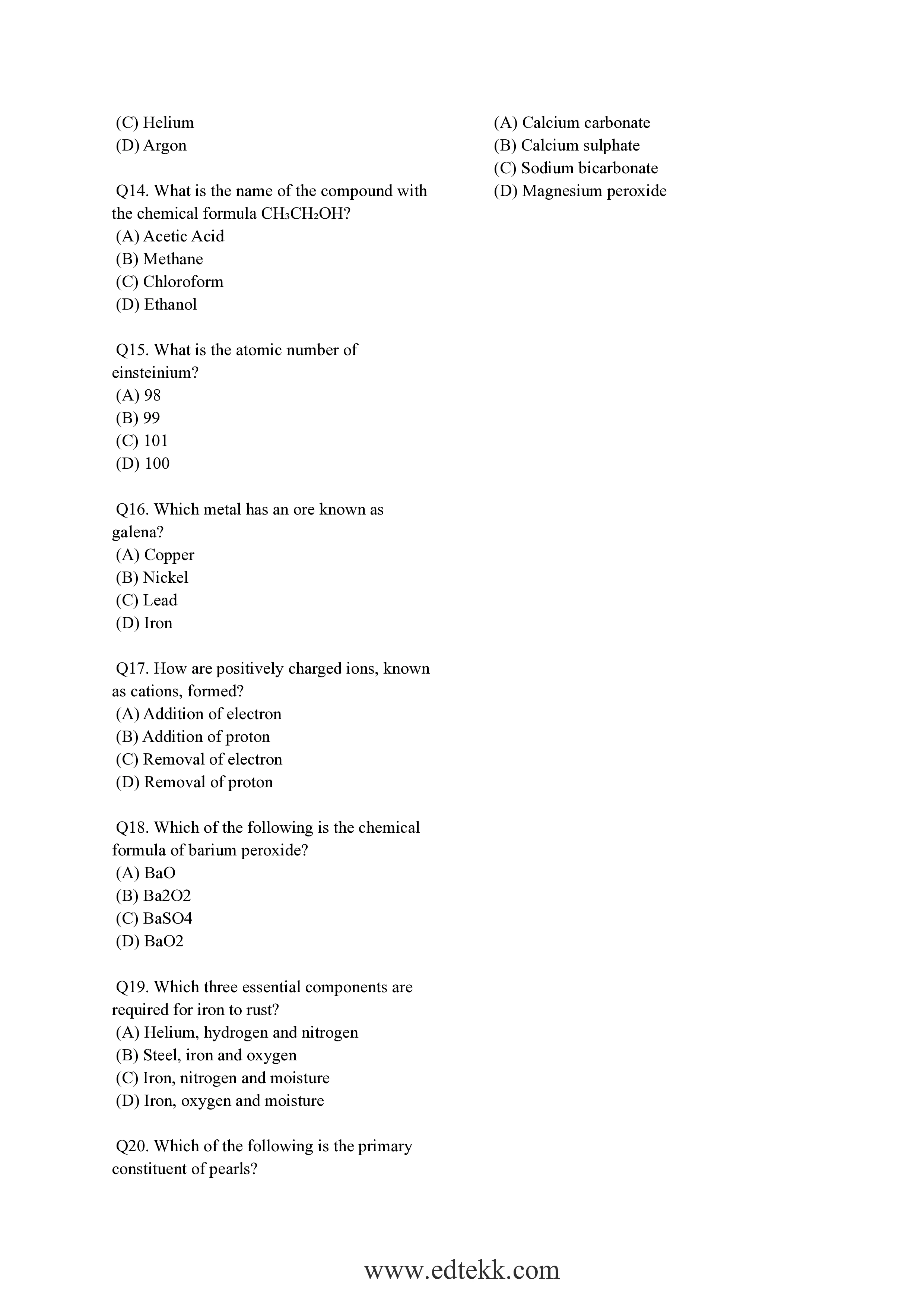
Q14. What is the name of the compound with the chemical formula CH₃CH₂OH?
(A) Acetic Acid
(B) Methane
(C) Chloroform
(D) Ethanol
Explanation: CH₃CH₂OH is the chemical formula of ethanol, a two-carbon alcohol containing a hydroxyl group (-OH). It is also known as ethyl alcohol and is the characteristic alcohol present in alcoholic beverages.
Q15. What is the atomic number of einsteinium?
(A) 98
(B) 99
(C) 101
(D) 100
Explanation: Einsteinium is a synthetic radioactive element with atomic number 99 and chemical symbol Es. It belongs to the actinide series of the periodic table. Atomic number represents the number of protons in an atom’s nucleus and uniquely identifies a chemical element.
Q16. Which metal has an ore known as galena?
(A) Copper
(B) Nickel
(C) Lead
(D) Iron
Explanation: Galena is the principal ore of lead and has the chemical formula PbS (lead sulphide). It is a naturally occurring mineral characterised by its metallic lustre and is an important source of lead extraction.
Q17. How are positively charged ions, known as cations, formed?
(A) Addition of electron
(B) Addition of proton
(C) Removal of electron
(D) Removal of proton
Explanation: Cations are positively charged ions commonly formed when neutral atoms lose one or more electrons. Electron loss leaves the species with more protons than electrons, producing a net positive charge. For example, sodium forms Na⁺ by losing one electron: Na → Na⁺ + e⁻. Electron gain generally produces anions.
Q18. Which of the following is the chemical formula of barium peroxide?
(A) BaO
(B) Ba2O2
(C) BaSO4
(D) BaO2
Explanation: Barium peroxide has the chemical formula BaO₂. It consists of barium ions (Ba²⁺) and peroxide ions (O₂²⁻). Barium oxide has the formula BaO, while barium sulphate is represented by BaSO₄.
Q19. Which three essential components are required for iron to rust?
(A) Helium, hydrogen and nitrogen
(B) Steel, iron and oxygen
(C) Iron, nitrogen and moisture
(D) Iron, oxygen and moisture
Explanation: Rusting of iron requires three essential components: iron, oxygen and moisture. In the presence of water and oxygen, iron undergoes corrosion and forms hydrated iron(III) oxide, commonly known as rust. Preventing contact with moisture or oxygen can significantly slow down or prevent rust formation.
Q20. Which of the following is the primary constituent of pearls?
(A) Calcium carbonate
(B) Calcium sulphate
(C) Sodium bicarbonate
(D) Magnesium peroxide
Explanation: Pearls consist predominantly of calcium carbonate (CaCO₃), mainly in the crystalline form of aragonite, along with small amounts of calcite. These mineral components are embedded in an organic protein matrix called conchiolin, making calcium carbonate their principal inorganic constituent.
Question Paper Images