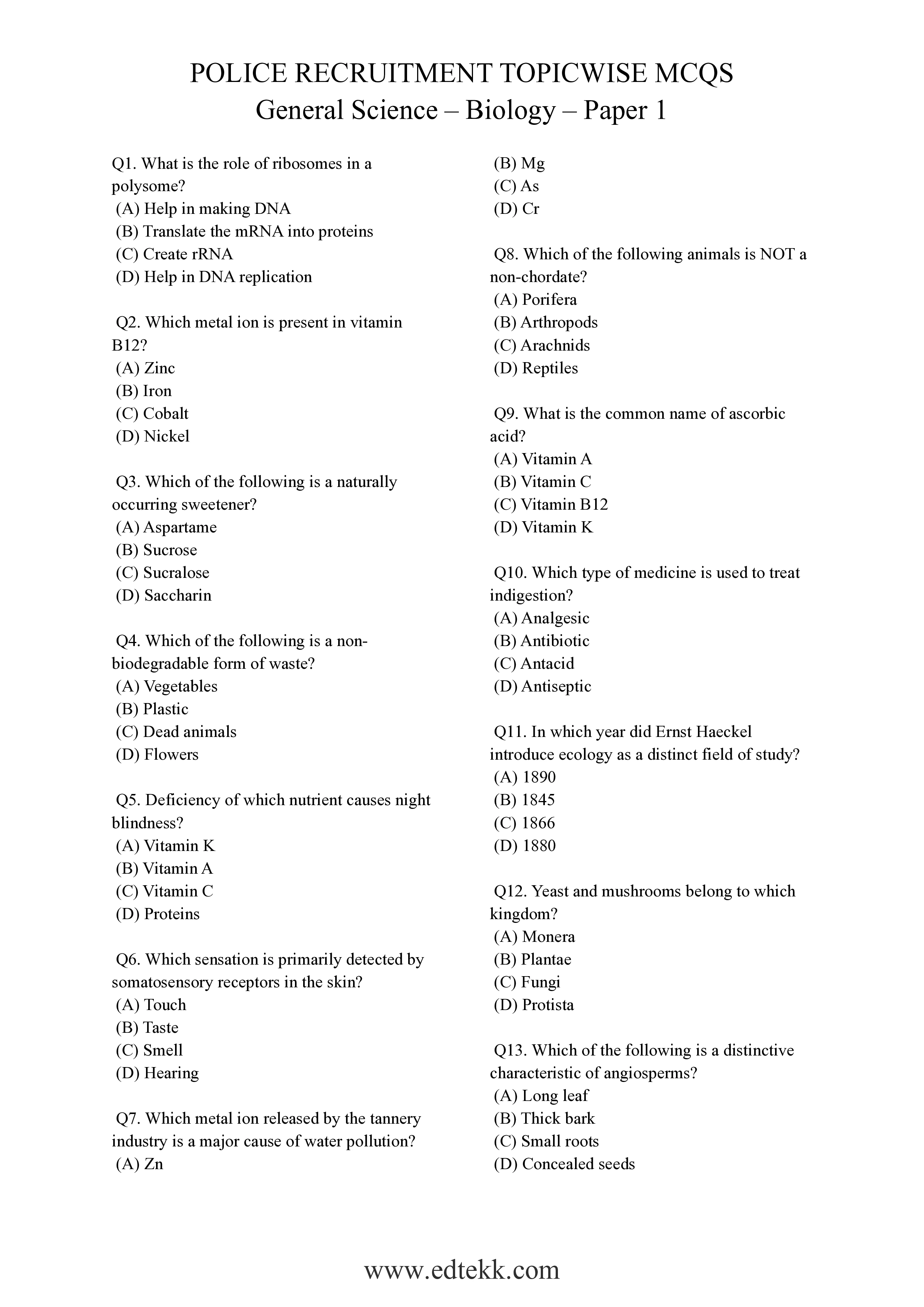
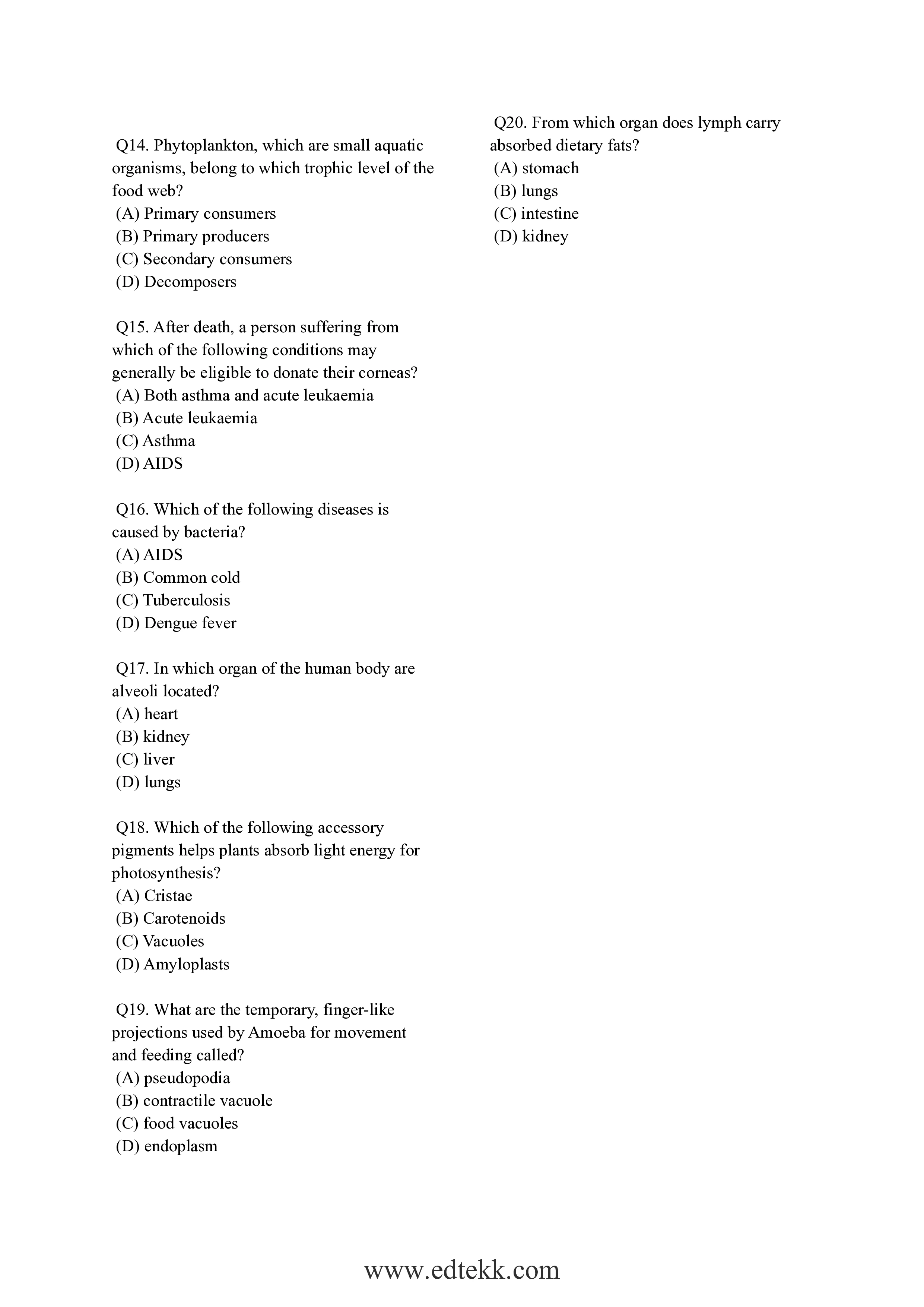
Prepare for Police Constable and Police SI examinations with this General Science Biology MCQ practice set (Paper 1). It covers important Biology concepts through topicwise multiple-choice questions, helping candidates build subject knowledge, strengthen conceptual understanding and improve exam performance with correct answers and explanations.
Test Details
Topic: Biology
Total Questions: 20
Question Format: MCQs – Single Correct Answer
Suitable for: Police Constable, Police SI
Download All Papers in This Series (PDF)
Questions and Answers
Q1. What is the role of ribosomes in a polysome?
(A) Help in making DNA
(B) Translate the mRNA into proteins
(C) Create rRNA
(D) Help in DNA replication
Explanation: Polysomes, or polyribosomes, consist of multiple ribosomes simultaneously attached to a single messenger RNA (mRNA) molecule. Each ribosome translates the mRNA sequence to synthesise a polypeptide chain. Thus, polysomes increase the efficiency of protein synthesis by enabling several ribosomes to produce protein molecules from the same mRNA simultaneously.
Q2. Which metal ion is present in vitamin B12?
(A) Zinc
(B) Iron
(C) Cobalt
(D) Nickel
Explanation: Vitamin B12, also known as cobalamin, contains cobalt as its central metal ion. This element forms an essential part of the vitamin’s molecular structure. Vitamin B12 is necessary for normal red blood cell formation, DNA synthesis and proper nervous system functioning.
Q3. Which of the following is a naturally occurring sweetener?
(A) Aspartame
(B) Sucrose
(C) Sucralose
(D) Saccharin
Explanation: Sucrose is a naturally occurring disaccharide commonly known as table sugar. It is found naturally in sugarcane, sugar beet and several fruits. Aspartame, sucralose and saccharin are artificial sweeteners. Although sucrose is a natural sweetener, excessive consumption can contribute to obesity, dental caries and metabolic disorders.
Q4. Which of the following is a non-biodegradable form of waste?
(A) Vegetables
(B) Plastic
(C) Dead animals
(D) Flowers
Explanation: Plastic is generally classified as non-biodegradable because conventional plastics resist decomposition by naturally occurring microorganisms. Unlike vegetables, dead animals and flowers, which decompose through biological processes, conventional plastic can persist in the environment for decades or even centuries.
Q5. Deficiency of which nutrient causes night blindness?
(A) Vitamin K
(B) Vitamin A
(C) Vitamin C
(D) Proteins
Explanation: Vitamin A deficiency can cause night blindness, a condition characterised by difficulty seeing in dim light or darkness. Vitamin A is required for the formation of retinal, a component of rhodopsin, the light-sensitive pigment present in the rod cells of the retina. Prolonged deficiency can cause corneal damage and permanent blindness.
Q6. Which sensation is primarily detected by somatosensory receptors in the skin?
(A) Touch
(B) Taste
(C) Smell
(D) Hearing
Explanation: Touch is detected by somatosensory receptors in the skin, including mechanoreceptors that respond to pressure, vibration and skin deformation. Other sensory receptors detect temperature and potentially damaging stimuli. Taste, smell and hearing depend on specialised receptors located primarily in the tongue, nasal cavity and inner ear, respectively.
Q7. Which metal ion released by the tannery industry is a major cause of water pollution?
(A) Zn
(B) Mg
(C) As
(D) Cr
Explanation: Chromium is a major pollutant associated with tannery effluents because chromium salts, particularly chromium(III) compounds, are widely used in leather tanning. Improper discharge contaminates water bodies. Hexavalent chromium (Cr(VI)) is particularly toxic, carcinogenic and harmful to aquatic organisms and human health.
Q8. Which of the following animals is NOT a non-chordate?
(A) Porifera
(B) Arthropods
(C) Arachnids
(D) Reptiles
Explanation: Reptiles are chordates and vertebrates, whereas arthropods, poriferans and arachnids are non-chordates. Chordates possess a notochord at least during some stage of development. Reptiles have a vertebral column and a well-developed internal skeleton.
Q9. What is the common name of ascorbic acid?
(A) Vitamin A
(B) Vitamin C
(C) Vitamin B12
(D) Vitamin K
Explanation: Ascorbic acid is the chemical name of vitamin C, a water-soluble vitamin essential for collagen synthesis, wound healing and normal immune function. Severe vitamin C deficiency causes scurvy, which may result in bleeding gums, easy bruising, poor wound healing and fatigue.
Q10. Which type of medicine is used to treat indigestion?
(A) Analgesic
(B) Antibiotic
(C) Antacid
(D) Antiseptic
Explanation: Antacids are medicines used to relieve indigestion associated with excess stomach acid, acidity and heartburn. They neutralise hydrochloric acid in the stomach. Common ingredients include magnesium hydroxide, aluminium hydroxide and calcium carbonate. Antacids provide symptomatic relief but do not treat every cause of indigestion.
Q11. In which year did Ernst Haeckel introduce ecology as a distinct field of study?
(A) 1890
(B) 1845
(C) 1866
(D) 1880
Explanation: Ernst Haeckel, a German zoologist, introduced the term ecology in 1866. He used it to describe the study of relationships between organisms and their surrounding environment. The term originates from the Greek words oikos (house or dwelling) and logos (study).
Q12. Yeast and mushrooms belong to which kingdom?
(A) Monera
(B) Plantae
(C) Fungi
(D) Protista
Explanation: Yeast and mushrooms belong to kingdom Fungi. Fungi are eukaryotic, heterotrophic organisms that obtain nutrients through absorption. Yeast is generally unicellular and reproduces mainly by budding, whereas mushrooms are multicellular fungi with specialised reproductive structures.
Q13. Which of the following is a distinctive characteristic of angiosperms?
(A) Long leaf
(B) Thick bark
(C) Small roots
(D) Concealed seeds
Explanation: Angiosperms are flowering plants characterised by ovules enclosed within an ovary. Following fertilisation, the ovules develop into seeds, and the ovary generally develops into a fruit enclosing them. This distinguishes angiosperms from gymnosperms, whose ovules and seeds are not enclosed within an ovary.
Q14. Phytoplankton, which are small aquatic organisms, belong to which trophic level of the food web?
(A) Primary consumers
(B) Primary producers
(C) Secondary consumers
(D) Decomposers
Explanation: Phytoplankton are microscopic, photosynthetic organisms found in aquatic ecosystems. They prepare their own food through photosynthesis and form the foundation of most aquatic food webs. Therefore, they occupy the first trophic level as primary producers and provide energy to higher-level consumers.
Q15. After death, a person suffering from which of the following conditions may generally be eligible to donate their corneas?
(A) Both asthma and acute leukaemia
(B) Acute leukaemia
(C) Asthma
(D) AIDS
Explanation: Asthma generally does not prevent cornea donation after death because it does not ordinarily compromise corneal tissue suitability. However, HIV/AIDS and certain malignancies, including acute leukaemia, may exclude a donor under applicable screening criteria. Final eligibility depends on medical history, tissue assessment and the eye bank’s protocols.
Q16. Which of the following diseases is caused by bacteria?
(A) AIDS
(B) Common cold
(C) Tuberculosis
(D) Dengue fever
Explanation: Tuberculosis (TB) is caused by bacteria belonging to the Mycobacterium tuberculosis complex. It most commonly affects the lungs and spreads through the air when a person with infectious TB releases airborne particles. The common cold and dengue are generally caused by viruses, while AIDS results from infection with HIV.
Q17. In which organ of the human body are alveoli located?
(A) heart
(B) kidney
(C) liver
(D) lungs
Explanation: Alveoli are tiny, balloon-like air sacs located within the lungs and serve as the primary sites of gaseous exchange. Oxygen diffuses across their thin walls into surrounding blood capillaries, while carbon dioxide diffuses from the blood into the alveoli and is subsequently expelled during exhalation.
Q18. Which of the following accessory pigments helps plants absorb light energy for photosynthesis?
(A) Cristae
(B) Carotenoids
(C) Vacuoles
(D) Amyloplasts
Explanation: Carotenoids are accessory photosynthetic pigments that absorb light at wavelengths not efficiently absorbed by chlorophyll. They transfer some of the captured energy to chlorophyll for photosynthesis and also protect photosynthetic structures from damage caused by excessive light. Examples include carotenes and xanthophylls.
Q19. What are the temporary, finger-like projections used by Amoeba for movement and feeding called?
(A) pseudopodia
(B) contractile vacuole
(C) food vacuoles
(D) endoplasm
Explanation: Pseudopodia are temporary, finger-like projections of the cytoplasm formed by Amoeba. The term literally means ‘false feet’. They help the organism move and capture food through phagocytosis. During feeding, pseudopodia surround food particles and enclose them within food vacuoles for digestion.
Q20. From which organ does lymph carry absorbed dietary fats?
(A) stomach
(B) lungs
(C) intestine
(D) kidney
Explanation: Lymph carries absorbed dietary fats from the small intestine through specialised lymphatic capillaries called lacteals. These vessels absorb fats packaged into chylomicrons. The resulting fat-rich lymph, known as chyle, travels through the lymphatic vessels and eventually enters the bloodstream, mainly through the thoracic duct.
Question Paper Images