Strengthen your General Science preparation with Biology topicwise MCQs (Paper 3) for Police Constable and Police SI examinations. This practice set covers important Biology concepts through objective questions, enabling candidates to test their understanding, revise essential topics and improve accuracy with answers and explanations.
Test Details
Topic: Biology
Total Questions: 20
Question Format: MCQs – Single Correct Answer
Suitable for: Police Constable, Police SI
Download All Papers in This Series (PDF)
Questions and Answers
Q1. Which ecologist’s research provided groundbreaking insights into the movement of energy and nutrients through ecosystems?
(A) Arthur Tansley
(B) Raymond L Lindeman
(C) Charles Elton
(D) Ernst Haeckel
Explanation: Raymond L. Lindeman made fundamental contributions to ecosystem ecology through his trophic-dynamic concept. His research explained how energy is transferred through successive trophic levels and how energy availability decreases along food chains. His work significantly advanced the scientific understanding of ecosystem functioning and energy flow.
Q2. Who is popularly known as the “Darwin of the 20th century”?
(A) Har Gobind Khorana
(B) Marshall Warren Nirenberg
(C) Ernst Mayr
(D) Katherine Esau
Explanation: Ernst Mayr was a prominent evolutionary biologist and a major contributor to the modern evolutionary synthesis. He is widely referred to as the Darwin of the 20th century for his contributions to evolutionary biology, speciation and systematics. His biological species concept significantly advanced the understanding of species formation and evolution.
Q3. What is the common name of Parthenium hysterophorus?
(A) Horse grass
(B) Lawn grass
(C) Carrot grass
(D) Lemongrass
Explanation: Parthenium hysterophorus is commonly known as carrot grass, congress grass or congress weed. It is an invasive weed that adversely affects agricultural productivity and biodiversity. Its pollen can cause allergic reactions, while contact with the plant may cause dermatitis and other allergic symptoms.
Q4. What are the rhythmic muscle contractions of the alimentary canal that propel food forward called?
(A) Guttation
(B) Segmentation
(C) Peristalsis
(D) Diffusion
Explanation: Peristalsis refers to coordinated, wave-like contractions and relaxations of the smooth muscles lining the alimentary canal. These movements propel food through the digestive tract, moving it along the oesophagus and through the stomach and intestines. Peristalsis is essential for the onward transport of food during digestion.
Q5. Which of the following animals is commonly known as the ‘white ant’?
(A) Mosquito
(B) Wasp
(C) Termite
(D) Housefly
Explanation: A termite is commonly called a white ant because of its pale appearance and social behaviour. However, termites are not true ants; they belong to a separate insect group and are evolutionarily more closely related to cockroaches. They live in organised colonies consisting of reproductive individuals, workers and soldiers.
Q6. Which process is the major driving force behind the movement of water through the xylem during the day?
(A) Evaporation
(B) Transpiration pull
(C) Translocation
(D) Suction
Explanation: Transpiration pull is the major driving force responsible for the upward movement of water through xylem during the day. Evaporation of water from leaf surfaces generates negative pressure, which pulls the continuous column of water upward from the roots.
Q7. In which of the following groups are ovules NOT enclosed by an ovary wall?
(A) Pteridophytes
(B) Gymnosperm
(C) Algae
(D) Angiosperm
Explanation: Gymnosperms possess naked ovules that are not enclosed within an ovary wall. Their seeds develop exposed on specialised structures, commonly associated with cones. This distinguishes them from angiosperms, in which ovules are enclosed within an ovary that generally develops into a fruit after fertilisation.
Q8. Which of the following diseases is generally caused by a virus?
(A) Tuberculosis
(B) Typhoid
(C) Cholera
(D) Dengue fever
Explanation: Dengue fever is caused by the dengue virus and is transmitted primarily through the bite of infected female Aedes mosquitoes. Typhoid and tuberculosis are bacterial diseases caused by Salmonella Typhi and Mycobacterium tuberculosis, respectively. Cholera is caused by the bacterium Vibrio cholerae.
Q9. Where are most blood cells produced in healthy adults?
(A) Heart
(B) Lungs
(C) Brain
(D) Bone marrow
Explanation: Bone marrow is the primary site of blood cell production in healthy adults. This process is called haematopoiesis. Red bone marrow produces red blood cells, white blood cells and platelets from haematopoietic stem cells. In adults, active red bone marrow is mainly found in the pelvis, sternum, ribs and vertebrae.
Q10. Which medical measurement uses the terms systolic and diastolic?
(A) Finding blood vessels
(B) Detecting problems in eyesight
(C) Counting blood platelets
(D) Measuring blood pressure
Explanation: Systolic and diastolic are terms used in measuring blood pressure. Systolic pressure represents the pressure in the arteries when the heart contracts, whereas diastolic pressure represents the pressure when the heart relaxes between beats. Blood pressure is conventionally expressed as systolic pressure over diastolic pressure and measured in millimetres of mercury (mmHg).
Q11. Where does glucose break down into pyruvate?
(A) Protoplasm
(B) Golgi bodies
(C) Chloroplast
(D) Cytoplasm
Explanation: Glycolysis is the metabolic pathway in which one molecule of glucose is converted into two molecules of pyruvate. It occurs in the cytoplasm of cells and does not directly require oxygen. The process produces a net gain of two ATP molecules and two NADH molecules per glucose molecule and constitutes the first stage of cellular respiration.
Q12. Which of the following diseases does NOT spread through the air?
(A) Cough-cold
(B) Pneumonia
(C) Cholera
(D) Tuberculosis
Explanation: Cholera is primarily transmitted through food or water contaminated with Vibrio cholerae, commonly due to inadequate sanitation. In contrast, tuberculosis spreads through airborne particles, while respiratory infections causing colds and some forms of pneumonia may spread through respiratory particles, depending on the causative pathogen.
Q13. Which neurological disorder causes seizures due to abnormal electrical activity in brain cells?
(A) Prostatitis
(B) Hypoglycaemia
(C) Epilepsy
(D) Rheumatoid arthritis
Explanation: Epilepsy is a neurological disorder characterised by an enduring predisposition to recurrent, unprovoked seizures. Seizures result from abnormal, excessive or synchronous electrical activity in the brain. Their manifestations vary depending on the brain regions involved and may include involuntary movements, altered awareness and temporary loss of consciousness.
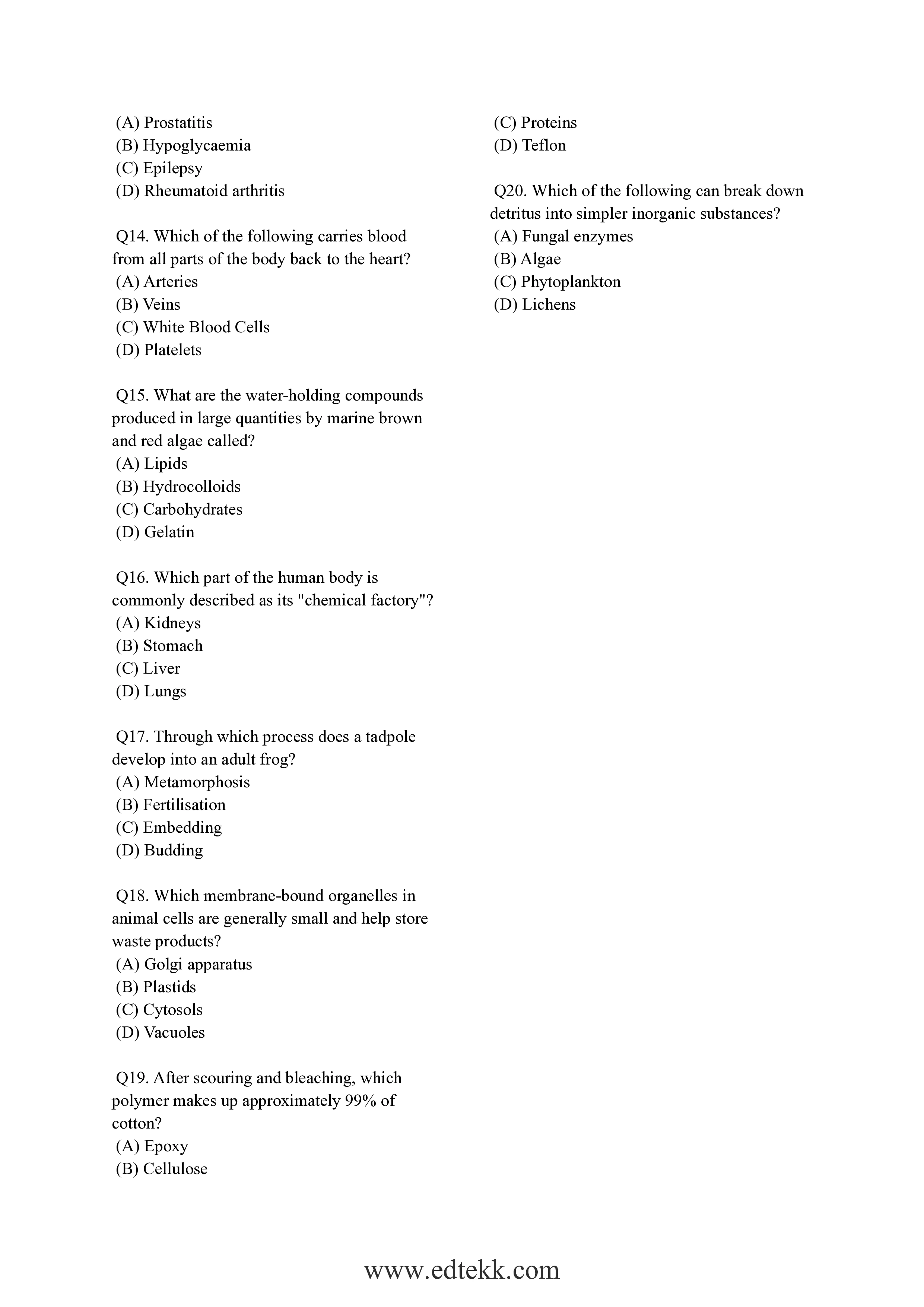
Q14. Which of the following carries blood from all parts of the body back to the heart?
(A) Arteries
(B) Veins
(C) White Blood Cells
(D) Platelets
Explanation: Veins generally carry blood from body tissues towards the heart. Most veins transport deoxygenated blood, although pulmonary veins carry oxygenated blood from the lungs to the heart. In contrast, arteries carry blood away from the heart, while white blood cells and platelets are components of blood.
Q15. What are the water-holding compounds produced in large quantities by marine brown and red algae called?
(A) Lipids
(B) Hydrocolloids
(C) Carbohydrates
(D) Gelatin
Explanation: Marine brown and red algae produce large quantities of hydrocolloids, which are water-absorbing, gel-forming substances. Important examples include alginates from brown algae, agar from red algae and carrageenan from red algae. These compounds are commercially useful as thickening, stabilising and gelling agents in food, pharmaceutical and cosmetic industries.
Q16. Which part of the human body is commonly described as its “chemical factory”?
(A) Kidneys
(B) Stomach
(C) Liver
(D) Lungs
Explanation: The liver is commonly described as the chemical factory of the human body because it performs numerous metabolic and biochemical functions. It processes nutrients, detoxifies many harmful substances, produces bile, synthesises important blood proteins and regulates the metabolism of carbohydrates, fats and proteins.
Q17. Through which process does a tadpole develop into an adult frog?
(A) Metamorphosis
(B) Fertilisation
(C) Embedding
(D) Budding
Explanation: Metamorphosis is the biological process through which a tadpole transforms into an adult frog. During this process, limbs develop, the tail is gradually absorbed, and the respiratory system changes from primarily gill-based respiration to lung-based respiration, supplemented by cutaneous respiration.
Q18. Which membrane-bound organelles in animal cells are generally small and help store waste products?
(A) Golgi apparatus
(B) Plastids
(C) Cytosols
(D) Vacuoles
Explanation: Vacuoles are membrane-bound organelles that are generally smaller and more numerous in animal cells than in plant cells. They help store water, nutrients and waste materials and participate in intracellular transport and waste management. In contrast, mature plant cells typically possess a large central vacuole.
Q19. After scouring and bleaching, which polymer makes up approximately 99% of cotton?
(A) Epoxy
(B) Cellulose
(C) Proteins
(D) Teflon
Explanation: Cellulose is the principal structural polymer of cotton fibres. After thorough scouring and bleaching, highly purified cotton may contain approximately 99% cellulose, depending on processing conditions. Cellulose is a natural polysaccharide composed of β-D-glucose units joined by β-1,4-glycosidic bonds.
Q20. Which of the following can break down detritus into simpler inorganic substances?
(A) Fungal enzymes
(B) Algae
(C) Phytoplankton
(D) Lichens
Explanation: Decomposers, particularly fungi and bacteria, break down detritus (dead organic matter) into simpler substances through enzymatic activity. Fungal enzymes help decompose complex organic materials, facilitating mineralisation and the recycling of nutrients within ecosystems.
Question Paper Images