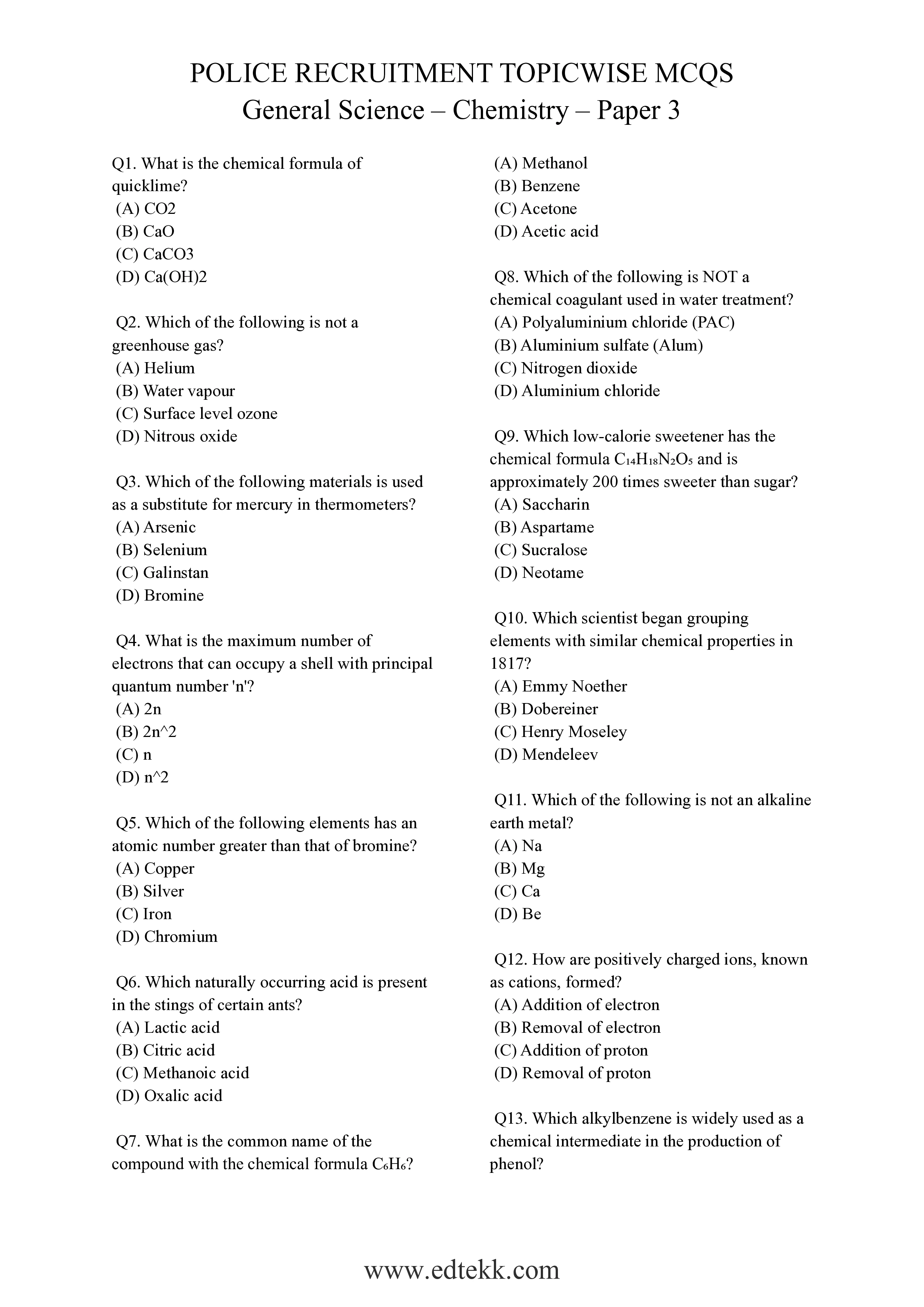
Strengthen your General Science preparation through Chemistry topicwise MCQs (Paper 3) for Police Constable and Police SI examinations. This question set provides objective practice on important Chemistry concepts, helping candidates evaluate their knowledge, improve accuracy and revise effectively with correct answers and detailed explanations.
Test Details
Topic: Chemistry
Total Questions: 20
Question Format: MCQs – Single Correct Answer
Suitable for: Police Constable, Police SI
Download All Papers in This Series (PDF)
Questions and Answers
Q1. What is the chemical formula of quicklime?
(A) CO2
(B) CaO
(C) CaCO3
(D) Ca(OH)2
Explanation: Quicklime is calcium oxide (CaO). It is produced by heating limestone (calcium carbonate, CaCO₃) strongly, causing it to decompose into calcium oxide and carbon dioxide. Calcium hydroxide [Ca(OH)₂] is known as slaked lime.
Q2. Which of the following is not a greenhouse gas?
(A) Helium
(B) Water vapour
(C) Surface level ozone
(D) Nitrous oxide
Explanation: Helium is not a greenhouse gas because it does not significantly absorb outgoing infrared radiation. It is a chemically inert noble gas belonging to Group 18. In contrast, water vapour, surface-level ozone and nitrous oxide absorb infrared radiation and contribute to the greenhouse effect.
Q3. Which of the following materials is used as a substitute for mercury in thermometers?
(A) Arsenic
(B) Selenium
(C) Galinstan
(D) Bromine
Explanation: Galinstan is a liquid metal alloy consisting primarily of gallium, indium and tin. It is used as a substitute for mercury in certain thermometers because it remains liquid at temperatures as low as approximately −19°C and has substantially lower toxicity than mercury.
Q4. What is the maximum number of electrons that can occupy a shell with principal quantum number ‘n’?
(A) 2n
(B) 2n^2
(C) n
(D) n^2
Explanation: The maximum number of electrons that can occupy a shell is given by 2n², where n is the principal quantum number. Accordingly, the first shell (n = 1) accommodates 2 electrons, the second (n = 2) accommodates 8, the third (n = 3) accommodates 18 and the fourth (n = 4) accommodates 32 electrons.
Q5. Which of the following elements has an atomic number greater than that of bromine?
(A) Copper
(B) Silver
(C) Iron
(D) Chromium
Explanation: Silver has atomic number 47, which is greater than bromine’s atomic number of 35. Copper has atomic number 29, iron 26 and chromium 24. Atomic number is determined by the number of protons present in an atom’s nucleus.
Q6. Which naturally occurring acid is present in the stings of certain ants?
(A) Lactic acid
(B) Citric acid
(C) Methanoic acid
(D) Oxalic acid
Explanation: Methanoic acid, commonly known as formic acid, is naturally present in the venom of many ant species. It is responsible for the characteristic irritating sensation associated with certain ant stings. Its chemical formula is HCOOH. However, not all ant species use formic acid as their primary defensive chemical.
Q7. What is the common name of the compound with the chemical formula C₆H₆?
(A) Methanol
(B) Benzene
(C) Acetone
(D) Acetic acid
Explanation: Benzene (C₆H₆) is an aromatic hydrocarbon consisting of a six-carbon ring with delocalised pi electrons. It is a colourless, volatile liquid widely used as an industrial chemical feedstock. Its molecular formula is C₆H₆, distinguishing it from methanol, acetic acid and acetone.
Q8. Which of the following is NOT a chemical coagulant used in water treatment?
(A) Polyaluminium chloride (PAC)
(B) Aluminium sulfate (Alum)
(C) Nitrogen dioxide
(D) Aluminium chloride
Explanation: Nitrogen dioxide (NO₂) is not a chemical coagulant used in conventional water treatment. Polyaluminium chloride (PAC), aluminium sulphate (alum) and aluminium chloride are aluminium-based coagulants that destabilise suspended and colloidal particles, facilitating their removal from water.
Q9. Which low-calorie sweetener has the chemical formula C₁₄H₁₈N₂O₅ and is approximately 200 times sweeter than sugar?
(A) Saccharin
(B) Aspartame
(C) Sucralose
(D) Neotame
Explanation: Aspartame has the molecular formula C₁₄H₁₈N₂O₅ and is an artificial low-calorie sweetener approximately 200 times sweeter than sucrose. It is used in various sugar-free and reduced-calorie food products. Due to its high sweetness, only a small quantity is required compared with ordinary sugar.
Q10. Which scientist began grouping elements with similar chemical properties in 1817?
(A) Emmy Noether
(B) Dobereiner
(C) Henry Moseley
(D) Mendeleev
Explanation: Johann Wolfgang Döbereiner began classifying elements with similar chemical properties in 1817. He subsequently developed the concept of triads, grouping three elements with similar properties. The atomic mass of the middle element was approximately the arithmetic mean of the other two.
Q11. Which of the following is not an alkaline earth metal?
(A) Na
(B) Mg
(C) Ca
(D) Be
Explanation: Sodium (Na) is not an alkaline earth metal; it is an alkali metal belonging to Group 1 of the periodic table. Magnesium (Mg), calcium (Ca) and beryllium (Be) are alkaline earth metals belonging to Group 2.
Q12. How are positively charged ions, known as cations, formed?
(A) Addition of electron
(B) Removal of electron
(C) Addition of proton
(D) Removal of proton
Explanation: Cations are positively charged ions commonly formed when neutral atoms lose one or more electrons. Electron loss leaves the species with more protons than electrons, producing a net positive charge. For example, sodium forms Na⁺ by losing one electron: Na → Na⁺ + e⁻. Electron gain generally produces anions.
Q13. Which alkylbenzene is widely used as a chemical intermediate in the production of phenol?
(A) Furan
(B) Cumene
(C) Styrene
(D) Toluene
Explanation: Cumene, also known as isopropylbenzene, is an alkylbenzene widely used as an industrial chemical intermediate. It is converted into cumene hydroperoxide through oxidation, followed by acid-catalysed cleavage to produce phenol and acetone. This industrial manufacturing method is known as the cumene process.
Q14. What is the common name of the compound with the chemical formula C₆H₆?
(A) Benzene
(B) Methanol
(C) Acetic acid
(D) Acetone
Explanation: Benzene is the common name of the compound with the molecular formula C₆H₆. It is an aromatic hydrocarbon consisting of a six-carbon ring with delocalised pi electrons. Benzene is an important industrial chemical used in the manufacture of plastics, synthetic fibres, detergents and other chemical products.
Q15. What is the chemical formula of calcium carbonate?
(A) CaSO4
(B) CaCO2
(C) CaCO3
(D) CaO
Explanation: Calcium carbonate has the chemical formula CaCO₃. It is the principal constituent of limestone, chalk and marble and is also found in materials such as eggshells and seashells.
Q16. Which of the following pure metals has the highest melting point?
(A) Tungsten
(B) Copper
(C) Platinum
(D) Gold
Explanation: Tungsten has the highest melting point among the listed metals, approximately 3,422°C. Its exceptionally high melting point makes it suitable for applications involving extreme temperatures. It was historically used in incandescent light-bulb filaments because it can withstand very high temperatures without melting.
Q17. Which of the following does NOT belong to the family of organic compounds?
(A) Nonane
(B) Ammonia
(C) Decane
(D) Furan
Explanation: Ammonia (NH₃) is an inorganic compound consisting of nitrogen and hydrogen. Nonane and decane are alkanes, while furan is a heterocyclic aromatic organic compound containing oxygen in its ring. Therefore, ammonia is the only inorganic compound among the given options.
Q18. What type of chemical reaction produces a single product from two or more reactants?
(A) Combination reaction
(B) Decomposition reaction
(C) Displacement reaction
(D) Double displacement reaction
Explanation: A combination reaction is a chemical reaction in which two or more reactants combine to form a single product. It is generally represented as A + B → AB. Decomposition reactions involve the opposite process, in which a single compound breaks down into two or more simpler substances.
Q19. What is the general formula of alkenes?
(A) CnH2n
(B) CnH3n
(C) CnH4n
(D) CnH6n
Explanation: The general molecular formula of open-chain alkenes containing one carbon–carbon double bond is CₙH₂ₙ, where n is at least 2. Alkenes are unsaturated hydrocarbons. For example, ethene (C₂H₄) and propene (C₃H₆) follow this formula. Cyclic alkenes and compounds with multiple double bonds have different general formulas.
Q20. Which compound has the chemical formula CHCl₃ and a melting point of 209 K?
(A) Chloroform
(B) Carbon tetrachloride
(C) Chlorophenol
(D) Chloroethanol
Explanation: Chloroform (CHCl₃), also known as trichloromethane, has a melting point of approximately 209 K (−64 °C). It is a colourless, volatile liquid with a characteristic sweet smell. Although historically used as an anaesthetic, it is no longer commonly used for this purpose because of its toxicity.
Question Paper Images