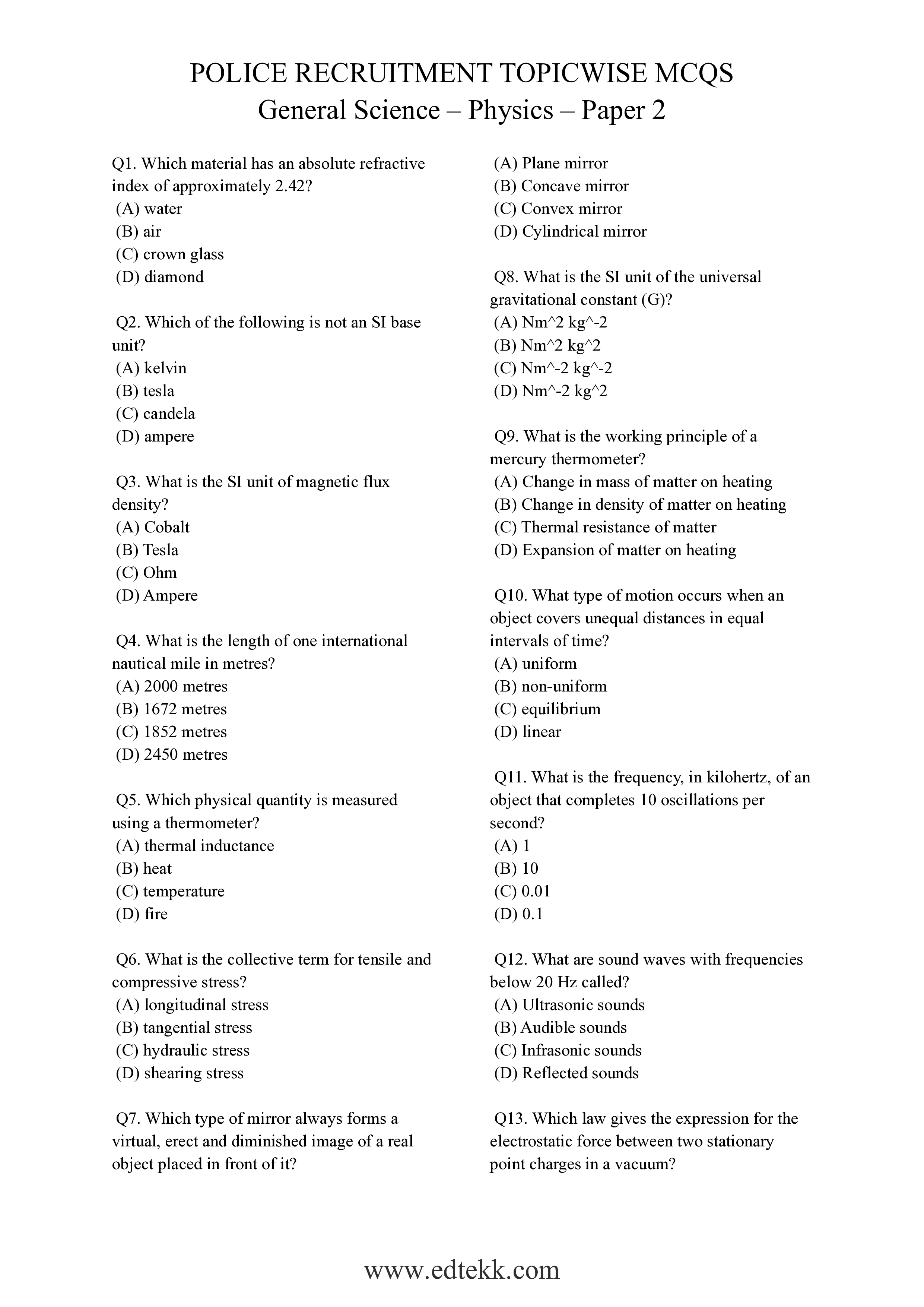
Improve your Physics preparation for Police Constable and Police SI recruitment examinations with this General Science MCQ practice set (Paper 2). Test your knowledge of important Physics concepts through topicwise objective questions, supported by accurate answers and explanations for effective revision and competitive-exam preparation.
Test Details
Topic: Physics
Total Questions: 20
Question Format: MCQs – Single Correct Answer
Suitable for: Police Constable, Police SI
Download All Papers in This Series (PDF)
Questions and Answers
Q1. Which material has an absolute refractive index of approximately 2.42?
(A) water
(B) air
(C) crown glass
(D) diamond
Explanation: Diamond has an absolute refractive index of approximately 2.42. The absolute refractive index of a medium is the ratio of the speed of light in vacuum to its speed in that medium. Diamond has a high refractive index because light travels considerably slower through it than through air or water.
Q2. Which of the following is not an SI base unit?
(A) kelvin
(B) tesla
(C) candela
(D) ampere
Explanation: Tesla (T) is a derived SI unit used to measure magnetic flux density, not an SI base unit. The seven SI base units include kelvin for thermodynamic temperature, candela for luminous intensity and ampere for electric current. Therefore, tesla is the correct answer.
Q3. What is the SI unit of magnetic flux density?
(A) Cobalt
(B) Tesla
(C) Ohm
(D) Ampere
Explanation: Tesla (T) is the SI unit of magnetic flux density, commonly called the magnetic field in elementary physics. One tesla is equivalent to one weber per square metre (Wb/m²). It is named after the scientist and inventor Nikola Tesla.
Q4. What is the length of one international nautical mile in metres?
(A) 2000 metres
(B) 1672 metres
(C) 1852 metres
(D) 2450 metres
Explanation: One international nautical mile is exactly 1,852 metres. It is commonly used in maritime and aviation navigation and corresponds approximately to one minute of latitude.
Q5. Which physical quantity is measured using a thermometer?
(A) thermal inductance
(B) heat
(C) temperature
(D) fire
Explanation: A thermometer is an instrument used to measure temperature, which indicates the degree of hotness or coldness of a body. Heat is energy transferred between bodies due to a temperature difference, whereas temperature is a measurable physical quantity.
Q6. What is the collective term for tensile and compressive stress?
(A) longitudinal stress
(B) tangential stress
(C) hydraulic stress
(D) shearing stress
Explanation: Tensile and compressive stresses are collectively called longitudinal stresses because they act perpendicular to the cross-sectional area of a body and produce changes in its length. Tensile stress tends to increase the body’s length, whereas compressive stress tends to decrease it. Shearing stress acts parallel to the surface.
Q7. Which type of mirror always forms a virtual, erect and diminished image of a real object placed in front of it?
(A) Plane mirror
(B) Concave mirror
(C) Convex mirror
(D) Cylindrical mirror
Explanation: A convex mirror always forms a virtual, erect and diminished image of a real object placed in front of it. The image appears behind the mirror, irrespective of the object’s position. Convex mirrors provide a wide field of view and are commonly used as rear-view and side-view mirrors in vehicles.
Q8. What is the SI unit of the universal gravitational constant (G)?
(A) Nm^2 kg^-2
(B) Nm^2 kg^2
(C) Nm^-2 kg^-2
(D) Nm^-2 kg^2
Explanation: The SI unit of the universal gravitational constant ((G)) is N m² kg⁻². According to Newton’s law of universal gravitation, it relates the gravitational force between two masses to their masses and the square of the distance between them. Its approximate value is (6.674 times 10^{-11}) N m² kg⁻².
Q9. What is the working principle of a mercury thermometer?
(A) Change in mass of matter on heating
(B) Change in density of matter on heating
(C) Thermal resistance of matter
(D) Expansion of matter on heating
Explanation: A mercury thermometer works on the principle of thermal expansion of matter. When temperature increases, mercury expands and rises through the narrow capillary tube. When temperature decreases, it contracts and its level falls. The change in mercury volume is used to indicate temperature.
Q10. What type of motion occurs when an object covers unequal distances in equal intervals of time?
(A) uniform
(B) non-uniform
(C) equilibrium
(D) linear
Explanation: Non-uniform motion occurs when an object covers unequal distances in equal intervals of time or equal distances in unequal intervals of time. In contrast, uniform motion involves covering equal distances in equal intervals of time.
Q11. What is the frequency, in kilohertz, of an object that completes 10 oscillations per second?
(A) 1
(B) 10
(C) 0.01
(D) 0.1
Explanation: Frequency is the number of oscillations completed per second. An object executing 10 oscillations per second has a frequency of 10 Hz. Since 1 kHz equals 1,000 Hz, its frequency in kilohertz is (10/1000=0.01) kHz.
Q12. What are sound waves with frequencies below 20 Hz called?
(A) Ultrasonic sounds
(B) Audible sounds
(C) Infrasonic sounds
(D) Reflected sounds
Explanation: Sound waves with frequencies below 20 Hz are called infrasonic sounds. These frequencies are below the lower limit of normal human hearing. Humans generally hear sounds ranging from 20 Hz to 20,000 Hz. Sounds with frequencies above 20,000 Hz are called ultrasonic sounds.
Q13. Which law gives the expression for the electrostatic force between two stationary point charges in a vacuum?
(A) Coulomb’s Law
(B) Lenz’s Law
(C) Gauss’s Law
(D) Ohm’s Law
Explanation: Coulomb’s law describes the electrostatic force between two stationary point charges in vacuum. The magnitude of this force is directly proportional to the product of the charges and inversely proportional to the square of the distance between them. The force acts along the line joining the charges and may be attractive or repulsive.
Q14. Which of the following physical quantities has the same dimensions as energy?
(A) Moment of inertia
(B) Linear Momentum
(C) Angular momentum
(D) Torque
Explanation: Torque and energy have the same dimensions, (ML^2T^{-2}). Torque is the product of force and perpendicular distance, whereas work is the product of force and displacement in the direction of the force. However, they represent different physical quantities: torque is expressed in N·m and energy in joules (J).
Q15. A rectangular copper-wire coil rotates in a magnetic field. After how much rotation does the direction of the induced current reverse?
(A) Two revolutions
(B) One revolution
(C) Half revolution
(D) One fourth revolution
Explanation: The direction of induced current in a rotating rectangular coil reverses after every half revolution (180°). This occurs because the direction of motion of the coil’s sides relative to the magnetic field reverses. This principle is used in an alternating-current (AC) generator.
Q16. What is the process involving the successive stages of vaporisation and condensation called?
(A) Distillation
(B) Sublimation
(C) Chromatography
(D) Crystallisation
Explanation: Distillation is a separation process involving vaporisation followed by condensation. The liquid mixture is heated to convert a component into vapour, which is subsequently cooled to obtain it in liquid form. It is commonly used to separate liquids with different boiling points or recover a solvent from a solution.
Q17. What is the approximate equivalent of 30°C on the Kelvin scale?
(A) -30
(B) -243
(C) 303
(D) 130
Explanation: Celsius temperature is converted into Kelvin using the formula (K=°C+273.15). For 30°C, (K=30+273.15=303.15) K. Rounded to the nearest whole number, the temperature is approximately 303 K. Kelvin is the SI unit of thermodynamic temperature.
Q18. Which principle of physics is illustrated by a horse pulling a carriage?
(A) Avogadro’s law
(B) Ohm’s law
(C) Archimedes principle
(D) Newton’s third law
Explanation: A horse pulling a carriage illustrates Newton’s third law of motion. The horse pushes the ground backwards, and the ground exerts an equal and opposite forward frictional force on the horse. This forward force enables the horse to pull the carriage. The action and reaction forces act on different bodies.
Q19. What is the SI unit of work?
(A) Ampere
(B) Watt
(C) Decibel
(D) Joule
Explanation: Work is the product of force and displacement in the direction of the applied force. Its SI unit is the joule (J), equivalent to one newton-metre (N·m). One joule of work is done when a force of one newton displaces an object by one metre in the direction of the force.
Q20. Which type of friction is considered a self-adjusting force?
(A) Kinetic Friction
(B) Static Friction
(C) Centripetal Friction
(D) Rolling Friction
Explanation: Static friction is a self-adjusting force that prevents relative motion between two surfaces in contact. Its magnitude adjusts to match the applied tangential force until it reaches the maximum limiting friction. When the applied force exceeds this limit, sliding begins and kinetic friction acts.
Question Paper Images