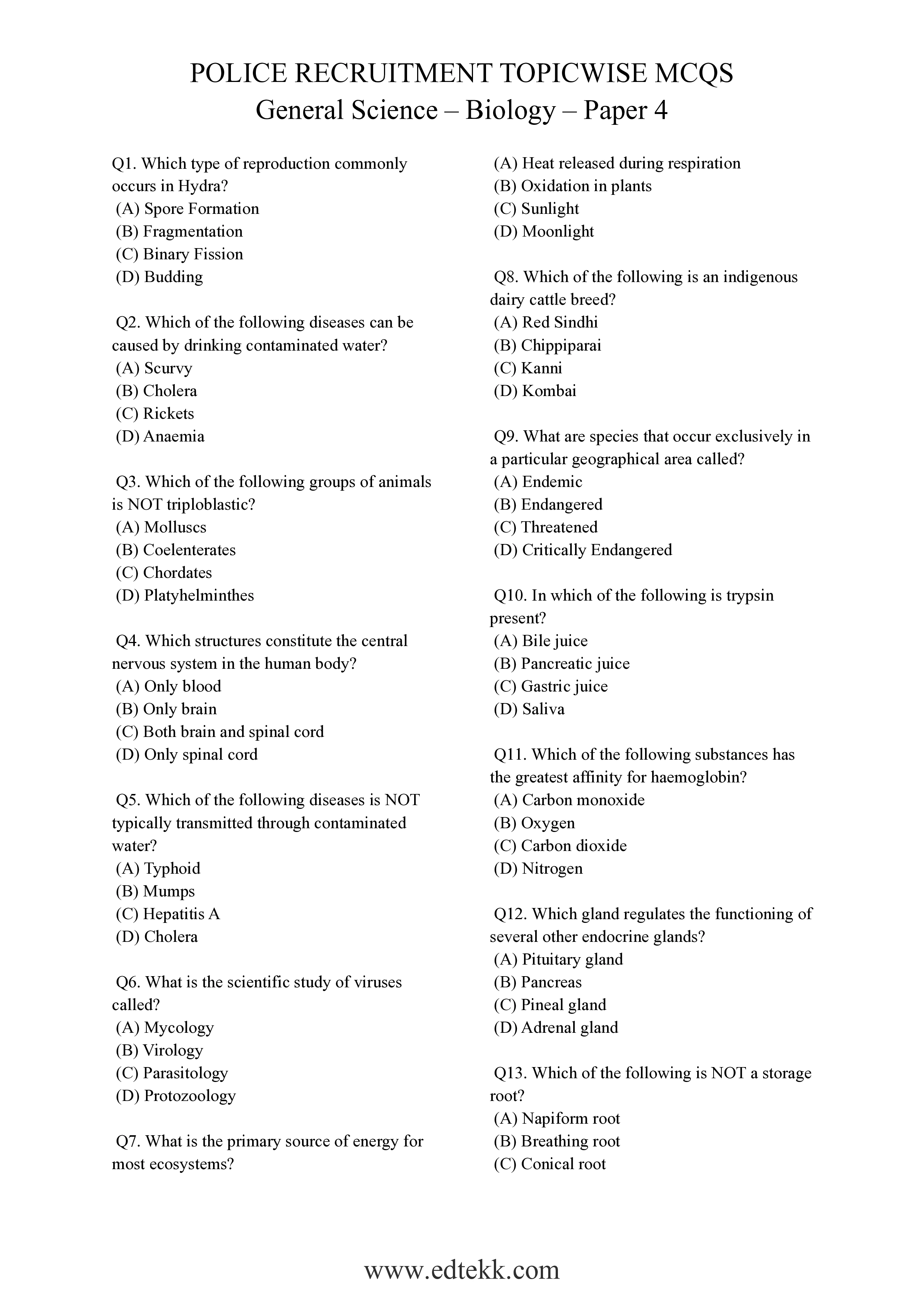
Enhance your Biology preparation for Police Constable and Police SI recruitment examinations with this General Science MCQ practice set (Paper 4). It includes topicwise objective questions on important Biology concepts, helping candidates assess their preparation, improve conceptual clarity and revise effectively through accurate answers and explanations.
Test Details
Topic: Biology
Total Questions: 20
Question Format: MCQs – Single Correct Answer
Suitable for: Police Constable, Police SI
Download All Papers in This Series (PDF)
Questions and Answers
Q1. Which type of reproduction commonly occurs in Hydra?
(A) Spore Formation
(B) Fragmentation
(C) Binary Fission
(D) Budding
Explanation: Hydra commonly reproduces asexually through budding. A small outgrowth develops on the parent’s body through repeated cell division, gradually forming a mouth and tentacles. Once fully developed, the bud separates from the parent and becomes an independent individual. Hydra can also reproduce sexually under certain environmental conditions.
Q2. Which of the following diseases can be caused by drinking contaminated water?
(A) Scurvy
(B) Cholera
(C) Rickets
(D) Anaemia
Explanation: Cholera is an infectious disease caused by the bacterium Vibrio cholerae. It commonly spreads through drinking water or consuming food contaminated with the bacterium. The disease causes severe watery diarrhoea and vomiting, which can lead to dangerous dehydration and electrolyte loss if left untreated.
Q3. Which of the following groups of animals is NOT triploblastic?
(A) Molluscs
(B) Coelenterates
(C) Chordates
(D) Platyhelminthes
Explanation: Coelenterates, traditionally called cnidarians, are diploblastic animals. They develop from two primary germ layers, the ectoderm and endoderm, with mesoglea between them. Molluscs, chordates and platyhelminthes are triploblastic animals possessing three primary germ layers.
Q4. Which structures constitute the central nervous system in the human body?
(A) Only blood
(B) Only brain
(C) Both brain and spinal cord
(D) Only spinal cord
Explanation: The human central nervous system (CNS) consists of the brain and spinal cord. It receives and processes sensory information, coordinates responses and regulates various bodily functions. The peripheral nervous system comprises nerves and ganglia outside the CNS and connects it with the rest of the body.
Q5. Which of the following diseases is NOT typically transmitted through contaminated water?
(A) Typhoid
(B) Mumps
(C) Hepatitis A
(D) Cholera
Explanation: Mumps is primarily transmitted through respiratory droplets and direct contact with infected saliva, not through contaminated water. In contrast, typhoid, hepatitis A and cholera can spread through contaminated food and water. Mumps is a viral disease commonly characterised by painful swelling of the salivary glands, particularly the parotid glands.
Q6. What is the scientific study of viruses called?
(A) Mycology
(B) Virology
(C) Parasitology
(D) Protozoology
Explanation: Virology is the branch of science concerned with the study of viruses. It examines their structure, classification, replication, genetics, evolution and interactions with host organisms. Virology also investigates viral diseases and contributes to the development of vaccines and antiviral treatments.
Q7. What is the primary source of energy for most ecosystems?
(A) Heat released during respiration
(B) Oxidation in plants
(C) Sunlight
(D) Moonlight
Explanation: Sunlight is the primary energy source for most ecosystems. Green plants and other photosynthetic organisms capture solar energy and convert it into chemical energy stored in organic compounds. This energy is transferred through different trophic levels via food chains and food webs. However, some ecosystems, such as deep-sea hydrothermal vent ecosystems, depend on chemical energy rather than sunlight.
Q8. Which of the following is an indigenous dairy cattle breed?
(A) Red Sindhi
(B) Chippiparai
(C) Kanni
(D) Kombai
Explanation: Red Sindhi is an indigenous Indian dairy cattle breed originating from the Sindh region of the Indian subcontinent. It is valued for its heat tolerance, disease resistance and milk production. Chippiparai, Kanni and Kombai are indigenous Indian dog breeds rather than cattle breeds.
Q9. What are species that occur exclusively in a particular geographical area called?
(A) Endemic
(B) Endangered
(C) Threatened
(D) Critically Endangered
Explanation: Endemic species are plants or animals naturally restricted to a particular geographical region and not found naturally elsewhere. Their distribution may be limited to an island, mountain range, country or other specific area. Endemism describes geographical restriction and does not necessarily indicate that a species is endangered.
Q10. In which of the following is trypsin present?
(A) Bile juice
(B) Pancreatic juice
(C) Gastric juice
(D) Saliva
Explanation: Trypsin is a protein-digesting enzyme produced by the pancreas and released into pancreatic juice in its inactive form, trypsinogen. In the small intestine, trypsinogen is activated by enteropeptidase, and active trypsin helps digest proteins into smaller peptides. Trypsin functions optimally in the alkaline environment of the small intestine.
Q11. Which of the following substances has the greatest affinity for haemoglobin?
(A) Carbon monoxide
(B) Oxygen
(C) Carbon dioxide
(D) Nitrogen
Explanation: Haemoglobin has a much greater affinity for carbon monoxide than for oxygen, approximately 200–250 times greater under commonly cited physiological conditions. Carbon monoxide forms carboxyhaemoglobin, reducing the blood’s oxygen-carrying capacity and impairing oxygen release to tissues. Exposure can cause severe, potentially fatal poisoning.
Q12. Which gland regulates the functioning of several other endocrine glands?
(A) Pituitary gland
(B) Pancreas
(C) Pineal gland
(D) Adrenal gland
Explanation: The pituitary gland is commonly called the master gland because it secretes hormones that regulate several other endocrine glands, including the thyroid, adrenal glands and gonads. However, the hypothalamus plays a major role in controlling pituitary function by regulating its hormone secretion.
Q13. Which of the following is NOT a storage root?
(A) Napiform root
(B) Breathing root
(C) Conical root
(D) Fusiform root
Explanation: Breathing roots, or pneumatophores, are specialised roots that grow upward from waterlogged, oxygen-deficient soil and facilitate gaseous exchange through lenticels. They occur in certain mangroves, such as Avicennia. Napiform, conical and fusiform roots are storage modifications of taproots. Therefore, breathing roots are not storage roots.
Q14. Which of the following structures is absent in a prokaryotic cell?
(A) Nucleus
(B) Ribosomes
(C) Cell membrane
(D) DNA
Explanation: Prokaryotic cells lack a membrane-bound nucleus. Their genetic material is located in a region called the nucleoid. However, they possess DNA, ribosomes and a cell membrane. Bacteria and archaea are examples of prokaryotic organisms.
Q15. Which of the following animals is oviparous?
(A) Frog
(B) Rabbit
(C) Mouse
(D) Squirrel
Explanation: Frogs are oviparous animals, meaning they reproduce by laying eggs. Most frogs lay their eggs in water, where fertilisation generally occurs externally. Rabbits, mice and squirrels are mammals that give birth to live young. Therefore, frog is the correct answer.
Q16. Which pigments produce red, pink, blue and purple colours in flowers?
(A) Chlorophyll
(B) Carotenoids
(C) Lycopene
(D) Anthocyanins
Explanation: Anthocyanins are water-soluble pigments responsible for many red, pink, blue and purple colours in flowers. Their colour can vary depending on cellular pH, pigment concentration and interactions with metal ions and other compounds.
Q17. Which of the following grass species is classified as Critically Endangered?
(A) Hubbardia heptaneuron
(B) Helianthus annuus
(C) Saccharum officinarum
(D) Bellis perennis
Explanation: Hubbardia heptaneuron is a rare grass species endemic to the Western Ghats of India, particularly the Mahabaleshwar region of Maharashtra. It is classified as Critically Endangered because of its restricted distribution and threatened habitat. The other options are common plant species and are not classified as Critically Endangered.
Q18. What level of organisation is exhibited by protozoans such as Amoeba and Paramecium?
(A) tissue-organ
(B) cell-tissue
(C) protoplasmic
(D) cellular
Explanation: Protozoans such as Paramecium, Amoeba and Euglena exhibit protoplasmic-level organisation. Their bodies consist of a single cell in which the protoplasm performs all essential life functions. They lack specialised tissues and organs, although different cellular structures perform specific functions.
Q19. Which syndrome is characterised by a fatty hump between the shoulders, a rounded face and pink or purple stretch marks on the skin?
(A) Angelman syndrome
(B) Down syndrome
(C) Marfan syndrome
(D) Cushing syndrome
Explanation: Cushing syndrome results from prolonged exposure to excessive cortisol. Its characteristic features include a rounded face (moon face), fat accumulation between the shoulders (buffalo hump) and pink or purple stretch marks (striae). Other symptoms may include weight gain, muscle weakness and high blood pressure.
Q20. Which gas contributes to global warming by trapping heat in the atmosphere?
(A) Oxygen
(B) Methane
(C) Nitrogen
(D) Hydrogen
Explanation: Methane is a greenhouse gas that contributes to global warming by absorbing and re-emitting infrared radiation in the atmosphere. Although present in much lower concentrations than carbon dioxide, methane has a substantially higher global warming potential per unit mass over a 100-year period.
Question Paper Images