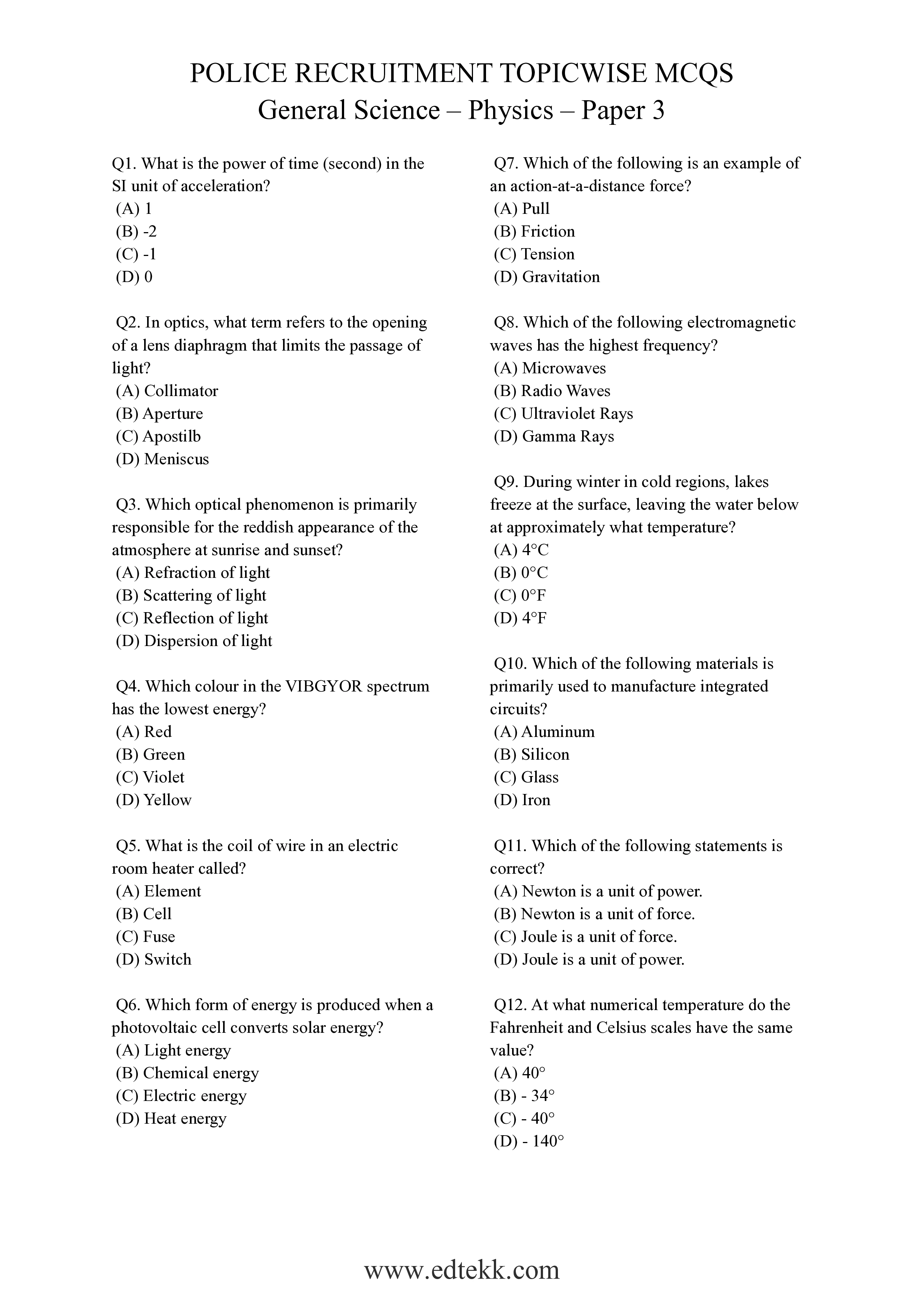
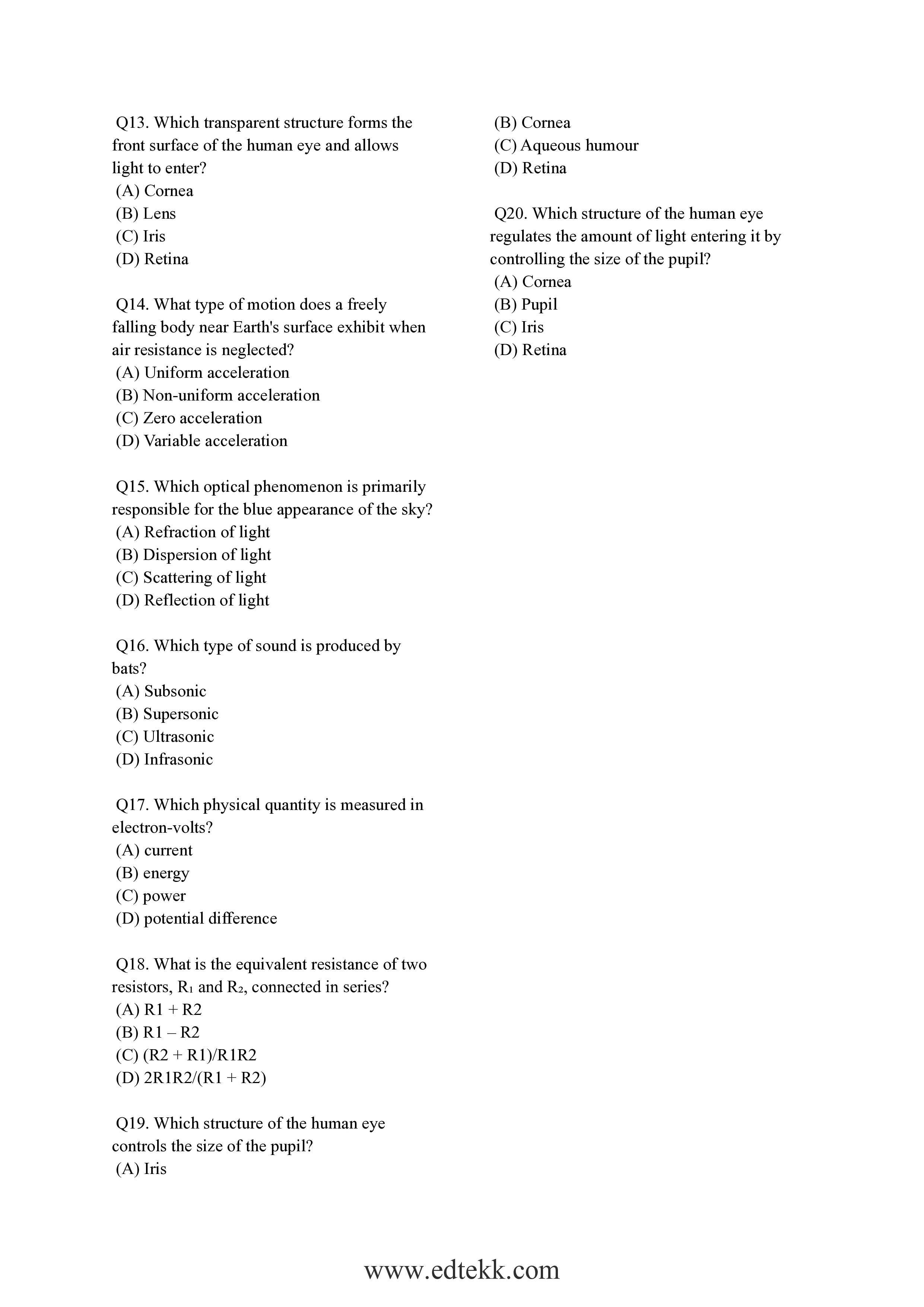
Strengthen your General Science preparation with Physics topicwise MCQs (Paper 3) designed for Police Constable and Police SI examinations. This practice set helps candidates revise important Physics concepts, assess their subject knowledge and improve accuracy through carefully selected multiple-choice questions, answers and explanations.
Test Details
Topic: Physics
Total Questions: 20
Question Format: MCQs – Single Correct Answer
Suitable for: Police Constable, Police SI
Download All Papers in This Series (PDF)
Questions and Answers
Q1. What is the power of time (second) in the SI unit of acceleration?
(A) 1
(B) -2
(C) -1
(D) 0
Explanation: Acceleration is the rate of change of velocity with respect to time. Its SI unit is metre per second squared (m/s²), which can be expressed as (LT^{-2}). Therefore, the power of the second in the SI unit of acceleration is −2.
Q2. In optics, what term refers to the opening of a lens diaphragm that limits the passage of light?
(A) Collimator
(B) Aperture
(C) Apostilb
(D) Meniscus
Explanation: Aperture refers to the opening in an optical instrument through which light enters or passes. It determines the amount of light admitted by the optical system. A larger aperture generally allows more light to enter, while the diaphragm can regulate the effective aperture.
Q3. Which optical phenomenon is primarily responsible for the reddish appearance of the atmosphere at sunrise and sunset?
(A) Refraction of light
(B) Scattering of light
(C) Reflection of light
(D) Dispersion of light
Explanation: The redness of the sky at sunrise and sunset is primarily caused by the scattering of sunlight in the atmosphere. Sunlight travels through a longer atmospheric path, causing shorter wavelengths, particularly blue light, to be scattered more strongly out of the direct beam. Consequently, the transmitted sunlight appears richer in red and orange wavelengths.
Q4. Which colour in the VIBGYOR spectrum has the lowest energy?
(A) Red
(B) Green
(C) Violet
(D) Yellow
Explanation: Red light has the longest wavelength and the lowest frequency among the seven colours of visible light (VIBGYOR). Since the energy of a photon is directly proportional to its frequency, according to E = hν, red light has the minimum energy, whereas violet light has the maximum energy.
Q5. What is the coil of wire in an electric room heater called?
(A) Element
(B) Cell
(C) Fuse
(D) Switch
Explanation: The coil of wire in an electric room heater is called the heating element. It is generally made of a high-resistivity alloy such as nichrome. When electric current passes through it, electrical energy is converted into heat due to its resistance, producing the heating effect.
Q6. Which form of energy is produced when a photovoltaic cell converts solar energy?
(A) Light energy
(B) Chemical energy
(C) Electric energy
(D) Heat energy
Explanation: A photovoltaic cell converts solar energy directly into electrical energy through the photovoltaic effect. When sunlight falls on its semiconductor material, photons generate electron–hole pairs, producing an electric current through the cell. This principle is widely used in solar panels for electricity generation.
Q7. Which of the following is an example of an action-at-a-distance force?
(A) Pull
(B) Friction
(C) Tension
(D) Gravitation
Explanation: Gravitation is an action-at-a-distance force because it acts between objects without requiring direct physical contact. Every object having mass attracts every other object having mass. In contrast, friction and tension are contact forces that require physical interaction between objects.
Q8. Which of the following electromagnetic waves has the highest frequency?
(A) Microwaves
(B) Radio Waves
(C) Ultraviolet Rays
(D) Gamma Rays
Explanation: Gamma rays have the highest frequency and shortest wavelength among the given electromagnetic waves. Their photon energies are higher than those of ultraviolet rays, microwaves and radio waves. According to the relationship c = νλ, frequency and wavelength are inversely proportional in a vacuum.
Q9. During winter in cold regions, lakes freeze at the surface, leaving the water below at approximately what temperature?
(A) 4°C
(B) 0°C
(C) 0°F
(D) 4°F
Explanation: Water has maximum density at approximately 4°C. During winter, water colder than 4°C becomes less dense and remains near the surface, eventually freezing. Consequently, the deeper water generally remains close to 4°C, allowing aquatic organisms to survive beneath the ice.
Q10. Which of the following materials is primarily used to manufacture integrated circuits?
(A) Aluminum
(B) Silicon
(C) Glass
(D) Iron
Explanation: Silicon is the primary semiconductor material used in manufacturing integrated circuits. Its electrical conductivity can be controlled through doping and other fabrication techniques. Transistors, diodes and other electronic components are fabricated on a silicon substrate to form integrated circuits.
Q11. Which of the following statements is correct?
(A) Newton is a unit of power.
(B) Newton is a unit of force.
(C) Joule is a unit of force.
(D) Joule is a unit of power.
Explanation: Newton (N) is the SI unit of force. One newton is the force required to accelerate a mass of one kilogram at one metre per second squared. Joule is the SI unit of work and energy, whereas watt is the SI unit of power.
Q12. At what numerical temperature do the Fahrenheit and Celsius scales have the same value?
(A) 40°
(B) – 34°
(C) – 40°
(D) – 140°
Explanation: The Fahrenheit and Celsius scales have the same numerical value at −40 degrees. This can be verified using the conversion formula (F=frac{9}{5}C+32). Substituting −40°C gives −40°F. Thus, −40 is the common numerical value on both scales.
Q13. Which transparent structure forms the front surface of the human eye and allows light to enter?
(A) Cornea
(B) Lens
(C) Iris
(D) Retina
Explanation: The cornea is the transparent, dome-shaped front surface of the human eye. It allows light to enter and provides much of the eye’s refractive power by bending incoming light. It also helps protect the eye from dust and microorganisms. The iris regulates pupil size, while the retina detects light and converts it into nerve signals.
Q14. What type of motion does a freely falling body near Earth’s surface exhibit when air resistance is neglected?
(A) Uniform acceleration
(B) Non-uniform acceleration
(C) Zero acceleration
(D) Variable acceleration
Explanation: A freely falling body near Earth’s surface experiences approximately constant gravitational acceleration when air resistance is neglected and the distance travelled is relatively small. This acceleration is approximately 9.8 m/s², directed vertically downward. Hence, its motion is an example of uniformly accelerated motion.
Q15. Which optical phenomenon is primarily responsible for the blue appearance of the sky?
(A) Refraction of light
(B) Dispersion of light
(C) Scattering of light
(D) Reflection of light
Explanation: The sky appears blue primarily because of Rayleigh scattering of sunlight by molecules in the atmosphere. Shorter visible wavelengths are scattered more strongly than longer wavelengths. Although violet light scatters even more strongly than blue light, the solar spectrum and the sensitivity of human vision contribute to the sky appearing blue.
Q16. Which type of sound is produced by bats?
(A) Subsonic
(B) Supersonic
(C) Ultrasonic
(D) Infrasonic
Explanation: Bats produce and use ultrasonic sounds for echolocation. They emit high-frequency sound waves and detect the returning echoes to locate prey, identify obstacles and navigate in darkness. These sounds generally have frequencies above the upper limit of human hearing (20 kHz).
Q17. Which physical quantity is measured in electron-volts?
(A) current
(B) energy
(C) power
(D) potential difference
Explanation: An electron-volt (eV) is a unit of energy. It is defined as the energy gained by an elementary charge when it moves through a potential difference of one volt. One electron-volt is approximately 1.602 × 10⁻¹⁹ joules. It is commonly used in atomic, nuclear and particle physics.
Q18. What is the equivalent resistance of two resistors, R₁ and R₂, connected in series?
(A) R1 + R2
(B) R1 – R2
(C) (R2 + R1)/R1R2
(D) 2R1R2/(R1 + R2)
Explanation: When two resistors are connected in series, their equivalent resistance is the sum of their individual resistances: R = R₁ + R₂. The same current flows through both resistors, while the total potential difference across the combination equals the sum of the potential differences across the individual resistors.
Q19. Which structure of the human eye controls the size of the pupil?
(A) Iris
(B) Cornea
(C) Aqueous humour
(D) Retina
Explanation: The iris controls the size of the pupil and regulates the amount of light entering the eye. In bright light, its circular muscles contract and its radial muscles relax, constricting the pupil. In dim light, the radial muscles contract and the circular muscles relax, dilating the pupil.
Q20. Which structure of the human eye regulates the amount of light entering it by controlling the size of the pupil?
(A) Cornea
(B) Pupil
(C) Iris
(D) Retina
Explanation: The iris regulates the amount of light entering the human eye by controlling the diameter of the pupil. In bright conditions, the pupil constricts to reduce incoming light. In dim conditions, it dilates to allow more light to enter. The pupil is the opening, whereas the iris is the structure that controls its size.
Question Paper Images