Prepare for Police Constable and Police SI examinations with this General Science Physics MCQ practice set (Paper 1). It covers important Physics concepts through topicwise multiple-choice questions, with correct answers and detailed explanations to strengthen conceptual understanding and improve examination readiness.
Test Details
Topic: Physics
Total Questions: 20
Question Format: MCQs – Single Correct Answer
Suitable for: Police Constable, Police SI
Download All Papers in This Series (PDF)
Questions and Answers
Q1. Who established the relationship between the electric current flowing through a metallic wire and the potential difference across its terminals?
(A) Georg Simon Ohm
(B) Albert Einstein
(C) Rutherford
(D) Niels Bohr
Explanation: Georg Simon Ohm established the relationship between electric current and potential difference in a conductor. His work led to Ohm’s law, which states that current through a conductor is directly proportional to the potential difference across it, provided temperature and other physical conditions remain constant.
Q2. How is a voltmeter connected between the two points across which the potential difference is to be measured?
(A) Along the same magnetic field
(B) In parallel
(C) In concentric circles
(D) Perpendicular to each other
Explanation: A voltmeter is connected in parallel across the two points between which the potential difference is to be measured. It has very high resistance, so it draws negligible current from the circuit and minimises disturbance to the potential difference being measured.
Q3. Which physical quantity is represented by the ratio of arc length to radius?
(A) Plane angle
(B) Surface tension
(C) Velocity
(D) Linear Momentum
Explanation: The ratio of arc length to radius, (s/r), gives the plane angle in radians when both measurements are expressed in the same units. The radian is the SI-derived unit of plane angle. Although this ratio is dimensionless, it represents a specific geometric quantity.
Q4. Which of the following physical quantities is a vector quantity?
(A) Energy
(B) Gravitational Intensity
(C) Density
(D) Mass
Explanation: Gravitational intensity, also known as gravitational field strength, is a vector quantity because it has both magnitude and direction. It represents the gravitational force experienced per unit mass at a given point. Energy, mass and density are scalar quantities.
Q5. What state of matter is acquired by a gas of very low density when cooled to an extremely low temperature under suitable conditions?
(A) Solid
(B) Bose – Einstein condensation
(C) Plasma
(D) Liquid
Explanation: At sufficiently low temperatures and under suitable conditions, a dilute gas of bosonic particles can undergo Bose–Einstein condensation. In this state, a macroscopic number of particles occupy the same lowest-energy quantum state. Low temperature and low density alone are not sufficient; appropriate quantum and thermodynamic conditions are necessary.
Q6. What is the SI unit of momentum?
(A) Kg m/sec
(B) Ampere
(C) Joule
(D) Kg-m
Explanation: Linear momentum is calculated as the product of mass and velocity, expressed as (p = mv). Its SI unit is kilogram metre per second (kg m/s). Ampere is the unit of electric current, while joule is the unit of energy.
Q7. How many times stronger is the magnetic field produced by an n-turn coil than that produced by an otherwise identical single-turn coil?
(A) (n/2)
(B) (n^2)
(C) (n^2/2)
(D) (n)
Explanation: The magnetic field at the centre of a circular coil is directly proportional to its number of turns, provided the current and radius remain constant. Therefore, an n-turn circular coil produces a magnetic field n times that of an otherwise identical single-turn coil carrying the same current.
Q8. Which physical quantity is measured using the Réaumur scale?
(A) Speed
(B) Length
(C) Elasticity
(D) Temperature
Explanation: The Réaumur scale is a historical temperature scale in which the freezing point of water is 0°Ré and its boiling point is 80°Ré at standard atmospheric pressure. It was formerly used in some European countries but has largely been replaced by the Celsius scale.
Q9. What is the SI unit of luminous intensity?
(A) Mole
(B) Candela
(C) Ampere
(D) Kelvin
Explanation: The candela (cd) is the SI base unit of luminous intensity, which measures the intensity of light emitted in a particular direction. The mole measures the amount of substance, the ampere measures electric current, and the kelvin measures thermodynamic temperature.
Q10. Who discovered in 1820 that an electric current could deflect a nearby magnetic needle, thereby establishing the connection between electricity and magnetism?
(A) Benjamin Franklin
(B) Hans Christian Oersted
(C) James Clerk Maxwell
(D) Andre-Marie Ampere
Explanation: Hans Christian Ørsted discovered the connection between electricity and magnetism in 1820. He observed that a compass needle deflected when placed near a current-carrying wire. This experiment demonstrated that an electric current produces a magnetic field and laid the foundation for the development of electromagnetism.
Q11. According to Newton’s second law of motion, which quantity is equal to mass multiplied by acceleration?
(A) force
(B) impulse
(C) torque
(D) kinetic energy
Explanation: According to Newton’s second law of motion, the net force acting on a body equals the product of its mass and acceleration. Mathematically, (F = ma), where (F) represents force, (m) represents mass and (a) represents acceleration. The SI unit of force is the newton (N).
Q12. Which force helps swimmers remain afloat in water?
(A) Frictional force.
(B) Muscular force
(C) Buoyant force
(D) Magnetic force
Explanation: Buoyant force is the upward force exerted by a fluid on an object partially or completely immersed in it. It helps swimmers remain afloat by opposing their weight. According to Archimedes’ principle, the buoyant force is equal to the weight of the fluid displaced by the immersed object.
Q13. Which scientist demonstrated through prism experiments that white light can be separated into its constituent colours?
(A) Niels Bohr
(B) Albert Einstein
(C) Isaac Newton
(D) Galileo Galilei
Explanation: Isaac Newton demonstrated the dispersion of white light through prism experiments. He showed that white light separates into its constituent colours when passed through a glass prism and that these colours can be recombined to produce white light. This established that white light contains light of different visible wavelengths.
Q14. What is 14°F equivalent to on the Celsius scale?
(A) 10
(B) 20
(C) -10
(D) -20
Explanation: Fahrenheit temperature is converted into Celsius using the formula (C=(F-32)times5/9). For 14°F, the calculation is ((14-32)times5/9=-10°C). Therefore, 14 degrees Fahrenheit is equivalent to minus 10 degrees Celsius.
Q15. In the equation of motion (v = u + at), what does the symbol ‘u’ represent?
(A) final velocity
(B) initial velocity
(C) kinetic energy
(D) potential energy
Explanation: In the equation of motion (v = u + at), (u) represents initial velocity, (v) represents final velocity, (a) represents uniform acceleration and (t) represents the time interval. This equation applies to motion with constant acceleration.
Q16. What is the study of the production and propagation of sound waves called?
(A) Photonics
(B) Optics
(C) Astrophysics
(D) Acoustics
Explanation: Acoustics is the branch of physics concerned with the production, transmission, propagation and effects of sound waves. It includes phenomena such as reflection, absorption, resonance and interference of sound. Optics deals with light, while astrophysics studies physical processes in celestial objects.
Q17. What is the rate of doing work called?
(A) energy
(B) impulse
(C) force
(D) power
Explanation: Power is defined as the rate of doing work or transferring energy per unit time. Mathematically, average power is expressed as (P=W/t), where (W) represents the work done and (t) represents the time taken. Its SI unit is the watt (W), equivalent to one joule per second.
Q18. How much heat energy, in joules, is released by a 20 W heating filament operating for 2 seconds?
(A) 80
(B) 10
(C) 40
(D) 20
Explanation: The heat energy produced by an electrical device is calculated using the formula (H=Ptimes t). Here, power is 20 W and time is 2 seconds. Therefore, (H=20times2=40) joules. This assumes that the filament operates at its rated power and all electrical energy is converted into heat.
Q19. Which metal changes from the liquid state to the gaseous state when heated to its boiling point of approximately 357°C?
(A) Copper
(B) Mercury
(C) Gallium
(D) Bronze
Explanation: Mercury has a boiling point of approximately 357°C at standard atmospheric pressure. When heated to this temperature, liquid mercury changes into mercury vapour. Mercury is unusual because it is a metal that remains liquid at ordinary room temperatures due to its relatively low melting point.
Q20. A bullet of mass 10 g is fired at a velocity of 20 m/s from a gun of mass 2 kg. What is the recoil velocity of the gun, in m/s?
(A) 2
(B) 1
(C) 0.2
(D) 0.1
Explanation: According to the law of conservation of momentum, the initial total momentum of the gun–bullet system is zero. Therefore, (0.01 times 20 + 2v = 0), giving (v = -0.1text{ m/s}). The negative sign indicates that the gun recoils in the direction opposite to the bullet’s motion.
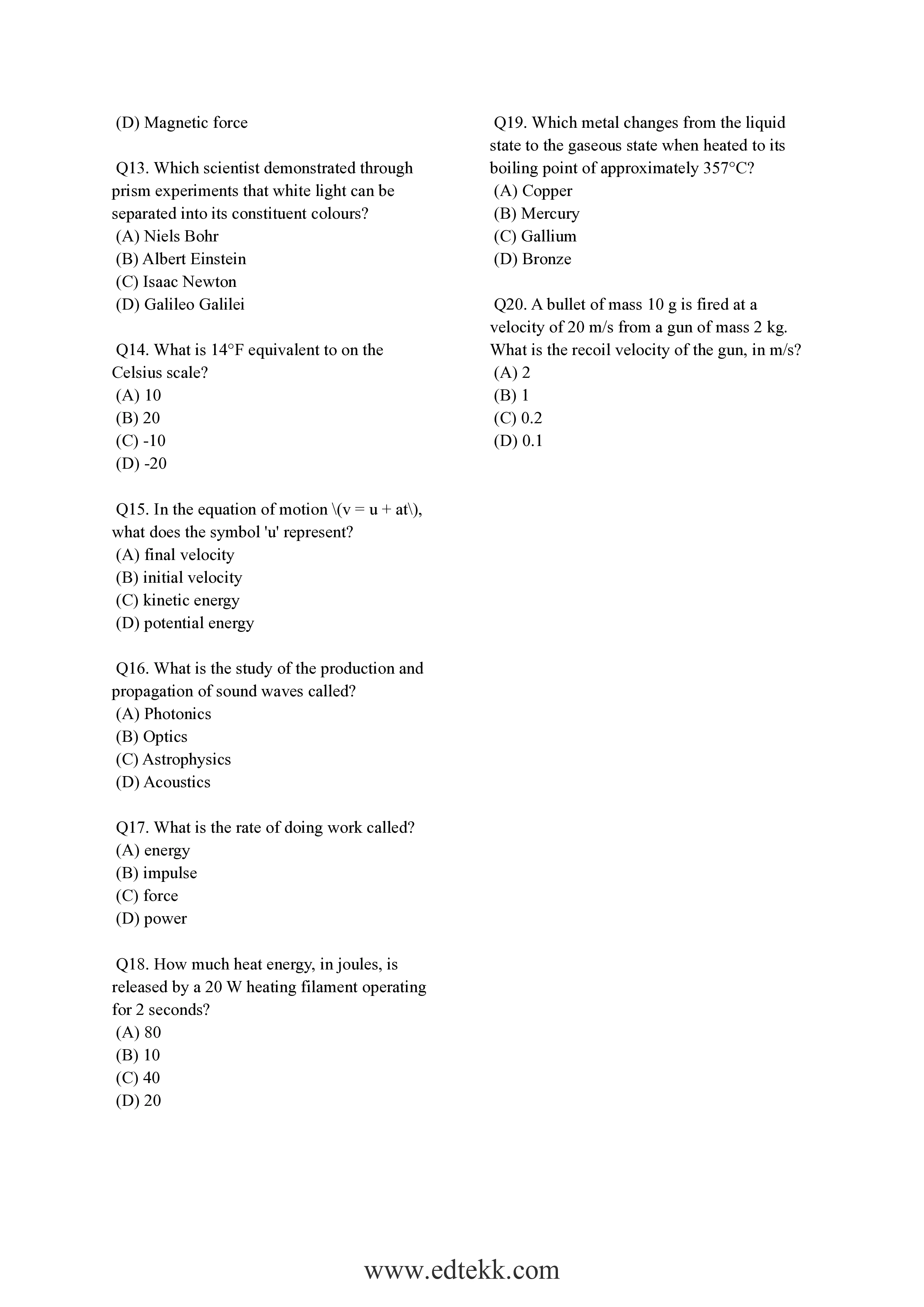
Question Paper Images