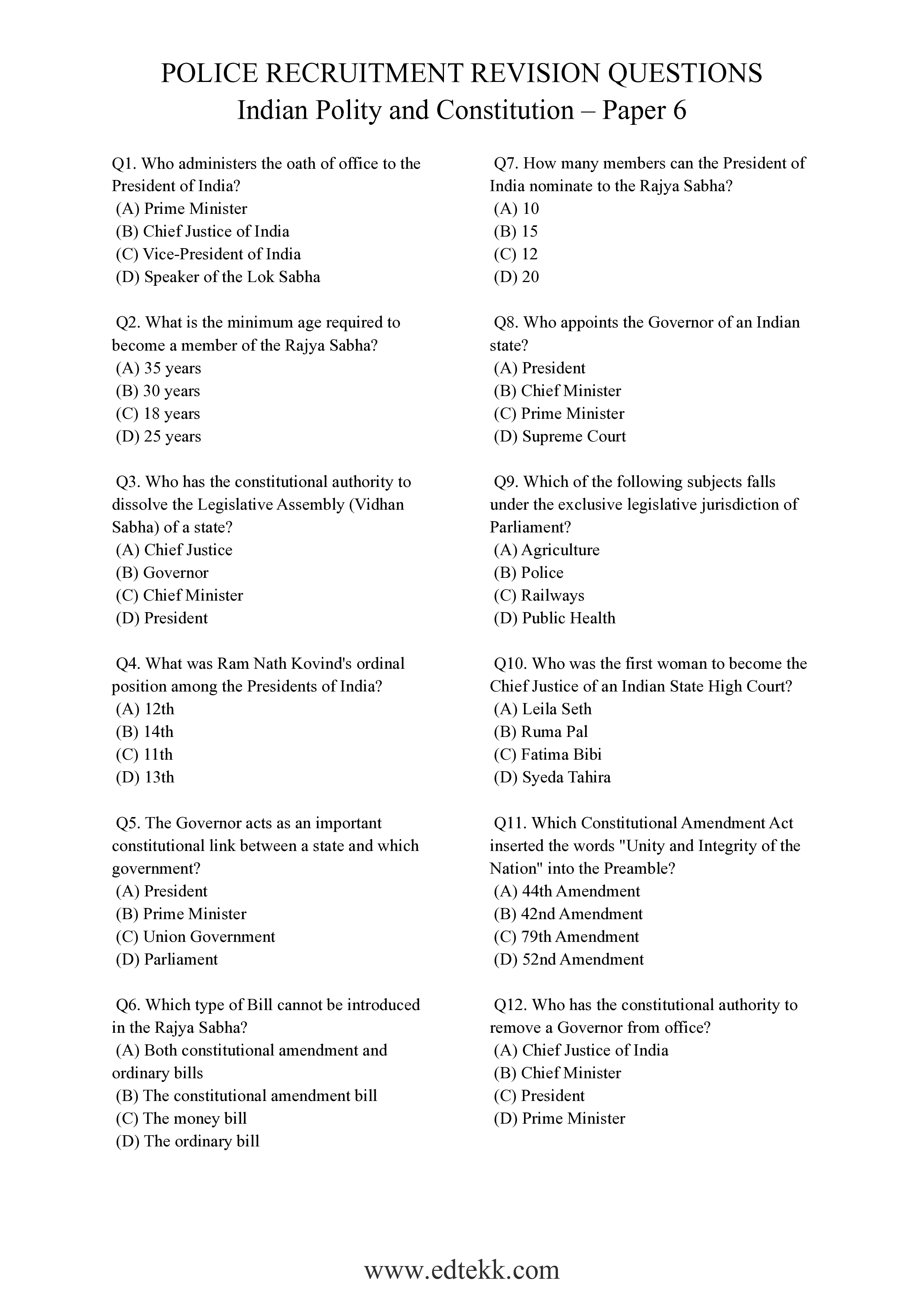
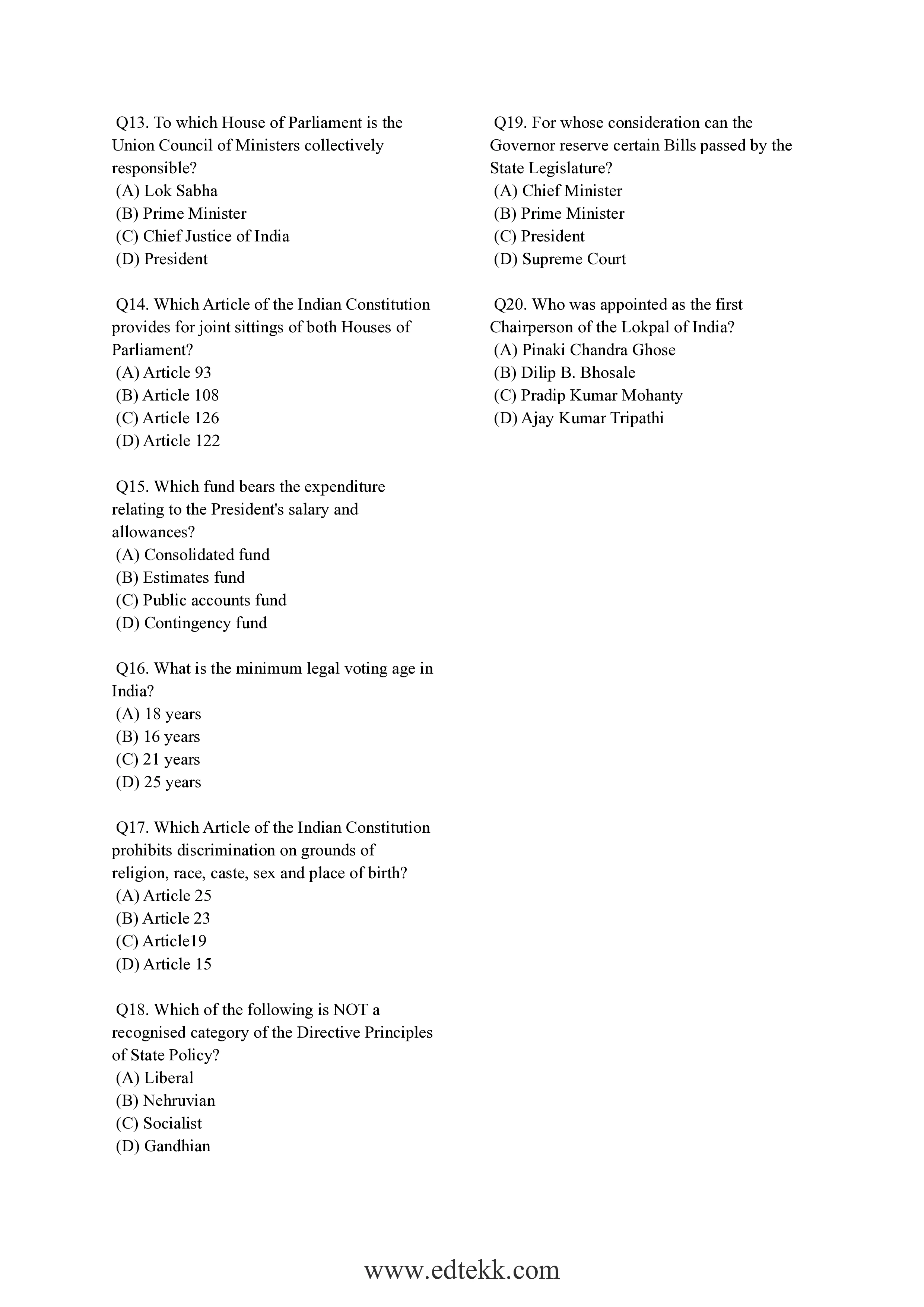
Get ready for Police Constable and Police SI examinations with Indian Polity and Constitution revision practice (Paper 6). This set includes 20 multiple-choice questions covering the subject, with correct answers and explanations to help aspirants revise important concepts, assess their preparation and strengthen exam performance.
Test Details
Topic: Indian Polity and Constitution
Total Questions: 20
Question Format: MCQs – Single Correct Answer
Suitable for: Police Constable, Police SI
Download All Papers in This Series (PDF)
Questions and Answers
Q1. Which Constitutional Amendment Act made the right to form cooperative societies a Fundamental Right?
(A) 83rd Amendment
(B) 97th Amendment
(C) 105th Amendment
(D) 118th Amendment
Explanation: The 97th Constitutional Amendment Act, 2011, amended Article 19(1)(c) to include the fundamental right to form cooperative societies. It also introduced Article 43B and Part IXB to promote their autonomous and democratic functioning. The Supreme Court subsequently invalidated Part IXB insofar as it applied to state cooperative societies.
Q2. Which of the following is not one of the three constitutionally recognised categories of municipalities in India?
(A) Municipal Council
(B) Municipal Corporation
(C) Nagar Panchayat
(D) Tehsil Parishad
Explanation: A Tehsil Parishad is not one of the three principal constitutional categories of urban municipality in India. Article 243Q provides for Municipal Corporations, Municipal Councils and Nagar Panchayats, corresponding broadly to larger urban areas, smaller urban areas and areas transitioning from rural to urban settlements.
Q3. How many Fundamental Duties were originally incorporated into the Indian Constitution?
(A) 5
(B) 9
(C) 10
(D) 11
Explanation: The Indian Constitution originally contained ten Fundamental Duties, introduced through the 42nd Constitutional Amendment Act, 1976, under Article 51A. The 86th Constitutional Amendment Act, 2002, added the eleventh duty, requiring parents or guardians to provide educational opportunities to children or wards aged 6–14 years.
Q4. Which Article of the Indian Constitution guarantees the Right to Education?
(A) Article 21
(B) Article 21A
(C) Article 29
(D) Article 19
Explanation: Article 21A of the Indian Constitution guarantees the Fundamental Right to Education for children aged six to fourteen years. It directs the State to provide free and compulsory education to children in this age group in the manner prescribed by law. This provision was introduced through the 86th Constitutional Amendment Act, 2002.
Q5. Who was the first Chief Minister of Delhi representing the Aam Aadmi Party (AAP)?
(A) Sheila Dikshit
(B) Arvind Kejriwal
(C) Kiran Bedi
(D) Manish Sisodia
Explanation: Arvind Kejriwal became the first Chief Minister of Delhi from the Aam Aadmi Party (AAP) on 28 December 2013. He initially served until February 2014, when his government resigned after 49 days. He subsequently returned as Chief Minister in February 2015 following AAP’s victory in the Delhi Assembly elections.
Q6. Which Houses of Parliament can the President summon and prorogue?
(A) Both Houses of Parliament
(B) Lok Sabha only
(C) Rajya Sabha only
(D) State Legislatures
Explanation: Under Article 85, the President summons and prorogues both Houses of Parliament: the Lok Sabha and the Rajya Sabha. The President may also dissolve the Lok Sabha. The Rajya Sabha is a permanent House and is not subject to dissolution.
Q7. Under which category of offences can the police arrest an accused without a warrant, subject to the law?
(A) Non-Cognizable offences
(B) Detention offences
(C) Cross offences
(D) Cognizable offences
Explanation: Cognizable offences are those in which the police may register a case and arrest an accused without a warrant, subject to the conditions prescribed by law. In non-cognizable offences, the police generally require a Magistrate’s order to investigate and cannot ordinarily make an arrest without a warrant.
Q8. How many Fundamental Duties are currently provided for under the Indian Constitution?
(A) 5
(B) 10
(C) 11
(D) 20
Explanation: The Indian Constitution provides for 11 Fundamental Duties under Article 51A. Initially, ten duties were introduced through the 42nd Constitutional Amendment Act, 1976. The 86th Constitutional Amendment Act, 2002, added the eleventh duty, requiring parents or guardians to provide educational opportunities to children or wards aged 6–14 years.
Q9. Which political party in India uses the bicycle as its election symbol?
(A) Bharatiya Janata Party
(B) Rashtriya Janata Dal
(C) Samajwadi Party
(D) Indian National Congress
Explanation: The bicycle is the reserved election symbol of the Samajwadi Party (SP). Founded in 1992, the party is primarily based in Uttar Pradesh and has a significant presence in the state’s political landscape.
Q10. Which Union Territory was granted a Legislative Assembly and a Council of Ministers under the 69th Constitutional Amendment Act?
(A) Chandigarh
(B) Delhi
(C) Puducherry
(D) Lakshadweep
Explanation: The 69th Constitutional Amendment Act, 1991, provided special constitutional status to Delhi by designating it as the National Capital Territory of Delhi. It introduced Article 239AA, providing for a Legislative Assembly and a Council of Ministers headed by the Chief Minister, subject to specified constitutional limitations.
Q11. What is the normal term of a Panchayati Raj Institution in India?
(A) 5 years
(B) 2 years
(C) 3 years
(D) 4 years
Explanation: Under Article 243E of the Constitution, every Panchayati Raj Institution has a five-year term from the date appointed for its first meeting, unless dissolved earlier. If dissolved prematurely, elections must generally be completed within six months. However, this requirement does not apply when the remaining term is less than six months.
Q12. In which year did the Supreme Court of India come into existence?
(A) 1952
(B) 1955
(C) 1948
(D) 1950
Explanation: The Supreme Court of India came into existence on 26 January 1950, when the Constitution of India came into force. It replaced the Federal Court of India, established in 1937. The Supreme Court formally commenced its proceedings on 28 January 1950.
Q13. Which Article of the Indian Constitution provides for the establishment of the Finance Commission?
(A) Article 280
(B) Article 270
(C) Article 260
(D) Article 250
Explanation: Article 280 of the Constitution of India provides for the establishment of the Finance Commission. The President constitutes the Commission every five years or earlier, if necessary. Its principal responsibility is to recommend the distribution of tax revenues between the Union and the States and the principles governing grants-in-aid to States.
Q14. Which of the following is NOT among the fields of special knowledge or practical experience specified for the President’s nominees to the Rajya Sabha?
(A) Science
(B) Eloquence
(C) Art
(D) Literature
Explanation: Under Article 80(3) of the Constitution, the President nominates 12 members to the Rajya Sabha having special knowledge or practical experience in literature, science, art or social service. Eloquence is not among the four specified fields. These nominated members contribute their specialised knowledge and experience to parliamentary deliberations.
Q15. Who was the first Chief Justice of independent India?
(A) Bijan Mukherjee
(B) AR Sarkar
(C) Harilal Kania
(D) YV Chandrachud
Explanation: Justice Harilal Jekisundas Kania was the first Chief Justice of independent India and the first Chief Justice of the Supreme Court of India. He assumed office on 26 January 1950, when the Constitution came into force, and served until 1951.
Q16. Who appoints the Attorney General of India?
(A) Speaker
(B) Prime Minister
(C) President
(D) Chief Justice of India
Explanation: Under Article 76, the President appoints the Attorney General of India, who must be qualified for appointment as a Supreme Court judge. The Attorney General is the highest law officer of the Union Government and advises the Government of India on legal matters.
Q17. Who is the constitutional Supreme Commander of the Indian Armed Forces?
(A) President
(B) Prime Minister
(C) Defence Minister
(D) Chief of Defence Staff
Explanation: The President of India is the constitutional Supreme Commander of the Indian Armed Forces, comprising the Army, Navy and Air Force. However, the elected government, acting through the Ministry of Defence and established military command structures, manages defence administration and operational matters.
Q18. How many elected seats does the Lok Sabha currently have?
(A) 252
(B) 543
(C) 555
(D) 630
Explanation: The Lok Sabha currently has 543 elected seats representing territorial constituencies across India’s states and Union Territories. Members are directly elected by eligible voters through general elections. This figure represents the sanctioned elected strength of the House, not the constitutional maximum of 550 members. Actual membership may temporarily be lower because of vacancies.
Q19. Which legislative body has the authority to make laws governing Panchayati Raj institutions?
(A) State Legislature
(B) Central Government
(C) President of India
(D) Union Cabinet
Explanation: State Legislatures have the principal authority to enact laws governing Panchayati Raj institutions, including their composition, powers and functions, subject to the Constitution. Part IX establishes the constitutional framework, while state laws provide the detailed operational arrangements.
Q20. Who succeeded Morarji Desai as Prime Minister of India in 1979?
(A) Chandrasekhar
(B) Devi Lal
(C) Charan Singh
(D) Jagjivan Ram
Explanation: Charan Singh replaced Morarji Desai as Prime Minister on 28 July 1979. He became India’s fifth Prime Minister and remained in office until January 1980. His government could not face a confidence vote in the Lok Sabha because the Congress withdrew its support before the vote.
Question Paper Images