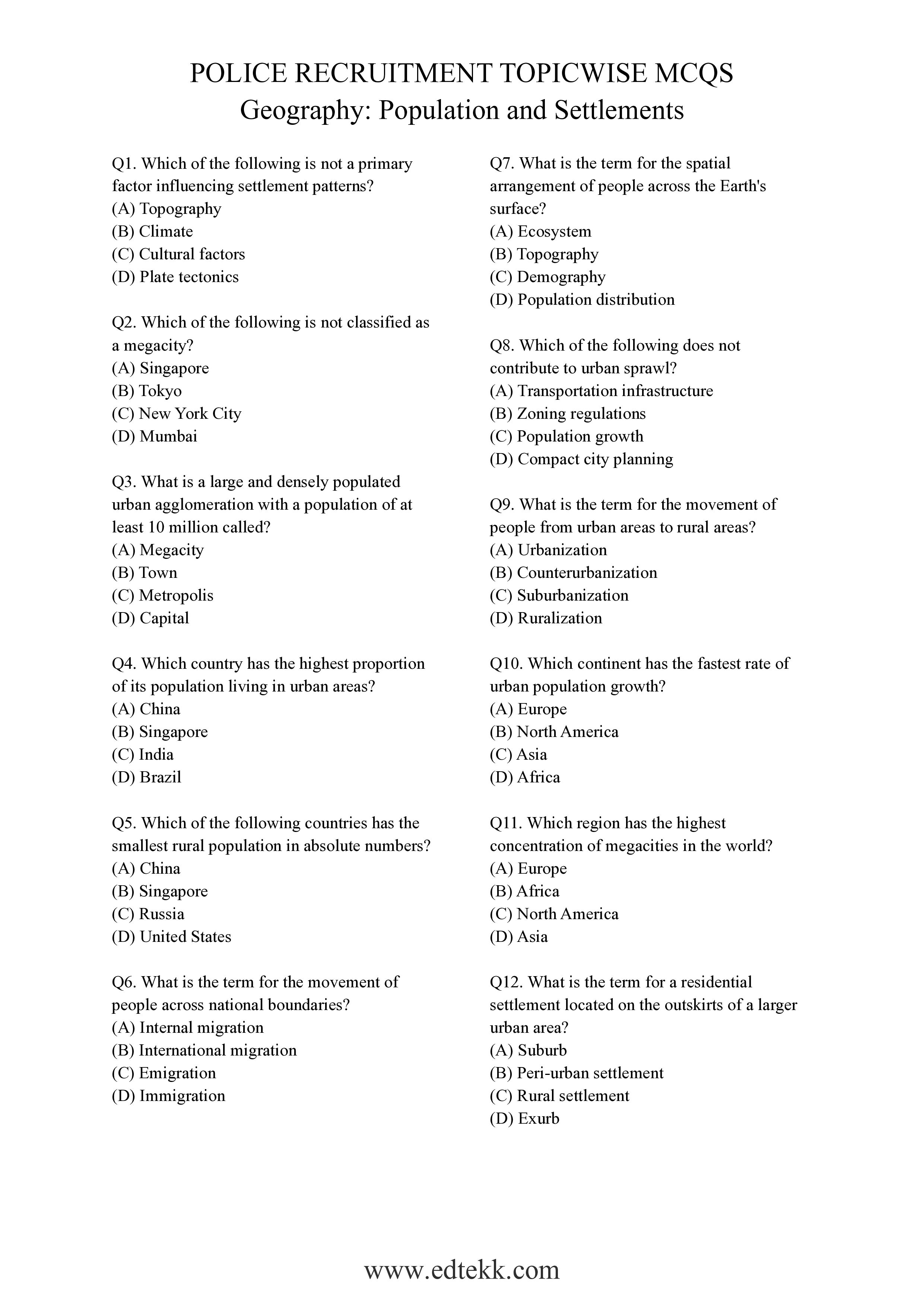
Enhance your Geography preparation for Police Constable and Police SI examinations with MCQs on population and settlements. This question set covers population distribution, density, growth, migration, census concepts, rural and urban settlements and related geographical patterns, with important practice questions, correct answers and detailed explanations.
Test Details
Topic: Geography: Population and Settlements
Total Questions: 20
Question Format: MCQs – Single Correct Answer
Suitable for: Police Constable, Police SI
Download All Papers in This Series (PDF)
Questions and Answers
Q1. Which of the following is not a primary factor influencing settlement patterns?
(A) Topography
(B) Climate
(C) Cultural factors
(D) Plate tectonics
Explanation: Settlement patterns are influenced by topography, climate, water availability, soil fertility, economic opportunities, transportation and cultural factors. Plate tectonics affects the Earth’s geological structure and can indirectly influence settlements through earthquakes, mountain formation and landforms. However, it is not generally considered a direct, primary determinant of settlement patterns.
Q2. Which of the following is not classified as a megacity?
(A) Singapore
(B) Tokyo
(C) New York City
(D) Mumbai
Explanation: Singapore is not classified as a megacity because its population does not meet the conventional threshold of 10 million inhabitants in an urban agglomeration. Tokyo, New York City and Mumbai have urban agglomerations exceeding this threshold. Megacity classification depends on population size rather than administrative boundaries.
Q3. What is a large and densely populated urban agglomeration with a population of at least 10 million called?
(A) Megacity
(B) Town
(C) Metropolis
(D) Capital
Explanation: A megacity is an urban agglomeration with a population of at least 10 million people. Megacities are characterised by extensive built-up areas, high population concentrations and complex economic and transportation networks. The classification is based primarily on population size rather than administrative status or political importance.
Q4. Which country has the highest proportion of its population living in urban areas?
(A) China
(B) Singapore
(C) India
(D) Brazil
Explanation: Singapore has an urban population proportion close to 100% under standard international demographic classifications. China, India and Brazil also have substantial urban populations but retain significant rural populations. The question concerns the proportion of urban residents, not their absolute number.
Q5. Which of the following countries has the smallest rural population in absolute numbers?
(A) China
(B) Singapore
(C) Russia
(D) United States
Explanation: Singapore has a very small rural population compared with China, Russia and the United States. It is a highly urbanised city-state with very limited land classified as rural. The question concerns absolute rural population rather than the percentage of the population living in rural areas, making Singapore the correct answer.
Q6. What is the term for the movement of people across national boundaries?
(A) Internal migration
(B) International migration
(C) Emigration
(D) Immigration
Explanation: International migration refers to the movement of people across national boundaries to reside temporarily or permanently in another country. Emigration means leaving one’s country, whereas immigration means entering another country. Internal migration takes place within the boundaries of a single country.
Q7. What is the term for the spatial arrangement of people across the Earth’s surface?
(A) Ecosystem
(B) Topography
(C) Demography
(D) Population distribution
Explanation: Population distribution describes the spatial arrangement of people across the Earth’s surface. It is generally uneven because of differences in climate, relief, water availability, soil fertility, economic opportunities and infrastructure. Demography studies population characteristics and changes, while topography describes the physical features of the land.
Q8. Which of the following does not contribute to urban sprawl?
(A) Transportation infrastructure
(B) Zoning regulations
(C) Population growth
(D) Compact city planning
Explanation: Compact city planning discourages urban sprawl by promoting high-density development, mixed land use and efficient utilisation of existing infrastructure. In contrast, transportation infrastructure and population growth can encourage outward urban expansion. Certain zoning regulations may also contribute to sprawl depending on their implementation.
Q9. What is the term for the movement of people from urban areas to rural areas?
(A) Urbanization
(B) Counterurbanization
(C) Suburbanization
(D) Ruralization
Explanation: Counterurbanization refers to the movement of people from large urban areas to smaller towns, villages and rural locations. It differs from suburbanization, which involves movement from central cities to surrounding suburbs. Counterurbanization may be driven by housing costs, lifestyle preferences, remote-working opportunities and the desire for less densely populated environments.
Q10. Which continent has the fastest rate of urban population growth?
(A) Europe
(B) North America
(C) Asia
(D) Africa
Explanation: Africa is generally identified as the continent with the fastest rate of urban population growth. Rapid natural population increase, rural-to-urban migration and the expansion of towns and cities contribute to this trend. The rate of urban growth refers to the percentage increase over time, rather than the absolute number of additional urban residents.
Q11. Which region has the highest concentration of megacities in the world?
(A) Europe
(B) Africa
(C) North America
(D) Asia
Explanation: Asia has the largest concentration of megacities in the world. Rapid population growth, industrialisation, economic development and rural-to-urban migration have contributed to the emergence of numerous megacities across South, East and Southeast Asia. Examples include Tokyo, Delhi, Shanghai and Dhaka.
Q12. What is the term for a residential settlement located on the outskirts of a larger urban area?
(A) Suburb
(B) Peri-urban settlement
(C) Rural settlement
(D) Exurb
Explanation: A suburb is a residential area or settlement situated on the outskirts of a larger urban centre and generally connected to it through economic and social activities. Peri-urban areas form transitional zones between urban and rural land uses, while exurbs are generally located farther from the urban core.
Q13. What is the term for the process in which the proportion of the population living in urban areas increases relative to the rural population?
(A) Suburbanization
(B) Ruralization
(C) Urbanization
(D) Counterurbanization
Explanation: Urbanization refers to an increase in the proportion of the population living in urban areas relative to rural areas. It results from rural-to-urban migration, natural population growth in cities and the reclassification of settlements. Counterurbanization involves movement away from large cities, whereas suburbanization involves movement towards surrounding suburbs.
Q14. Which of the following countries has the highest proportion of its population living in urban areas?
(A) Brazil
(B) China
(C) Singapore
(D) India
Explanation: Singapore has an urban population proportion approaching 100% under standard international demographic classifications. Brazil and China also have high levels of urbanisation, while India’s urbanisation proportion is comparatively lower. The question concerns the percentage of the population living in urban areas, not the absolute number of urban residents.
Q15. What is the term for leaving one’s home country to settle in another country?
(A) Emigration
(B) Internal migration
(C) International migration
(D) Immigration
Explanation: Emigration is the act of leaving one’s home country to settle in another country. Immigration refers to entering another country to establish residence there. International migration is the broader term covering movement between countries, whereas internal migration occurs within a country’s borders. Therefore, emigration is the precise term for departure from one’s home country.
Q16. What is the term for a temporary settlement typically established for activities such as mining or construction?
(A) Hamlet
(B) Camp
(C) Suburb
(D) Colony
Explanation: A camp is a temporary settlement established to accommodate people engaged in activities such as mining, construction, logging or other projects in remote locations. Such settlements generally provide temporary housing and basic facilities for workers. A hamlet is usually a small permanent settlement, whereas a suburb forms part of a larger urban area.
Q17. What is the term for the movement of people within the boundaries of a country?
(A) Immigration
(B) Emigration
(C) International migration
(D) Internal migration
Explanation: Internal migration refers to the movement of people from one geographical location to another within the national boundaries of the same country. It includes rural-to-urban migration, urban-to-rural migration and movement between states or regions. Immigration and emigration involve movement across international boundaries.
Q18. What is the term for a very small rural settlement, generally smaller than a village?
(A) Metropolis
(B) Megalopolis
(C) Borough
(D) Hamlet
Explanation: A hamlet is a very small rural settlement, generally smaller than a village. It usually consists of a small group of houses with limited public facilities and services. Hamlets are often associated with agricultural communities and may form part of a larger village or administrative unit.
Q19. Which of the following is a major pull factor attracting people from rural areas to cities?
(A) Access to agricultural land
(B) Traditional lifestyle
(C) Better job opportunities
(D) Close-knit community
Explanation: Better job opportunities are a major pull factor attracting people from rural areas to cities. Urban centres generally provide a wider range of employment opportunities in manufacturing, services, trade and administration. Access to agricultural land, traditional lifestyles and close-knit rural communities may encourage people to remain in rural areas.
Q20. Which of the following countries has the largest rural population in absolute numbers?
(A) China
(B) United States
(C) India
(D) Brazil
Explanation: India has the world’s largest rural population in recent demographic estimates. Although China historically had the largest rural population, rapid urbanisation has reduced its rural population substantially. This question concerns the absolute number of rural residents rather than the percentage of the population living in rural areas.
Question Paper Images