Improve your Indian Geography preparation for Police Constable and Police SI examinations with MCQs on the soils of India. This practice set covers major soil types, their characteristics, distribution, agricultural suitability and regional occurrence. It includes exam-oriented questions, correct answers and detailed explanations for effective revision.
Test Details
Topic: Geography: Soils of India
Total Questions: 20
Question Format: MCQs – Single Correct Answer
Suitable for: Police Constable, Police SI
Download All Papers in This Series (PDF)
Questions and Answers
Q1. What is the process of preventing soil erosion through measures such as hedges, trenches and bunds known as?
(A) Soil enrichment
(B) Soil conservation
(C) Soil degradation
(D) Soil aeration
Explanation: Soil conservation refers to the protection and sustainable management of soil to prevent erosion and degradation. Measures such as planting hedges, constructing trenches, building bunds and practising contour farming reduce surface runoff and soil loss. These techniques help maintain soil fertility and support sustainable agricultural production.
Q2. Which measures can be implemented to prevent soil erosion?
(A) Intensive grazing
(B) Deforestation
(C) Overgrazing
(D) Implementing soil conservation measures
Explanation: Soil erosion can be prevented or reduced through soil conservation measures such as contour ploughing, terracing, afforestation, mulching and controlled grazing. These practices reduce surface runoff, protect the soil from wind and water action, and help maintain soil structure and fertility.
Q3. What do soil conservation methods primarily aim to prevent?
(A) Soil enrichment
(B) Soil compaction
(C) Soil erosion and degradation
(D) Soil acidity
Explanation: Soil conservation aims to prevent soil erosion and degradation while maintaining soil productivity and ecological stability. Techniques such as contour ploughing, terracing, afforestation, crop rotation and bund construction help protect fertile topsoil, reduce surface runoff and maintain the long-term health of agricultural land.
Q4. What does the pH value of soil primarily indicate?
(A) Acidity or alkalinity
(B) Soil fertility
(C) Soil texture
(D) Soil compaction
Explanation: Soil pH measures the acidity or alkalinity of soil based on hydrogen ion activity in the soil solution. The conventional pH scale ranges from 0 to 14, with 7 representing neutrality. Values below 7 indicate acidic soil, while values above 7 indicate alkaline soil.
Q5. Which Indian state has extensive areas of red soil?
(A) Uttar Pradesh
(B) West Bengal
(C) Tamil Nadu
(D) Punjab
Explanation: Tamil Nadu has extensive areas of red soil, particularly in its interior regions. Red soils are also widespread across Karnataka, Andhra Pradesh, Telangana and parts of Odisha and Maharashtra. Their characteristic colour results from iron oxide compounds formed during the weathering of iron-bearing rocks.
Q6. Which component of soil provides organic matter and plays a major role in maintaining soil fertility?
(A) Clay
(B) Sand
(C) Humus
(D) Silt
Explanation: Humus is the dark organic component of soil formed through the decomposition of dead plants, animals and other organic materials. It contributes to soil fertility by improving nutrient availability, enhancing water retention and improving soil structure. Clay, sand and silt are primarily inorganic mineral particles.
Q7. What does soil erosion cause the loss of?
(A) Soil compaction
(B) Soil acidity
(C) Nutrients and topsoil
(D) Soil pH
Explanation: Soil erosion removes the nutrient-rich upper layer of soil, resulting in the loss of essential plant nutrients and organic matter. This reduces soil fertility and agricultural productivity. Severe erosion may also expose less fertile subsoil, adversely affecting vegetation growth and accelerating land degradation.
Q8. Which soil type is rich in iron compounds and is widely found in the southern part of the Indian Peninsula?
(A) Red soil
(B) Laterite soil
(C) Black soil
(D) Alluvial soil
Explanation: Red soil contains iron compounds, particularly iron oxides, which impart its characteristic reddish colour. It is widely distributed across the southern Indian Peninsula, including Tamil Nadu, Karnataka and Andhra Pradesh. Its fertility is generally moderate to low and depends on its composition, nutrient content and agricultural management.
Q9. Which soil type is commonly found in river basins and is highly fertile because of sediment deposition?
(A) Laterite soil
(B) Black soil
(C) Red soil
(D) Alluvial soil
Explanation: Alluvial soil develops through the deposition of sediments transported by rivers. It is commonly found in river valleys, floodplains and deltas. Its generally high fertility results from the accumulation of mineral-rich sediments, making it particularly suitable for intensive agriculture.
Q10. Which of the following is not recognised as a major type of soil found in India?
(A) Yellow soil
(B) Green soil
(C) Black soil
(D) Red soil
Explanation: Green soil is not recognised as a major soil group in the conventional classification of Indian soils. Major soil groups include alluvial, black, red and yellow, laterite, arid, and forest or mountain soils. Red and yellow soils are often classified together, whereas green soil is not a standard category.
Q11. Which of the following factors is not traditionally included among the natural factors influencing soil formation?
(A) Human population
(B) Climate
(C) Topography
(D) Parent material
Explanation: Human population is not traditionally included among the five fundamental natural factors of soil formation. These are climate, organisms, relief or topography, parent material and time. However, human activities can indirectly influence soil conditions through deforestation, land-use changes and intensive agriculture.
Q12. Which factors can accelerate soil erosion?
(A) Planting cover crops
(B) Soil conservation practices
(C) Mulching
(D) Deforestation and overgrazing
Explanation: Deforestation and overgrazing accelerate soil erosion by reducing protective vegetation cover. Without sufficient vegetation, rainfall directly strikes the soil surface, increasing runoff and removing topsoil. Overgrazing further damages plant cover and exposes the soil to wind and water erosion.
Q13. By what alternative name is black soil commonly known in India?
(A) Laterite soil
(B) Alluvial soil
(C) Mountain soil
(D) Regur soil
Explanation: Black soil is commonly known as Regur soil or black cotton soil. It is widespread across the Deccan Plateau and is particularly suitable for cotton cultivation because of its high clay content and moisture-retention capacity. It develops mainly from the weathering of basaltic rocks.
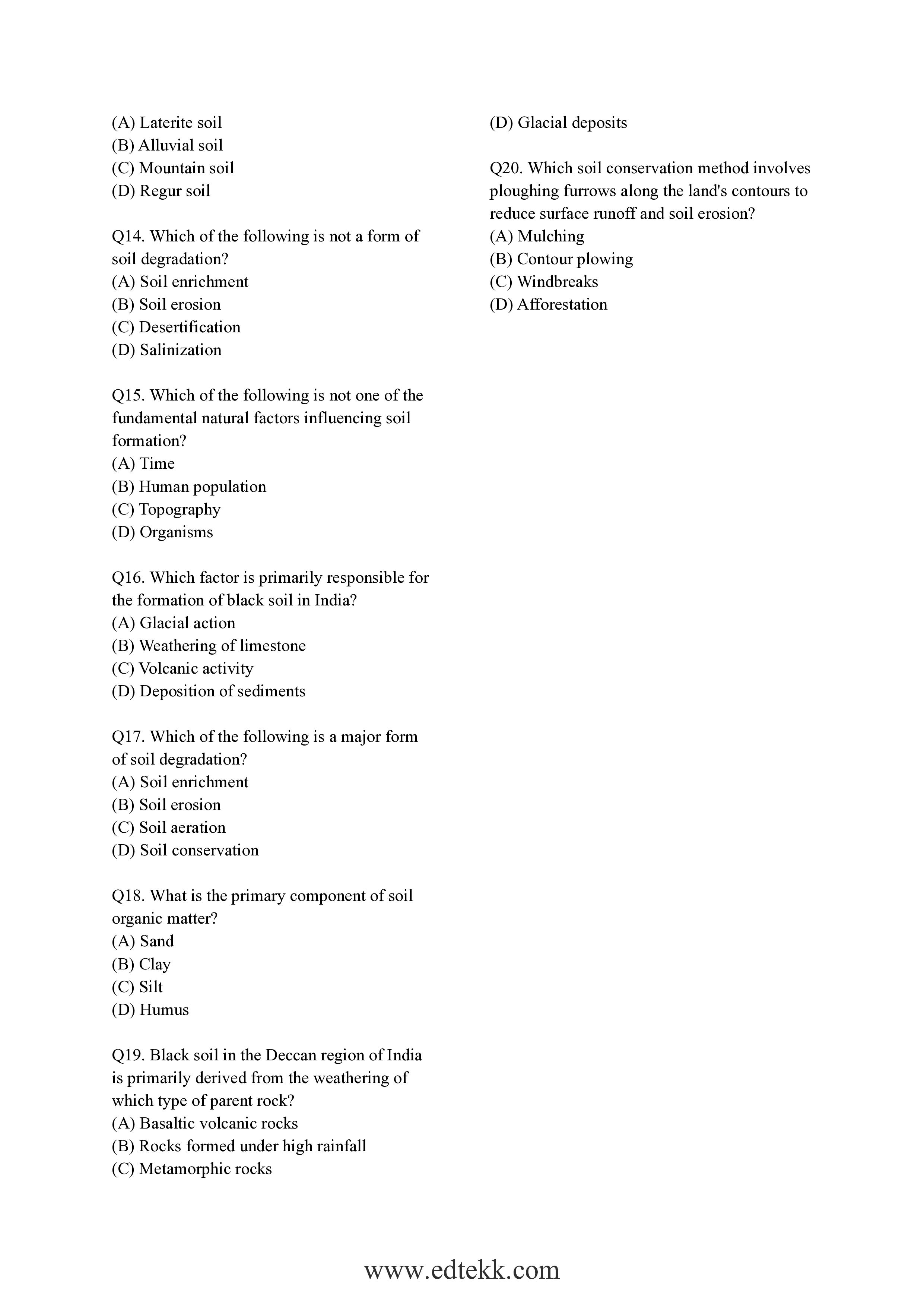
Q14. Which of the following is not a form of soil degradation?
(A) Soil enrichment
(B) Soil erosion
(C) Desertification
(D) Salinization
Explanation: Soil enrichment improves soil quality and fertility rather than degrading it. In contrast, soil erosion removes fertile topsoil, desertification reduces the biological productivity of drylands, and salinization causes excessive accumulation of soluble salts. These degradation processes adversely affect soil quality, agricultural productivity and ecosystem functioning.
Q15. Which of the following is not one of the fundamental natural factors influencing soil formation?
(A) Time
(B) Human population
(C) Topography
(D) Organisms
Explanation: Human population is not one of the five fundamental natural factors of soil formation. These factors are climate, parent material, topography, organisms and time. Although human activities can significantly influence soil formation, modification and degradation, population itself is not conventionally included among these five factors.
Q16. Which factor is primarily responsible for the formation of black soil in India?
(A) Glacial action
(B) Weathering of limestone
(C) Volcanic activity
(D) Deposition of sediments
Explanation: Black soil in India is primarily associated with the weathering of basaltic lava rocks formed through volcanic activity, particularly in the Deccan Trap region. It contains clay minerals, especially montmorillonite, which provide high moisture-retention capacity and cause characteristic swelling and shrinking during wet and dry conditions.
Q17. Which of the following is a major form of soil degradation?
(A) Soil enrichment
(B) Soil erosion
(C) Soil aeration
(D) Soil conservation
Explanation: Soil erosion is a major form of soil degradation involving the removal of fertile topsoil by water, wind or other agents. It reduces soil depth, nutrient availability and agricultural productivity. In contrast, soil enrichment, aeration and conservation are generally beneficial soil-management practices.
Q18. What is the primary component of soil organic matter?
(A) Sand
(B) Clay
(C) Silt
(D) Humus
Explanation: Humus is the dark, relatively stable organic component of soil formed through the decomposition and transformation of plant and animal remains by microorganisms. It improves soil fertility, enhances nutrient availability, increases water retention and contributes to better soil structure. Sand, clay and silt are mineral soil particles.
Q19. Black soil in the Deccan region of India is primarily derived from the weathering of which type of parent rock?
(A) Basaltic volcanic rocks
(B) Rocks formed under high rainfall
(C) Metamorphic rocks
(D) Glacial deposits
Explanation: The black soil of the Deccan Plateau is primarily derived from the weathering of basaltic volcanic rocks associated with the Deccan Trap formations. These soils contain clay minerals, particularly montmorillonite, which give them high moisture-retention capacity and characteristic swelling and shrinking properties. They are particularly suitable for cotton cultivation.
Q20. Which soil conservation method involves ploughing furrows along the land’s contours to reduce surface runoff and soil erosion?
(A) Mulching
(B) Contour plowing
(C) Windbreaks
(D) Afforestation
Explanation: Contour ploughing involves cultivating agricultural land along lines of equal elevation rather than up and down a slope. The furrows act as barriers that slow surface runoff, increase water infiltration and reduce the removal of fertile topsoil. This technique is particularly useful in sloping agricultural areas.
Question Paper Images