Master Ancient Indian History with topicwise MCQs for Police Constable and Police SI examinations. This question set covers the Indus Valley Civilisation, Vedic period, Mahajanapadas, Mauryan and Gupta empires, religious movements, ancient kingdoms and important historical developments, with practice questions, correct answers and explanations.
Test Details
Topic: History: Ancient India
Total Questions: 20
Question Format: MCQs – Single Correct Answer
Suitable for: Police Constable, Police SI
Download All Papers in This Series (PDF)
Questions and Answers
Q1. Which of the following was not a prescribed ethical principle of Ashoka’s Dhamma?
(A) Obedience to parents
(B) Charity
(C) Faith in the Buddhist Sangha
(D) Respect for elders
Explanation: Ashoka’s Dhamma emphasised moral conduct, respect for parents and elders, kindness, charity, non-violence and tolerance towards different religious communities. It was a broad ethical and social philosophy intended to promote harmony and moral responsibility. Mandatory faith in the Buddhist Sangha was not a prescribed principle of Dhamma, which was intended to have wider social applicability beyond Buddhism.
Q2. Which dynasty is particularly renowned for its highly polished, freestanding monolithic stone pillars?
(A) Gothic tradition
(B) Achaemenid dynasty
(C) Mauryan dynasty
(D) Mughal dynasty
Explanation: The Mauryan dynasty is particularly famous for its highly polished, freestanding stone pillars, many of which were erected during Emperor Ashoka’s reign. These monolithic pillars were carved from single blocks of stone and often carried inscriptions promoting moral conduct and Dhamma. The Lion Capital at Sarnath is among the most celebrated examples of Mauryan artistic achievement.
Q3. What are the traditional collections of Vedic hymns and mantras called?
(A) Samhita
(B) Vidatha
(C) Jnati
(D) Bali
Explanation: Samhitas are collections of Vedic hymns, prayers and mantras. The four principal Vedic Samhitas are the Rigveda, Samaveda, Yajurveda and Atharvaveda. Each contains sacred compositions associated with different religious and ritual traditions.
Q4. The Barabar Caves, among the oldest surviving rock-cut caves in India, primarily belong to which historical period?
(A) Gupta Empire
(B) Chola Dynasty
(C) Chera Dynasty
(D) Maurya Empire
Explanation: The Barabar Caves were excavated during the Mauryan period, mainly in the third century BCE, under the patronage of Ashoka and his successors. Several inscriptions record donations to the Ajivika sect. Their remarkably smooth, polished granite interiors demonstrate sophisticated Mauryan stone-working techniques. These caves are among the earliest surviving examples of India’s rock-cut architectural tradition.
Q5. Kanishka was a prominent ruler of which ancient Indian dynasty?
(A) Satavahana Dynasty
(B) Kushan Dynasty
(C) Chola Dynasty
(D) Maurya Dynasty
Explanation: Kanishka was a prominent ruler of the Kushan dynasty. His empire extended across substantial parts of Central Asia and northern India. He made Purushapura (modern Peshawar) and Mathura important centres of administration. Mathura also flourished as a major centre of Buddhist, Jain and Hindu art and culture under Kushan rule.
Q6. Which Mauryan emperor is prominently identified by the title ‘Devanampiya Piyadasi’ in his inscriptions?
(A) Ashoka
(B) Kanishka
(C) Amoghavarsha
(D) Kharavela
Explanation: Emperor Ashoka was prominently identified by the title Devanampiya Piyadasi in his inscriptions. Devanampiya means ‘Beloved of the Gods’, while Piyadasi means ‘of pleasing appearance’ or ‘of gracious mien’. The identification of Ashoka with Piyadasi is established through historical inscriptions, particularly the Maski inscription, which explicitly mentions Ashoka by name.
Q7. Which Rashtrakuta ruler performed the ritual known as Hiranyagarbha?
(A) Dantidurga
(B) Govinda I
(C) Dhruva Dharavarsha
(D) Krishna I
Explanation: Dantidurga, the founder of Rashtrakuta imperial power, performed the Hiranyagarbha ritual. This ritual symbolically represented rebirth into the Kshatriya social order and was used by rulers to establish or legitimise their royal status. Dantidurga performed it to strengthen his political and social legitimacy.
Q8. Which Harappan site is traditionally associated with the discovery of a dockyard?
(A) Mehrgarh
(B) Lothal
(C) Mohenjo-Daro
(D) Banawali
Explanation: Lothal, located in present-day Gujarat, was an important Harappan trading settlement. Its large rectangular brick-lined basin has traditionally been interpreted as a dockyard connected to maritime trade. However, some archaeologists dispute this interpretation and suggest alternative functions. Despite this debate, Lothal remains the conventionally accepted answer in competitive examinations.
Q9. Who is traditionally credited with composing the Vaisheshika Sutra?
(A) Jaimini
(B) Shankaracharya
(C) Patanjali
(D) Kanada
Explanation: Kanada, also known as Uluka and traditionally associated with the name Kashyapa, is credited with composing the Vaisheshika Sutra. Vaisheshika is one of the six orthodox schools of Indian philosophy. It analyses reality through categories such as substance, quality, action, universality, particularity and inherence. Non-existence was later recognised as a seventh category.
Q10. Which river was known as Parushni or Purushni during the Vedic period?
(A) Ravi
(B) Sutlej
(C) Beas
(D) Chenab
Explanation: The Ravi River was known as Parushni or Purushni during the Vedic period. It is one of the five rivers of the Punjab region and is mentioned in the Rigveda. The Battle of Ten Kings (Dasharajna) is traditionally associated with the banks of the Parushni River.
Q11. Along which major water body is the Sun Temple at Konark situated?
(A) Bay of Bengal
(B) Red Sea
(C) Arabian Sea
(D) Indian Ocean
Explanation: The Sun Temple at Konark is situated on the coast of Odisha, near the Bay of Bengal. Built in the 13th century under the Eastern Ganga ruler Narasimhadeva I, it is designed as a monumental stone chariot dedicated to the Sun God and is renowned for its architectural excellence.
Q12. Sriperumbudur is traditionally recognised as the birthplace of which philosopher?
(A) Sri Madhvacharya
(B) Sri Ramanujacharya
(C) Sri Basavanna
(D) Sri Shankaracharya
Explanation: Sri Ramanujacharya, the philosopher and theologian who propounded the Vishishtadvaita school of Vedanta, was born at Sriperumbudur in present-day Tamil Nadu. He played a significant role in the development of the Sri Vaishnava tradition and the Bhakti movement in medieval India.
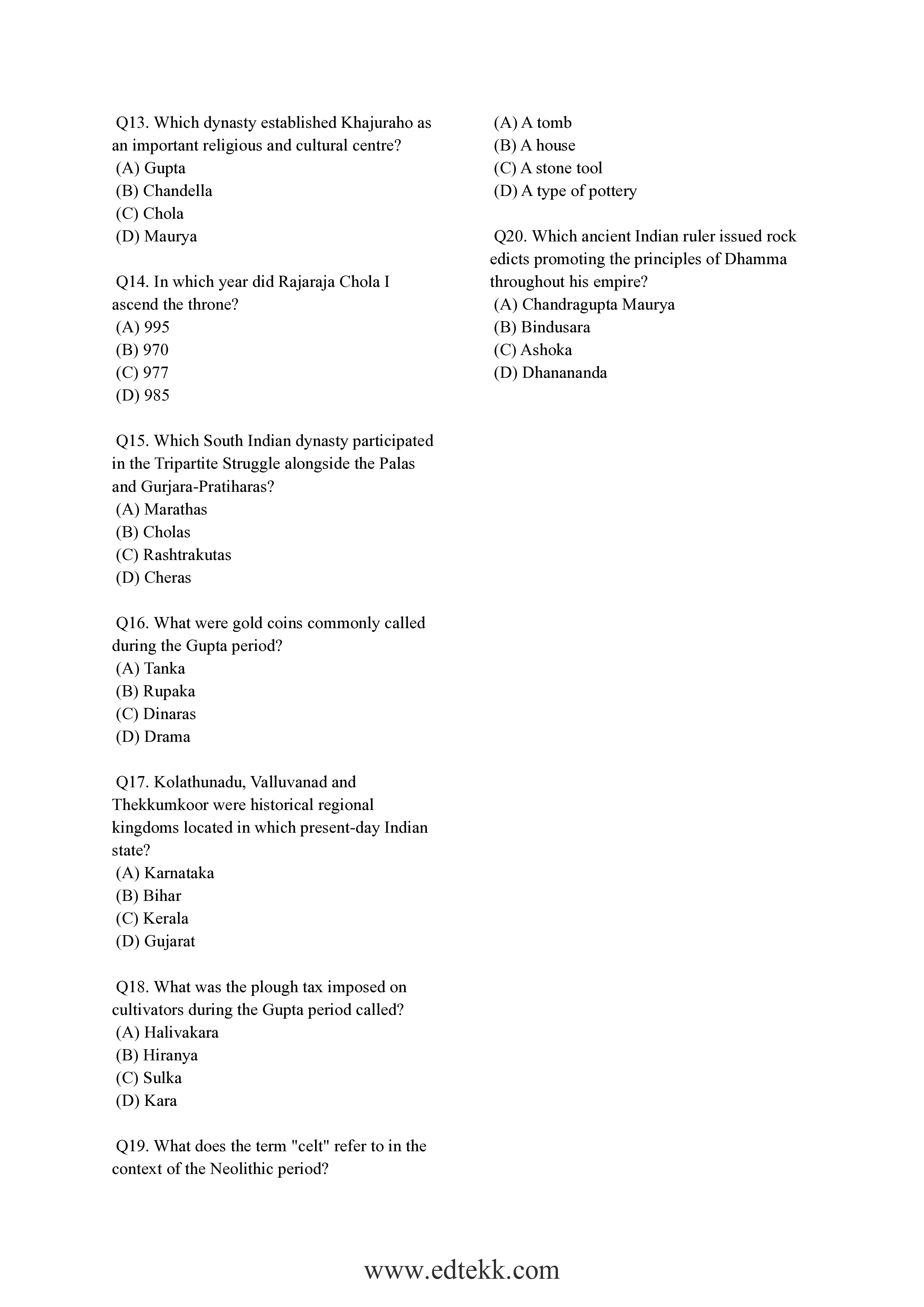
Q13. Which dynasty established Khajuraho as an important religious and cultural centre?
(A) Gupta
(B) Chandella
(C) Chola
(D) Maurya
Explanation: The Chandella rulers established Khajuraho as an important religious and cultural centre in central India. They patronised the construction of numerous Hindu and Jain temples, particularly between the tenth and eleventh centuries CE. These monuments reflect the Chandellas’ political power, religious patronage and contribution to medieval Indian temple architecture.
Q14. In which year did Rajaraja Chola I ascend the throne?
(A) 995
(B) 970
(C) 977
(D) 985
Explanation: Rajaraja Chola I ascended the Chola throne in 985 CE. He transformed the Chola kingdom into a major imperial power through military expansion, administrative reforms and naval campaigns. His reign also witnessed significant architectural achievements, particularly the construction of the Brihadisvara Temple at Thanjavur.
Q15. Which South Indian dynasty participated in the Tripartite Struggle alongside the Palas and Gurjara-Pratiharas?
(A) Marathas
(B) Cholas
(C) Rashtrakutas
(D) Cheras
Explanation: The Tripartite Struggle involved the Gurjara-Pratiharas of northern India, the Palas of eastern India and the Rashtrakutas of the Deccan. These three dynasties competed for control over Kannauj, which held considerable political and strategic importance. The conflict continued intermittently for several generations.
Q16. What were gold coins commonly called during the Gupta period?
(A) Tanka
(B) Rupaka
(C) Dinaras
(D) Drama
Explanation: Gupta gold coins were commonly known as Dinaras. They were issued in considerable quantities and frequently depicted royal activities, religious symbols and significant achievements. Gupta gold coinage provides valuable evidence of the empire’s economic conditions, political authority and artistic excellence.
Q17. Kolathunadu, Valluvanad and Thekkumkoor were historical regional kingdoms located in which present-day Indian state?
(A) Karnataka
(B) Bihar
(C) Kerala
(D) Gujarat
Explanation: Kolathunadu, Valluvanad and Thekkumkoor were historical regional kingdoms or principalities located in present-day Kerala. They formed part of the region’s complex medieval political landscape, alongside several other ruling houses and local chieftaincies. Their histories reflect the fragmented political organisation of Kerala before the formation of modern administrative boundaries.
Q18. What was the plough tax imposed on cultivators during the Gupta period called?
(A) Halivakara
(B) Hiranya
(C) Sulka
(D) Kara
Explanation: Halivakara was a tax associated with the use or ownership of a plough during the Gupta period. It is traditionally identified as a plough tax imposed on cultivators. Other taxes included Hiranya, generally associated with payments in cash or gold, and Sulka, which referred to customs duties or tolls.
Q19. What does the term “celt” refer to in the context of the Neolithic period?
(A) A tomb
(B) A house
(C) A stone tool
(D) A type of pottery
Explanation: A celt is a prehistoric stone tool commonly associated with the Neolithic period. It was generally made by grinding and polishing stone and was used as an axe, adze or woodworking implement. Celts were important agricultural and domestic tools before the widespread adoption of metal implements.
Q20. Which ancient Indian ruler issued rock edicts promoting the principles of Dhamma throughout his empire?
(A) Chandragupta Maurya
(B) Bindusara
(C) Ashoka
(D) Dhanananda
Explanation: Ashoka, the third ruler of the Mauryan Empire, issued rock and pillar edicts to communicate his principles of Dhamma. These inscriptions promoted moral conduct, compassion, non-violence, respect for elders, religious tolerance, and concern for the welfare of people and animals. They provide important evidence of Mauryan administration and royal policy.
Question Paper Images