Strengthen your Indian History preparation with Colonial India MCQs for Police Constable and Police SI examinations. This question set covers European trading companies, British expansion, colonial administration, economic policies, resistance movements, major revolts and the freedom struggle, with important practice questions, answers and explanations.
Test Details
Topic: History: Colonial India
Total Questions: 20
Question Format: MCQs – Single Correct Answer
Suitable for: Police Constable, Police SI
Download All Papers in This Series (PDF)
Questions and Answers
Q1. During whose tenure as Governor-General was the Vernacular Press Act passed?
(A) Lord Canning
(B) Lord Curzon
(C) Lord Ripon
(D) Lord Lytton
Explanation: The Vernacular Press Act was passed in 1878 during the tenure of Lord Lytton. It restricted Indian-language newspapers to suppress criticism of British colonial rule. The Act empowered the government to confiscate printing equipment and take action against objectionable publications. Lord Ripon repealed it in 1882.
Q2. Who was the first Indian to qualify for the Indian Civil Service (ICS)?
(A) Dadabhai Naoroji
(B) Raja Ram Mohan Roy
(C) Gopal Krishna Gokhale
(D) Satyendranath Tagore
Explanation: Satyendranath Tagore became the first Indian to qualify for the Indian Civil Service (ICS) examination in 1863 and joined the service in 1864. He was the elder brother of Rabindranath Tagore and an important figure associated with the Bengal Renaissance.
Q3. Who coined the slogan “Inquilab Zindabad”?
(A) Bhagat Singh
(B) Subhas Chandra Bose
(C) Maulana Hasrat Mohani
(D) Lala Lajpat Rai
Explanation: The slogan “Inquilab Zindabad”, meaning “Long Live the Revolution”, was coined by Maulana Hasrat Mohani in 1921. It was subsequently popularised by revolutionaries such as Bhagat Singh and his associates during India’s freedom struggle. The slogan became an important expression of revolutionary nationalism.
Q4. The Ilbert Bill controversy of 1883 concerned which issue?
(A) Partition of Bengal
(B) Vernacular Press Act
(C) Judicial powers for Indian judges
(D) Doctrine of Lapse
Explanation: The Ilbert Bill controversy of 1883 concerned the judicial powers of Indian judges. The proposed legislation sought to empower qualified Indian district magistrates and sessions judges to try European British subjects. Strong opposition from the European community forced the colonial government to introduce compromises, weakening the original proposal.
Q5. Which Indian nationalist leader was most closely associated with the Indian National Army (INA)?
(A) Subhas Chandra Bose
(B) Jawaharlal Nehru
(C) Bhagat Singh
(D) Sardar Vallabhbhai Patel
Explanation: Subhas Chandra Bose was the most prominent leader associated with the Indian National Army (INA). He assumed command of the reorganised INA in 1943 and established the Provisional Government of Azad Hind. The INA fought against British forces during the Second World War to secure India’s independence.
Q6. By what name is the Indian Councils Act of 1909 commonly known?
(A) Montagu-Chelmsford Reforms
(B) Minto-Simon Reforms
(C) Simon Commission
(D) Morley-Minto Reforms
Explanation: The Indian Councils Act of 1909 is popularly known as the Morley-Minto Reforms. It was named after John Morley, the Secretary of State for India, and Lord Minto, the Viceroy of India. The reforms introduced separate electorates for Muslims and expanded the membership of legislative councils.
Q7. In which years was the First Anglo-Sikh War fought?
(A) 1865-1866
(B) 1857-1858
(C) 1845-1846
(D) 1839-1842
Explanation: The First Anglo-Sikh War was fought between the British East India Company and the Sikh Empire from 1845 to 1846. It ended with British victory and the Treaty of Lahore in March 1846, which imposed significant territorial and political concessions on the Sikh Empire.
Q8. Who was the first Indian to qualify for the Indian Civil Services examination?
(A) Dadabhai Naoroji
(B) Satyendranath Tagore
(C) Gopal Krishna Gokhale
(D) Surendranath Banerjee
Explanation: Satyendranath Tagore became the first Indian to qualify for the Indian Civil Service examination in 1863. He subsequently joined the service in 1864. He was the elder brother of Rabindranath Tagore and an important personality associated with the Bengal Renaissance.
Q9. Who popularised the slogan “Swaraj is my birthright, and I shall have it”?
(A) Jawaharlal Nehru
(B) Bipin Chandra Pal
(C) Lala Lajpat Rai
(D) Bal Gangadhar Tilak
Explanation: Bal Gangadhar Tilak is widely credited with popularising the nationalist slogan, “Swaraj is my birthright and I shall have it.” The slogan expressed the demand for self-government and became an influential rallying cry of India’s freedom struggle. Tilak was a prominent leader of the assertive nationalist movement.
Q10. Who was popularly known as the “Grand Old Man of India”?
(A) Raja Ram Mohan Roy
(B) Dadabhai Naoroji
(C) Gopal Krishna Gokhale
(D) Bal Gangadhar Tilak
Explanation: Dadabhai Naoroji is popularly known as the “Grand Old Man of India”. He was an early nationalist leader and served as President of the Indian National Congress three times. He developed the Drain Theory, which explained how British colonial rule systematically transferred India’s wealth to Britain.
Q11. Which Indian nationalist leader coined and popularised the term “Drain of Wealth”?
(A) Dadabhai Naoroji
(B) Jawaharlal Nehru
(C) Gopal Krishna Gokhale
(D) Bal Gangadhar Tilak
Explanation: Dadabhai Naoroji developed and popularised the Drain of Wealth theory, explaining how British colonial rule transferred India’s economic resources to Britain. He argued that this continuous economic drain contributed significantly to India’s poverty and underdevelopment. His arguments were extensively presented in his work Poverty and Un-British Rule in India.
Q12. In which years were the Indian National Army trials held at the Red Fort in Delhi?
(A) 1935-36
(B) 1947-48
(C) 1951-52
(D) 1945-46
Explanation: The INA trials at the Red Fort in Delhi began in November 1945 and continued into 1946. The first major trial involved three INA officers: Shah Nawaz Khan, Prem Kumar Sahgal and Gurbaksh Singh Dhillon. These trials triggered widespread nationalist protests and intensified opposition to British colonial rule.
Q13. What was the primary issue addressed by the Champaran Satyagraha of 1917?
(A) Indigo cultivation
(B) Salt tax
(C) Forest rights
(D) Land revenue system
Explanation: The Champaran Satyagraha of 1917 was associated with the exploitation of indigo cultivators by European planters in Bihar. Under the oppressive Tinkathia system, peasants were compelled to cultivate indigo on three-twentieths of their land. Mahatma Gandhi led the movement through non-violent resistance.
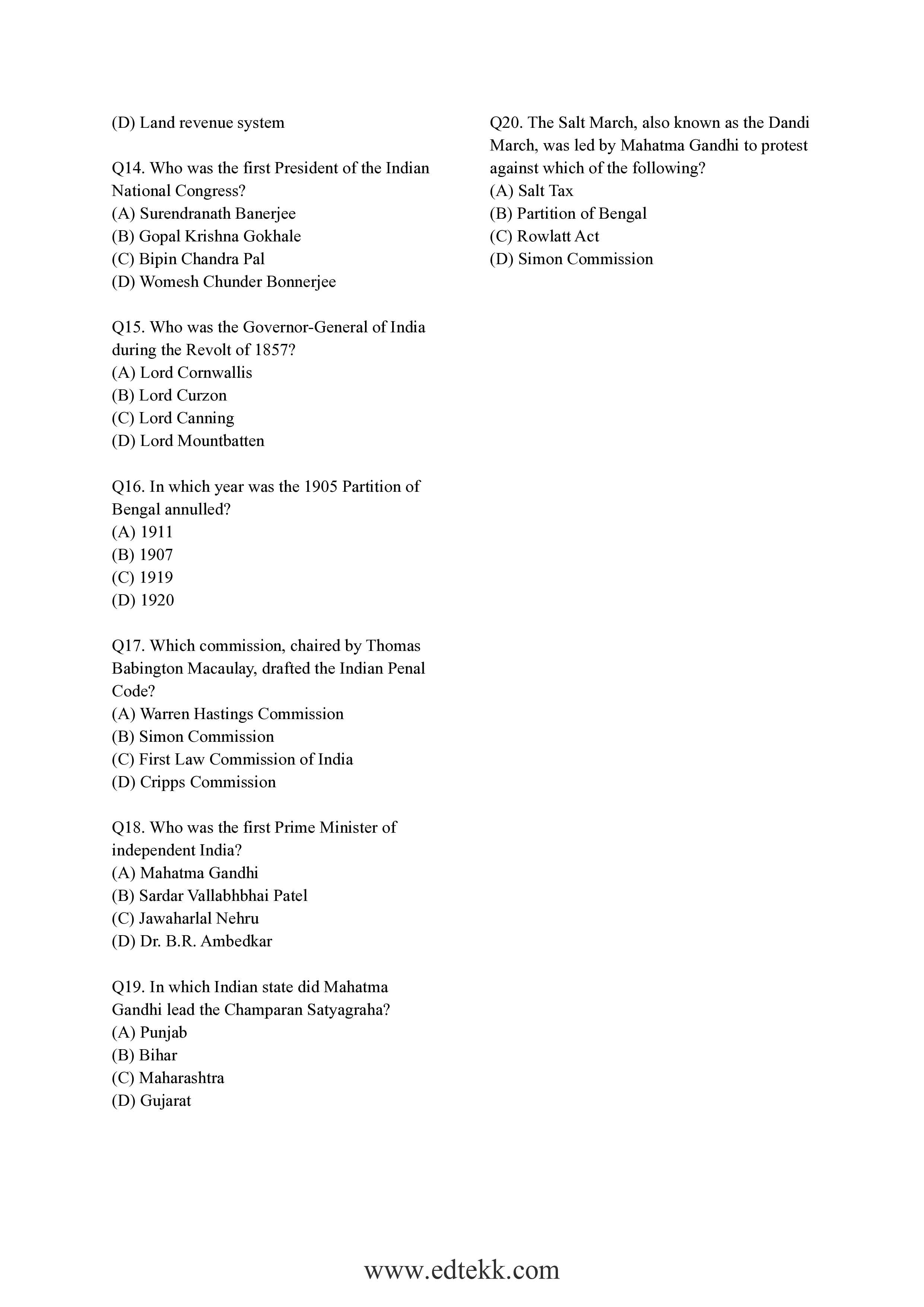
Q14. Who was the first President of the Indian National Congress?
(A) Surendranath Banerjee
(B) Gopal Krishna Gokhale
(C) Bipin Chandra Pal
(D) Womesh Chunder Bonnerjee
Explanation: Womesh Chunder Bonnerjee (W. C. Bonnerjee) was the first President of the Indian National Congress. He presided over its inaugural session held in Bombay in December 1885. A prominent lawyer, he played an important role in establishing the organisational foundations of the Indian nationalist movement.
Q15. Who was the Governor-General of India during the Revolt of 1857?
(A) Lord Cornwallis
(B) Lord Curzon
(C) Lord Canning
(D) Lord Mountbatten
Explanation: Lord Canning was the Governor-General of India during the Revolt of 1857. He served from 1856 to 1862 and became the first Viceroy of India in 1858 following the transfer of administration from the East India Company to the British Crown under the Government of India Act, 1858.
Q16. In which year was the 1905 Partition of Bengal annulled?
(A) 1911
(B) 1907
(C) 1919
(D) 1920
Explanation: The Partition of Bengal, implemented in 1905 under Lord Curzon, was annulled in 1911 during the reign of King George V. The announcement was made at the Delhi Durbar. The decision was accompanied by the transfer of the capital of British India from Calcutta to Delhi.
Q17. Which commission, chaired by Thomas Babington Macaulay, drafted the Indian Penal Code?
(A) Warren Hastings Commission
(B) Simon Commission
(C) First Law Commission of India
(D) Cripps Commission
Explanation: The First Law Commission of India, established in 1834 under the chairmanship of Thomas Babington Macaulay, drafted the Indian Penal Code. The draft was submitted in 1837 and subsequently revised before being enacted in 1860. The Code came into force in 1862.
Q18. Who was the first Prime Minister of independent India?
(A) Mahatma Gandhi
(B) Sardar Vallabhbhai Patel
(C) Jawaharlal Nehru
(D) Dr. B.R. Ambedkar
Explanation: Jawaharlal Nehru became the first Prime Minister of independent India on 15 August 1947. He held office until his death on 27 May 1964. He played a significant role in shaping India’s parliamentary democracy, foreign policy, industrial development and scientific institutions after independence.
Q19. In which Indian state did Mahatma Gandhi lead the Champaran Satyagraha?
(A) Punjab
(B) Bihar
(C) Maharashtra
(D) Gujarat
Explanation: The Champaran Satyagraha was launched by Mahatma Gandhi in 1917 in the Champaran district of Bihar. It was directed against the exploitation of indigo cultivators by European planters under oppressive agricultural arrangements. It was Gandhi’s first major Satyagraha movement in India.
Q20. The Salt March, also known as the Dandi March, was led by Mahatma Gandhi to protest against which of the following?
(A) Salt Tax
(B) Partition of Bengal
(C) Rowlatt Act
(D) Simon Commission
Explanation: Mahatma Gandhi launched the Salt March in 1930 to protest against the British salt monopoly and salt tax. Beginning at Sabarmati Ashram on 12 March, Gandhi and his followers marched to Dandi, where he broke the salt law on 6 April 1930. This event marked the beginning of the Civil Disobedience Movement.
Question Paper Images