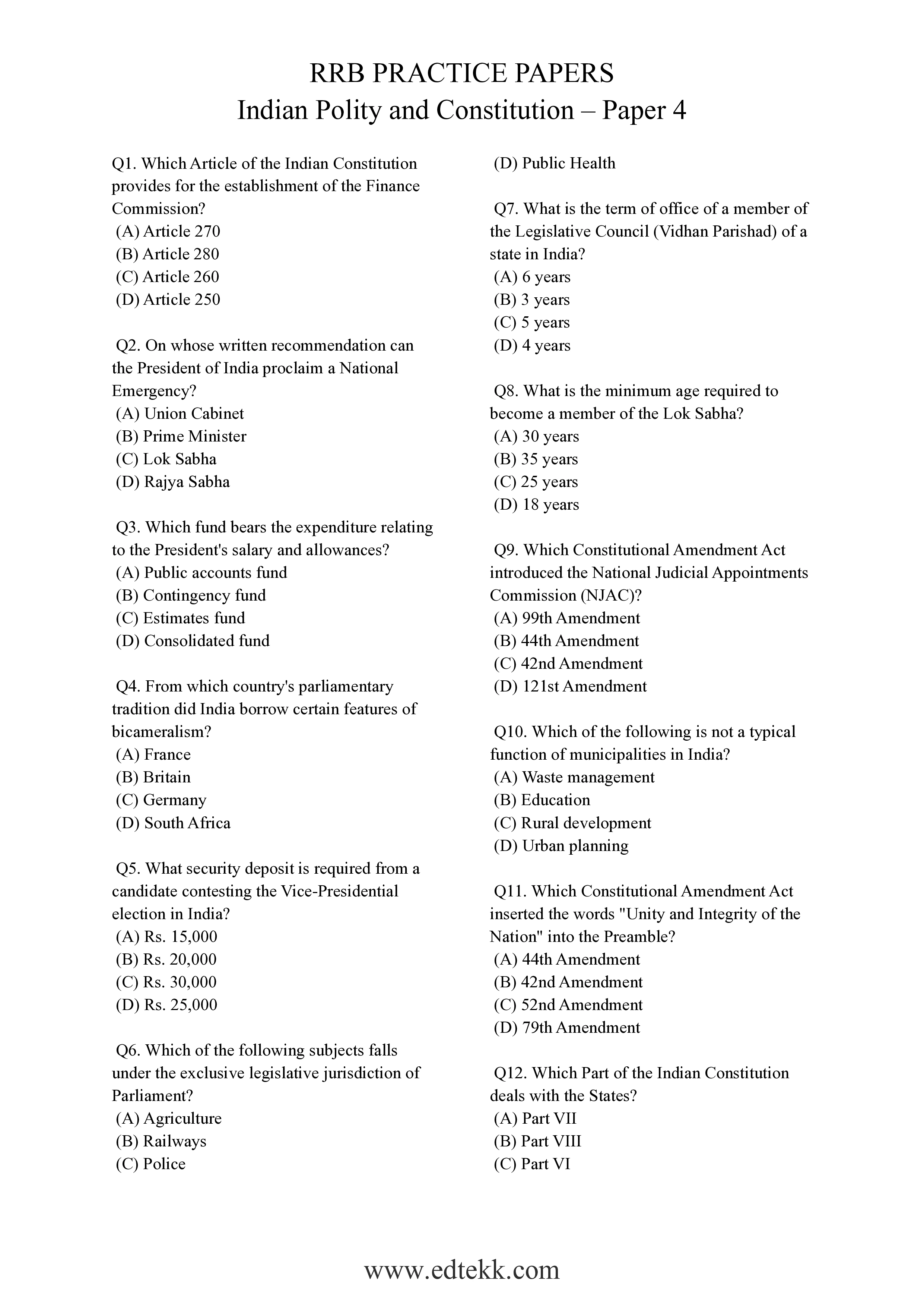
Test your knowledge of Indian Polity and Constitution through Practice Paper 4, prepared for Railway recruitment examinations. This set is relevant to RRB NTPC, Group D, ALP and Technician aspirants and provides 20 objective questions with correct answers and explanations for systematic practice.
Test Details
Topic: Indian Polity and Constitution
Total Questions: 20
Question Format: MCQs – Single Correct Answer
Suitable for: RRB NTPC, Group D, ALP, Technician
Download All Papers in This Series (PDF)
Questions and Answers
Q1. Which Article of the Indian Constitution provides for the establishment of the Finance Commission?
(A) Article 270
(B) Article 280
(C) Article 260
(D) Article 250
Explanation: Article 280 of the Constitution of India provides for the establishment of the Finance Commission. The President constitutes the Commission every five years or earlier, if necessary. Its principal responsibility is to recommend the distribution of tax revenues between the Union and the States and the principles governing grants-in-aid to States.
Q2. On whose written recommendation can the President of India proclaim a National Emergency?
(A) Union Cabinet
(B) Prime Minister
(C) Lok Sabha
(D) Rajya Sabha
Explanation: Under Article 352(3), the President can proclaim a National Emergency only when the decision of the Union Cabinet has been communicated to the President in writing. The Union Cabinet comprises the Prime Minister and other ministers of Cabinet rank. This requirement, introduced by the 44th Constitutional Amendment, ensures collective Cabinet responsibility rather than reliance solely on the Prime Minister’s advice.
Q3. Which fund bears the expenditure relating to the President’s salary and allowances?
(A) Public accounts fund
(B) Contingency fund
(C) Estimates fund
(D) Consolidated fund
Explanation: Under Article 112(3)(a) of the Constitution of India, the emoluments and allowances of the President and other expenditure relating to the office are charged on the Consolidated Fund of India. Such expenditure is not submitted to the vote of Parliament, ensuring the financial independence of the constitutional office.
Q4. From which country’s parliamentary tradition did India borrow certain features of bicameralism?
(A) France
(B) Britain
(C) Germany
(D) South Africa
Explanation: The Indian Constitution drew upon the British parliamentary tradition for its legislative institutions, including aspects of bicameralism. The Parliament of India consists of the Lok Sabha, the House of the People, and the Rajya Sabha, the Council of States. However, bicameralism has a broader historical background and should not be attributed exclusively to Britain.
Q5. What security deposit is required from a candidate contesting the Vice-Presidential election in India?
(A) Rs. 15,000
(B) Rs. 20,000
(C) Rs. 30,000
(D) Rs. 25,000
Explanation: A candidate contesting the election for Vice-President of India must deposit ₹15,000 as security under the Presidential and Vice-Presidential Elections Act, 1952. The deposit is submitted along with the nomination requirements and is intended to discourage frivolous candidatures.
Q6. Which of the following subjects falls under the exclusive legislative jurisdiction of Parliament?
(A) Agriculture
(B) Railways
(C) Police
(D) Public Health
Explanation: Railways fall under the Union List in the Seventh Schedule, specifically Entry 22. Parliament ordinarily has exclusive legislative authority over this subject. Union-level legislation supports coordinated railway administration, development and regulation across States.
Q7. What is the term of office of a member of the Legislative Council (Vidhan Parishad) of a state in India?
(A) 6 years
(B) 3 years
(C) 5 years
(D) 4 years
Explanation: A member of a State Legislative Council (Vidhan Parishad) serves a six-year term under Article 172 of the Constitution. The Legislative Council is a permanent House and cannot be dissolved. Approximately one-third of its members retire every two years, ensuring continuity and periodic renewal of membership.
Q8. What is the minimum age required to become a member of the Lok Sabha?
(A) 30 years
(B) 35 years
(C) 25 years
(D) 18 years
Explanation: The minimum age prescribed for membership of the Lok Sabha is 25 years under Article 84 of the Constitution. A candidate must also satisfy the applicable citizenship and other electoral eligibility requirements. In comparison, the minimum age for membership of the Rajya Sabha is 30 years.
Q9. Which Constitutional Amendment Act introduced the National Judicial Appointments Commission (NJAC)?
(A) 99th Amendment
(B) 44th Amendment
(C) 42nd Amendment
(D) 121st Amendment
Explanation: The 99th Constitutional Amendment Act, 2014, introduced the National Judicial Appointments Commission (NJAC) to replace the collegium system for appointing judges to the higher judiciary. However, in 2015, the Supreme Court declared the amendment unconstitutional, thereby restoring the collegium system.
Q10. Which of the following is not a typical function of municipalities in India?
(A) Waste management
(B) Education
(C) Rural development
(D) Urban planning
Explanation: Rural development is primarily associated with Panchayati Raj institutions, which work towards improving infrastructure and welfare in rural areas. Municipalities are urban local bodies responsible for functions such as sanitation, waste management, urban planning, public health and the promotion of educational and cultural activities within their jurisdictions.
Q11. Which Constitutional Amendment Act inserted the words “Unity and Integrity of the Nation” into the Preamble?
(A) 44th Amendment
(B) 42nd Amendment
(C) 52nd Amendment
(D) 79th Amendment
Explanation: The 42nd Constitutional Amendment Act, 1976, inserted the expression “Unity and Integrity of the Nation” into the Preamble. It modified the original expression “unity of the Nation” by adding the word “Integrity”, emphasising national unity and territorial integrity.
Q12. Which Part of the Indian Constitution deals with the States?
(A) Part VII
(B) Part VIII
(C) Part VI
(D) Part IX
Explanation: Part VI (Articles 152–237) of the Indian Constitution deals with the States. It contains provisions relating to the Governor, State Executive, State Legislature, High Courts and subordinate courts, establishing the constitutional framework for state governance.
Q13. Which Article of the Indian Constitution deals with the abolition of titles?
(A) Article 51
(B) Article 50
(C) Article 18
(D) Article 32
Explanation: Article 18 of the Indian Constitution deals with the abolition of titles. It prohibits the State from conferring titles, except military and academic distinctions. Indian citizens cannot accept titles from foreign states, while certain restrictions also apply to non-citizens holding offices under the State. This provision promotes equality and prevents artificial social distinctions.
Q14. What is the normal term of the Legislative Assembly (Vidhan Sabha) of an Indian state?
(A) 6 years
(B) 4 years
(C) 5 years
(D) 3 years
Explanation: The normal tenure of a State Legislative Assembly is five years from the date appointed for its first meeting, unless dissolved earlier (Article 172). During a National Emergency, Parliament may extend its term by law for up to one year at a time, but the extension cannot continue beyond six months after the Emergency ceases.
Q15. Which Constitutional Amendment Act extended the reservation of seats for Scheduled Castes and Scheduled Tribes in the Lok Sabha and State Legislative Assemblies?
(A) 101st Amendment
(B) 105th Amendment
(C) 95th Amendment
(D) 109th Amendment
Explanation: The 95th Constitutional Amendment Act, 2009, extended the reservation of seats for Scheduled Castes and Scheduled Tribes in the Lok Sabha and State Legislative Assemblies for ten years, until 2020. Subsequently, the 104th Constitutional Amendment Act, 2019, extended this reservation until 2030.
Q16. Which Commission was appointed by the Central Government to examine issues relating to Centre-State relations?
(A) Sarkaria Commission
(B) Mandal Commission
(C) Nanavati Commission
(D) Kothari Commission
Explanation: The Sarkaria Commission was appointed by the Central Government in 1983 to examine Centre-State relations and recommend improvements. It was chaired by Justice R.S. Sarkaria. Its recommendations covered legislative, administrative and financial relations between the Union and the States, emphasising cooperative federalism.
Q17. Which Article of the Indian Constitution prohibits discrimination on grounds of religion, race, caste, sex and place of birth?
(A) Article 15
(B) Article 23
(C) Article 25
(D) Article19
Explanation: Article 15 prohibits the State from discriminating against any citizen on grounds only of religion, race, caste, sex or place of birth. It also enables the State to introduce special provisions for disadvantaged groups, including women, children, socially and educationally backward classes, Scheduled Castes and Scheduled Tribes.
Q18. Under which Article can the President recognise a language spoken by a substantial section of a State’s population?
(A) Article 357
(B) Article 347
(C) Article 374
(D) Article 337
Explanation: Article 347 empowers the President to direct the official recognition of a language spoken by a substantial proportion of a state’s population, provided the President is satisfied that there is a sufficient demand for such recognition. This provision safeguards linguistic interests and facilitates recognition of regional languages within states.
Q19. Who was the first woman judge of the Delhi High Court?
(A) Anna Chandy
(B) Sujata Manohar
(C) Ruma Pal
(D) Leila Seth
Explanation: Justice Leila Seth was the first woman judge of the Delhi High Court. She was appointed an additional judge on 25 July 1978 and became a permanent judge in 1980. Subsequently, in 1991, she became the first woman Chief Justice of a State High Court when she was appointed Chief Justice of the Himachal Pradesh High Court.
Q20. The 74th Constitutional Amendment Act is associated with which aspect of governance?
(A) Panchayati Raj institutions
(B) Land reforms
(C) Fiscal federalism
(D) Urban local bodies
Explanation: The 74th Constitutional Amendment Act, 1992, granted constitutional recognition to urban local bodies by introducing Part IXA of the Constitution. It established a framework for municipalities, including Municipal Corporations, Municipal Councils and Nagar Panchayats, strengthening urban local self-government.
Question Paper Images