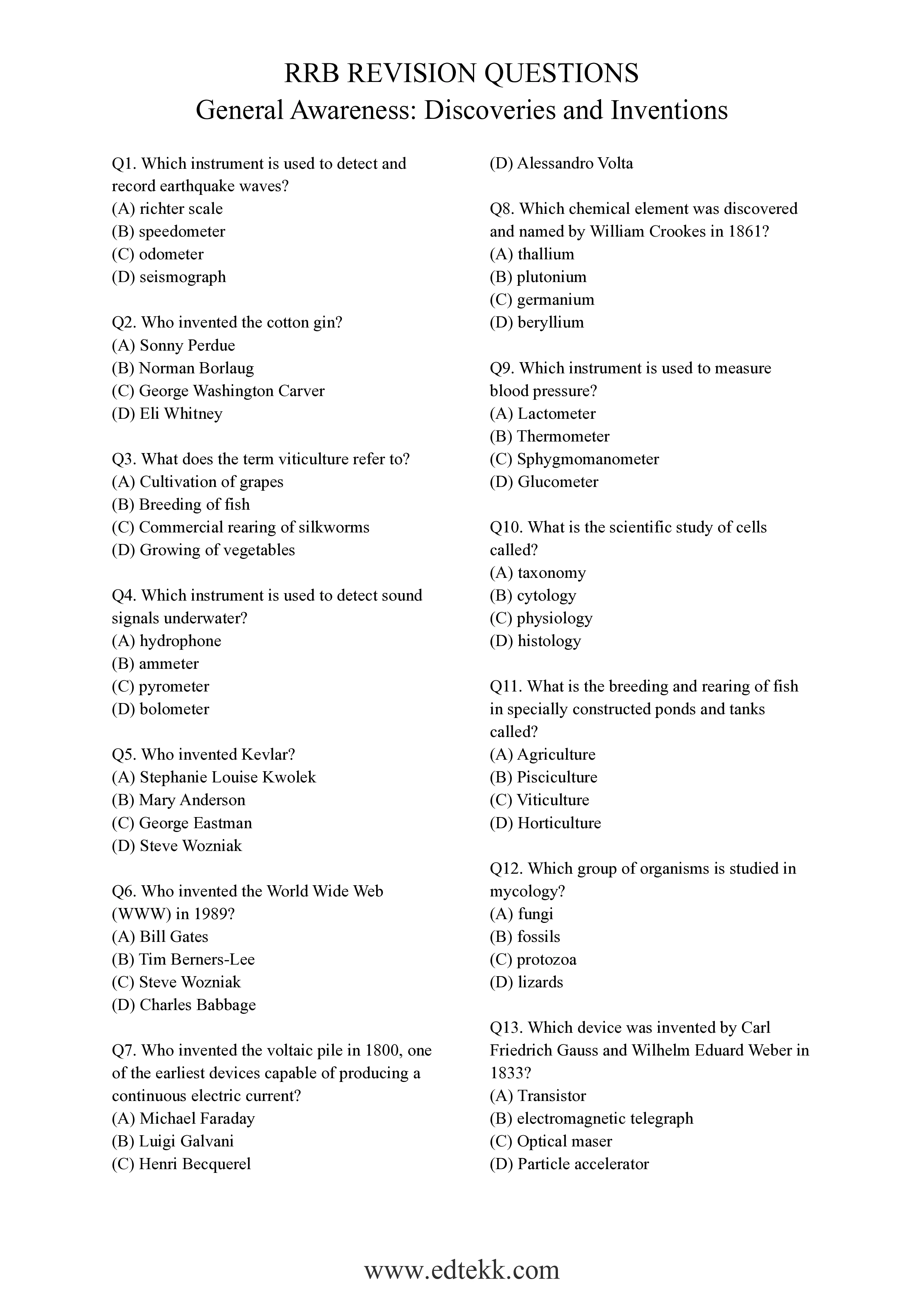
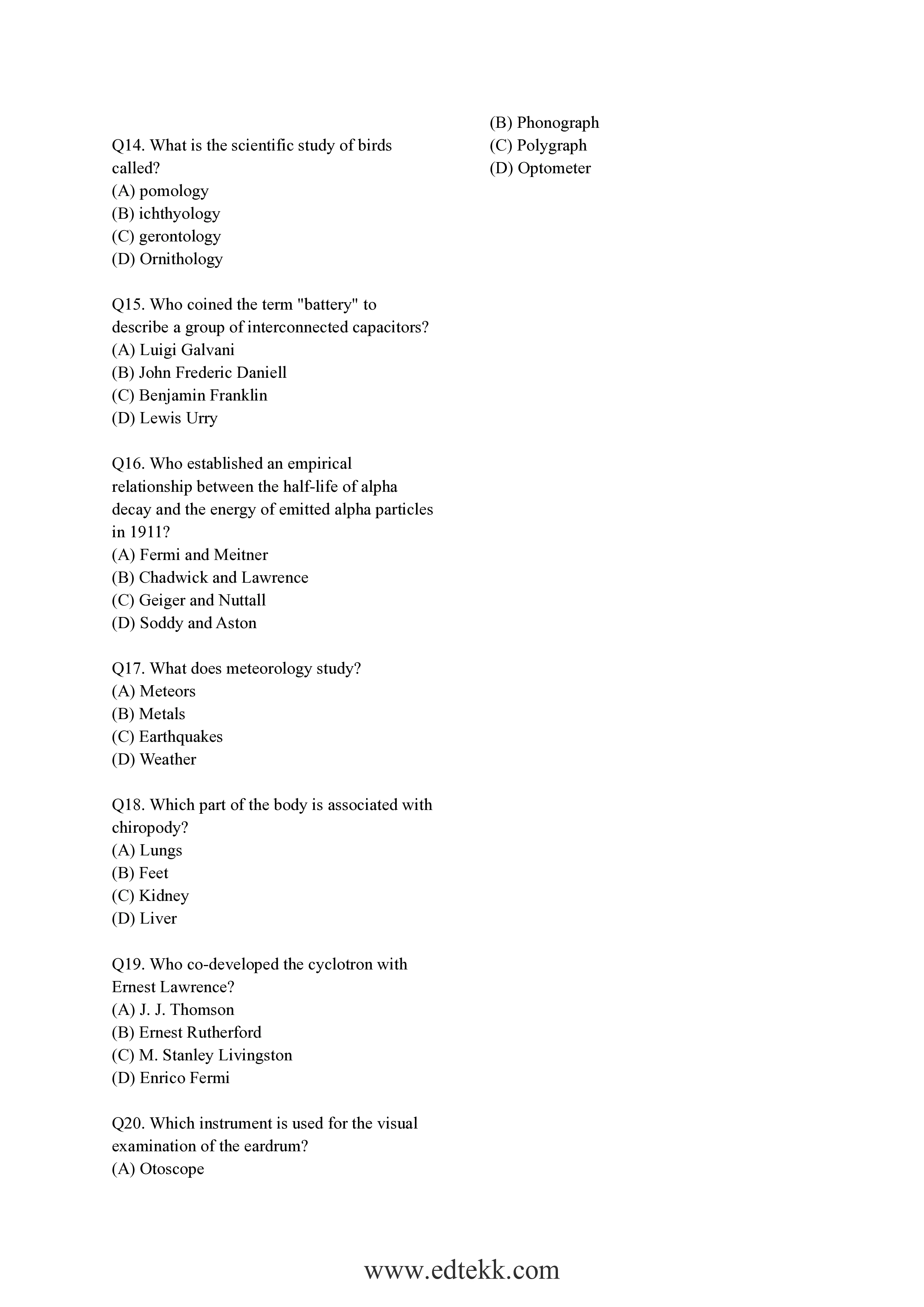
This General Awareness revision set focuses on Discoveries and Inventions for RRB NTPC, Group D, ALP and Technician exams. The question set covers important scientific discoveries, inventions, inventors, answers and explanations for effective railway exam preparation.
Test Details
Topic: Discoveries and Inventions
Total Questions: 20
Question Format: MCQs – Single Correct Answer
Suitable for: RRB NTPC, Group D, ALP, Technician
Download All Papers in This Series (PDF)
Questions and Answers
Q1. Which instrument is used to detect and record earthquake waves?
(A) richter scale
(B) speedometer
(C) odometer
(D) seismograph
Explanation: A seismograph detects and records seismic waves generated by earthquakes and other sources. The resulting record is called a seismogram. The Richter scale, by contrast, is a magnitude scale historically used to quantify earthquake size; it is not an instrument for recording seismic waves.
Q2. Who invented the cotton gin?
(A) Sonny Perdue
(B) Norman Borlaug
(C) George Washington Carver
(D) Eli Whitney
Explanation: Eli Whitney is conventionally credited with inventing the cotton gin in 1793. The machine mechanically separated cotton fibres from their seeds, greatly increasing processing efficiency. Its widespread adoption transformed cotton production in the United States and contributed to the expansion of plantation slavery.
Q3. What does the term viticulture refer to?
(A) Cultivation of grapes
(B) Breeding of fish
(C) Commercial rearing of silkworms
(D) Growing of vegetables
Explanation: Viticulture refers to the cultivation and management of grapevines, including planting, pruning, irrigation, pest management and harvesting. Grapes may be grown for fresh consumption, drying or winemaking. Oenology, by contrast, is the science and technology of winemaking.
Q4. Which instrument is used to detect sound signals underwater?
(A) hydrophone
(B) ammeter
(C) pyrometer
(D) bolometer
Explanation: A hydrophone is an instrument used to detect and receive sound waves underwater. It functions similarly to a microphone but is specifically designed for underwater acoustic measurements. Hydrophones are widely used in oceanography, marine research, underwater communication, acoustic monitoring and submarine detection.
Q5. Who invented Kevlar?
(A) Stephanie Louise Kwolek
(B) Mary Anderson
(C) George Eastman
(D) Steve Wozniak
Explanation: Stephanie Louise Kwolek, an American chemist at DuPont, invented Kevlar in 1965. Kevlar is a lightweight, high-strength synthetic aramid fibre used in bullet-resistant body armour, protective equipment, tyres and other applications requiring high tensile strength.
Q6. Who invented the World Wide Web (WWW) in 1989?
(A) Bill Gates
(B) Tim Berners-Lee
(C) Steve Wozniak
(D) Charles Babbage
Explanation: Tim Berners-Lee proposed the World Wide Web in 1989 while working at CERN. He developed its foundational technologies, including HTML, HTTP and URLs. The first website and web server became operational in 1991. The Web enables access to interconnected information resources through the Internet.
Q7. Who invented the voltaic pile in 1800, one of the earliest devices capable of producing a continuous electric current?
(A) Michael Faraday
(B) Luigi Galvani
(C) Henri Becquerel
(D) Alessandro Volta
Explanation: Alessandro Volta, an Italian physicist, invented the voltaic pile in 1800. It was one of the earliest devices capable of generating a continuous electric current through chemical reactions. The device consisted of alternating discs of zinc and copper separated by electrolyte-soaked material. This invention marked a significant milestone in the development of electrical science.
Q8. Which chemical element was discovered and named by William Crookes in 1861?
(A) thallium
(B) plutonium
(C) germanium
(D) beryllium
Explanation: William Crookes discovered thallium in 1861 while examining residues from sulphuric acid production. He identified the element through its distinctive green spectral emission line and named it after the Greek word thallos, meaning a green shoot.
Q9. Which instrument is used to measure blood pressure?
(A) Lactometer
(B) Thermometer
(C) Sphygmomanometer
(D) Glucometer
Explanation: A sphygmomanometer is an instrument used to measure blood pressure. It typically consists of an inflatable cuff and a pressure-measuring mechanism. Manual measurement generally also requires a stethoscope. Blood pressure is expressed in millimetres of mercury (mmHg) and recorded as systolic pressure over diastolic pressure.
Q10. What is the scientific study of cells called?
(A) taxonomy
(B) cytology
(C) physiology
(D) histology
Explanation: Cytology is the branch of biology concerned with the study of cells, including their structure, composition, functions and reproduction. Cells are the fundamental structural and functional units of living organisms. Histology, by contrast, focuses on the microscopic study of tissues.
Q11. What is the breeding and rearing of fish in specially constructed ponds and tanks called?
(A) Agriculture
(B) Pisciculture
(C) Viticulture
(D) Horticulture
Explanation: Pisciculture refers to the breeding and rearing of fish under controlled conditions, typically in specially constructed ponds or tanks. It is a component of aquaculture and contributes to fish production, food security and employment. Aquaculture is broader and includes the cultivation of other aquatic organisms as well.
Q12. Which group of organisms is studied in mycology?
(A) fungi
(B) fossils
(C) protozoa
(D) lizards
Explanation: Mycology is the branch of biology concerned with the scientific study of fungi, including mushrooms, moulds and yeasts. It examines their classification, structure, reproduction, genetics and ecological roles. Fungi are important in decomposition, food production, medicine and various industrial processes.
Q13. Which device was invented by Carl Friedrich Gauss and Wilhelm Eduard Weber in 1833?
(A) Transistor
(B) electromagnetic telegraph
(C) Optical maser
(D) Particle accelerator
Explanation: Carl Friedrich Gauss and Wilhelm Eduard Weber developed an electromagnetic telegraph in 1833. Their device transmitted electrical signals through wires using electromagnetic principles and demonstrated the practical application of electromagnetism in communication. It represented an important early development in the history of electrical telegraphy.
Q14. What is the scientific study of birds called?
(A) pomology
(B) ichthyology
(C) gerontology
(D) Ornithology
Explanation: Ornithology is the branch of zoology concerned with the scientific study of birds. It includes their classification, anatomy, physiology, behaviour, reproduction, migration and ecological relationships. Ornithological research also contributes to bird conservation and the understanding of biodiversity.
Q15. Who coined the term “battery” to describe a group of interconnected capacitors?
(A) Luigi Galvani
(B) John Frederic Daniell
(C) Benjamin Franklin
(D) Lewis Urry
Explanation: Benjamin Franklin popularised the term battery in 1749 to describe an arrangement of interconnected Leyden jars used to store electrical charge. He borrowed the term from military usage, in which a battery referred to a group of weapons operating together. The term subsequently became established in electrical science.
Q16. Who established an empirical relationship between the half-life of alpha decay and the energy of emitted alpha particles in 1911?
(A) Fermi and Meitner
(B) Chadwick and Lawrence
(C) Geiger and Nuttall
(D) Soddy and Aston
Explanation: Hans Geiger and John Mitchell Nuttall established the Geiger–Nuttall law in 1911. It describes the empirical relationship between the half-life of an alpha-emitting radioactive nucleus and the energy of its emitted alpha particles. The law provided important insights into radioactive decay and the behaviour of alpha-emitting elements.
Q17. What does meteorology study?
(A) Meteors
(B) Metals
(C) Earthquakes
(D) Weather
Explanation: Meteorology is the scientific study of the atmosphere, particularly weather processes and atmospheric conditions. It involves observing and forecasting temperature, rainfall, wind, humidity and atmospheric pressure. The study of meteors belongs to astronomy, metals are studied in metallurgy and materials science, while earthquakes are studied in seismology.
Q18. Which part of the body is associated with chiropody?
(A) Lungs
(B) Feet
(C) Kidney
(D) Liver
Explanation: Chiropody is a branch of healthcare concerned with the examination, diagnosis and treatment of conditions affecting the feet. It is commonly associated with podiatry and includes the management of foot skin disorders, nail problems and structural abnormalities.
Q19. Who co-developed the cyclotron with Ernest Lawrence?
(A) J. J. Thomson
(B) Ernest Rutherford
(C) M. Stanley Livingston
(D) Enrico Fermi
Explanation: M. Stanley Livingston co-developed the cyclotron with Ernest O. Lawrence in the early 1930s. The cyclotron is a particle accelerator that uses alternating electric fields and magnetic fields to accelerate charged particles along a spiral path. It became an important instrument in nuclear physics and experimental research.
Q20. Which instrument is used for the visual examination of the eardrum?
(A) Otoscope
(B) Phonograph
(C) Polygraph
(D) Optometer
Explanation: An otoscope is a medical instrument used to examine the external ear canal and tympanic membrane (eardrum). It typically contains a light source and a magnifying lens, enabling healthcare professionals to identify conditions such as inflammation, ear infections and eardrum perforations.
Question Paper Images