Revise important topics in Indian Polity and the Constitution with this sixth set of 20 practice questions. Designed for Railway exam aspirants, the paper includes objective questions covering essential political and constitutional fundamentals, with answers and explanations to support preparation for RRB NTPC, Group D, ALP and Technician examinations.
Test Details
Topic: Indian Polity and Constitution
Total Questions: 20
Question Format: MCQs – Single Correct Answer
Suitable for: RRB NTPC, Group D, ALP, Technician
Download All Papers in This Series (PDF)
Questions and Answers
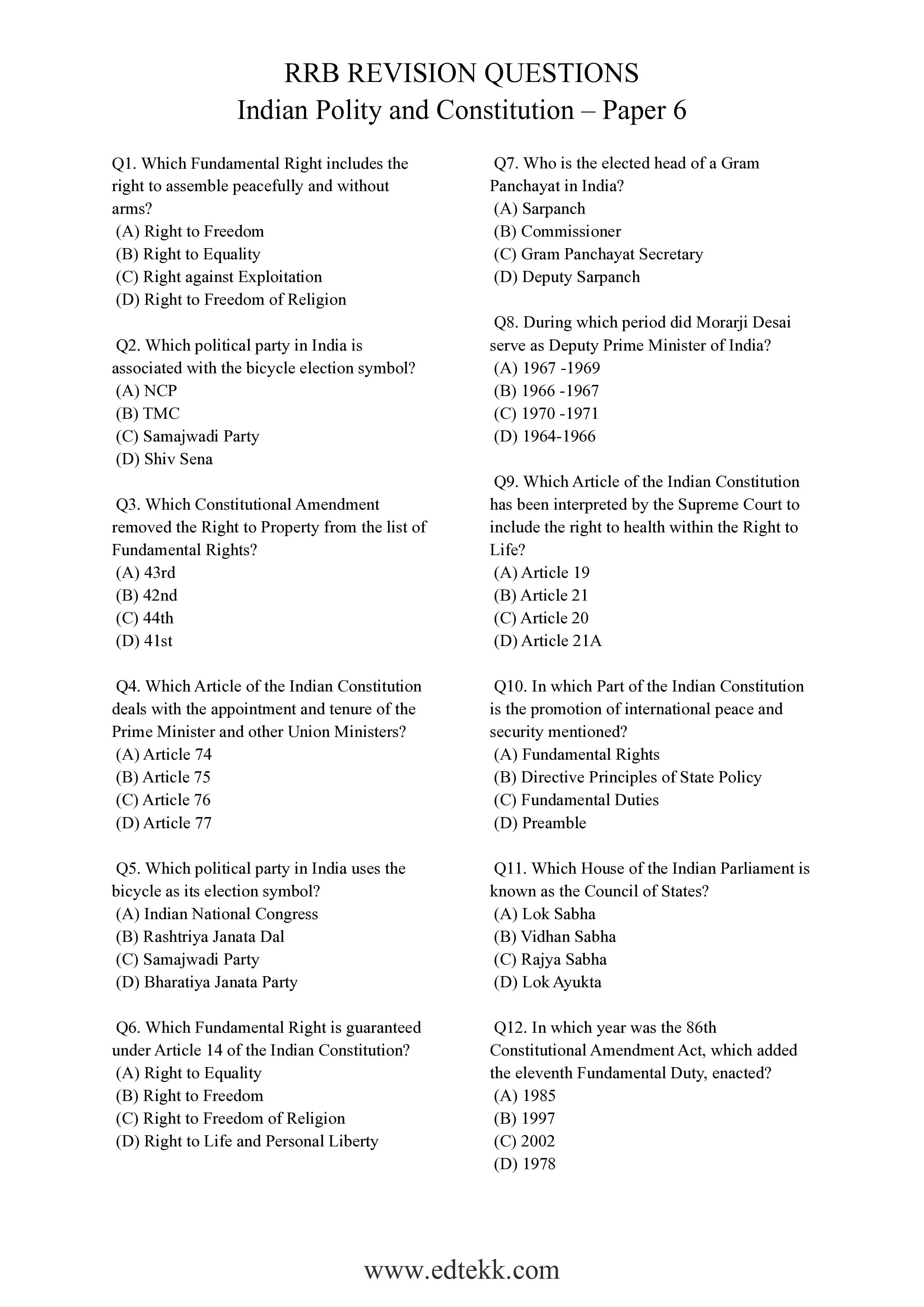
Q1. Which Fundamental Right includes the right to assemble peacefully and without arms?
(A) Right to Freedom
(B) Right to Equality
(C) Right against Exploitation
(D) Right to Freedom of Religion
Explanation: Article 19(1)(b), under the Right to Freedom, guarantees citizens the right to assemble peacefully and without arms. This right is subject to reasonable restrictions under Article 19(3) in the interests of the sovereignty and integrity of India and public order. It does not protect violent or unlawful assemblies.
Q2. Which political party in India is associated with the bicycle election symbol?
(A) NCP
(B) TMC
(C) Samajwadi Party
(D) Shiv Sena
Explanation: The Samajwadi Party uses the bicycle as its election symbol. The party is particularly influential in Uttar Pradesh and was founded in 1992 by Mulayam Singh Yadav. The bicycle distinguishes it from the electoral symbols of the TMC, NCP and Shiv Sena.
Q3. Which Constitutional Amendment removed the Right to Property from the list of Fundamental Rights?
(A) 43rd
(B) 42nd
(C) 44th
(D) 41st
Explanation: The 44th Constitutional Amendment Act, 1978, removed the Right to Property from the list of Fundamental Rights by omitting Article 19(1)(f) and Article 31. It was subsequently retained as a constitutional right under Article 300A, which states that no person shall be deprived of property except by authority of law.
Q4. Which Article of the Indian Constitution deals with the appointment and tenure of the Prime Minister and other Union Ministers?
(A) Article 74
(B) Article 75
(C) Article 76
(D) Article 77
Explanation: Article 75 of the Indian Constitution deals with the appointment, tenure and other provisions relating to the Union Council of Ministers. The President appoints the Prime Minister, while other ministers are appointed on the Prime Minister’s advice. Ministers hold office during the President’s pleasure, and the Council of Ministers is collectively responsible to the Lok Sabha.
Q5. Which political party in India uses the bicycle as its election symbol?
(A) Indian National Congress
(B) Rashtriya Janata Dal
(C) Samajwadi Party
(D) Bharatiya Janata Party
Explanation: The bicycle is the reserved election symbol of the Samajwadi Party (SP). Founded in 1992, the party is primarily based in Uttar Pradesh and has a significant presence in the state’s political landscape.
Q6. Which Fundamental Right is guaranteed under Article 14 of the Indian Constitution?
(A) Right to Equality
(B) Right to Freedom
(C) Right to Freedom of Religion
(D) Right to Life and Personal Liberty
Explanation: Article 14 guarantees equality before the law and equal protection of the laws to every person within the territory of India. It prohibits arbitrary State action and ensures equal treatment of similarly situated persons. Unlike several other Fundamental Rights, Article 14 is available to both citizens and non-citizens.
Q7. Who is the elected head of a Gram Panchayat in India?
(A) Sarpanch
(B) Commissioner
(C) Gram Panchayat Secretary
(D) Deputy Sarpanch
Explanation: The Sarpanch is the commonly used designation for the elected head of a Gram Panchayat, the village-level institution of rural local self-government. The Sarpanch generally presides over meetings and supervises Panchayat functioning. The official designation, method of election and specific powers may vary across states according to their respective Panchayati Raj legislation.
Q8. During which period did Morarji Desai serve as Deputy Prime Minister of India?
(A) 1967 -1969
(B) 1966 -1967
(C) 1970 -1971
(D) 1964-1966
Explanation: Morarji Desai served as Deputy Prime Minister of India from 1967 to 1969 under Prime Minister Indira Gandhi. He also held the Finance portfolio during this period. He later became India’s Prime Minister in March 1977 and remained in office until July 1979.
Q9. Which Article of the Indian Constitution has been interpreted by the Supreme Court to include the right to health within the Right to Life?
(A) Article 19
(B) Article 21
(C) Article 20
(D) Article 21A
Explanation: Article 21 guarantees the Right to Life and Personal Liberty. The Supreme Court has interpreted this right to include the right to health and access to medical care. This interpretation recognises that the right to life extends beyond mere physical existence and includes conditions necessary for living with human dignity.
Q10. In which Part of the Indian Constitution is the promotion of international peace and security mentioned?
(A) Fundamental Rights
(B) Directive Principles of State Policy
(C) Fundamental Duties
(D) Preamble
Explanation: The promotion of international peace and security is included in the Directive Principles of State Policy under Article 51 of Part IV of the Indian Constitution. It directs the State to promote just and honourable relations among nations, respect international law and treaty obligations, and encourage the settlement of international disputes through arbitration.
Q11. Which House of the Indian Parliament is known as the Council of States?
(A) Lok Sabha
(B) Vidhan Sabha
(C) Rajya Sabha
(D) Lok Ayukta
Explanation: The Rajya Sabha is known as the Council of States and represents the states and eligible Union Territories in the Indian Parliament. It is the Upper House and a permanent body that cannot be dissolved. Its members are elected by the prescribed electoral colleges or nominated by the President according to constitutional provisions.
Q12. In which year was the 86th Constitutional Amendment Act, which added the eleventh Fundamental Duty, enacted?
(A) 1985
(B) 1997
(C) 2002
(D) 1978
Explanation: The 86th Constitutional Amendment Act was enacted in 2002. It added the eleventh Fundamental Duty under Article 51A(k), requiring parents or guardians to provide opportunities for education to children between six and fourteen years of age. It also inserted Article 21A, guaranteeing free and compulsory education to children in this age group.
Q13. Under which rule of the Lok Sabha can members raise matters that are not covered by regular parliamentary procedures?
(A) Rule 214
(B) Rule 302
(C) Rule 223
(D) Rule 377
Explanation: Rule 377 of the Lok Sabha’s Rules of Procedure allows members to raise matters that are not points of order and cannot conveniently be raised through other parliamentary procedures. It provides an opportunity to bring important matters of public interest to the attention of the House without initiating a formal discussion.
Q14. Under the Indian Constitution, what is the minimum number of times Parliament must meet in a year?
(A) Twice
(B) Once
(C) Thrice
(D) Four times
Explanation: Under Article 85 of the Indian Constitution, no more than six months can elapse between the last sitting of one session of Parliament and the first sitting of the next. Consequently, Parliament must hold at least two sessions annually.
Q15. Which list in the Seventh Schedule includes subjects such as education, forests, marriage and divorce?
(A) Residual Powers
(B) Union List
(C) State List
(D) Concurrent List
Explanation: The Concurrent List of the Seventh Schedule includes education, forests, marriage and divorce. Both Parliament and State Legislatures can ordinarily legislate on these subjects. In case of a conflict, Union legislation generally prevails under Article 254, subject to the exception for certain State laws receiving Presidential assent.
Q16. Which of the following is NOT a recognised category of parliamentary questions in India?
(A) Long-notice question
(B) Short-notice question
(C) Starred question
(D) Unstarred question
Explanation: Parliamentary questions are classified into three recognised categories: starred questions, unstarred questions and short-notice questions. Starred questions require oral answers and may be followed by supplementary questions, whereas unstarred questions receive written answers. Short-notice questions concern urgent matters of public importance and are admitted with shorter notice.
Q17. Who appoints the State Election Commissioner responsible for conducting Panchayati Raj elections?
(A) President of India
(B) Governor of the State
(C) Chief Minister
(D) Prime Minister
Explanation: Under Article 243K of the Constitution, the Governor appoints the State Election Commissioner. The Commissioner supervises, directs and controls elections to Panchayati Raj institutions. Article 243ZA extends the State Election Commission’s role to municipal elections, and constitutional safeguards protect the Commissioner’s independence.
Q18. Which of the following is not a guiding principle of the Panchayati Raj system?
(A) Democratic decentralization
(B) Social justice
(C) Centralization of power
(D) Grassroots democracy
Explanation: Panchayati Raj is founded on democratic decentralisation, grassroots participation and social justice. It transfers governance responsibilities closer to rural communities and encourages public participation in local decision-making. Centralisation of power contradicts these principles because it concentrates authority at higher levels rather than empowering local institutions.
Q19. Which of the following subjects falls under the Concurrent List of the Seventh Schedule?
(A) National security
(B) Agriculture
(C) Police
(D) Marriage and divorce
Explanation: Marriage and divorce fall under Entry 5 of the Concurrent List in the Seventh Schedule of the Indian Constitution. Both Parliament and State Legislatures can legislate on these subjects. Under Article 254, where a valid central law and state law conflict, the central law generally prevails, subject to the constitutional exception for certain state laws receiving Presidential assent.
Q20. Which constitutional authority formally summons the Houses of Parliament in India?
(A) Prime Minister
(B) President
(C) Speaker
(D) Vice President
Explanation: The President of India formally summons each House of Parliament under Article 85 of the Constitution. The President exercises this power on the aid and advice of the Council of Ministers. The interval between the last sitting of one session and the first sitting of the next cannot exceed six months.
Question Paper Images