Build confidence in Indian Polity and Constitution for Railway competitive examinations through 20 objective revision questions. This eighth practice paper helps aspirants assess their understanding of constitutional and political fundamentals with MCQs, answers and explanations, relevant to RRB NTPC, Group D, ALP and Technician examinations.
Test Details
Topic: Indian Polity and Constitution
Total Questions: 20
Question Format: MCQs – Single Correct Answer
Suitable for: RRB NTPC, Group D, ALP, Technician
Download All Papers in This Series (PDF)
Questions and Answers
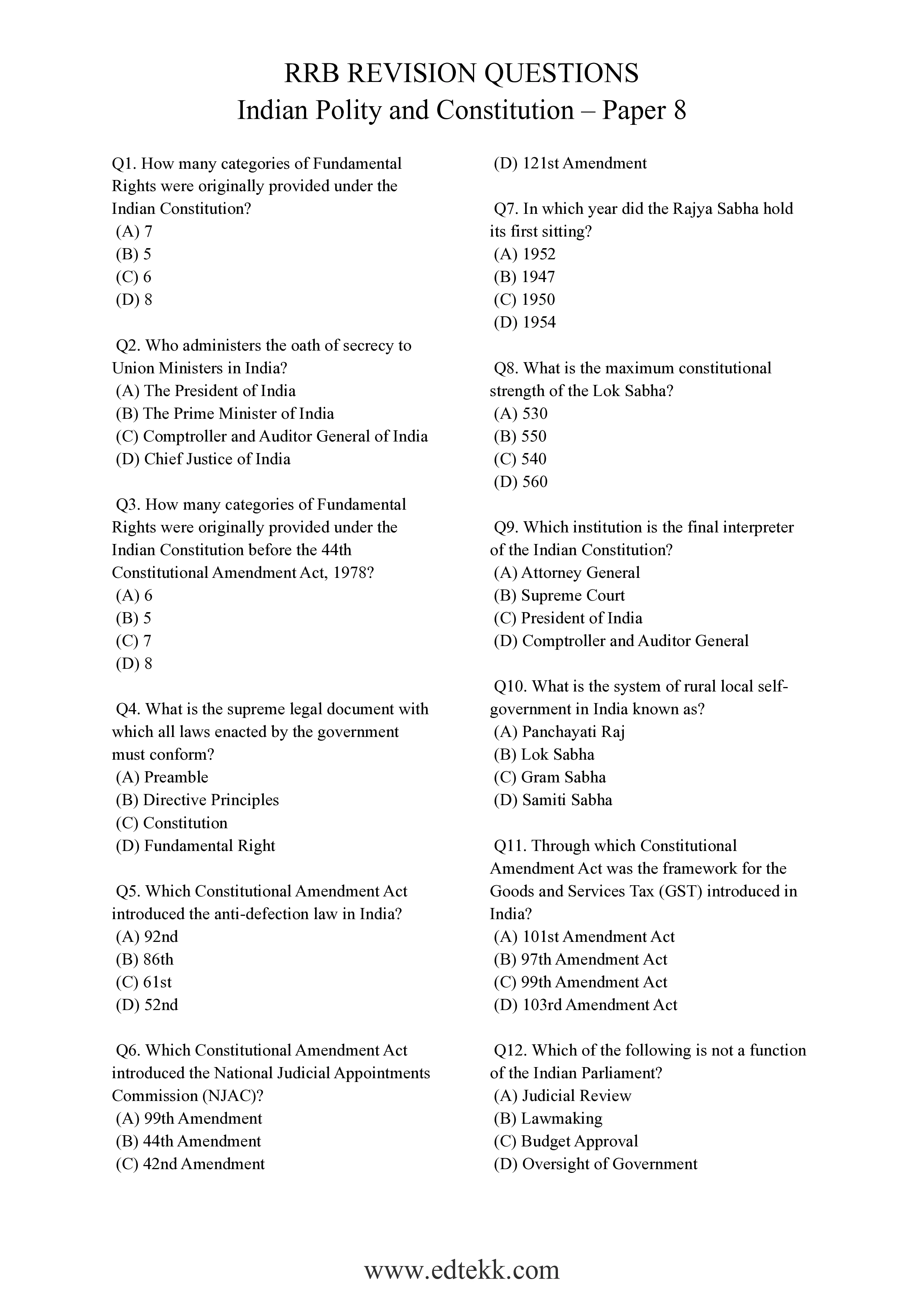
Q1. How many categories of Fundamental Rights were originally provided under the Indian Constitution?
(A) 7
(B) 5
(C) 6
(D) 8
Explanation: The Indian Constitution originally provided seven categories of Fundamental Rights, including the Right to Equality, Right to Freedom, Right against Exploitation, Right to Freedom of Religion, Cultural and Educational Rights, Right to Property and Right to Constitutional Remedies. The 44th Constitutional Amendment Act, 1978, removed the Right to Property from this list, leaving six categories.
Q2. Who administers the oath of secrecy to Union Ministers in India?
(A) The President of India
(B) The Prime Minister of India
(C) Comptroller and Auditor General of India
(D) Chief Justice of India
Explanation: The President of India administers the oath of office and secrecy to Union Ministers under Article 75(4) of the Constitution. The oath of secrecy requires ministers to maintain confidentiality regarding matters brought to their knowledge in the discharge of their official duties.
Q3. How many categories of Fundamental Rights were originally provided under the Indian Constitution before the 44th Constitutional Amendment Act, 1978?
(A) 6
(B) 5
(C) 7
(D) 8
Explanation: The original Constitution recognised seven categories of Fundamental Rights, including the Right to Property. The 44th Constitutional Amendment Act, 1978, removed the Right to Property from Part III of the Constitution. Consequently, six categories of Fundamental Rights remain. The Right to Property is now protected as a constitutional right under Article 300A.
Q4. What is the supreme legal document with which all laws enacted by the government must conform?
(A) Preamble
(B) Directive Principles
(C) Constitution
(D) Fundamental Right
Explanation: The Constitution is the supreme law of India, and all laws enacted by the legislature must conform to its provisions. The judiciary may declare legislation unconstitutional if it violates constitutional requirements. Fundamental Rights are important limits on state power, but constitutional validity also depends on other applicable constitutional provisions.
Q5. Which Constitutional Amendment Act introduced the anti-defection law in India?
(A) 92nd
(B) 86th
(C) 61st
(D) 52nd
Explanation: The 52nd Constitutional Amendment Act, 1985, introduced the anti-defection provisions by inserting the Tenth Schedule into the Indian Constitution. These provisions provide for the disqualification of members of Parliament and state legislatures in specified circumstances, including voluntarily giving up membership of a political party or voting contrary to party directions, subject to prescribed exceptions.
Q6. Which Constitutional Amendment Act introduced the National Judicial Appointments Commission (NJAC)?
(A) 99th Amendment
(B) 44th Amendment
(C) 42nd Amendment
(D) 121st Amendment
Explanation: The 99th Constitutional Amendment Act, 2014, introduced the National Judicial Appointments Commission (NJAC) to replace the collegium system for appointing judges to the higher judiciary. However, in 2015, the Supreme Court declared the amendment unconstitutional, thereby restoring the collegium system.
Q7. In which year did the Rajya Sabha hold its first sitting?
(A) 1952
(B) 1947
(C) 1950
(D) 1954
Explanation: The Rajya Sabha held its first sitting on 13 May 1952. It was first constituted on 3 April 1952 and is the Upper House of India’s Parliament. It is a permanent body that cannot be dissolved, with approximately one-third of its members retiring every two years.
Q8. What is the maximum constitutional strength of the Lok Sabha?
(A) 530
(B) 550
(C) 540
(D) 560
Explanation: Under Article 81, the constitutional maximum strength of the Lok Sabha is 550 elected members: up to 530 representatives from states and up to 20 from Union Territories. The earlier provision for nominating two Anglo-Indian members ceased to operate following the 104th Constitutional Amendment. The present sanctioned elected strength is 543.
Q9. Which institution is the final interpreter of the Indian Constitution?
(A) Attorney General
(B) Supreme Court
(C) President of India
(D) Comptroller and Auditor General
Explanation: The Supreme Court of India is the final interpreter and guardian of the Constitution. It interprets constitutional provisions and examines the validity of legislative and executive actions through judicial review. Its constitutional interpretations and the law declared by it are binding on all courts throughout India under Article 141.
Q10. What is the system of rural local self-government in India known as?
(A) Panchayati Raj
(B) Lok Sabha
(C) Gram Sabha
(D) Samiti Sabha
Explanation: Panchayati Raj is the system of rural local self-government in India. It generally provides elected institutions at village, intermediate and district levels. The Gram Sabha, comprising persons registered on the electoral rolls of a village within the Panchayat area, facilitates direct participation and local accountability.
Q11. Through which Constitutional Amendment Act was the framework for the Goods and Services Tax (GST) introduced in India?
(A) 101st Amendment Act
(B) 97th Amendment Act
(C) 99th Amendment Act
(D) 103rd Amendment Act
Explanation: The 101st Constitutional Amendment Act, 2016, introduced the constitutional framework for the Goods and Services Tax (GST) in India. It enabled the Union and State governments to levy GST through a coordinated indirect taxation system. GST was implemented nationwide on 1 July 2017, replacing several central and state indirect taxes.
Q12. Which of the following is not a function of the Indian Parliament?
(A) Judicial Review
(B) Lawmaking
(C) Budget Approval
(D) Oversight of Government
Explanation: Judicial review is primarily a function of the judiciary, not Parliament. It enables constitutional courts to examine whether legislation and executive actions conform to the Constitution. Parliament performs legislative, financial and executive oversight functions, including lawmaking, approving the Budget and holding the government accountable through parliamentary procedures.
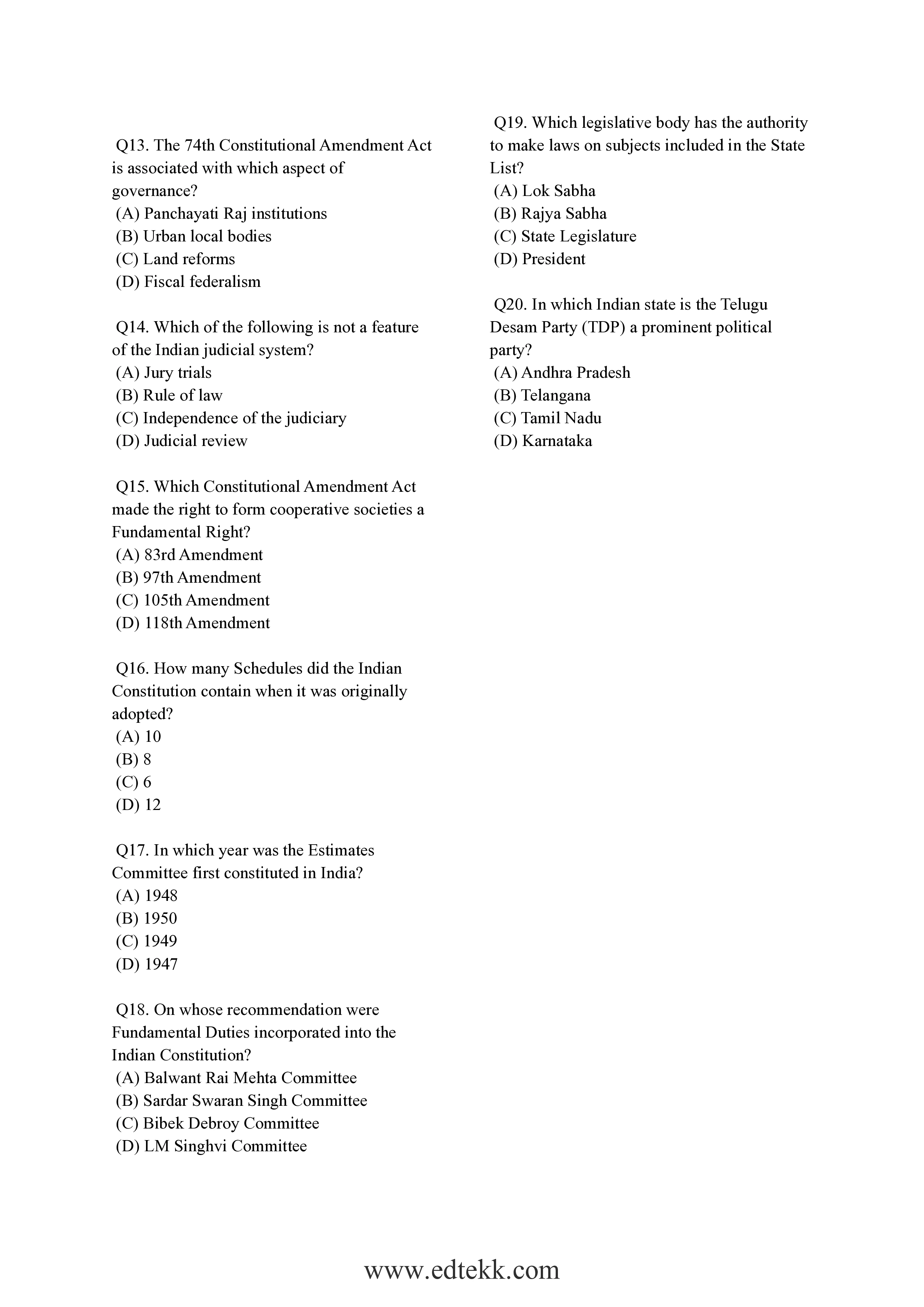
Q13. The 74th Constitutional Amendment Act is associated with which aspect of governance?
(A) Panchayati Raj institutions
(B) Urban local bodies
(C) Land reforms
(D) Fiscal federalism
Explanation: The 74th Constitutional Amendment Act, 1992, granted constitutional recognition to urban local bodies by introducing Part IXA of the Constitution. It established a framework for municipalities, including Municipal Corporations, Municipal Councils and Nagar Panchayats, strengthening urban local self-government.
Q14. Which of the following is not a feature of the Indian judicial system?
(A) Jury trials
(B) Rule of law
(C) Independence of the judiciary
(D) Judicial review
Explanation: The Indian judicial system is characterised by the rule of law, independence of the judiciary and judicial review. Jury trials are not a feature of the contemporary Indian criminal justice system, as the jury system was discontinued following concerns about its functioning. Criminal cases are generally decided by judges.
Q15. Which Constitutional Amendment Act made the right to form cooperative societies a Fundamental Right?
(A) 83rd Amendment
(B) 97th Amendment
(C) 105th Amendment
(D) 118th Amendment
Explanation: The 97th Constitutional Amendment Act, 2011, amended Article 19(1)(c) to include the fundamental right to form cooperative societies. It also introduced Article 43B and Part IXB to promote their autonomous and democratic functioning. The Supreme Court subsequently invalidated Part IXB insofar as it applied to state cooperative societies.
Q16. How many Schedules did the Indian Constitution contain when it was originally adopted?
(A) 10
(B) 8
(C) 6
(D) 12
Explanation: At the time of its adoption on 26 November 1949, the Indian Constitution contained eight Schedules. Over time, constitutional amendments increased their number to twelve. The distinction between the original number of Schedules and the present number is important for understanding Indian constitutional history.
Q17. In which year was the Estimates Committee first constituted in India?
(A) 1948
(B) 1950
(C) 1949
(D) 1947
Explanation: The Estimates Committee was constituted for the first time in 1950. It is a parliamentary financial committee consisting of 30 members elected exclusively from the Lok Sabha. Its functions include examining budget estimates, suggesting administrative improvements and recommending measures to achieve economy in public expenditure.
Q18. On whose recommendation were Fundamental Duties incorporated into the Indian Constitution?
(A) Balwant Rai Mehta Committee
(B) Sardar Swaran Singh Committee
(C) Bibek Debroy Committee
(D) LM Singhvi Committee
Explanation: The Sardar Swaran Singh Committee recommended the inclusion of Fundamental Duties in the Indian Constitution. Based on its recommendations, Fundamental Duties were incorporated through the 42nd Constitutional Amendment Act, 1976, by inserting Part IVA and Article 51A.
Q19. Which legislative body has the authority to make laws on subjects included in the State List?
(A) Lok Sabha
(B) Rajya Sabha
(C) State Legislature
(D) President
Explanation: State Legislatures generally have the power to make laws on subjects included in the State List under the Seventh Schedule. These include public order, police, agriculture and public health. However, Parliament can also legislate on these subjects under specified circumstances, including a national emergency or a Rajya Sabha resolution under Article 249.
Q20. In which Indian state is the Telugu Desam Party (TDP) a prominent political party?
(A) Andhra Pradesh
(B) Telangana
(C) Tamil Nadu
(D) Karnataka
Explanation: The Telugu Desam Party (TDP) is a prominent regional political party in Andhra Pradesh. Founded by N. T. Rama Rao in 1982, it has played a significant role in the state’s politics and also maintains a political presence in Telangana.
Question Paper Images