Strengthen your Indian History knowledge with Medieval Indian History revision questions for Police Constable and Police SI examinations. This set covers important medieval dynasties, rulers, kingdoms, administration and historical events through exam-oriented MCQs, complete with answers and explanations for effective revision.
Test Details
Topic: Medieval Indian History
Total Questions: 20
Question Format: MCQs – Single Correct Answer
Suitable for: Police Constable, Police SI
Download All Papers in This Series (PDF)
Questions and Answers
Q1. Which city served as the capital of the Delhi Sultanate during the reign of Iltutmish?
(A) Delhi
(B) Lahore
(C) Badaun
(D) Agra
Explanation: Delhi was the capital of the Delhi Sultanate during the reign of Iltutmish. He consolidated the Sultanate, strengthened its administrative structure and established Delhi as a major political and cultural centre. He also completed significant construction work on the Qutub Minar, which had been initiated by Qutbuddin Aibak.
Q2. What was Shivaji Maharaj’s council of ministers known as?
(A) Navaratnas
(B) Ashta Pradhan
(C) Ashtadiggajas
(D) Agraharam
Explanation: Shivaji Maharaj’s Ashta Pradhan was a council of eight principal ministers, formally organised around his coronation in 1674. It included the Peshwa (chief minister), Amatya (finance), Sachiv (correspondence), Mantri (intelligence and records), Senapati (military), Sumant (foreign affairs), Nyayadhish (justice) and Panditrao (religious matters).
Q3. Which Bhakti saint made significant contributions to Marathi literature and language?
(A) Guru Nanak
(B) Ramanuja
(C) Kabir
(D) Sant Dnyaneshwar
Explanation: Sant Dnyaneshwar, also known as Jnaneshwar, was a thirteenth-century Marathi saint, philosopher, and poet associated with the Varkari Bhakti tradition. His Marathi commentary on the Bhagavad Gita, known as the Dnyaneshwari, made philosophical teachings accessible to a wider audience and profoundly influenced Marathi literature and devotional culture.
Q4. In which fort was Razia Sultan imprisoned by Malik Ikhtiyar-ud-din Altunia?
(A) Qila Mubarak in Bathinda
(B) Jaigarh fort in Jaipur
(C) Golconda fort in Golconda
(D) Mehrangarh fort in Jodhpur
Explanation: Razia Sultan was imprisoned at Bathinda by Malik Ikhtiyar-ud-din Altunia, the governor of Bathinda, following his rebellion against her authority. She was subsequently married to Altunia, and together they attempted to regain control of the Delhi Sultanate but were ultimately unsuccessful.
Q5. Who was the principal spiritual leader of the 12th-century Veerashaiva movement in Karnataka?
(A) Basavanna
(B) Anda
(C) Ramanuja
(D) Karaikal Ammaiyar
Explanation: Basavanna was the principal philosopher and social reformer associated with the 12th-century Veerashaiva or Lingayat movement in Karnataka. He challenged caste discrimination and ritualistic practices and promoted devotion to Lord Shiva. His teachings were expressed through devotional compositions known as Vachanas.
Q6. Who founded the Bahmani Kingdom?
(A) Firoz Shah
(B) Hasan Gangu
(C) Asaf Khan
(D) Mahmud Gawan
Explanation: Hasan Gangu, also known as Ala-ud-Din Hasan Bahman Shah, founded the Bahmani Kingdom in 1347 CE after declaring independence from the Delhi Sultanate. Gulbarga initially served as its capital. The kingdom emerged as an important political power in the Deccan region.
Q7. Which two metals are traditionally associated with the inlay work of Bidriware from Bidar?
(A) Gold and Bronze
(B) Copper and Silver
(C) Bronze and Silver
(D) Gold and Copper
Explanation: Bidar in Karnataka is famous for Bidriware, a distinctive metalcraft involving intricate silver inlay. The craft traditionally uses a zinc-copper alloy as its base, with pure silver used for decorative inlay. Therefore, copper and silver are the intended materials in the given options, although zinc is the principal component of the alloy.
Q8. Which kingdom was established by the Bahmani dynasty?
(A) Vijayanagara Kingdom
(B) Bahmani Sultanate
(C) Rajput Kingdom
(D) Maratha Kingdom
Explanation: Alauddin Bahman Shah, originally known as Hasan Gangu, founded the Bahmani Sultanate in 1347 after a revolt against the Delhi Sultanate. Gulbarga, also known as Ahsanabad, served as its initial capital. The sultanate emerged as a major political power in the Deccan.
Q9. Which ruler was defeated by Queen Naikidevi in 1178 CE?
(A) Muhammad bin Tughlaq
(B) Muhammad al-Baqir
(C) Muhammad Ghori
(D) Al-Salih Muhammad
Explanation: Queen Naikidevi, the regent of the Chaulukya (Solanki) kingdom of Gujarat, is traditionally credited with defeating Muhammad Ghori in 1178 CE at the Battle of Kasahrada (Kayadara). The defeat forced Ghori to retreat from Gujarat and demonstrated the resistance of the regional kingdoms against Ghurid expansion.
Q10. In which year was the Vijayanagara Empire founded?
(A) 1368
(B) 1210
(C) 1315
(D) 1336
Explanation: The Vijayanagara Empire was founded in 1336 CE by Harihara I and Bukka Raya I. It emerged in the Deccan region of southern India and became one of the most powerful kingdoms of medieval India. Its capital, Vijayanagara, was situated near present-day Hampi in Karnataka.
Q11. In which year did Timur invade India?
(A) 1210 AD
(B) 1492 AD
(C) 1398 AD
(D) 1526 AD
Explanation: Timur invaded India in 1398 CE during the reign of Sultan Nasir-ud-Din Mahmud Shah Tughlaq. He invaded Delhi, defeated the forces of the Delhi Sultanate and plundered the city. His invasion further weakened the already declining Tughlaq dynasty.
Q12. Which Mughal emperor commissioned the construction of the Taj Mahal?
(A) Babur
(B) Humayun
(C) Shah Jahan
(D) Akbar
Explanation: Shah Jahan commissioned the Taj Mahal in Agra in memory of his wife Mumtaz Mahal, who died in 1631. Construction began around 1632, and the main mausoleum was substantially completed by 1648, although additional work continued afterward. The monument is regarded as a masterpiece of Mughal architecture.
Q13. Which dynasty was founded by Qutbuddin Aibak in 1206 CE?
(A) Lodi
(B) Tughlaq
(C) Slave
(D) Khilji
Explanation: Qutbuddin Aibak founded the Slave dynasty, also known as the Mamluk dynasty, in 1206 CE. It ruled the Delhi Sultanate until 1290 CE. Important rulers of this dynasty included Iltutmish and Razia Sultan, who contributed significantly to the consolidation of the early Delhi Sultanate.
Q14. Who composed Tabaqat-i-Nasiri during the Delhi Sultanate period?
(A) Minhaj-us-Siraj
(B) Hasan Nizami
(C) Amir Khusrau
(D) Ziauddin Barani
Explanation: Minhaj-us-Siraj Juzjani, a thirteenth-century Persian historian, composed Tabaqat-i-Nasiri. The work chronicles Islamic dynasties and provides important accounts of the Delhi Sultanate, particularly its early rulers. Hasan Nizami authored Taj-ul-Maasir, while Ziauddin Barani wrote works such as Tarikh-i-Firuz Shahi.
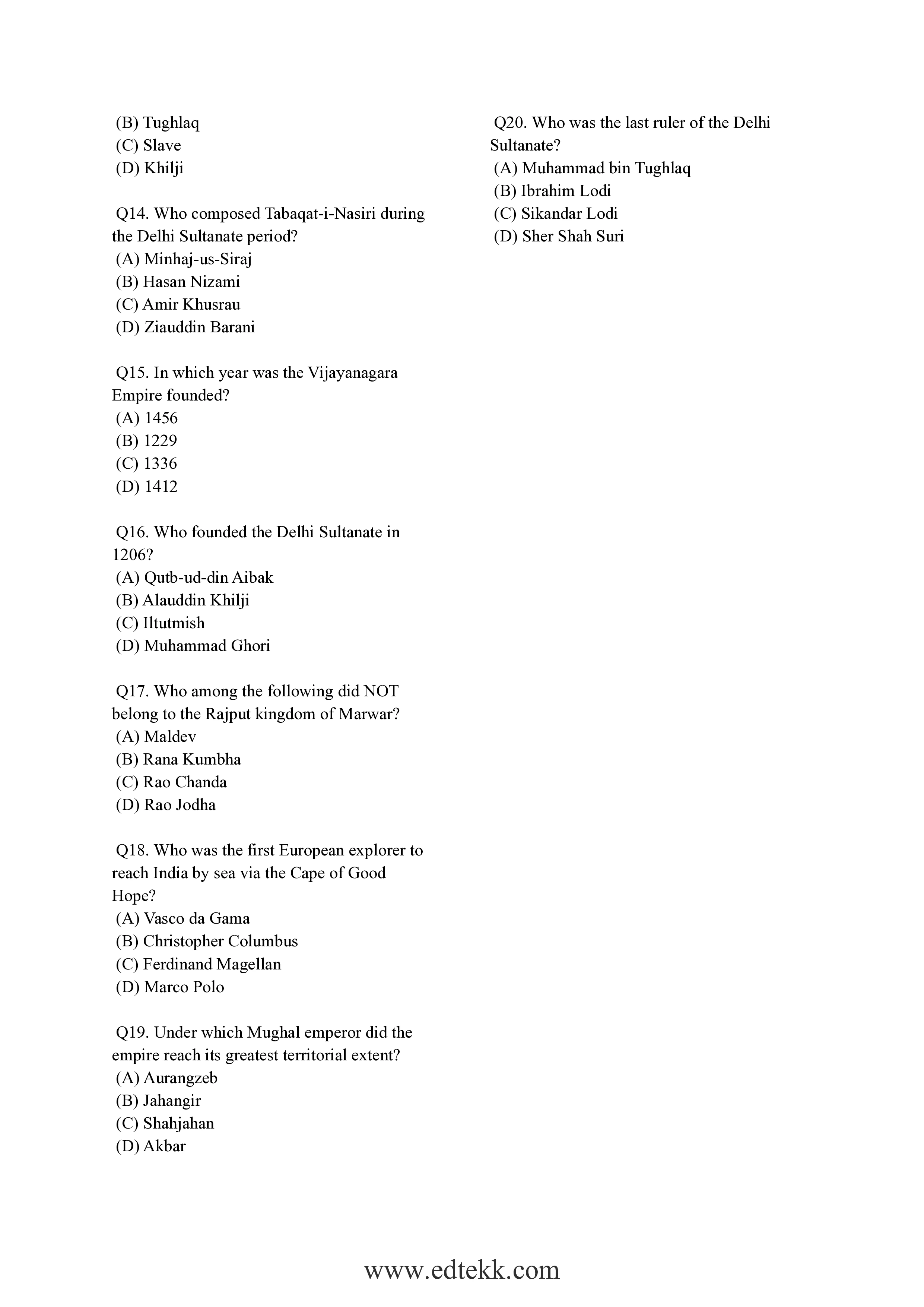
Q15. In which year was the Vijayanagara Empire founded?
(A) 1456
(B) 1229
(C) 1336
(D) 1412
Explanation: The Vijayanagara Empire was founded in 1336 CE by the brothers Harihara I and Bukka Raya I. They established their kingdom in southern India, with its capital at Vijayanagara, near present-day Hampi in Karnataka. The empire subsequently emerged as a major political, economic and cultural power in medieval South India.
Q16. Who founded the Delhi Sultanate in 1206?
(A) Qutb-ud-din Aibak
(B) Alauddin Khilji
(C) Iltutmish
(D) Muhammad Ghori
Explanation: Qutb-ud-din Aibak founded the Mamluk, or Slave, dynasty in 1206, conventionally marking the beginning of the Delhi Sultanate. A former military commander of Muhammad Ghori, he established independent rule in northern India following Ghori’s death. Iltutmish subsequently consolidated and strengthened the Sultanate.
Q17. Who among the following did NOT belong to the Rajput kingdom of Marwar?
(A) Maldev
(B) Rana Kumbha
(C) Rao Chanda
(D) Rao Jodha
Explanation: Rana Kumbha was a prominent fifteenth-century ruler of Mewar belonging to the Sisodia Rajput dynasty. He did not belong to Marwar. Rao Chunda, Rao Jodha and Maldev Rathore were associated with the Rathore dynasty of Marwar. Rao Jodha founded Jodhpur in 1459, while Maldev Rathore ruled Marwar during the sixteenth century.
Q18. Who was the first European explorer to reach India by sea via the Cape of Good Hope?
(A) Vasco da Gama
(B) Christopher Columbus
(C) Ferdinand Magellan
(D) Marco Polo
Explanation: Vasco da Gama was the first European explorer to reach India by sea through the Cape of Good Hope route. He arrived at Calicut (present-day Kozhikode) on the Malabar Coast in May 1498. His voyage established a direct maritime trade route between Europe and India.
Q19. Under which Mughal emperor did the empire reach its greatest territorial extent?
(A) Aurangzeb
(B) Jahangir
(C) Shahjahan
(D) Akbar
Explanation: The Mughal Empire reached its greatest territorial extent under Aurangzeb (1658–1707). His prolonged military campaigns, particularly in the Deccan, expanded Mughal control over much of the Indian subcontinent. However, these campaigns strained imperial finances and administration, contributing to political instability and the empire’s subsequent decline.
Q20. Who was the last ruler of the Delhi Sultanate?
(A) Muhammad bin Tughlaq
(B) Ibrahim Lodi
(C) Sikandar Lodi
(D) Sher Shah Suri
Explanation: Ibrahim Lodi was the last ruler of the Delhi Sultanate and the final ruler of the Lodi dynasty. He was defeated and killed by Babur at the First Battle of Panipat in 1526. This defeat ended the Delhi Sultanate and paved the way for the establishment of Mughal rule in India.
Question Paper Images