Continue your preparation with this second paper of Medieval Indian History revision questions. Designed for Police Constable and Police SI aspirants, it covers significant medieval rulers, dynasties, battles, administration and cultural developments through objective questions with accurate answers and explanations.
Test Details
Topic: Medieval Indian History
Total Questions: 20
Question Format: MCQs – Single Correct Answer
Suitable for: Police Constable, Police SI
Download All Papers in This Series (PDF)
Questions and Answers
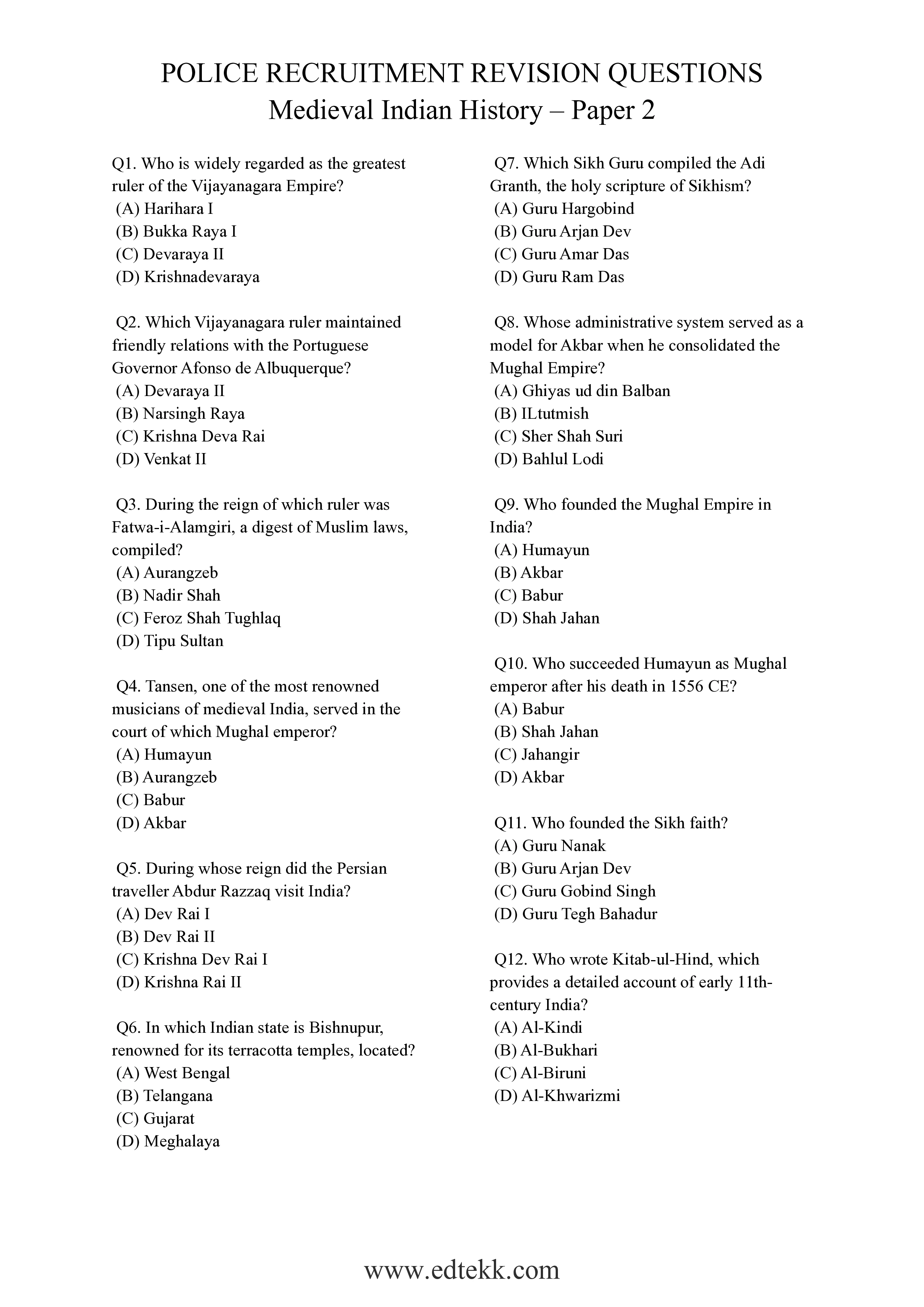
Q1. Who is widely regarded as the greatest ruler of the Vijayanagara Empire?
(A) Harihara I
(B) Bukka Raya I
(C) Devaraya II
(D) Krishnadevaraya
Explanation: Krishnadevaraya, who ruled the Vijayanagara Empire from 1509 to 1529, is widely regarded as its greatest ruler. Under his leadership, the empire achieved remarkable progress in military strength, territorial expansion, administration, literature, art and architecture. His reign is considered the golden age of the Vijayanagara Empire.
Q2. Which Vijayanagara ruler maintained friendly relations with the Portuguese Governor Afonso de Albuquerque?
(A) Devaraya II
(B) Narsingh Raya
(C) Krishna Deva Rai
(D) Venkat II
Explanation: Krishna Deva Raya (1509–1529 CE), the most prominent ruler of the Tuluva dynasty of Vijayanagara, maintained friendly diplomatic and commercial relations with the Portuguese under Governor Afonso de Albuquerque. These relations facilitated Portuguese trade, particularly in Arabian horses, which were essential for the Vijayanagara cavalry.
Q3. During the reign of which ruler was Fatwa-i-Alamgiri, a digest of Muslim laws, compiled?
(A) Aurangzeb
(B) Nadir Shah
(C) Feroz Shah Tughlaq
(D) Tipu Sultan
Explanation: The Fatawa-e-Alamgiri, also known as Al-Fatawa al-Hindiyya, was compiled during the reign of Mughal emperor Aurangzeb (1658–1707). It was prepared by a committee of Islamic jurists under imperial patronage and systematically organised legal rulings based on the Hanafi school of Islamic jurisprudence.
Q4. Tansen, one of the most renowned musicians of medieval India, served in the court of which Mughal emperor?
(A) Humayun
(B) Aurangzeb
(C) Babur
(D) Akbar
Explanation: Tansen was a celebrated musician in the court of Mughal emperor Akbar and is traditionally counted among his Navaratnas, or nine distinguished courtiers. Previously associated with the court of Raja Ramchandra of Rewa, he joined Akbar’s court in the sixteenth century. He is remembered for his major influence on Hindustani classical music and traditions associated with several ragas.
Q5. During whose reign did the Persian traveller Abdur Razzaq visit India?
(A) Dev Rai I
(B) Dev Rai II
(C) Krishna Dev Rai I
(D) Krishna Rai II
Explanation: The Persian traveller Abdur Razzaq visited the Vijayanagara Empire during the reign of Deva Raya II (1422–1446 CE). He arrived around 1443 CE as an envoy of the Timurid ruler Shah Rukh. His travel account provides valuable information about the empire’s wealth, administration and urban life.
Q6. In which Indian state is Bishnupur, renowned for its terracotta temples, located?
(A) West Bengal
(B) Telangana
(C) Gujarat
(D) Meghalaya
Explanation: Bishnupur is located in the Bankura district of West Bengal and is renowned for its terracotta temples built under the patronage of the Malla rulers. Many of these temples date from the seventeenth and eighteenth centuries. Their distinctive architecture features curved roofs and intricate terracotta panels depicting episodes from Hindu mythology, particularly the Ramayana and Mahabharata.
Q7. Which Sikh Guru compiled the Adi Granth, the holy scripture of Sikhism?
(A) Guru Hargobind
(B) Guru Arjan Dev
(C) Guru Amar Das
(D) Guru Ram Das
Explanation: Guru Arjan Dev, the fifth Sikh Guru, compiled the Adi Granth in 1604. It contained hymns of Sikh Gurus and saints from different religious traditions. The scripture was installed at the Harmandir Sahib in Amritsar, with Baba Buddha as its first granthi. Guru Gobind Singh later affirmed the Guru Granth Sahib as the eternal Sikh Guru in 1708.
Q8. Whose administrative system served as a model for Akbar when he consolidated the Mughal Empire?
(A) Ghiyas ud din Balban
(B) ILtutmish
(C) Sher Shah Suri
(D) Bahlul Lodi
Explanation: Sher Shah Suri’s administrative reforms influenced Emperor Akbar’s governance. His measures included systematic land revenue assessment, currency standardisation, road development, postal arrangements and military administration. Akbar subsequently refined and expanded several such practices, particularly revenue administration, while developing a more elaborate imperial administrative structure.
Q9. Who founded the Mughal Empire in India?
(A) Humayun
(B) Akbar
(C) Babur
(D) Shah Jahan
Explanation: Babur founded the Mughal Empire in India after defeating Ibrahim Lodi at the First Battle of Panipat in 1526. This victory established the foundation of Mughal rule in northern India. Babur was descended from Timur on his father’s side and from Genghis Khan through his maternal lineage.
Q10. Who succeeded Humayun as Mughal emperor after his death in 1556 CE?
(A) Babur
(B) Shah Jahan
(C) Jahangir
(D) Akbar
Explanation: Akbar was born in 1542 CE at Umarkot in Sindh while Humayun was in exile after losing control of his Indian territories. Humayun died in 1556 CE, when Akbar was thirteen years old. Akbar subsequently became the third Mughal emperor and consolidated the Mughal Empire.
Q11. Who founded the Sikh faith?
(A) Guru Nanak
(B) Guru Arjan Dev
(C) Guru Gobind Singh
(D) Guru Tegh Bahadur
Explanation: Guru Nanak founded Sikhism and established its central teachings around devotion to one God, equality, honest work and sharing with others. Born in 1469 in the Punjab region, he challenged religious discrimination and social inequalities. His spiritual teachings became the foundation of the Sikh religious tradition.
Q12. Who wrote Kitab-ul-Hind, which provides a detailed account of early 11th-century India?
(A) Al-Kindi
(B) Al-Bukhari
(C) Al-Biruni
(D) Al-Khwarizmi
Explanation: Al-Biruni, a renowned Khwarazmian scholar and polymath, wrote Kitab-ul-Hind in the early 11th century. The work provides a detailed account of Indian society, religion, philosophy, mathematics, astronomy and customs. He studied Indian intellectual traditions during the period of Mahmud of Ghazni’s invasions.
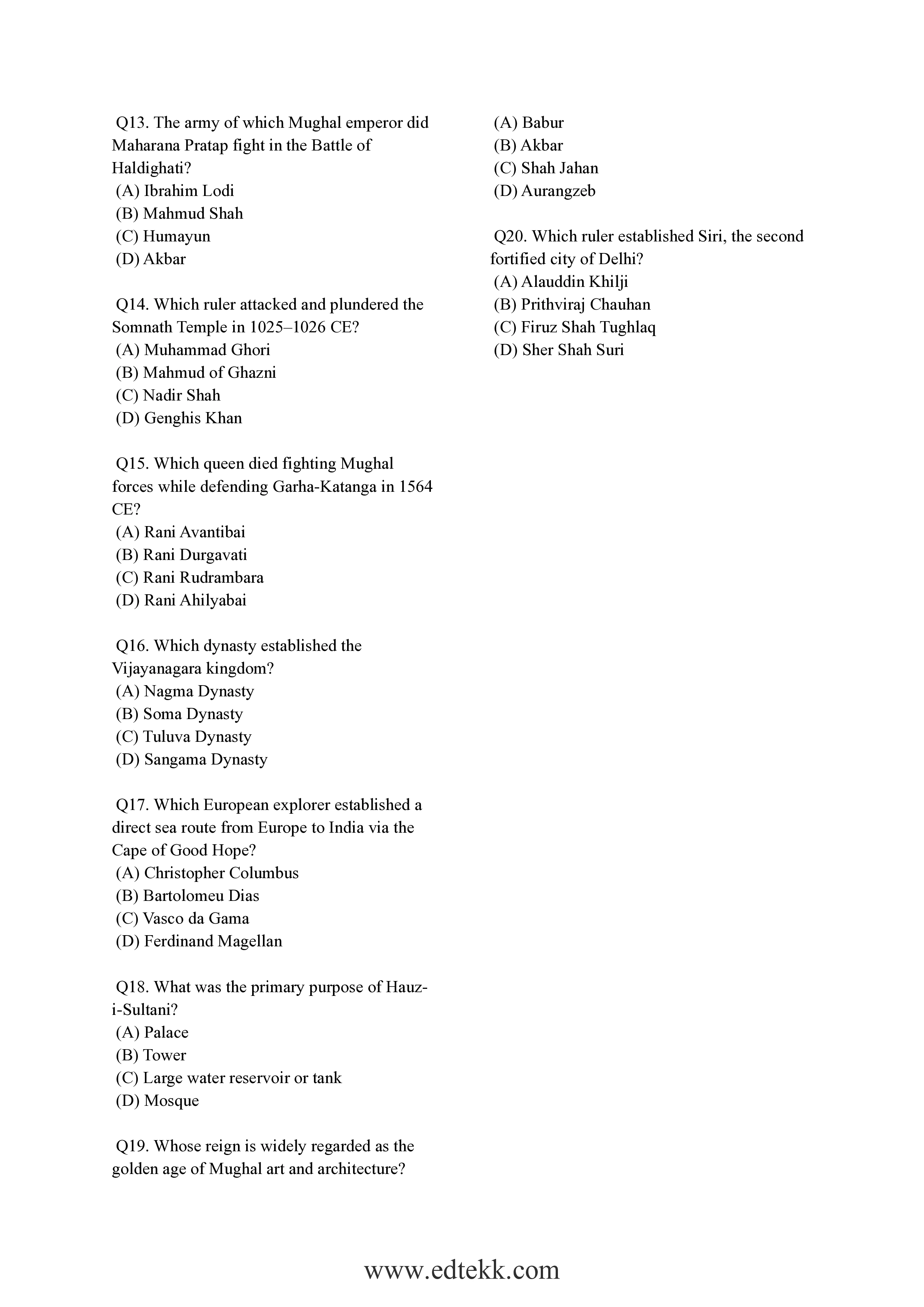
Q13. The army of which Mughal emperor did Maharana Pratap fight in the Battle of Haldighati?
(A) Ibrahim Lodi
(B) Mahmud Shah
(C) Humayun
(D) Akbar
Explanation: Maharana Pratap of Mewar fought against the Mughal forces of Emperor Akbar in the Battle of Haldighati on 18 June 1576. The Mughal army was commanded by Raja Man Singh I of Amber. Although Maharana Pratap withdrew from the battlefield, he continued resisting Mughal authority and later recovered substantial territories in Mewar.
Q14. Which ruler attacked and plundered the Somnath Temple in 1025–1026 CE?
(A) Muhammad Ghori
(B) Mahmud of Ghazni
(C) Nadir Shah
(D) Genghis Khan
Explanation: Mahmud of Ghazni attacked and plundered the famous Somnath Temple in Gujarat in 1025–1026 CE. This raid was part of his military expeditions into the Indian subcontinent. The Somnath attack became one of the most prominent episodes of his campaigns in India.
Q15. Which queen died fighting Mughal forces while defending Garha-Katanga in 1564 CE?
(A) Rani Avantibai
(B) Rani Durgavati
(C) Rani Rudrambara
(D) Rani Ahilyabai
Explanation: Rani Durgavati, the Gond queen of Garha-Katanga, fought against Mughal forces led by Asaf Khan in 1564 CE. After her forces suffered defeat and she was wounded, she chose to take her own life rather than surrender to the enemy. She is remembered for her courageous resistance against Mughal expansion in central India.
Q16. Which dynasty established the Vijayanagara kingdom?
(A) Nagma Dynasty
(B) Soma Dynasty
(C) Tuluva Dynasty
(D) Sangama Dynasty
Explanation: The Sangama dynasty established the Vijayanagara kingdom in 1336 CE. Its founders, Harihara I and Bukka Raya I, laid the foundations of the empire in southern India. The Sangama dynasty was the first of the four major dynasties that ruled the Vijayanagara Empire.
Q17. Which European explorer established a direct sea route from Europe to India via the Cape of Good Hope?
(A) Christopher Columbus
(B) Bartolomeu Dias
(C) Vasco da Gama
(D) Ferdinand Magellan
Explanation: Vasco da Gama was the first European to reach India by sailing around the Cape of Good Hope, arriving at Calicut in 1498. Bartolomeu Dias had rounded the southern tip of Africa in 1488, demonstrating the feasibility of the passage. Vasco da Gama completed the maritime route connecting Europe and India.
Q18. What was the primary purpose of Hauz-i-Sultani?
(A) Palace
(B) Tower
(C) Large water reservoir or tank
(D) Mosque
Explanation: Hauz-i-Sultani refers to a large water reservoir or tank associated with medieval Delhi. Such reservoirs were constructed to collect and store water for public use and to meet the needs of the settlement. They played an important role in supplying water to inhabitants, particularly during periods of limited rainfall.
Q19. Whose reign is widely regarded as the golden age of Mughal art and architecture?
(A) Babur
(B) Akbar
(C) Shah Jahan
(D) Aurangzeb
Explanation: Shah Jahan’s reign (1628–1658) is widely regarded as a golden age of Mughal architecture. Major monuments commissioned during his rule include the Taj Mahal, the Red Fort in Delhi, and the Jama Masjid. These structures demonstrate the period’s refined architectural design, decorative craftsmanship, and monumental imperial patronage.
Q20. Which ruler established Siri, the second fortified city of Delhi?
(A) Alauddin Khilji
(B) Prithviraj Chauhan
(C) Firuz Shah Tughlaq
(D) Sher Shah Suri
Explanation: Alauddin Khalji established Siri, the second fortified city of Delhi, in the early fourteenth century. He developed it as a military and administrative centre, particularly to defend his kingdom against Mongol invasions. Siri became an important part of the historical urban development of Delhi.
Question Paper Images