Prepare for Police Constable and Police SI examinations with Post-Independence Indian History revision questions. This practice set covers major political, social, economic and administrative developments in India after 1947, with carefully selected MCQs, answers and explanations to strengthen historical knowledge and exam preparation.
Test Details
Topic: Post-Independence Indian History
Total Questions: 20
Question Format: MCQs – Single Correct Answer
Suitable for: Police Constable, Police SI
Download All Papers in This Series (PDF)
Questions and Answers
Q1. Which Constitutional Amendment introduced the anti-defection law in India?
(A) 42nd Amendment
(B) 10th Amendment
(C) 52nd Amendment
(D) 91st Amendment
Explanation: The 52nd Constitutional Amendment Act, 1985, introduced the anti-defection law in India by adding the Tenth Schedule to the Constitution. It provides for the disqualification of elected legislators on grounds of defection, including voluntarily giving up party membership or voting contrary to party directions without permission.
Q2. In which year was the Integrated Child Development Services (ICDS) scheme launched?
(A) 1965
(B) 1975
(C) 1985
(D) 1992
Explanation: The Integrated Child Development Services (ICDS) scheme was launched on 2 October 1975. It provides an integrated package of six services for children below six years of age and pregnant and lactating women, including supplementary nutrition, immunisation, health check-ups, referral services, preschool non-formal education and nutrition and health education. Its primary objective is to improve maternal and child health and development.
Q3. In which Indian state are the famous Ajanta and Ellora Caves located?
(A) Maharashtra
(B) Madhya Pradesh
(C) Rajasthan
(D) Karnataka
Explanation: The Ajanta and Ellora Caves are located in Maharashtra, near Chhatrapati Sambhajinagar (formerly Aurangabad). Ajanta is renowned primarily for its Buddhist paintings and sculptures, while Ellora features Buddhist, Hindu and Jain monuments. Both are UNESCO World Heritage Sites.
Q4. Who was the Prime Minister of India when the Right to Information Act was enacted in 2005?
(A) Atal Bihari Vajpayee
(B) P.V. Narasimha Rao
(C) Manmohan Singh
(D) Indira Gandhi
Explanation: Manmohan Singh was Prime Minister when the Right to Information (RTI) Act was enacted in 2005. The Act empowered citizens to obtain information from public authorities, promoting transparency, accountability and public participation in governance. It came fully into force on 12 October 2005.
Q5. The Chauri Chaura incident took place during which Indian freedom movement?
(A) Civil Disobedience Movement
(B) Non-Cooperation Movement
(C) Quit India Movement
(D) Khilafat Movement
Explanation: The Chauri Chaura incident occurred on 4 February 1922 during the Non-Cooperation Movement. Protesters clashed with police and set fire to a police station, killing 22 policemen. Mahatma Gandhi subsequently withdrew the movement because he believed that the growing violence contradicted the principles of non-violence.
Q6. Who was the Prime Minister of India during the National Emergency of 1975–1977?
(A) Charan Singh
(B) Atal Bihari Vajpayee
(C) Indira Gandhi
(D) Morarji Desai
Explanation: Indira Gandhi was Prime Minister during the National Emergency, which lasted from 25 June 1975 to 21 March 1977. During this period, civil liberties were curtailed, press censorship was imposed, political opponents were detained and democratic institutions faced significant restrictions.
Q7. What was the primary objective of the Swarna Jayanti Gram Swarozgar Yojana (SGSY)?
(A) Self-employment among rural poor
(B) Rural Electrification
(C) Women Empowerment
(D) Primary Healthcare
Explanation: The Swarna Jayanti Gram Swarozgar Yojana (SGSY) was launched in 1999 to promote self-employment among rural poor households. It encouraged the formation of self-help groups (SHGs) and provided assistance through capacity-building, bank credit and government subsidies for sustainable income-generating activities. In 2011, it was restructured into the National Rural Livelihoods Mission (NRLM), subsequently known as Deendayal Antyodaya Yojana–NRLM.
Q8. Which Indian State is famous for celebrating the Hornbill Festival?
(A) Mizoram
(B) Nagaland
(C) Tripura
(D) Manipur
Explanation: Nagaland is famous for its annual Hornbill Festival, organised by the state government. It is generally celebrated during the first ten days of December at Kisama Heritage Village near Kohima. The festival showcases the traditions, dances, music, handicrafts, cuisine and cultural heritage of Nagaland’s indigenous tribes.
Q9. Which Indian State is known for successfully implementing the Kudumbashree programme for poverty eradication?
(A) Kerala
(B) Karnataka
(C) Tamil Nadu
(D) Andhra Pradesh
Explanation: Kudumbashree is a Kerala government initiative launched in 1998 to address poverty through women-led neighbourhood groups, community participation, microfinance and livelihood development. It promotes women’s empowerment, self-help activities, social inclusion and local economic development. Its community-based approach has made it a prominent example of a state-level poverty alleviation programme in India.
Q10. Who was the first Indian to receive the Nobel Prize in Physics?
(A) Subrahmanyan Chandrasekhar
(B) C.V. Raman
(C) Venkatraman Ramakrishnan
(D) Har Gobind Khorana
Explanation: C. V. Raman became the first Indian to receive the Nobel Prize in Physics in 1930. He was awarded the prize for discovering the Raman Effect, which explains the inelastic scattering of light and the resulting change in its wavelength when it interacts with molecules. His discovery made a significant contribution to spectroscopy.
Q11. Who was India’s first non-Congress Prime Minister?
(A) Morarji Desai
(B) Charan Singh
(C) V.P. Singh
(D) Atal Bihari Vajpayee
Explanation: Morarji Desai became India’s first non-Congress Prime Minister in March 1977 after the Janata Party won the general elections. He served until July 1979. His premiership marked the end of uninterrupted Congress rule at the national level since independence in 1947.
Q12. In which year was the National Food Security Act enacted?
(A) 2013
(B) 2010
(C) 2005
(D) 2008
Explanation: The National Food Security Act (NFSA) was enacted in 2013 to provide subsidised food grains to eligible households through a rights-based framework. It covers priority households and Antyodaya Anna Yojana families and provides nutritional support for pregnant women, lactating mothers and children. The legislation aims to strengthen food and nutritional security across India.
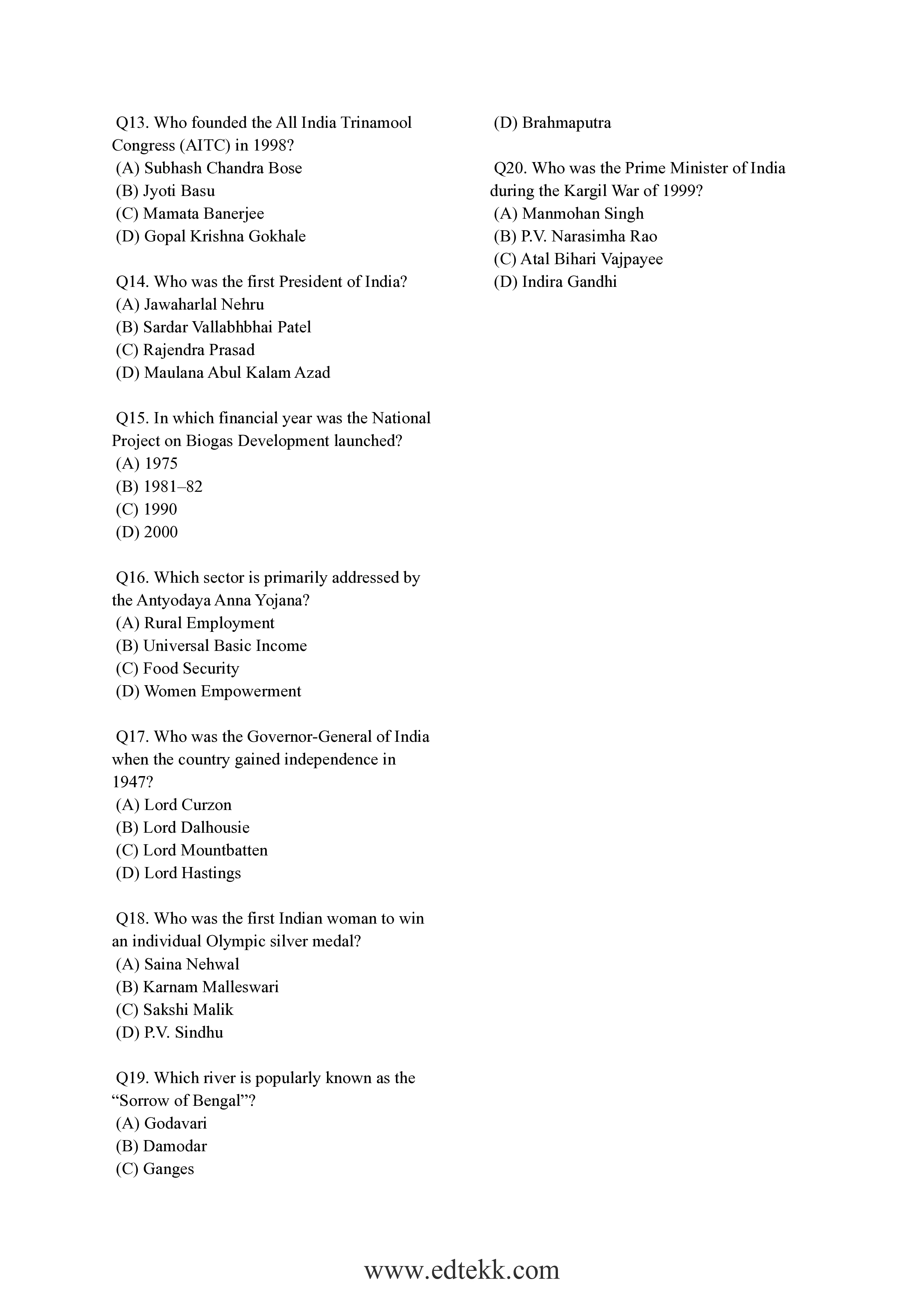
Q13. Who founded the All India Trinamool Congress (AITC) in 1998?
(A) Subhash Chandra Bose
(B) Jyoti Basu
(C) Mamata Banerjee
(D) Gopal Krishna Gokhale
Explanation: Mamata Banerjee founded the All India Trinamool Congress (AITC) in January 1998 after separating from the Indian National Congress. The party emerged as a major political force in West Bengal and formed the state government in 2011 under her leadership.
Q14. Who was the first President of India?
(A) Jawaharlal Nehru
(B) Sardar Vallabhbhai Patel
(C) Rajendra Prasad
(D) Maulana Abul Kalam Azad
Explanation: Dr. Rajendra Prasad was India’s first President, assuming office on 26 January 1950 when the Constitution came into effect. He served until 13 May 1962 and remains the only Indian President to have completed two full terms. Earlier, he had served as President of the Constituent Assembly.
Q15. In which financial year was the National Project on Biogas Development launched?
(A) 1975
(B) 1981–82
(C) 1990
(D) 2000
Explanation: The National Project on Biogas Development was launched during the financial year 1981–82 to promote biogas technology, particularly household biogas plants. It encouraged the utilisation of organic waste, especially cattle dung, for renewable energy production. The programme also promoted the use of biogas slurry as organic manure, contributing to sustainable agriculture and rural energy development.
Q16. Which sector is primarily addressed by the Antyodaya Anna Yojana?
(A) Rural Employment
(B) Universal Basic Income
(C) Food Security
(D) Women Empowerment
Explanation: Antyodaya Anna Yojana (AAY) was launched in December 2000 to provide highly subsidised food grains to the poorest households in India. It operates through the Public Distribution System (PDS) and aims to improve food security among the most economically vulnerable sections of society.
Q17. Who was the Governor-General of India when the country gained independence in 1947?
(A) Lord Curzon
(B) Lord Dalhousie
(C) Lord Mountbatten
(D) Lord Hastings
Explanation: Lord Mountbatten was the last Viceroy of British India and became the first Governor-General of independent India on 15 August 1947. He held this position until June 1948, when C. Rajagopalachari succeeded him. Mountbatten played a central role in the transfer of power and the Partition of British India.
Q18. Who was the first Indian woman to win an individual Olympic silver medal?
(A) Saina Nehwal
(B) Karnam Malleswari
(C) Sakshi Malik
(D) P.V. Sindhu
Explanation: P. V. Sindhu became the first Indian woman to win an individual Olympic silver medal at the 2016 Rio Olympics. She secured silver in women’s badminton singles after reaching the final. Karnam Malleswari was the first Indian woman to win an Olympic medal, securing bronze in weightlifting at the 2000 Sydney Olympics.
Q19. Which river is popularly known as the “Sorrow of Bengal”?
(A) Godavari
(B) Damodar
(C) Ganges
(D) Brahmaputra
Explanation: The Damodar River is traditionally known as the Sorrow of Bengal because its frequent floods historically caused extensive damage to life, agriculture and property. The establishment of the Damodar Valley Corporation (DVC) in 1948 introduced integrated flood-control and water-management measures to reduce the river’s destructive impact.
Q20. Who was the Prime Minister of India during the Kargil War of 1999?
(A) Manmohan Singh
(B) P.V. Narasimha Rao
(C) Atal Bihari Vajpayee
(D) Indira Gandhi
Explanation: Atal Bihari Vajpayee was the Prime Minister of India during the Kargil War of 1999. The conflict involved Indian and Pakistani forces in the Kargil region of Jammu and Kashmir. India successfully recaptured the occupied positions through Operation Vijay, which concluded in July 1999.
Question Paper Images