Enhance your preparation with the second paper of Modern Indian History revision questions for Police Constable and Police SI examinations. It focuses on the Indian national movement, freedom fighters, important acts, revolutionary activities and independence-related events, with objective questions, answers and explanations.
Test Details
Topic: Modern Indian History
Total Questions: 20
Question Format: MCQs – Single Correct Answer
Suitable for: Police Constable, Police SI
Download All Papers in This Series (PDF)
Questions and Answers
Q1. At which jail was Khudiram Bose executed?
(A) Barishal
(B) Chittagong
(C) Muzaffarpur
(D) Alipore
Explanation: Khudiram Bose was executed at Muzaffarpur Jail on 11 August 1908. He was arrested following the 1908 bomb attack intended to assassinate British magistrate Douglas Kingsford. The attack mistakenly killed two British women, Mrs and Miss Kennedy. Khudiram Bose was subsequently tried and sentenced to death.
Q2. Which young Ghadar revolutionary was executed in Lahore in November 1915?
(A) Kartar Singh Sarabha
(B) Tantia Mama
(C) Maganbhai Patel
(D) Vijay Singh Pathik
Explanation: Kartar Singh Sarabha was a young revolutionary associated with the Ghadar movement. He participated in efforts to organise an armed uprising against British rule in 1915. Following the failure of the Ghadar conspiracy, he was arrested, tried, and executed at Lahore Central Jail on 16 November 1915. He subsequently became an inspirational figure for Indian revolutionaries, including Bhagat Singh.
Q3. Which war ended with the signing of the Treaty of Salbai?
(A) Third Battle of Panipat
(B) First Maratha War
(C) Second Anglo-Maratha War
(D) Battle of Buxar
Explanation: The First Anglo-Maratha War (1775–1782) ended with the Treaty of Salbai, signed in 1782 between the British East India Company and the Maratha Confederacy. The treaty recognised Madhav Rao II as Peshwa and restored several territories to the Marathas, establishing peace between the two powers.
Q4. Who founded the Asiatic Society of Bengal in 1784?
(A) Sir William Jones
(B) Raja Ram Mohan Roy
(C) Dwarkanath Tagore
(D) Henry Vivian Derozio
Explanation: Sir William Jones founded the Asiatic Society of Bengal in Calcutta in 1784. The society promoted research into Asian history, languages, literature, culture and natural sciences. Jones’s studies of Sanskrit and comparative linguistics contributed significantly to the development of Oriental studies. The institution became an important centre of historical and scholarly research in colonial India.
Q5. Who is popularly known as the “Grand Old Man of India”?
(A) Jawaharlal Nehru
(B) Dadabhai Naoroji
(C) Mohandas Gandhi
(D) Vallabhbhai Patel
Explanation: Dadabhai Naoroji was popularly known as the “Grand Old Man of India” and is widely associated with early Indian nationalism. He developed the Drain Theory, explaining how British colonial policies transferred wealth from India to Britain. In 1892, he became the first Indian elected to the British House of Commons and served as President of the Indian National Congress three times.
Q6. Who was the Governor-General of India during the Revolt of 1857?
(A) Lord Cornwallis
(B) Lord Curzon
(C) Lord Canning
(D) Lord Mountbatten
Explanation: Lord Canning was the Governor-General of India during the Revolt of 1857. He served from 1856 to 1862 and became the first Viceroy of India in 1858 following the transfer of administration from the East India Company to the British Crown under the Government of India Act, 1858.
Q7. Which commission, chaired by Thomas Babington Macaulay, drafted the Indian Penal Code?
(A) Warren Hastings Commission
(B) Simon Commission
(C) First Law Commission of India
(D) Cripps Commission
Explanation: The First Law Commission of India, established in 1834 under the chairmanship of Thomas Babington Macaulay, drafted the Indian Penal Code. The draft was submitted in 1837 and subsequently revised before being enacted in 1860. The Code came into force in 1862.
Q8. How old was Bhagat Singh when he was executed?
(A) 23 years
(B) 20 years
(C) 30 years
(D) 26 years
Explanation: Bhagat Singh was 23 years old when he was executed on 23 March 1931, along with fellow revolutionaries Rajguru and Sukhdev. Born on 28 September 1907, he became a prominent figure in India’s revolutionary freedom movement. His execution by the British colonial government made him an enduring symbol of resistance and patriotism.
Q9. In which state did C. Rajagopalachari lead the Salt Satyagraha?
(A) Tamil Nadu
(B) Gujarat
(C) Maharashtra
(D) Rajasthan
Explanation: C. Rajagopalachari led the Salt Satyagraha in the Madras Presidency in April 1930. He organised a march from Tiruchirappalli to Vedaranyam, where volunteers broke the British salt law. This campaign was the southern counterpart of Mahatma Gandhi’s Dandi March in Gujarat and formed part of the Civil Disobedience Movement.
Q10. In which region of British India was the Ryotwari system primarily introduced for revenue collection?
(A) Eastern India
(B) North India
(C) Western India
(D) South India
Explanation: The Ryotwari system was introduced primarily in South India, particularly in the Madras Presidency, and was subsequently implemented in parts of the Bombay Presidency. Under this system, land revenue was collected directly from individual cultivators (ryots), rather than through intermediaries such as zamindars. Thomas Munro and Alexander Read played important roles in its development and implementation.
Q11. Which Viceroy appointed the Hunter Commission in 1882?
(A) Lord Minto
(B) Lord Ripon
(C) Lord Mayo
(D) Lord Lytton
Explanation: Lord Ripon appointed the Indian Education Commission in 1882, popularly known as the Hunter Commission, under the chairmanship of William Wilson Hunter. The commission reviewed the progress of education following Wood’s Despatch of 1854. It emphasised primary education, greater local participation in educational administration and the promotion of private educational institutions.
Q12. In which present-day Indian state did the Telangana Armed Struggle against feudal landlords and the Nizam’s rule take place?
(A) Karnataka
(B) Andhra Pradesh
(C) Telangana
(D) Tamil Nadu
Explanation: The Telangana Armed Struggle (1946–1951) was a peasant uprising against oppressive feudal landlords, particularly deshmukhs and jagirdars, and the autocratic rule of the Nizam of Hyderabad. It primarily occurred in the Telangana region of the erstwhile Hyderabad State, which became part of Andhra Pradesh in 1956 and a separate state in 2014.
Q13. Which of the following universities was founded by Pandit Madan Mohan Malaviya?
(A) Delhi University
(B) Punjab University
(C) Banaras Hindu University
(D) Sambalpur University
Explanation: Banaras Hindu University (BHU) was founded by Pandit Madan Mohan Malaviya and formally established in 1916 in Varanasi, Uttar Pradesh. He sought to promote modern scientific education alongside Indian cultural and traditional learning. The university subsequently became one of India’s prominent institutions of higher education.
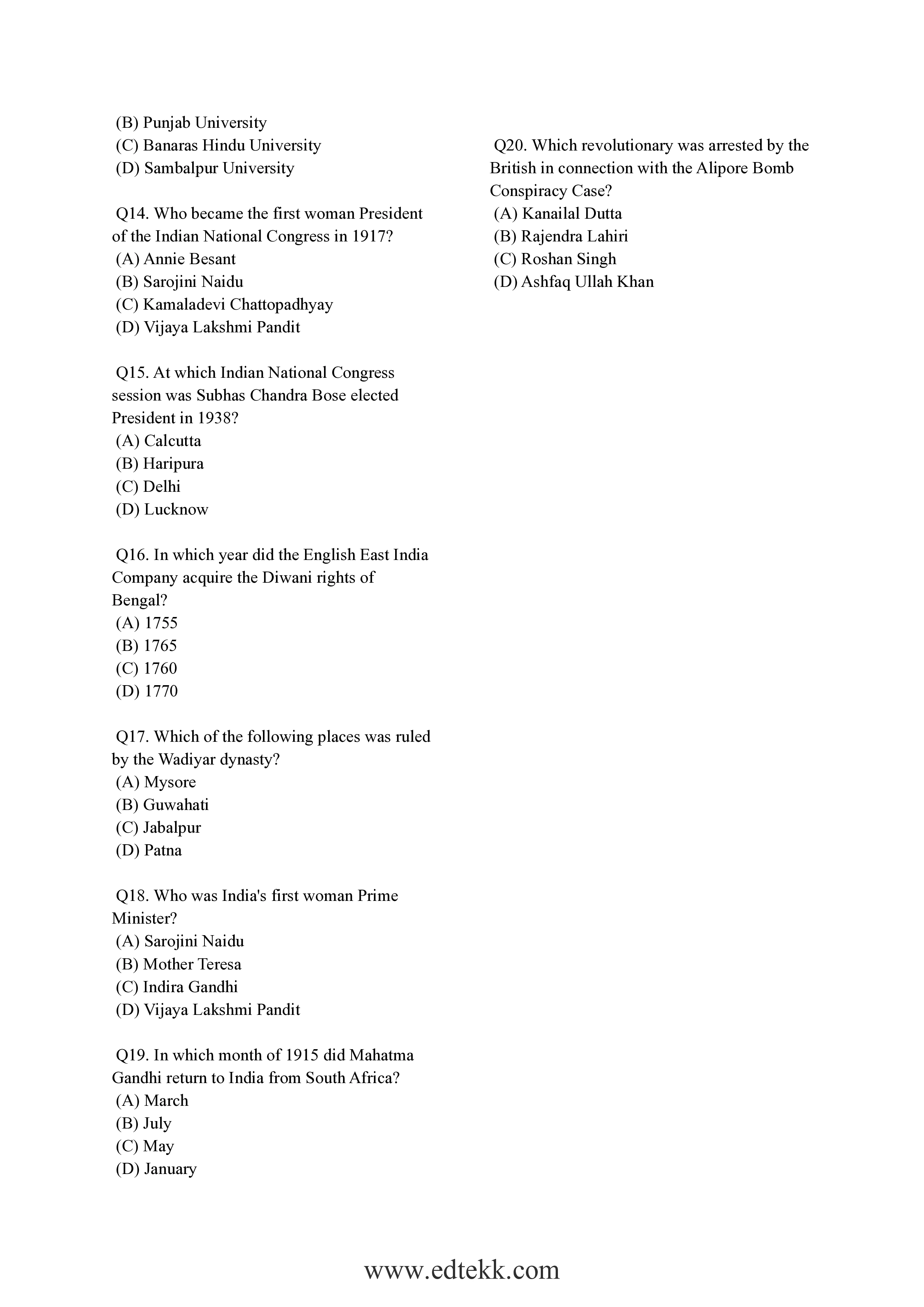
Q14. Who became the first woman President of the Indian National Congress in 1917?
(A) Annie Besant
(B) Sarojini Naidu
(C) Kamaladevi Chattopadhyay
(D) Vijaya Lakshmi Pandit
Explanation: Annie Besant became the first woman president of the Indian National Congress at its Calcutta session in 1917. She was a prominent Theosophist and political activist who campaigned for Indian self-government through the Home Rule Movement. Sarojini Naidu subsequently became the first Indian woman to preside over the Congress in 1925.
Q15. At which Indian National Congress session was Subhas Chandra Bose elected President in 1938?
(A) Calcutta
(B) Haripura
(C) Delhi
(D) Lucknow
Explanation: Subhas Chandra Bose was elected President of the Indian National Congress at its Haripura Session in February 1938. He succeeded Jawaharlal Nehru. Bose was subsequently re-elected at the 1939 Tripuri Session, defeating Pattabhi Sitaramayya, who was supported by Mahatma Gandhi.
Q16. In which year did the English East India Company acquire the Diwani rights of Bengal?
(A) 1755
(B) 1765
(C) 1760
(D) 1770
Explanation: The English East India Company acquired the Diwani rights of Bengal, Bihar and Orissa in 1765 from Mughal Emperor Shah Alam II under the Treaty of Allahabad. These rights granted the Company authority to collect revenue in these territories, marking a major transition from a trading enterprise to a territorial power in India.
Q17. Which of the following places was ruled by the Wadiyar dynasty?
(A) Mysore
(B) Guwahati
(C) Jabalpur
(D) Patna
Explanation: The Wadiyar dynasty ruled the Kingdom of Mysore for several centuries. Its founder, Yaduraya Wadiyar, is traditionally believed to have established the dynasty in 1399 CE. Although Mysore came under the control of Hyder Ali and Tipu Sultan during the eighteenth century, the Wadiyars were restored to the throne in 1799.
Q18. Who was India’s first woman Prime Minister?
(A) Sarojini Naidu
(B) Mother Teresa
(C) Indira Gandhi
(D) Vijaya Lakshmi Pandit
Explanation: Indira Gandhi became India’s first woman Prime Minister on 24 January 1966, following the death of Lal Bahadur Shastri. She served from 1966 to 1977 and again from 1980 until her assassination in 1984. Her tenure included the 1971 India–Pakistan War, the creation of Bangladesh and the Emergency of 1975–1977. She was the daughter of Jawaharlal Nehru, India’s first Prime Minister.
Q19. In which month of 1915 did Mahatma Gandhi return to India from South Africa?
(A) March
(B) July
(C) May
(D) January
Explanation: Mahatma Gandhi returned to India from South Africa on 9 January 1915. This day is commemorated as Pravasi Bharatiya Divas. His return marked an important phase in India’s freedom struggle. Subsequently, he travelled across the country to understand the conditions of ordinary Indians before emerging as a leading figure in the national movement.
Q20. Which revolutionary was arrested by the British in connection with the Alipore Bomb Conspiracy Case?
(A) Kanailal Dutta
(B) Rajendra Lahiri
(C) Roshan Singh
(D) Ashfaq Ullah Khan
Explanation: Kanailal Dutta was arrested in connection with the Alipore Bomb Conspiracy Case of 1908. While imprisoned, he participated in the assassination of Narendranath Gosain, an approver who had turned witness against the revolutionaries. Kanailal Dutta was subsequently tried and executed on 10 November 1908.
Question Paper Images