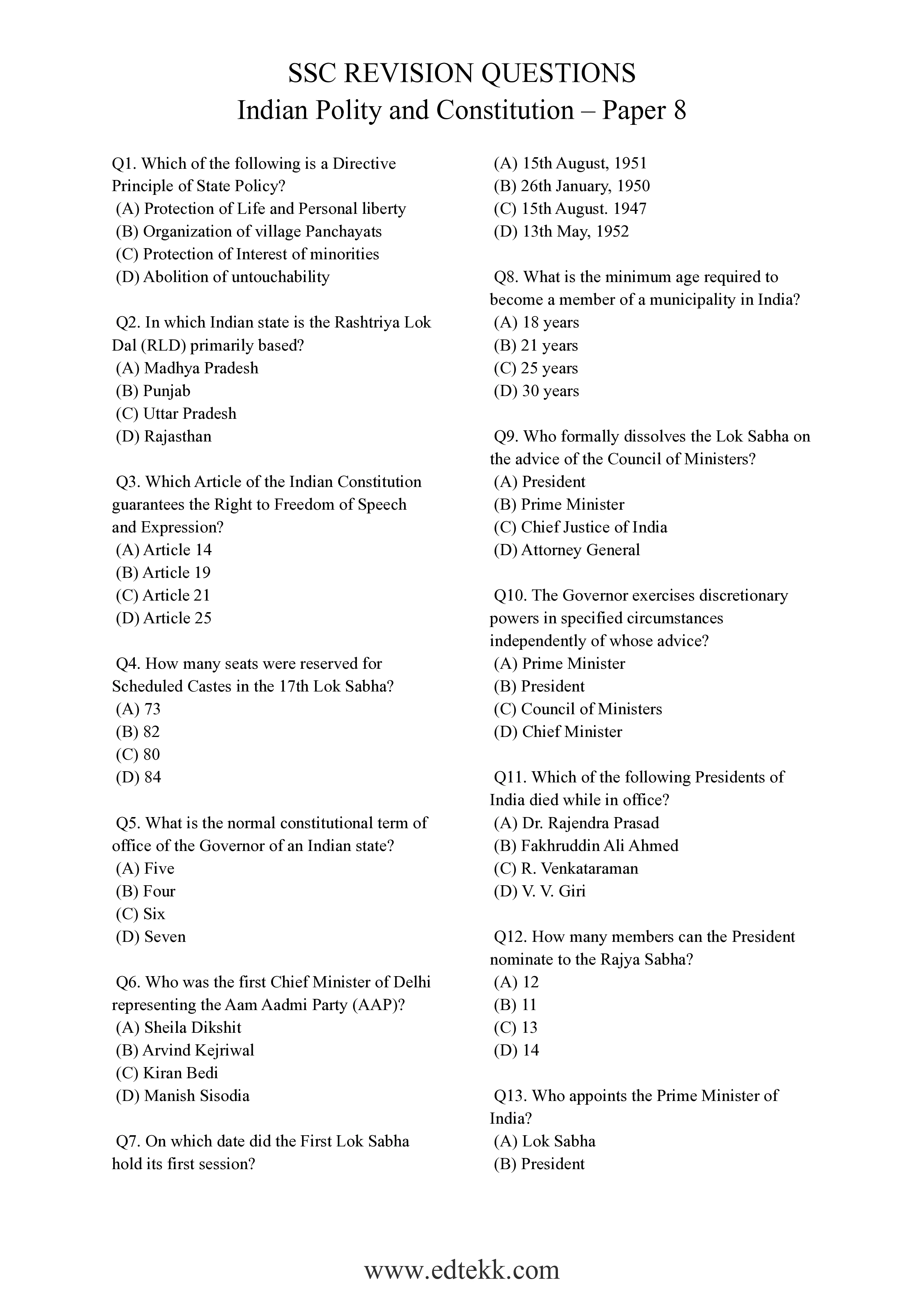
Build stronger conceptual knowledge with Indian Polity and Constitution Revision Questions Paper 8 for SSC aspirants. This practice set contains objective questions on important polity and constitutional topics, along with answers and explanations. It is suitable for focused revision and self-assessment for SSC CGL, CHSL, CPO, MTS, GD and Selection Post examinations.
Test Details
Topic: Indian Polity and Constitution
Total Questions: 20
Question Format: MCQs – Single Correct Answer
Suitable for: SSC CGL, CHSL, CPO, MTS, GD, Selection Post
Download All Papers in This Series (PDF)
Questions and Answers
Q1. Which of the following is a Directive Principle of State Policy?
(A) Protection of Life and Personal liberty
(B) Organization of village Panchayats
(C) Protection of Interest of minorities
(D) Abolition of untouchability
Explanation: The organisation of village panchayats is a Directive Principle of State Policy under Article 40 of the Indian Constitution. It directs the State to organise village panchayats and endow them with the necessary powers to function as units of self-government, promoting decentralisation and grassroots democracy.
Q2. In which Indian state is the Rashtriya Lok Dal (RLD) primarily based?
(A) Madhya Pradesh
(B) Punjab
(C) Uttar Pradesh
(D) Rajasthan
Explanation: The Rashtriya Lok Dal (RLD), founded by Ajit Singh in 1996, is primarily associated with Uttar Pradesh, particularly its western region. The party has traditionally represented farmers’ interests and rural communities in western Uttar Pradesh.
Q3. Which Article of the Indian Constitution guarantees the Right to Freedom of Speech and Expression?
(A) Article 14
(B) Article 19
(C) Article 21
(D) Article 25
Explanation: Article 19(1)(a) guarantees citizens the Fundamental Right to freedom of speech and expression. It includes expressing opinions through speech, writing, publication and other forms of communication. However, this right is not absolute. Reasonable restrictions may be imposed under Article 19(2) on specified grounds, including public order, security of the State, defamation and incitement to an offence.
Q4. How many seats were reserved for Scheduled Castes in the 17th Lok Sabha?
(A) 73
(B) 82
(C) 80
(D) 84
Explanation: The 17th Lok Sabha had 84 seats reserved for Scheduled Castes. Such reserved constituencies are intended to ensure representation of Scheduled Castes in the Lok Sabha. The reservation is broadly based on the proportion of Scheduled Castes in the population.
Q5. What is the normal constitutional term of office of the Governor of an Indian state?
(A) Five
(B) Four
(C) Six
(D) Seven
Explanation: Under Article 156, the Governor is appointed by the President and ordinarily holds office for five years from the date of entering office. However, the Governor holds office during the pleasure of the President and may resign by writing to the President. The five-year term does not guarantee tenure for the entire period.
Q6. Who was the first Chief Minister of Delhi representing the Aam Aadmi Party (AAP)?
(A) Sheila Dikshit
(B) Arvind Kejriwal
(C) Kiran Bedi
(D) Manish Sisodia
Explanation: Arvind Kejriwal became the first Chief Minister of Delhi from the Aam Aadmi Party (AAP) on 28 December 2013. He initially served until February 2014, when his government resigned after 49 days. He subsequently returned as Chief Minister in February 2015 following AAP’s victory in the Delhi Assembly elections.
Q7. On which date did the First Lok Sabha hold its first session?
(A) 15th August, 1951
(B) 26th January, 1950
(C) 15th August. 1947
(D) 13th May, 1952
Explanation: The first session of the First Lok Sabha commenced on 13 May 1952. The First Lok Sabha was constituted following India’s first general elections, conducted between 1951 and 1952. This marked the beginning of the functioning of India’s first directly elected House of Parliament.
Q8. What is the minimum age required to become a member of a municipality in India?
(A) 18 years
(B) 21 years
(C) 25 years
(D) 30 years
Explanation: The minimum age for becoming a member of a municipality in India is 21 years, as provided under Article 243V of the Constitution. A candidate must also satisfy other eligibility conditions prescribed by the relevant state laws. This age requirement should not be confused with the minimum voting age of 18 years.
Q9. Who formally dissolves the Lok Sabha on the advice of the Council of Ministers?
(A) President
(B) Prime Minister
(C) Chief Justice of India
(D) Attorney General
Explanation: The President of India formally dissolves the Lok Sabha under Article 85(2)(b) of the Constitution, generally acting on the advice of the Council of Ministers headed by the Prime Minister. Dissolution brings the elected House to an end and normally necessitates general elections to constitute a new Lok Sabha.
Q10. The Governor exercises discretionary powers in specified circumstances independently of whose advice?
(A) Prime Minister
(B) President
(C) Council of Ministers
(D) Chief Minister
Explanation: Under Article 163, the Governor ordinarily exercises executive functions on the aid and advice of the State Council of Ministers headed by the Chief Minister. However, the Constitution permits the Governor to exercise discretion in specified circumstances, including certain constitutional responsibilities and situations requiring an assessment of majority support in the Legislative Assembly.
Q11. Which of the following Presidents of India died while in office?
(A) Dr. Rajendra Prasad
(B) Fakhruddin Ali Ahmed
(C) R. Venkataraman
(D) V. V. Giri
Explanation: Fakhruddin Ali Ahmed was the fifth President of India and died in office on 11 February 1977. He was serving as President when he passed away. Dr. Rajendra Prasad, V. V. Giri and R. Venkataraman completed their respective presidential tenures and did not die while holding the office.
Q12. How many members can the President nominate to the Rajya Sabha?
(A) 12
(B) 11
(C) 13
(D) 14
Explanation: The President nominates 12 members to the Rajya Sabha under Article 80(1)(a) of the Constitution. These members are selected for their special knowledge or practical experience in literature, science, art and social service. Their nomination enables individuals with expertise in these fields to contribute to parliamentary deliberations.
Q13. Who appoints the Prime Minister of India?
(A) Lok Sabha
(B) President
(C) Rajya Sabha
(D) Chief Justice of India
Explanation: The President of India appoints the Prime Minister under Article 75(1) of the Constitution. Normally, the President appoints the leader of the political party or coalition commanding a majority in the Lok Sabha. The Prime Minister heads the Union Council of Ministers and advises the President on the appointment of other ministers.
Q14. Which Article of the Indian Constitution deals with Fundamental Duties?
(A) Article 21
(B) Article 19
(C) Article 51A
(D) Article 14
Explanation: Fundamental Duties are mentioned in Article 51A of the Indian Constitution. They outline citizens’ responsibilities, including respecting the Constitution, national flag and national anthem, protecting the environment and promoting harmony. They were introduced by the 42nd Constitutional Amendment Act, 1976, and one additional duty was incorporated by the 86th Amendment Act, 2002.
Q15. To which House of Parliament is the Union Council of Ministers collectively responsible?
(A) President
(B) Lok Sabha
(C) Prime Minister
(D) Chief Justice of India
Explanation: Under Article 75(3) of the Constitution, the Union Council of Ministers is collectively responsible to the Lok Sabha. This means that the ministry functions as a team and must retain the confidence of the Lok Sabha. If it loses a confidence vote, the Council of Ministers must resign.
Q16. Who is the constitutional head of an Indian state?
(A) Governor
(B) President
(C) Prime Minister
(D) Chief Minister
Explanation: The Governor is the constitutional head of an Indian state, while the Chief Minister is the head of the elected state government. Under the parliamentary system, the Governor ordinarily exercises executive functions on the aid and advice of the Council of Ministers headed by the Chief Minister.
Q17. Which of the following is NOT a constitutional body?
(A) National Human Rights Commission
(B) Finance Commission
(C) Election Commission
(D) Union Public Service Commission
Explanation: The National Human Rights Commission is a statutory body established under the Protection of Human Rights Act, 1993. The Finance Commission, Election Commission of India and UPSC are constitutional bodies.
Q18. The President of India is the Supreme Commander of which of the following forces?
(A) Indian Army only
(B) All the Armed Forces of India
(C) Indian Air Force only
(D) Indian Navy only
Explanation: The President of India is the Supreme Commander of the Indian Armed Forces, comprising the Army, Navy and Air Force. This is a constitutional position; operational command and defence administration are exercised through the established military hierarchy and the Union Government.
Q19. How many types of emergencies are provided for under the Indian Constitution?
(A) 2
(B) 4
(C) 3
(D) 5
Explanation: The Indian Constitution provides for three types of emergencies: National Emergency under Article 352, President’s Rule (State Emergency) under Article 356, and Financial Emergency under Article 360. These provisions address threats to national security, failure of constitutional machinery in a State, and threats to India’s financial stability or credit, respectively.
Q20. Who presides over the sittings of the Rajya Sabha?
(A) Prime Minister
(B) President
(C) Vice President
(D) Chief Justice of India
Explanation: Under Article 64, the Vice President of India serves as the ex officio Chairman of the Rajya Sabha and ordinarily presides over its sittings. The Chairman maintains order, regulates debates and interprets procedural rules. In the Chairman’s absence, the Deputy Chairman or another authorised member presides. The Vice President is not a member of the Rajya Sabha.
Question Paper Images