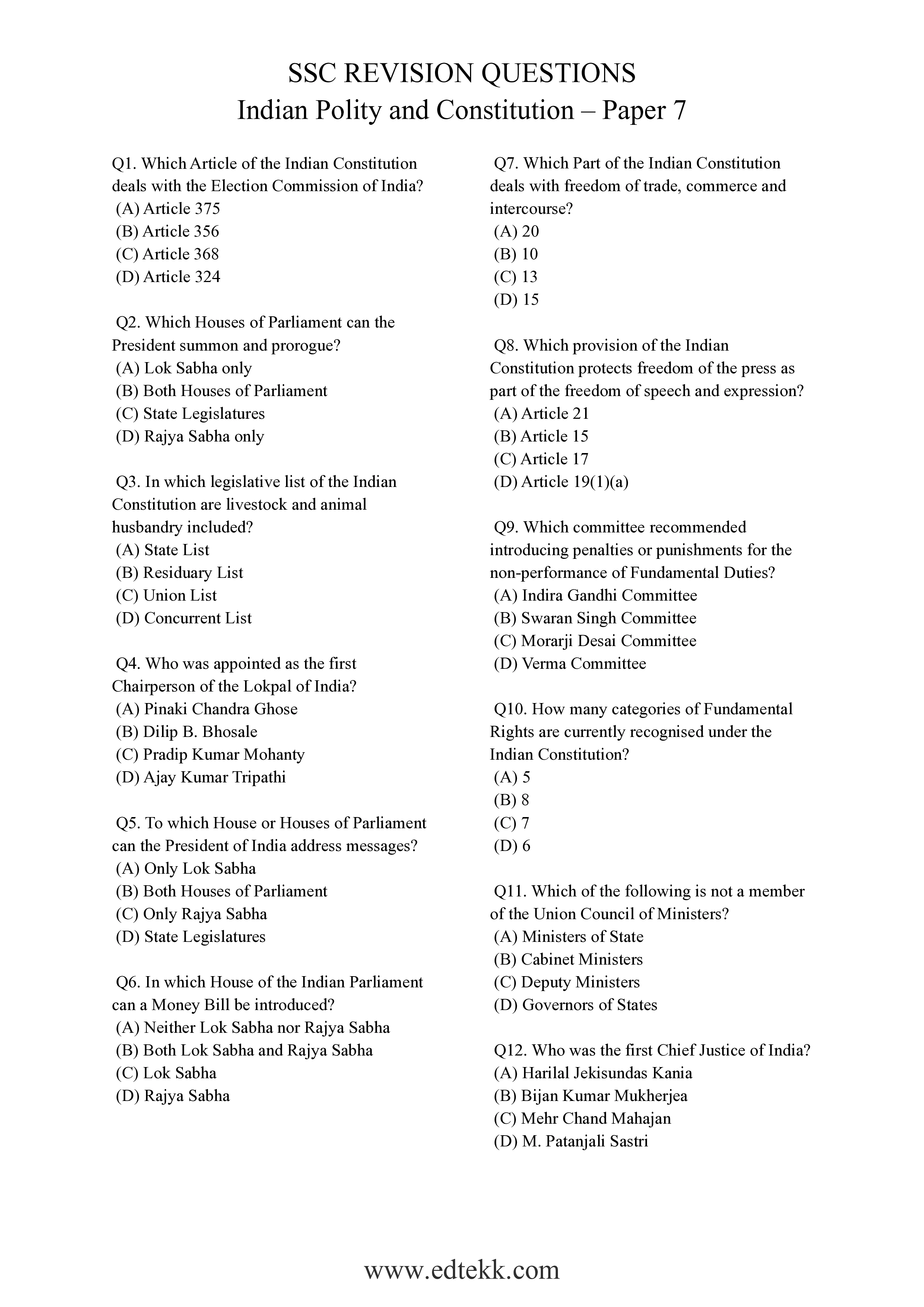
Prepare more effectively for SSC examinations with Indian Polity and Constitution Revision Questions Paper 7. The set focuses on objective practice of important constitutional and political concepts, including answers and explanations for each question. It helps aspirants strengthen subject knowledge and improve their revision strategy for SSC CGL, CHSL, CPO, MTS, GD and Selection Post exams.
Test Details
Topic: Indian Polity and Constitution
Total Questions: 20
Question Format: MCQs – Single Correct Answer
Suitable for: SSC CGL, CHSL, CPO, MTS, GD, Selection Post
Download All Papers in This Series (PDF)
Questions and Answers
Q1. Which Article of the Indian Constitution deals with the Election Commission of India?
(A) Article 375
(B) Article 356
(C) Article 368
(D) Article 324
Explanation: Article 324 of the Indian Constitution deals with the Election Commission of India. It vests the Commission with the superintendence, direction and control of elections to Parliament, State Legislatures, and the offices of the President and Vice-President. It establishes the constitutional framework for independent election administration in India.
Q2. Which Houses of Parliament can the President summon and prorogue?
(A) Lok Sabha only
(B) Both Houses of Parliament
(C) State Legislatures
(D) Rajya Sabha only
Explanation: Under Article 85, the President summons and prorogues both Houses of Parliament: the Lok Sabha and the Rajya Sabha. The President may also dissolve the Lok Sabha. The Rajya Sabha is a permanent House and is not subject to dissolution.
Q3. In which legislative list of the Indian Constitution are livestock and animal husbandry included?
(A) State List
(B) Residuary List
(C) Union List
(D) Concurrent List
Explanation: Livestock and animal husbandry fall under the State List in the Seventh Schedule of the Indian Constitution, particularly Entry 15. State legislatures have authority over the preservation, protection and improvement of livestock, prevention of animal diseases, and veterinary training and practice, subject to other applicable constitutional provisions.
Q4. Who was appointed as the first Chairperson of the Lokpal of India?
(A) Pinaki Chandra Ghose
(B) Dilip B. Bhosale
(C) Pradip Kumar Mohanty
(D) Ajay Kumar Tripathi
Explanation: Justice Pinaki Chandra Ghose was appointed as the first Chairperson of the Lokpal of India in March 2019. The Lokpal is an anti-corruption ombudsman established to investigate allegations of corruption against specified public functionaries. Its chairperson and members are appointed through a prescribed selection process.
Q5. To which House or Houses of Parliament can the President of India address messages?
(A) Only Lok Sabha
(B) Both Houses of Parliament
(C) Only Rajya Sabha
(D) State Legislatures
Explanation: Under Article 86, the President may address either House of Parliament or both Houses assembled together and may send messages to either House concerning pending legislation or other matters. This power relates to Parliament, not state legislatures.
Q6. In which House of the Indian Parliament can a Money Bill be introduced?
(A) Neither Lok Sabha nor Rajya Sabha
(B) Both Lok Sabha and Rajya Sabha
(C) Lok Sabha
(D) Rajya Sabha
Explanation: Under Article 109, a Money Bill can be introduced only in the Lok Sabha, with the President’s recommendation. The Rajya Sabha cannot amend it but may recommend changes within fourteen days. The Lok Sabha may accept or reject these recommendations. If the Rajya Sabha fails to return the Bill within fourteen days, it is deemed passed by both Houses.
Q7. Which Part of the Indian Constitution deals with freedom of trade, commerce and intercourse?
(A) 20
(B) 10
(C) 13
(D) 15
Explanation: Part XIII of the Indian Constitution, comprising Articles 301–307, deals with trade, commerce and intercourse within the territory of India. Article 301 establishes the general principle of freedom of trade, commerce and intercourse throughout India, subject to the constitutional restrictions and exceptions provided in subsequent articles.
Q8. Which provision of the Indian Constitution protects freedom of the press as part of the freedom of speech and expression?
(A) Article 21
(B) Article 15
(C) Article 17
(D) Article 19(1)(a)
Explanation: Freedom of the press is protected under Article 19(1)(a) of the Indian Constitution as part of the fundamental right to freedom of speech and expression. Although the Constitution does not expressly mention freedom of the press, the Supreme Court has recognised it as an essential component of this fundamental right.
Q9. Which committee recommended introducing penalties or punishments for the non-performance of Fundamental Duties?
(A) Indira Gandhi Committee
(B) Swaran Singh Committee
(C) Morarji Desai Committee
(D) Verma Committee
Explanation: The Sardar Swaran Singh Committee recommended that Parliament should provide penalties or punishments for non-performance of Fundamental Duties. However, this recommendation was not incorporated as a general constitutional punishment. Fundamental Duties are generally non-justiciable.
Q10. How many categories of Fundamental Rights are currently recognised under the Indian Constitution?
(A) 5
(B) 8
(C) 7
(D) 6
Explanation: The Indian Constitution currently recognises six categories of Fundamental Rights: Right to Equality, Right to Freedom, Right against Exploitation, Right to Freedom of Religion, Cultural and Educational Rights, and Right to Constitutional Remedies. The Right to Property is no longer a Fundamental Right; it is protected as a constitutional right under Article 300A.
Q11. Which of the following is not a member of the Union Council of Ministers?
(A) Ministers of State
(B) Cabinet Ministers
(C) Deputy Ministers
(D) Governors of States
Explanation: The Union Council of Ministers consists of the Prime Minister and other ministers, including Cabinet Ministers, Ministers of State and, where appointed, Deputy Ministers. Governors are not members of the Union Council of Ministers; they serve as constitutional heads of their respective states.
Q12. Who was the first Chief Justice of India?
(A) Harilal Jekisundas Kania
(B) Bijan Kumar Mukherjea
(C) Mehr Chand Mahajan
(D) M. Patanjali Sastri
Explanation: Harilal Jekisundas Kania was the first Chief Justice of India. He assumed office on 26 January 1950, when the Constitution came into effect and India became a republic. He headed the Supreme Court during its formative years and helped establish the institutional foundations of India’s highest judicial body.
Q13. Which Article of the Indian Constitution provides for administrative tribunals?
(A) Article 307
(B) Article 271
(C) Article 290A
(D) Article 323A
Explanation: Article 323A of the Constitution of India deals with administrative tribunals. It empowers Parliament to establish tribunals for adjudicating disputes relating to the recruitment and conditions of service of persons appointed to public services and posts under the Union, states and other specified authorities. The Administrative Tribunals Act, 1985 was enacted under this provision.
Q14. Which Constitutional Amendment Act made the Right to Education a Fundamental Right?
(A) 42nd Amendment
(B) 92nd Amendment
(C) 86th Amendment
(D) 44th Amendment
Explanation: The 86th Constitutional Amendment Act, 2002, made free and compulsory education a Fundamental Right for children aged 6 to 14 years by inserting Article 21A. This constitutional provision subsequently provided the foundation for the Right of Children to Free and Compulsory Education Act, 2009.
Q15. Which writ can a court issue to secure the release of a person who has been unlawfully detained?
(A) Habeas corpus
(B) Prohibition
(C) Mandamus
(D) Quo warranto
Explanation: Habeas corpus is a writ issued by a court directing the authority detaining a person to produce that individual before the court and justify the detention. If the detention is found unlawful, the court can order the person’s release.
Q16. What is the maximum constitutional strength of the Rajya Sabha?
(A) 260
(B) 250
(C) 240
(D) 270
Explanation: The maximum constitutional strength of the Rajya Sabha is 250 members under Article 80 of the Constitution. Of these, up to 238 represent the states and Union Territories, while 12 are nominated by the President. The nominated members must possess special knowledge or practical experience in literature, science, art and social service.
Q17. What is the maximum term of office of an Election Commissioner of India under the applicable law, subject to the prescribed age limit?
(A) Five years
(B) Six years
(C) Seven years
(D) Eight years
Explanation: Under the 2023 legislation governing the appointment and service conditions of Election Commissioners, an Election Commissioner can hold office for six years or until attaining 65 years of age, whichever is earlier. An Election Commissioner is not eligible for reappointment, and the applicable law also regulates tenure when appointed as Chief Election Commissioner.
Q18. Which political party in India uses the lantern as its election symbol?
(A) RJD
(B) JDU
(C) NCP
(D) BSP
Explanation: The Rashtriya Janata Dal (RJD), founded by Lalu Prasad Yadav in 1997, uses the lantern as its election symbol. The party is primarily influential in Bihar and has played an important role in the state’s political landscape.
Q19. Which Article of the Indian Constitution empowers Parliament to confer supplementary powers on the Supreme Court?
(A) Article 143
(B) Article 140
(C) Article 138
(D) Article 150
Explanation: Article 140 empowers Parliament to confer supplementary powers on the Supreme Court that are necessary for the more effective exercise of its jurisdiction and administration of justice. These are known as ancillary powers. Article 143, in contrast, deals with the President’s power to seek the Supreme Court’s advisory opinion.
Q20. Which two categories of distinctions may the State confer under Article 18 of the Indian Constitution?
(A) Military and academic
(B) Religious and musical
(C) Military and social
(D) Sports and musical
Explanation: Article 18 of the Indian Constitution abolishes titles and prohibits the State from conferring titles, except military and academic distinctions. These exceptions allow recognition of military service and academic achievements without creating hereditary or artificial social privileges.
Question Paper Images