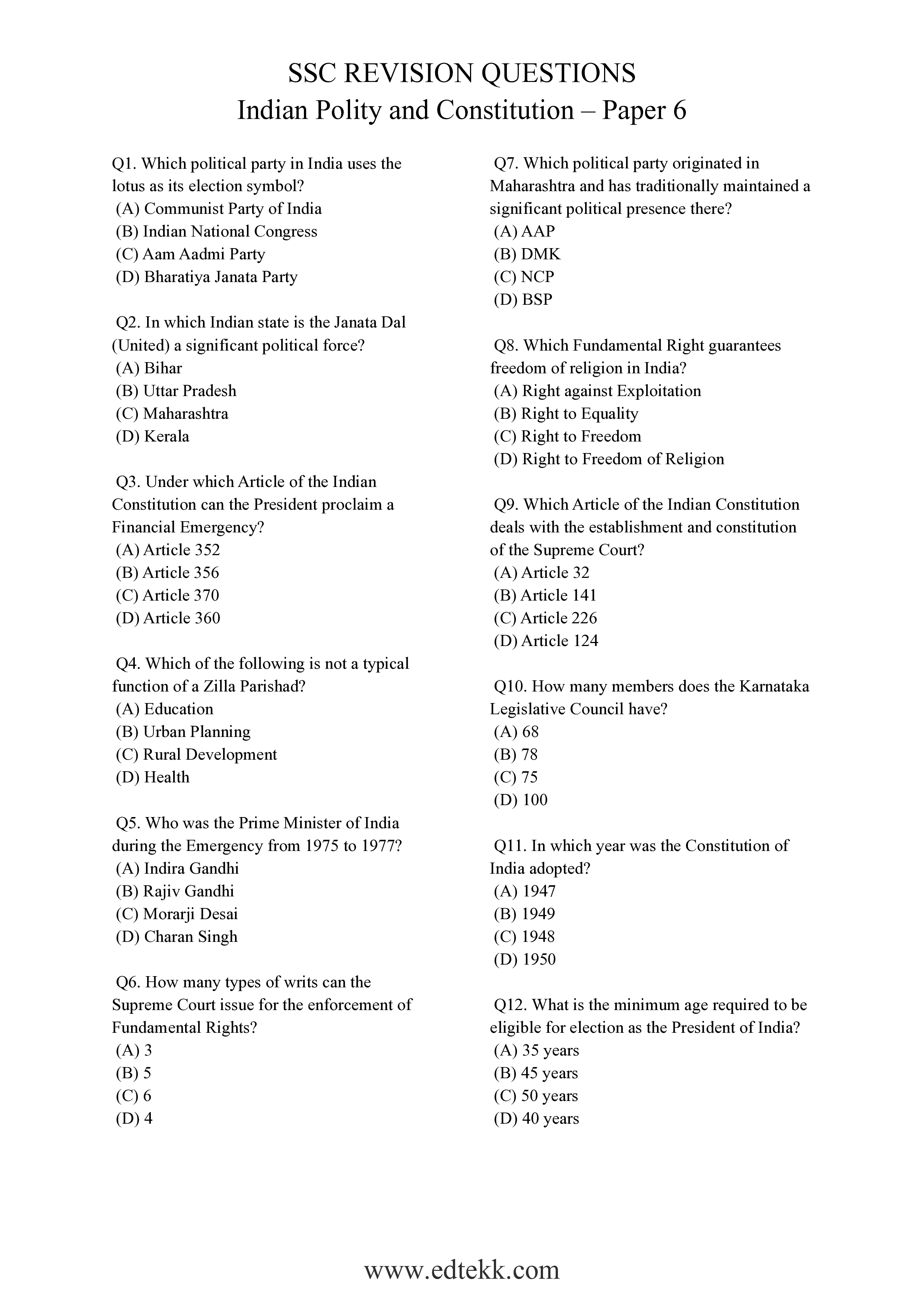
Enhance your SSC exam preparation with Indian Polity and Constitution Revision Questions Paper 6. This practice set offers objective questions on relevant polity and constitutional concepts, accompanied by answers and explanations. Candidates preparing for SSC CGL, CHSL, CPO, MTS, GD and Selection Post can use it to revise important topics and evaluate their preparation.
Test Details
Topic: Indian Polity and Constitution
Total Questions: 20
Question Format: MCQs – Single Correct Answer
Suitable for: SSC CGL, CHSL, CPO, MTS, GD, Selection Post
Download All Papers in This Series (PDF)
Questions and Answers
Q1. Which political party in India uses the lotus as its election symbol?
(A) Communist Party of India
(B) Indian National Congress
(C) Aam Aadmi Party
(D) Bharatiya Janata Party
Explanation: The Bharatiya Janata Party (BJP) uses the lotus as its election symbol. The lotus is one of the most recognisable political symbols in India and serves as the party’s principal electoral identifier.
Q2. In which Indian state is the Janata Dal (United) a significant political force?
(A) Bihar
(B) Uttar Pradesh
(C) Maharashtra
(D) Kerala
Explanation: The Janata Dal (United), commonly known as JD(U), is a prominent regional political party in Bihar. It has played an important role in the state’s politics and government, particularly under the leadership of Nitish Kumar.
Q3. Under which Article of the Indian Constitution can the President proclaim a Financial Emergency?
(A) Article 352
(B) Article 356
(C) Article 370
(D) Article 360
Explanation: Article 360 empowers the President to proclaim a financial emergency if the financial stability or credit of India or any part of its territory is threatened. The proclamation must be approved by both Houses of Parliament within two months. No financial emergency has been proclaimed in India to date.
Q4. Which of the following is not a typical function of a Zilla Parishad?
(A) Education
(B) Urban Planning
(C) Rural Development
(D) Health
Explanation: Urban planning is primarily associated with urban local bodies and relevant planning authorities rather than being a typical core function of a Zilla Parishad. Zilla Parishads focus on rural development and may oversee or coordinate activities related to education, public health, sanitation and other rural services under state law.
Q5. Who was the Prime Minister of India during the Emergency from 1975 to 1977?
(A) Indira Gandhi
(B) Rajiv Gandhi
(C) Morarji Desai
(D) Charan Singh
Explanation: Indira Gandhi was the Prime Minister of India throughout the National Emergency from 25 June 1975 to 21 March 1977. The Emergency was proclaimed under Article 352, and Morarji Desai became Prime Minister following the 1977 general election.
Q6. How many types of writs can the Supreme Court issue for the enforcement of Fundamental Rights?
(A) 3
(B) 5
(C) 6
(D) 4
Explanation: The Supreme Court can issue five types of writs under Article 32 to enforce Fundamental Rights: Habeas Corpus, Mandamus, Prohibition, Certiorari and Quo Warranto. These writs protect individuals against unlawful detention, improper exercise of jurisdiction and other violations of legal or constitutional rights.
Q7. Which political party originated in Maharashtra and has traditionally maintained a significant political presence there?
(A) AAP
(B) DMK
(C) NCP
(D) BSP
Explanation: The Nationalist Congress Party (NCP) originated in Maharashtra and has traditionally maintained a significant political presence there. Founded in 1999 by Sharad Pawar and others, it became an important participant in Maharashtra’s coalition politics before experiencing a major split in 2023.
Q8. Which Fundamental Right guarantees freedom of religion in India?
(A) Right against Exploitation
(B) Right to Equality
(C) Right to Freedom
(D) Right to Freedom of Religion
Explanation: The Right to Freedom of Religion is one of the six categories of Fundamental Rights under Part III of the Constitution. Articles 25–28 protect freedom of conscience, the right to profess, practise and propagate religion, and certain related religious freedoms, subject to constitutional restrictions.
Q9. Which Article of the Indian Constitution deals with the establishment and constitution of the Supreme Court?
(A) Article 32
(B) Article 141
(C) Article 226
(D) Article 124
Explanation: Article 124 of the Indian Constitution deals with the establishment and constitution of the Supreme Court of India. It provides for the composition of the Court, appointment of judges, their qualifications, tenure and removal. Article 32 deals with constitutional remedies, Article 141 with binding judicial precedents and Article 226 with High Court writ jurisdiction.
Q10. How many members does the Karnataka Legislative Council have?
(A) 68
(B) 78
(C) 75
(D) 100
Explanation: The Karnataka Legislative Council has 75 members. Karnataka has a bicameral legislature consisting of the Legislative Assembly and Legislative Council. The Council is a permanent body, with approximately one-third of its members retiring every two years.
Q11. In which year was the Constitution of India adopted?
(A) 1947
(B) 1949
(C) 1948
(D) 1950
Explanation: The Indian Constitution was adopted by the Constituent Assembly on 26 November 1949. It came into force on 26 January 1950, which is celebrated as Republic Day. The distinction between adoption and commencement is important for understanding the constitutional timeline.
Q12. What is the minimum age required to be eligible for election as the President of India?
(A) 35 years
(B) 45 years
(C) 50 years
(D) 40 years
Explanation: Under Article 58 of the Constitution, a candidate for President of India must be an Indian citizen, have completed 35 years of age and be qualified for election as a member of the Lok Sabha. The candidate must also satisfy the constitutional conditions concerning office of profit.
Q13. Which Article of the Indian Constitution provides for the imposition of President’s Rule in a state?
(A) Article 19
(B) Article 356
(C) Article 42
(D) Article 84
Explanation: Article 356 of the Indian Constitution provides for President’s Rule when the government of a state cannot be carried on in accordance with the Constitution. The President may assume specified state governmental functions, subject to constitutional limitations. The proclamation must be approved by both Houses of Parliament within two months and is subject to prescribed conditions for continuation.
Q14. Who serves as the chief executive officer of a Municipal Corporation in India?
(A) Commissioner
(B) Mayor
(C) Chairman
(D) President
Explanation: The Municipal Commissioner is generally the chief executive officer of a Municipal Corporation. The Commissioner oversees administration, municipal employees and public services and implements municipal decisions. The appointment is generally made by the state government, while the Mayor serves as the elected political head.
Q15. In which year was the Jammu and Kashmir Reorganisation Act passed?
(A) 2009
(B) 2015
(C) 2019
(D) 2017
Explanation: The Jammu and Kashmir Reorganisation Act was passed in 2019. It provided for the division of the former State of Jammu and Kashmir into two Union Territories: Jammu and Kashmir, with a legislature, and Ladakh, without a legislature. The reorganisation came into effect on 31 October 2019.
Q16. How many types of writs can the Supreme Court of India issue for the protection of Fundamental Rights?
(A) Six
(B) Four
(C) Seven
(D) Five
Explanation: The Supreme Court can issue five types of writs under Article 32 for the enforcement of Fundamental Rights: Habeas Corpus, Mandamus, Prohibition, Certiorari and Quo Warranto. These writs provide constitutional remedies against violations of Fundamental Rights and unlawful exercises of public authority.
Q17. Who presides over a joint sitting of the Lok Sabha and the Rajya Sabha?
(A) Prime Minister
(B) President
(C) Vice President
(D) Speaker of Lok Sabha
Explanation: Under Article 118(4) and the relevant parliamentary rules, the Speaker of the Lok Sabha presides over a joint sitting of Parliament. In the Speaker’s absence, the Deputy Speaker presides. If both are absent, the Deputy Chairman of the Rajya Sabha presides. If all three are unavailable, another member presides according to the prescribed procedure.
Q18. Who appoints the Advocate General of a State in India?
(A) Chief Minister of the State
(B) Prime Minister of India
(C) President of India
(D) Governor of the State
Explanation: The Governor of a State appoints the Advocate General under Article 165. The Advocate General is the highest law officer of the State and must possess the qualifications required for appointment as a High Court judge.
Q19. The 73rd Constitutional Amendment Act is associated with which aspect of governance?
(A) Urban local bodies
(B) Panchayati Raj institutions
(C) Land reforms
(D) Fiscal federalism
Explanation: The 73rd Constitutional Amendment Act, 1992, granted constitutional status to Panchayati Raj institutions. It introduced Part IX of the Constitution and established a framework for rural local self-government through village, intermediate and district-level Panchayats, strengthening democratic decentralisation.
Q20. Which of the following is a type of election conducted by the Election Commission of India?
(A) Primary elections
(B) Bye-elections
(C) Opinion polls
(D) Referendums
Explanation: Bye-elections are conducted to fill vacant seats in Parliament or State Legislatures before the expiry of their normal terms. Vacancies may arise due to death, resignation or disqualification of elected representatives. The Election Commission of India conducts these elections in accordance with applicable constitutional and statutory provisions.
Question Paper Images