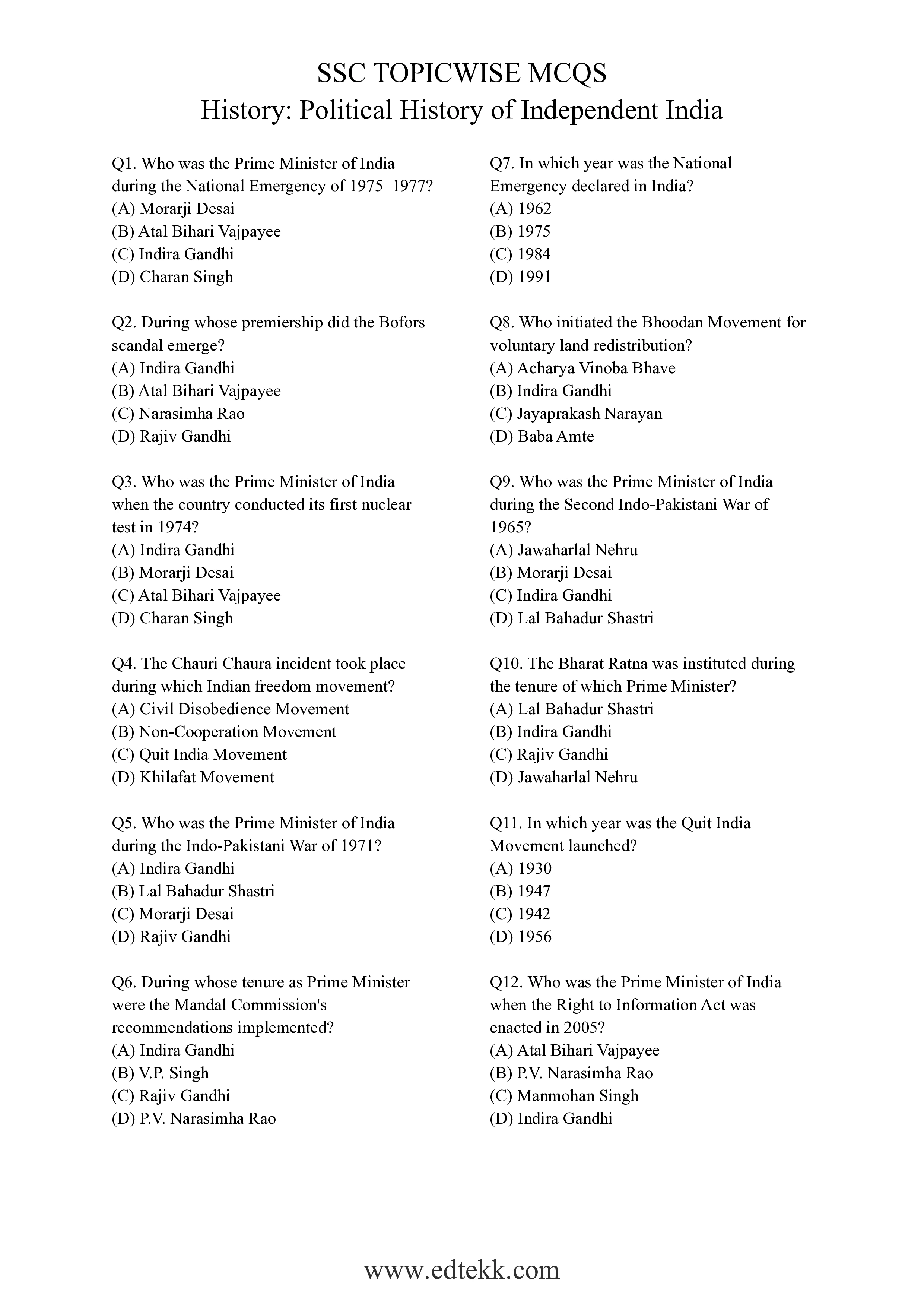
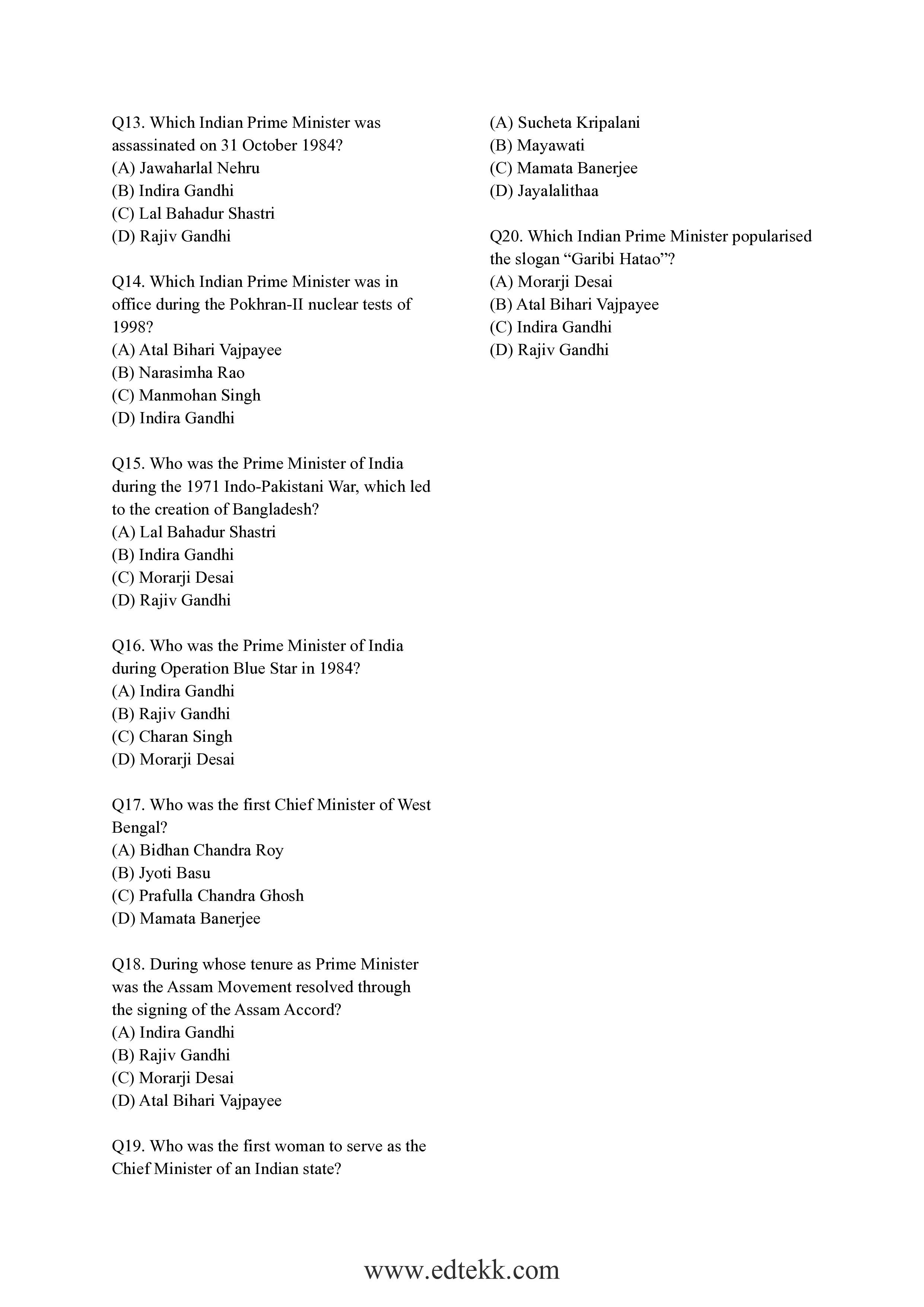
Prepare for SSC examinations with Indian History MCQs on the political history of independent India. This set covers political developments, elections, governments, major leaders, landmark events and changes in India’s political system since 1947. Test your knowledge through important questions with answers and explanations for SSC CGL, CHSL, CPO, MTS, GD and Selection Post.
Test Details
Topic: History: Political History of Independent India
Total Questions: 20
Question Format: MCQs – Single Correct Answer
Suitable for: SSC CGL, CHSL, CPO, MTS, GD, Selection Post
Download All Papers in This Series (PDF)
Questions and Answers
Q1. Who was the Prime Minister of India during the National Emergency of 1975–1977?
(A) Morarji Desai
(B) Atal Bihari Vajpayee
(C) Indira Gandhi
(D) Charan Singh
Explanation: Indira Gandhi was Prime Minister during the National Emergency, which lasted from 25 June 1975 to 21 March 1977. During this period, civil liberties were curtailed, press censorship was imposed, political opponents were detained and democratic institutions faced significant restrictions.
Q2. During whose premiership did the Bofors scandal emerge?
(A) Indira Gandhi
(B) Atal Bihari Vajpayee
(C) Narasimha Rao
(D) Rajiv Gandhi
Explanation: The Bofors scandal emerged during Rajiv Gandhi’s premiership following allegations of kickbacks in a 1986 defence contract between the Indian government and Swedish arms manufacturer Bofors for the purchase of howitzer guns. The controversy seriously damaged the government’s credibility and became a major issue in the 1989 general elections.
Q3. Who was the Prime Minister of India when the country conducted its first nuclear test in 1974?
(A) Indira Gandhi
(B) Morarji Desai
(C) Atal Bihari Vajpayee
(D) Charan Singh
Explanation: Indira Gandhi was Prime Minister when India conducted its first successful nuclear test on 18 May 1974 at Pokhran in Rajasthan. Code-named Smiling Buddha, the test was officially described by India as a peaceful nuclear explosion and marked a significant milestone in the country’s nuclear programme.
Q4. The Chauri Chaura incident took place during which Indian freedom movement?
(A) Civil Disobedience Movement
(B) Non-Cooperation Movement
(C) Quit India Movement
(D) Khilafat Movement
Explanation: The Chauri Chaura incident occurred on 4 February 1922 during the Non-Cooperation Movement. Protesters clashed with police and set fire to a police station, killing 22 policemen. Mahatma Gandhi subsequently withdrew the movement because he believed that the growing violence contradicted the principles of non-violence.
Q5. Who was the Prime Minister of India during the Indo-Pakistani War of 1971?
(A) Indira Gandhi
(B) Lal Bahadur Shastri
(C) Morarji Desai
(D) Rajiv Gandhi
Explanation: Indira Gandhi was the Prime Minister of India during the Indo-Pakistani War of 1971. The war resulted in the surrender of Pakistani forces in East Pakistan on 16 December 1971 and led to the creation of Bangladesh as an independent nation.
Q6. During whose tenure as Prime Minister were the Mandal Commission’s recommendations implemented?
(A) Indira Gandhi
(B) V.P. Singh
(C) Rajiv Gandhi
(D) P.V. Narasimha Rao
Explanation: V.P. Singh’s government implemented the Mandal Commission’s recommendation in 1990 by announcing 27% reservation for Other Backward Classes (OBCs) in central government services. This decision generated widespread political debate and protests and became a landmark development in India’s reservation policy.
Q7. In which year was the National Emergency declared in India?
(A) 1962
(B) 1975
(C) 1984
(D) 1991
Explanation: The National Emergency was declared in India on 25 June 1975 by President Fakhruddin Ali Ahmed on the advice of Prime Minister Indira Gandhi, under Article 352 of the Constitution. It remained in force until 21 March 1977 and was accompanied by restrictions on civil liberties, press freedom and political activities.
Q8. Who initiated the Bhoodan Movement for voluntary land redistribution?
(A) Acharya Vinoba Bhave
(B) Indira Gandhi
(C) Jayaprakash Narayan
(D) Baba Amte
Explanation: Acharya Vinoba Bhave initiated the Bhoodan Movement in April 1951 at Pochampally village in present-day Telangana. He encouraged wealthy landowners to voluntarily donate portions of their land to landless people. The movement promoted voluntary land redistribution and social justice through non-violent means.
Q9. Who was the Prime Minister of India during the Second Indo-Pakistani War of 1965?
(A) Jawaharlal Nehru
(B) Morarji Desai
(C) Indira Gandhi
(D) Lal Bahadur Shastri
Explanation: Lal Bahadur Shastri was the Prime Minister of India during the Second Indo-Pakistani War in 1965. His leadership during the conflict strengthened India’s national resolve. His famous slogan “Jai Jawan, Jai Kisan” highlighted the importance of soldiers and farmers in national development.
Q10. The Bharat Ratna was instituted during the tenure of which Prime Minister?
(A) Lal Bahadur Shastri
(B) Indira Gandhi
(C) Rajiv Gandhi
(D) Jawaharlal Nehru
Explanation: The Bharat Ratna, India’s highest civilian award, was instituted in 1954 during the tenure of Prime Minister Jawaharlal Nehru. The first recipients in 1954 were C. Rajagopalachari, Dr. Sarvepalli Radhakrishnan and C. V. Raman, in recognition of their exceptional contributions.
Q11. In which year was the Quit India Movement launched?
(A) 1930
(B) 1947
(C) 1942
(D) 1956
Explanation: The Quit India Movement was launched by Mahatma Gandhi and the Indian National Congress in August 1942. The Congress adopted the Quit India resolution on 8 August at Bombay (now Mumbai), and the movement began on 9 August following the arrest of major leaders. Gandhi gave the famous call of “Do or Die”.
Q12. Who was the Prime Minister of India when the Right to Information Act was enacted in 2005?
(A) Atal Bihari Vajpayee
(B) P.V. Narasimha Rao
(C) Manmohan Singh
(D) Indira Gandhi
Explanation: Manmohan Singh was Prime Minister when the Right to Information (RTI) Act was enacted in 2005. The Act empowered citizens to obtain information from public authorities, promoting transparency, accountability and public participation in governance. It came fully into force on 12 October 2005.
Q13. Which Indian Prime Minister was assassinated on 31 October 1984?
(A) Jawaharlal Nehru
(B) Indira Gandhi
(C) Lal Bahadur Shastri
(D) Rajiv Gandhi
Explanation: Indira Gandhi was assassinated on 31 October 1984 by two of her bodyguards in New Delhi. Her assassination followed Operation Blue Star, conducted earlier that year at the Golden Temple in Amritsar. Following her death, her son Rajiv Gandhi became Prime Minister of India.
Q14. Which Indian Prime Minister was in office during the Pokhran-II nuclear tests of 1998?
(A) Atal Bihari Vajpayee
(B) Narasimha Rao
(C) Manmohan Singh
(D) Indira Gandhi
Explanation: Atal Bihari Vajpayee was Prime Minister when India conducted the Pokhran-II nuclear tests in May 1998. Five underground nuclear explosions were carried out on 11 and 13 May. The tests established India’s declared nuclear weapons capability and triggered international diplomatic and economic reactions, including sanctions.
Q15. Who was the Prime Minister of India during the 1971 Indo-Pakistani War, which led to the creation of Bangladesh?
(A) Lal Bahadur Shastri
(B) Indira Gandhi
(C) Morarji Desai
(D) Rajiv Gandhi
Explanation: Indira Gandhi was the Prime Minister during the Indo-Pakistani War of 1971. India’s military intervention supported the liberation of East Pakistan, resulting in the surrender of Pakistani forces on 16 December 1971 and the emergence of Bangladesh as an independent nation.
Q16. Who was the Prime Minister of India during Operation Blue Star in 1984?
(A) Indira Gandhi
(B) Rajiv Gandhi
(C) Charan Singh
(D) Morarji Desai
Explanation: Indira Gandhi was Prime Minister during Operation Blue Star, conducted by the Indian Army in June 1984 at the Golden Temple complex in Amritsar. The operation aimed to remove armed militants occupying the complex. It had significant political, religious and social consequences and intensified tensions in Punjab.
Q17. Who was the first Chief Minister of West Bengal?
(A) Bidhan Chandra Roy
(B) Jyoti Basu
(C) Prafulla Chandra Ghosh
(D) Mamata Banerjee
Explanation: Prafulla Chandra Ghosh became the first Chief Minister of West Bengal on 15 August 1947, following India’s independence. He served until January 1948 and was succeeded by Bidhan Chandra Roy, who subsequently served as Chief Minister for an extended period.
Q18. During whose tenure as Prime Minister was the Assam Movement resolved through the signing of the Assam Accord?
(A) Indira Gandhi
(B) Rajiv Gandhi
(C) Morarji Desai
(D) Atal Bihari Vajpayee
Explanation: The Assam Movement was resolved through the Assam Accord, signed on 15 August 1985 between the Government of India and leaders of the All Assam Students’ Union (AASU) and All Assam Gana Sangram Parishad (AAGSP). Rajiv Gandhi was the Prime Minister when the agreement was signed.
Q19. Who was the first woman to serve as the Chief Minister of an Indian state?
(A) Sucheta Kripalani
(B) Mayawati
(C) Mamata Banerjee
(D) Jayalalithaa
Explanation: Sucheta Kripalani became the first woman Chief Minister of an Indian state in 1963, when she assumed office in Uttar Pradesh. She served from 2 October 1963 to 13 March 1967. Her appointment marked a significant milestone in the political history of independent India.
Q20. Which Indian Prime Minister popularised the slogan “Garibi Hatao”?
(A) Morarji Desai
(B) Atal Bihari Vajpayee
(C) Indira Gandhi
(D) Rajiv Gandhi
Explanation: Indira Gandhi popularised the slogan “Garibi Hatao” (Remove Poverty) during the 1971 general election campaign. The slogan emphasised poverty alleviation, economic equality and social welfare. It became a central theme of her political programme and helped shape her electoral campaign.
Question Paper Images