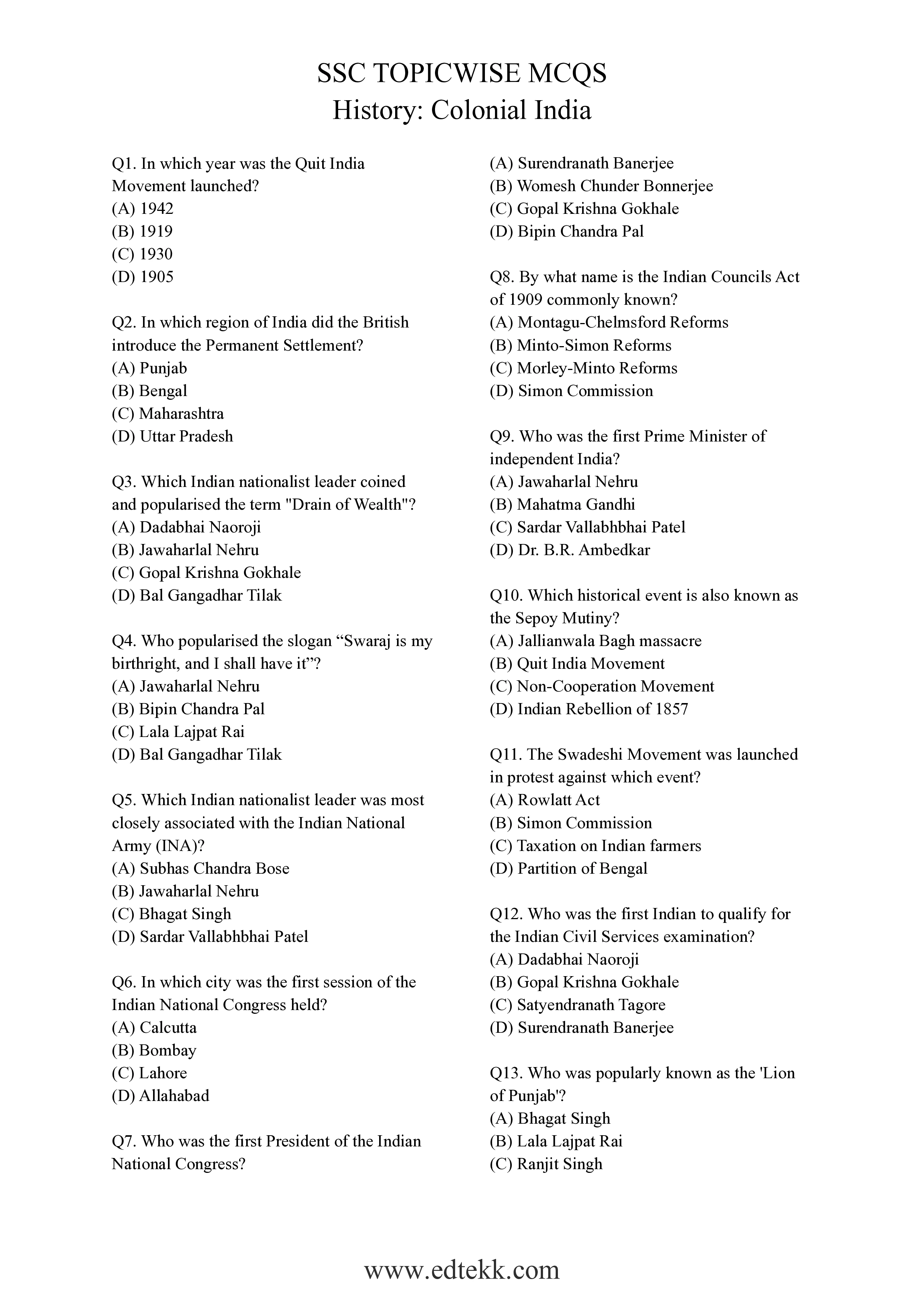
Prepare for competitive examinations with Indian History MCQs on Colonial India. This question set covers European trading companies, British expansion, colonial administration, economic policies, important acts, revolts and the freedom struggle. Practise significant historical questions with correct answers and explanations for SSC CGL, CHSL, CPO, MTS, GD and Selection Post exams.
Test Details
Topic: History: Colonial India
Total Questions: 20
Question Format: MCQs – Single Correct Answer
Suitable for: SSC CGL, CHSL, CPO, MTS, GD, Selection Post
Download All Papers in This Series (PDF)
Questions and Answers
Q1. In which year was the Quit India Movement launched?
(A) 1942
(B) 1919
(C) 1930
(D) 1905
Explanation: The Quit India Movement was launched on 8 August 1942 during the Bombay session of the All India Congress Committee. Mahatma Gandhi gave the famous call of “Do or Die”. The British government responded with mass arrests of Congress leaders, triggering widespread protests and demonstrations across India.
Q2. In which region of India did the British introduce the Permanent Settlement?
(A) Punjab
(B) Bengal
(C) Maharashtra
(D) Uttar Pradesh
Explanation: The Permanent Settlement was introduced in Bengal in 1793 by Governor-General Lord Cornwallis. It fixed the land revenue payable by zamindars to the British East India Company. The system aimed to ensure regular revenue collection and established a landlord-based structure of land revenue administration.
Q3. Which Indian nationalist leader coined and popularised the term “Drain of Wealth”?
(A) Dadabhai Naoroji
(B) Jawaharlal Nehru
(C) Gopal Krishna Gokhale
(D) Bal Gangadhar Tilak
Explanation: Dadabhai Naoroji developed and popularised the Drain of Wealth theory, explaining how British colonial rule transferred India’s economic resources to Britain. He argued that this continuous economic drain contributed significantly to India’s poverty and underdevelopment. His arguments were extensively presented in his work Poverty and Un-British Rule in India.
Q4. Who popularised the slogan “Swaraj is my birthright, and I shall have it”?
(A) Jawaharlal Nehru
(B) Bipin Chandra Pal
(C) Lala Lajpat Rai
(D) Bal Gangadhar Tilak
Explanation: Bal Gangadhar Tilak is widely credited with popularising the nationalist slogan, “Swaraj is my birthright and I shall have it.” The slogan expressed the demand for self-government and became an influential rallying cry of India’s freedom struggle. Tilak was a prominent leader of the assertive nationalist movement.
Q5. Which Indian nationalist leader was most closely associated with the Indian National Army (INA)?
(A) Subhas Chandra Bose
(B) Jawaharlal Nehru
(C) Bhagat Singh
(D) Sardar Vallabhbhai Patel
Explanation: Subhas Chandra Bose was the most prominent leader associated with the Indian National Army (INA). He assumed command of the reorganised INA in 1943 and established the Provisional Government of Azad Hind. The INA fought against British forces during the Second World War to secure India’s independence.
Q6. In which city was the first session of the Indian National Congress held?
(A) Calcutta
(B) Bombay
(C) Lahore
(D) Allahabad
Explanation: The first session of the Indian National Congress was held in Bombay (present-day Mumbai) in December 1885 at Gokuldas Tejpal Sanskrit College. It was attended by 72 delegates and presided over by Womesh Chunder Bonnerjee. The session was originally planned for Poona but shifted to Bombay following a cholera outbreak.
Q7. Who was the first President of the Indian National Congress?
(A) Surendranath Banerjee
(B) Womesh Chunder Bonnerjee
(C) Gopal Krishna Gokhale
(D) Bipin Chandra Pal
Explanation: Womesh Chunder Bonnerjee (W. C. Bonnerjee) was the first President of the Indian National Congress. He presided over its inaugural session held in Bombay in December 1885. A prominent lawyer, he played an important role in establishing the organisational foundations of the Indian nationalist movement.
Q8. By what name is the Indian Councils Act of 1909 commonly known?
(A) Montagu-Chelmsford Reforms
(B) Minto-Simon Reforms
(C) Morley-Minto Reforms
(D) Simon Commission
Explanation: The Indian Councils Act of 1909 is popularly known as the Morley-Minto Reforms. It was named after John Morley, the Secretary of State for India, and Lord Minto, the Viceroy of India. The reforms introduced separate electorates for Muslims and expanded the membership of legislative councils.
Q9. Who was the first Prime Minister of independent India?
(A) Jawaharlal Nehru
(B) Mahatma Gandhi
(C) Sardar Vallabhbhai Patel
(D) Dr. B.R. Ambedkar
Explanation: Jawaharlal Nehru became the first Prime Minister of independent India on 15 August 1947. He held office until his death on 27 May 1964. He played a significant role in shaping India’s parliamentary democracy, foreign policy, industrial development and scientific institutions after independence.
Q10. Which historical event is also known as the Sepoy Mutiny?
(A) Jallianwala Bagh massacre
(B) Quit India Movement
(C) Non-Cooperation Movement
(D) Indian Rebellion of 1857
Explanation: The Indian Rebellion of 1857 is also known as the Sepoy Mutiny, the Revolt of 1857 and the First War of Indian Independence. It began with an uprising among Indian soldiers of the East India Company’s army at Meerut and subsequently spread across several parts of northern and central India.
Q11. The Swadeshi Movement was launched in protest against which event?
(A) Rowlatt Act
(B) Simon Commission
(C) Taxation on Indian farmers
(D) Partition of Bengal
Explanation: The Swadeshi Movement emerged in response to the Partition of Bengal in 1905. It encouraged the boycott of British manufactured goods and the promotion of indigenous products and industries. It also promoted national education, indigenous enterprises and mass participation in the Indian nationalist movement.
Q12. Who was the first Indian to qualify for the Indian Civil Services examination?
(A) Dadabhai Naoroji
(B) Gopal Krishna Gokhale
(C) Satyendranath Tagore
(D) Surendranath Banerjee
Explanation: Satyendranath Tagore became the first Indian to qualify for the Indian Civil Service examination in 1863. He subsequently joined the service in 1864. He was the elder brother of Rabindranath Tagore and an important personality associated with the Bengal Renaissance.
Q13. Who was popularly known as the ‘Lion of Punjab’?
(A) Bhagat Singh
(B) Lala Lajpat Rai
(C) Ranjit Singh
(D) Bal Gangadhar Tilak
Explanation: Lala Lajpat Rai was popularly known as the ‘Lion of Punjab’ (Punjab Kesari). He was a prominent nationalist leader and participated in protests against the Simon Commission in Lahore in 1928. He sustained injuries during a police lathi charge and subsequently died on 17 November 1928.
Q14. Who was one of the founders of the Swaraj Party in 1923?
(A) Jawaharlal Nehru
(B) Mahatma Gandhi
(C) Subhas Chandra Bose
(D) Motilal Nehru
Explanation: Motilal Nehru and Chittaranjan Das founded the Swaraj Party in 1923. It emerged following disagreements within the Congress over participation in legislative councils established under British rule. The party aimed to enter these councils and obstruct colonial administration from within.
Q15. Who was the first Indian to qualify for the Indian Civil Service (ICS)?
(A) Dadabhai Naoroji
(B) Raja Ram Mohan Roy
(C) Gopal Krishna Gokhale
(D) Satyendranath Tagore
Explanation: Satyendranath Tagore became the first Indian to qualify for the Indian Civil Service (ICS) examination in 1863 and joined the service in 1864. He was the elder brother of Rabindranath Tagore and an important figure associated with the Bengal Renaissance.
Q16. Who was the last Mughal Emperor of India?
(A) Akbar
(B) Shah Jahan
(C) Aurangzeb
(D) Bahadur Shah II
Explanation: Bahadur Shah II, popularly known as Bahadur Shah Zafar, was the last Mughal emperor. He became the symbolic leader of the Revolt of 1857. Following the suppression of the rebellion, the British deposed him and exiled him to Rangoon (present-day Yangon), where he died in 1862.
Q17. The Ilbert Bill controversy of 1883 concerned which issue?
(A) Partition of Bengal
(B) Judicial powers for Indian judges
(C) Vernacular Press Act
(D) Doctrine of Lapse
Explanation: The Ilbert Bill controversy of 1883 concerned the judicial powers of Indian judges. The proposed legislation sought to empower qualified Indian district magistrates and sessions judges to try European British subjects. Strong opposition from the European community forced the colonial government to introduce compromises, weakening the original proposal.
Q18. In which city did the Jallianwala Bagh massacre take place?
(A) Delhi
(B) Lahore
(C) Mumbai
(D) Amritsar
Explanation: The Jallianwala Bagh massacre occurred in Amritsar, Punjab, on 13 April 1919. British troops under Brigadier-General Reginald Dyer opened fire on an unarmed gathering of people. The massacre intensified anti-British sentiment and became a major turning point in India’s freedom struggle.
Q19. In which Indian state did Mahatma Gandhi lead the Champaran Satyagraha?
(A) Bihar
(B) Punjab
(C) Maharashtra
(D) Gujarat
Explanation: The Champaran Satyagraha was launched by Mahatma Gandhi in 1917 in the Champaran district of Bihar. It was directed against the exploitation of indigo cultivators by European planters under oppressive agricultural arrangements. It was Gandhi’s first major Satyagraha movement in India.
Q20. In which years was the First Anglo-Sikh War fought?
(A) 1865-1866
(B) 1845-1846
(C) 1857-1858
(D) 1839-1842
Explanation: The First Anglo-Sikh War was fought between the British East India Company and the Sikh Empire from 1845 to 1846. It ended with British victory and the Treaty of Lahore in March 1846, which imposed significant territorial and political concessions on the Sikh Empire.
Question Paper Images