Revise important personalities in Indian History through this exam-focused MCQ practice set. It covers influential rulers, reformers, freedom fighters, political leaders, scholars and other notable historical figures. Strengthen factual knowledge with important questions, correct answers and explanations for SSC CGL, CHSL, CPO, MTS, GD and Selection Post examinations.
Test Details
Topic: History: Important Personalities
Total Questions: 20
Question Format: MCQs – Single Correct Answer
Suitable for: SSC CGL, CHSL, CPO, MTS, GD, Selection Post
Download All Papers in This Series (PDF)
Questions and Answers
Q1. Who was the first Indian to receive the Nobel Prize in Literature?
(A) Rabindranath Tagore
(B) Bankim Chandra Chattopadhyay
(C) Sarojini Naidu
(D) Amartya Sen
Explanation: Rabindranath Tagore became the first Indian and the first Asian Nobel laureate in Literature in 1913. The Swedish Academy recognised his profoundly sensitive, fresh, and beautiful poetry, particularly through the English version of Gitanjali. His contributions to poetry, songs, fiction, and drama greatly influenced modern Indian literature.
Q2. Which Indian athlete was popularly known as the “Flying Sikh”?
(A) P. T. Usha
(B) Anju Bobby George
(C) Dutee Chand
(D) Milkha Singh
Explanation: Milkha Singh was popularly known as the Flying Sikh because of his exceptional speed and achievements in athletics, particularly sprinting. He won gold medals in the 400-metre events at the 1958 and 1962 Asian Games and finished fourth in the 400-metre final at the 1960 Rome Olympics. He became one of India’s most celebrated athletes.
Q3. Who is popularly known as the “Grand Old Man of India”?
(A) Jawaharlal Nehru
(B) Dadabhai Naoroji
(C) Mohandas Gandhi
(D) Vallabhbhai Patel
Explanation: Dadabhai Naoroji was popularly known as the “Grand Old Man of India” and is widely associated with early Indian nationalism. He developed the Drain Theory, explaining how British colonial policies transferred wealth from India to Britain. In 1892, he became the first Indian elected to the British House of Commons and served as President of the Indian National Congress three times.
Q4. Which Indian artist is renowned for paintings depicting Indian mythology, folklore and cultural heritage?
(A) M.F. Husain
(B) Tyeb Mehta
(C) Raja Ravi Varma
(D) Amrita Sher-Gil
Explanation: Raja Ravi Varma was a celebrated Indian painter known for combining European academic painting techniques with Indian subjects. His famous paintings depicted characters and episodes from the Ramayana and Mahabharata, as well as Indian mythology. His artistic representations significantly influenced popular Indian religious imagery and calendar art.
Q5. Which Indian leader is popularly known as the “Iron Lady of India”?
(A) Sarojini Naidu
(B) Rani Laxmibai
(C) Vijayalakshmi Pandit
(D) Indira Gandhi
Explanation: Indira Gandhi is popularly known as the Iron Lady of India because of her strong political leadership and decisive approach to governance. She became India’s first woman Prime Minister in 1966 and served until 1977, and again from 1980 until her assassination on 31 October 1984.
Q6. Who played the leading organisational role in founding the Indian National Congress in 1885?
(A) A.O. Hume
(B) Mahatma Gandhi
(C) Jawaharlal Nehru
(D) Dadabhai Naoroji
Explanation: Allan Octavian Hume, a retired British civil servant, played a leading organisational role in founding the Indian National Congress in 1885, alongside Indian political leaders. Its first session was held in Bombay from 28 to 31 December 1885, under the presidency of Womesh Chunder Bonnerjee. The Congress subsequently became a major force in India’s nationalist movement.
Q7. Which Indian social reformer is renowned for fighting caste discrimination and promoting social equality?
(A) Dr. B. R. Ambedkar
(B) Swami Vivekananda
(C) Raja Ram Mohan Roy
(D) Mahatma Gandhi
Explanation: Dr. B.R. Ambedkar was a leading social reformer who fought against caste discrimination and untouchability. He advocated the annihilation of caste, social equality, justice, education and the rights of marginalised communities. He also chaired the Drafting Committee of the Indian Constitution and played a crucial role in establishing constitutional safeguards for individual liberty and equality.
Q8. Which filmmaker is widely regarded as the “Father of Indian Cinema”?
(A) Satyajit Ray
(B) Guru Dutt
(C) Dadasaheb Phalke
(D) Raj Kapoor
Explanation: Dadasaheb Phalke is widely regarded as the Father of Indian Cinema because of his pioneering contribution to Indian filmmaking. He directed Raja Harishchandra in 1913, generally recognised as India’s first full-length indigenous feature film. His pioneering work laid the foundation for the development of the Indian film industry.
Q9. Which social reformer is renowned for campaigning against untouchability and advocating the upliftment of Dalits?
(A) Raja Ram Mohan Roy
(B) Bhimrao Ambedkar
(C) Dayanand Saraswati
(D) Ishwar Chandra Vidyasagar
Explanation: Dr. Bhimrao Ramji Ambedkar was a prominent social reformer, jurist, economist and political leader who campaigned against caste discrimination and untouchability. He advocated equality, education and political representation for Dalits and other marginalised communities. As Chairman of the Drafting Committee of the Constituent Assembly, he played a central role in preparing the Constitution and advancing constitutional protections for equality and social justice.
Q10. Who founded the Sikh Empire in the Punjab region?
(A) Guru Nanak
(B) Maharaja Ranjit Singh
(C) Guru Gobind Singh
(D) Guru Arjan Dev
Explanation: Maharaja Ranjit Singh founded the Sikh Empire by capturing Lahore in 1799 and consolidating Sikh political power in Punjab. He formally assumed the title of Maharaja in 1801. He established a powerful administration and expanded his kingdom across northwestern India. His reign is remembered for military strength and religious tolerance.
Q11. Which Indian philosopher and spiritual leader founded the Ramakrishna Mission?
(A) Paramahansa Yogananda
(B) Ramana Maharshi
(C) Swami Vivekananda
(D) Sri Aurobindo
Explanation: Swami Vivekananda founded the Ramakrishna Mission in 1897 to promote spiritual development, education, healthcare and social service based on Sri Ramakrishna’s teachings. The Ramakrishna Math originated from the monastic brotherhood formed by Ramakrishna’s disciples after his death. Vivekananda played a central role in organising and developing both institutions.
Q12. Which Mughal emperor commissioned the construction of the Taj Mahal?
(A) Akbar
(B) Jahangir
(C) Shah Jahan
(D) Aurangzeb
Explanation: Shah Jahan, the fifth Mughal emperor, commissioned the construction of the Taj Mahal in Agra in memory of his wife Mumtaz Mahal, who died in 1631. Construction began around 1632, and the principal mausoleum was substantially completed by 1648. The monument is regarded as one of the finest examples of Mughal architecture.
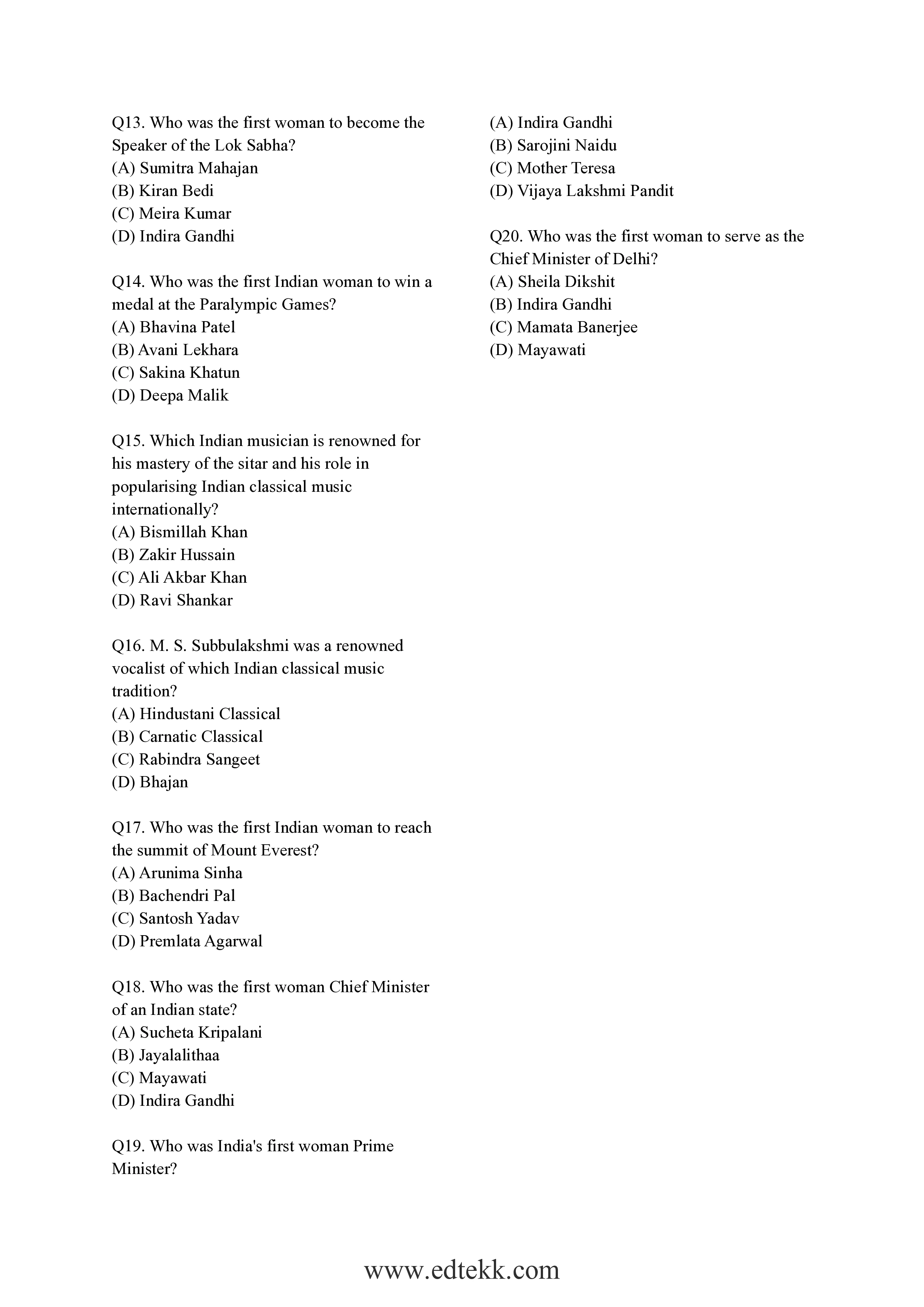
Q13. Who was the first woman to become the Speaker of the Lok Sabha?
(A) Sumitra Mahajan
(B) Kiran Bedi
(C) Meira Kumar
(D) Indira Gandhi
Explanation: Meira Kumar became the first woman Speaker of the Lok Sabha in 2009, during the Fifteenth Lok Sabha. She served until 2014. Before entering politics, she was a member of the Indian Foreign Service (IFS). Her election marked a significant milestone in women’s representation in India’s parliamentary institutions.
Q14. Who was the first Indian woman to win a medal at the Paralympic Games?
(A) Bhavina Patel
(B) Avani Lekhara
(C) Sakina Khatun
(D) Deepa Malik
Explanation: Deepa Malik became the first Indian woman to win a Paralympic medal when she secured a silver medal in the shot put event at the 2016 Rio Paralympics. Her achievement marked a historic milestone for Indian para-sports and women’s participation in international disability sports competitions.
Q15. Which Indian musician is renowned for his mastery of the sitar and his role in popularising Indian classical music internationally?
(A) Bismillah Khan
(B) Zakir Hussain
(C) Ali Akbar Khan
(D) Ravi Shankar
Explanation: Pandit Ravi Shankar was an internationally acclaimed Indian sitar virtuoso and composer. He played a significant role in popularising Indian classical music among Western audiences through international performances and collaborations with prominent Western musicians, including George Harrison of the Beatles. His contributions earned him worldwide recognition and numerous prestigious awards.
Q16. M. S. Subbulakshmi was a renowned vocalist of which Indian classical music tradition?
(A) Hindustani Classical
(B) Carnatic Classical
(C) Rabindra Sangeet
(D) Bhajan
Explanation: M. S. Subbulakshmi was one of the most celebrated exponents of Carnatic classical music, a tradition predominantly associated with southern India. She was renowned for her exceptional vocal technique and devotional compositions. In 1998, she became the first musician to receive the Bharat Ratna. She received the Ramon Magsaysay Award in 1974 for her contribution to public service through music.
Q17. Who was the first Indian woman to reach the summit of Mount Everest?
(A) Arunima Sinha
(B) Bachendri Pal
(C) Santosh Yadav
(D) Premlata Agarwal
Explanation: Bachendri Pal became the first Indian woman to summit Mount Everest on 23 May 1984. She achieved this feat as a member of an Indian mountaineering expedition. Her accomplishment established a major milestone in Indian mountaineering and inspired generations of women to pursue adventure sports and mountaineering.
Q18. Who was the first woman Chief Minister of an Indian state?
(A) Sucheta Kripalani
(B) Jayalalithaa
(C) Mayawati
(D) Indira Gandhi
Explanation: Sucheta Kripalani became the first woman Chief Minister of an Indian state when she assumed office in Uttar Pradesh on 2 October 1963. She served until March 1967. A prominent freedom fighter, she participated in the Quit India Movement and was a member of the Constituent Assembly.
Q19. Who was India’s first woman Prime Minister?
(A) Indira Gandhi
(B) Sarojini Naidu
(C) Mother Teresa
(D) Vijaya Lakshmi Pandit
Explanation: Indira Gandhi became India’s first woman Prime Minister on 24 January 1966, following the death of Lal Bahadur Shastri. She served from 1966 to 1977 and again from 1980 until her assassination in 1984. Her tenure included the 1971 India–Pakistan War, the creation of Bangladesh and the Emergency of 1975–1977. She was the daughter of Jawaharlal Nehru, India’s first Prime Minister.
Q20. Who was the first woman to serve as the Chief Minister of Delhi?
(A) Sheila Dikshit
(B) Indira Gandhi
(C) Mamata Banerjee
(D) Mayawati
Explanation: Sheila Dikshit became the first woman Chief Minister of Delhi in 1998 and served until 2013, completing three consecutive terms. Her tenure saw significant urban development, including the expansion of the Delhi Metro and improvements to public transport and infrastructure.
Question Paper Images