Strengthen your Indian History preparation with MCQs on post-independence India. This question set covers nation-building, integration of princely states, constitutional developments, economic planning, major policies and important historical events after 1947. Practise exam-oriented questions with answers and explanations for SSC CGL, CHSL, CPO, MTS, GD and Selection Post.
Test Details
Topic: History: Post-Independence India
Total Questions: 20
Question Format: MCQs – Single Correct Answer
Suitable for: SSC CGL, CHSL, CPO, MTS, GD, Selection Post
Download All Papers in This Series (PDF)
Questions and Answers
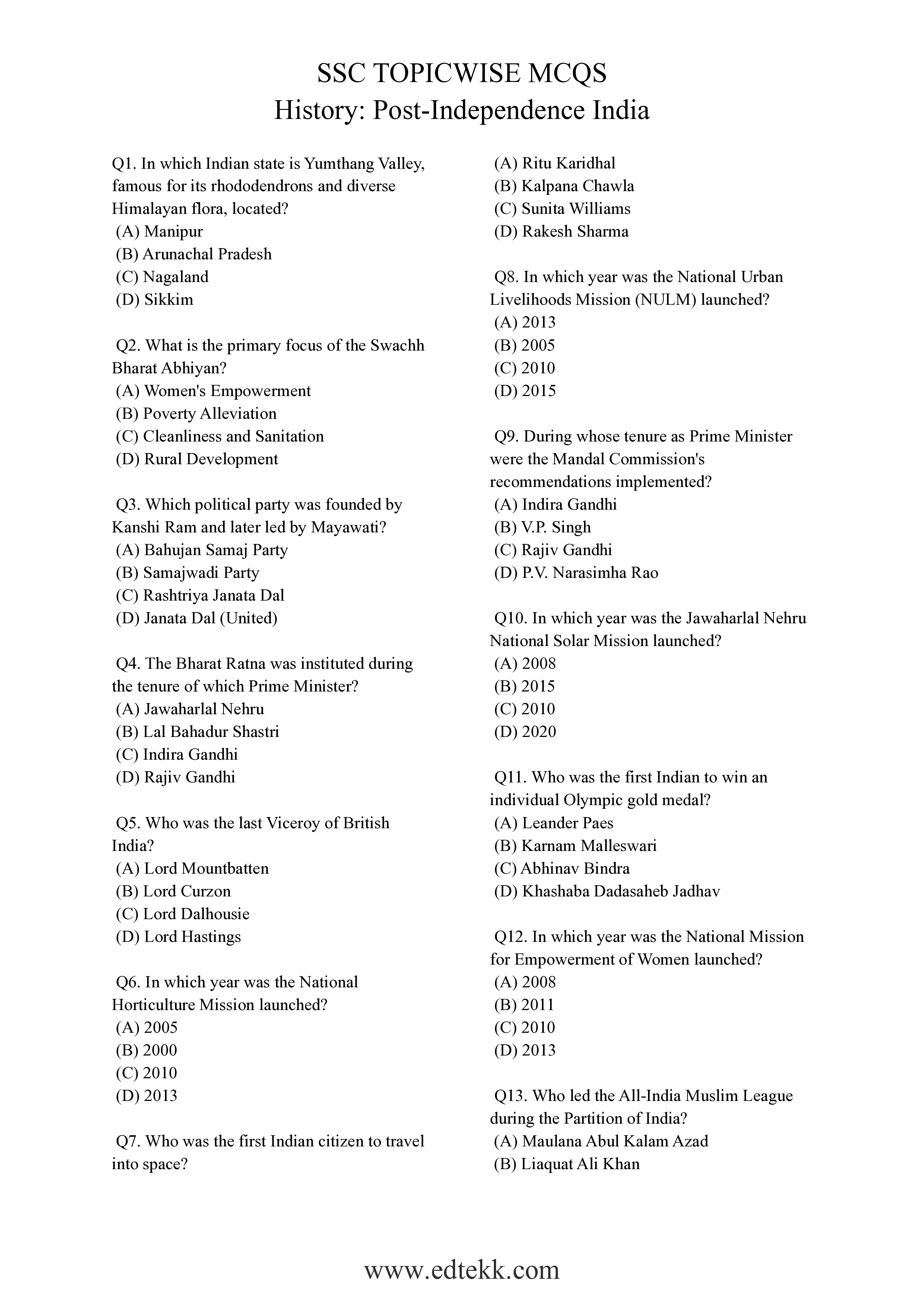
Q1. In which Indian state is Yumthang Valley, famous for its rhododendrons and diverse Himalayan flora, located?
(A) Manipur
(B) Arunachal Pradesh
(C) Nagaland
(D) Sikkim
Explanation: Yumthang Valley is situated in North Sikkim and is renowned for its Himalayan scenery, alpine vegetation and spectacular rhododendron blooms. Often called the Valley of Flowers of Sikkim, it supports diverse flora and attracts tourists, particularly during the spring flowering season.
Q2. What is the primary focus of the Swachh Bharat Abhiyan?
(A) Women’s Empowerment
(B) Poverty Alleviation
(C) Cleanliness and Sanitation
(D) Rural Development
Explanation: Swachh Bharat Abhiyan was launched on 2 October 2014 to improve cleanliness and sanitation across India. Its major objectives include eliminating open defecation, constructing household and community toilets, improving solid waste management and promoting behavioural changes related to hygiene and sanitation.
Q3. Which political party was founded by Kanshi Ram and later led by Mayawati?
(A) Bahujan Samaj Party
(B) Samajwadi Party
(C) Rashtriya Janata Dal
(D) Janata Dal (United)
Explanation: Kanshi Ram founded the Bahujan Samaj Party (BSP) on 14 April 1984 to represent the political interests of Dalits, Adivasis, Other Backward Classes and other marginalised communities. Mayawati subsequently became its prominent leader and served multiple terms as Chief Minister of Uttar Pradesh.
Q4. The Bharat Ratna was instituted during the tenure of which Prime Minister?
(A) Jawaharlal Nehru
(B) Lal Bahadur Shastri
(C) Indira Gandhi
(D) Rajiv Gandhi
Explanation: The Bharat Ratna, India’s highest civilian award, was instituted in 1954 during the tenure of Prime Minister Jawaharlal Nehru. The first recipients in 1954 were C. Rajagopalachari, Dr. Sarvepalli Radhakrishnan and C. V. Raman, in recognition of their exceptional contributions.
Q5. Who was the last Viceroy of British India?
(A) Lord Mountbatten
(B) Lord Curzon
(C) Lord Dalhousie
(D) Lord Hastings
Explanation: Lord Mountbatten was the last Viceroy of British India, serving from March 1947 until 15 August 1947. He oversaw the transfer of power and Partition. Following independence, he became the first Governor-General of independent India and held the position until June 1948.
Q6. In which year was the National Horticulture Mission launched?
(A) 2005
(B) 2000
(C) 2010
(D) 2013
Explanation: The National Horticulture Mission (NHM) was launched in 2005–06 to promote the holistic development of horticulture in India. Its objectives included increasing horticultural production and productivity, improving product quality, expanding cultivated areas, strengthening post-harvest management and developing marketing infrastructure. It was subsequently subsumed under the Mission for Integrated Development of Horticulture (MIDH) in 2014–15.
Q7. Who was the first Indian citizen to travel into space?
(A) Ritu Karidhal
(B) Kalpana Chawla
(C) Sunita Williams
(D) Rakesh Sharma
Explanation: Rakesh Sharma became the first Indian citizen to travel into space in April 1984. He flew aboard the Soviet spacecraft Soyuz T-11 as part of a joint Indo-Soviet space mission. He spent approximately eight days in space and became the first Indian to visit the Soviet space station Salyut 7.
Q8. In which year was the National Urban Livelihoods Mission (NULM) launched?
(A) 2013
(B) 2005
(C) 2010
(D) 2015
Explanation: The National Urban Livelihoods Mission (NULM) was launched in September 2013 to reduce urban poverty. It focuses on promoting self-employment, providing skill development and livelihood opportunities, and supporting urban street vendors. It was subsequently renamed Deendayal Antyodaya Yojana–National Urban Livelihoods Mission (DAY-NULM).
Q9. During whose tenure as Prime Minister were the Mandal Commission’s recommendations implemented?
(A) Indira Gandhi
(B) V.P. Singh
(C) Rajiv Gandhi
(D) P.V. Narasimha Rao
Explanation: V.P. Singh’s government implemented the Mandal Commission’s recommendation in 1990 by announcing 27% reservation for Other Backward Classes (OBCs) in central government services. This decision generated widespread political debate and protests and became a landmark development in India’s reservation policy.
Q10. In which year was the Jawaharlal Nehru National Solar Mission launched?
(A) 2008
(B) 2015
(C) 2010
(D) 2020
Explanation: The Jawaharlal Nehru National Solar Mission was launched on 11 January 2010 under India’s National Action Plan on Climate Change (NAPCC). Its objectives include promoting solar energy, reducing dependence on fossil fuels and increasing India’s solar power generation capacity.
Q11. Who was the first Indian to win an individual Olympic gold medal?
(A) Leander Paes
(B) Karnam Malleswari
(C) Abhinav Bindra
(D) Khashaba Dadasaheb Jadhav
Explanation: Abhinav Bindra became the first Indian to win an individual Olympic gold medal at the 2008 Beijing Olympics. He secured the gold medal in the men’s 10-metre air rifle shooting event. Before this achievement, India’s Olympic gold medals had predominantly come from team events, particularly men’s field hockey.
Q12. In which year was the National Mission for Empowerment of Women launched?
(A) 2008
(B) 2011
(C) 2010
(D) 2013
Explanation: The National Mission for Empowerment of Women was launched in 2011 to promote women’s socioeconomic empowerment. It aimed to improve coordination among government ministries, facilitate women’s access to welfare schemes and integrate gender-related concerns into development policies and programmes.
Q13. Who led the All-India Muslim League during the Partition of India?
(A) Maulana Abul Kalam Azad
(B) Liaquat Ali Khan
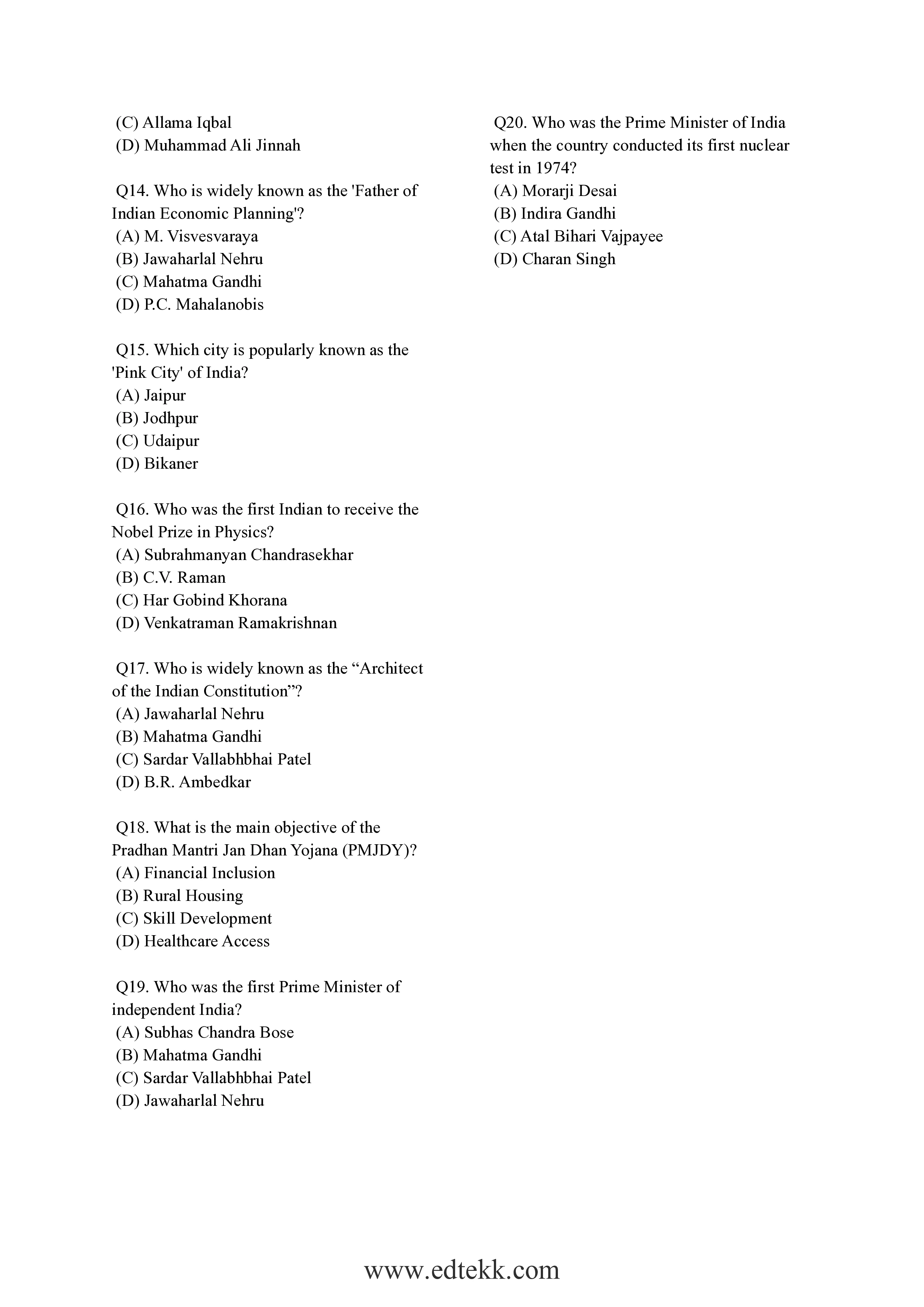
(C) Allama Iqbal
(D) Muhammad Ali Jinnah
Explanation: Muhammad Ali Jinnah was the principal leader of the All-India Muslim League during the Partition of India in 1947. He played a central role in demanding the creation of Pakistan and negotiating the transfer of power. Following Partition, he became the first Governor-General of Pakistan.
Q14. Who is widely known as the ‘Father of Indian Economic Planning’?
(A) M. Visvesvaraya
(B) Jawaharlal Nehru
(C) Mahatma Gandhi
(D) P.C. Mahalanobis
Explanation: M. Visvesvaraya is widely known as the Father of Indian Economic Planning for his pioneering contributions to planned economic and industrial development. His book Planned Economy for India, published in 1934, advocated systematic national economic planning. P. C. Mahalanobis subsequently made significant contributions to India’s planning strategy, particularly during the Second Five Year Plan.
Q15. Which city is popularly known as the ‘Pink City’ of India?
(A) Jaipur
(B) Jodhpur
(C) Udaipur
(D) Bikaner
Explanation: Jaipur, the capital of Rajasthan, is popularly known as the Pink City of India. Its buildings were painted pink in 1876 to welcome the Prince of Wales, later King Edward VII. The city’s distinctive architecture, historic forts, palaces and planned urban layout make it an important cultural and tourist destination.
Q16. Who was the first Indian to receive the Nobel Prize in Physics?
(A) Subrahmanyan Chandrasekhar
(B) C.V. Raman
(C) Har Gobind Khorana
(D) Venkatraman Ramakrishnan
Explanation: C. V. Raman became the first Indian to receive the Nobel Prize in Physics in 1930. He was awarded the prize for discovering the Raman Effect, which explains the inelastic scattering of light and the resulting change in its wavelength when it interacts with molecules. His discovery made a significant contribution to spectroscopy.
Q17. Who is widely known as the “Architect of the Indian Constitution”?
(A) Jawaharlal Nehru
(B) Mahatma Gandhi
(C) Sardar Vallabhbhai Patel
(D) B.R. Ambedkar
Explanation: Dr. B. R. Ambedkar is widely regarded as the Architect of the Indian Constitution because he chaired the Drafting Committee and played a central role in preparing the constitutional text. He made significant contributions to constitutional democracy, equality, fundamental rights and social justice. The Constitution was ultimately a collective achievement of the Constituent Assembly.
Q18. What is the main objective of the Pradhan Mantri Jan Dhan Yojana (PMJDY)?
(A) Financial Inclusion
(B) Rural Housing
(C) Skill Development
(D) Healthcare Access
Explanation: The Pradhan Mantri Jan Dhan Yojana (PMJDY) was launched on 28 August 2014 to promote financial inclusion. Its objectives include providing access to basic bank accounts, remittance facilities, credit, insurance and pension-related services. The scheme particularly targets households that were previously excluded from formal banking services and promotes access to affordable financial services.
Q19. Who was the first Prime Minister of independent India?
(A) Subhas Chandra Bose
(B) Mahatma Gandhi
(C) Sardar Vallabhbhai Patel
(D) Jawaharlal Nehru
Explanation: Jawaharlal Nehru became India’s first Prime Minister on 15 August 1947, following independence. He remained in office until his death on 27 May 1964, making him India’s longest-serving Prime Minister. His tenure was instrumental in establishing democratic institutions and shaping India’s early economic and foreign policies.
Q20. Who was the Prime Minister of India when the country conducted its first nuclear test in 1974?
(A) Morarji Desai
(B) Indira Gandhi
(C) Atal Bihari Vajpayee
(D) Charan Singh
Explanation: Indira Gandhi was Prime Minister when India conducted its first successful nuclear test on 18 May 1974 at Pokhran in Rajasthan. Code-named Smiling Buddha, the test was officially described by India as a peaceful nuclear explosion and marked a significant milestone in the country’s nuclear programme.
Question Paper Images