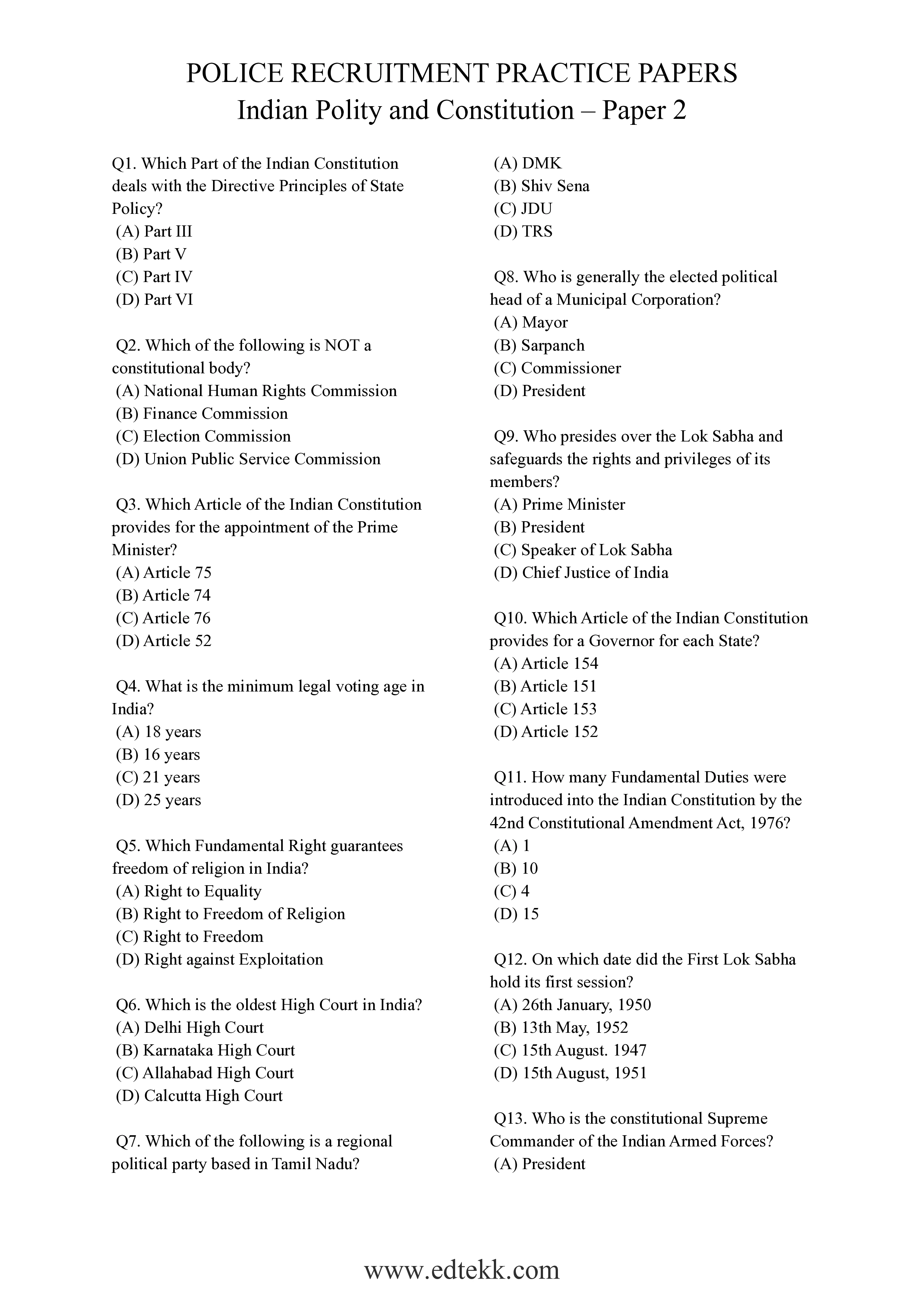
Strengthen your preparation for Police Constable and Police SI recruitment examinations with Indian Polity and Constitution Practice Paper 2. This question set provides objective-type practice covering the subject’s important concepts, helping candidates assess their knowledge through relevant MCQs, accurate answers and clear explanations for better examination readiness.
Test Details
Topic: Indian Polity and Constitution
Total Questions: 20
Question Format: MCQs – Single Correct Answer
Suitable for: Police Constable, Police SI
Download All Papers in This Series (PDF)
Questions and Answers
Q1. Which Part of the Indian Constitution deals with the Directive Principles of State Policy?
(A) Part III
(B) Part V
(C) Part IV
(D) Part VI
Explanation: Part IV (Articles 36–51) of the Indian Constitution deals with the Directive Principles of State Policy. These principles guide the State in promoting social and economic justice and public welfare. Although they are not directly enforceable by courts, Article 37 declares them fundamental to the governance of the country.
Q2. Which of the following is NOT a constitutional body?
(A) National Human Rights Commission
(B) Finance Commission
(C) Election Commission
(D) Union Public Service Commission
Explanation: The National Human Rights Commission is a statutory body established under the Protection of Human Rights Act, 1993. The Finance Commission, Election Commission of India and UPSC are constitutional bodies.
Q3. Which Article of the Indian Constitution provides for the appointment of the Prime Minister?
(A) Article 75
(B) Article 74
(C) Article 76
(D) Article 52
Explanation: Article 75(1) of the Indian Constitution provides that the Prime Minister is appointed by the President of India. The President also appoints other ministers on the advice of the Prime Minister. The Council of Ministers is collectively responsible to the Lok Sabha, and the Prime Minister must command its majority support.
Q4. What is the minimum legal voting age in India?
(A) 18 years
(B) 16 years
(C) 21 years
(D) 25 years
Explanation: The minimum voting age in India is 18 years. It was reduced from 21 to 18 years through the 61st Constitutional Amendment Act, 1988, which came into effect in 1989. Eligible Indian citizens who satisfy the applicable electoral registration requirements can vote in elections to the Lok Sabha and State Legislative Assemblies.
Q5. Which Fundamental Right guarantees freedom of religion in India?
(A) Right to Equality
(B) Right to Freedom of Religion
(C) Right to Freedom
(D) Right against Exploitation
Explanation: The Right to Freedom of Religion is one of the six categories of Fundamental Rights under Part III of the Constitution. Articles 25–28 protect freedom of conscience, the right to profess, practise and propagate religion, and certain related religious freedoms, subject to constitutional restrictions.
Q6. Which is the oldest High Court in India?
(A) Delhi High Court
(B) Karnataka High Court
(C) Allahabad High Court
(D) Calcutta High Court
Explanation: The Calcutta High Court is the oldest High Court in India. It was established on 1 July 1862 under the Indian High Courts Act, 1861, and was originally known as the High Court of Judicature at Fort William. The Bombay and Madras High Courts were also established in 1862, but commenced operations later.
Q7. Which of the following is a regional political party based in Tamil Nadu?
(A) DMK
(B) Shiv Sena
(C) JDU
(D) TRS
Explanation: The Dravida Munnetra Kazhagam (DMK) is a regional political party based in Tamil Nadu. Emerging from the Dravidian movement, it emphasises social justice, regional identity and state-level issues. Shiv Sena is associated primarily with Maharashtra, while Janata Dal (United) is prominent in Bihar.
Q8. Who is generally the elected political head of a Municipal Corporation?
(A) Mayor
(B) Sarpanch
(C) Commissioner
(D) President
Explanation: A Mayor is generally the elected political head of a Municipal Corporation. The Mayor presides over meetings and represents the corporation in official and public functions. The Municipal Commissioner, in contrast, is responsible for executive administration and implementing municipal policies and decisions.
Q9. Who presides over the Lok Sabha and safeguards the rights and privileges of its members?
(A) Prime Minister
(B) President
(C) Speaker of Lok Sabha
(D) Chief Justice of India
Explanation: The Speaker is the presiding officer of the Lok Sabha, responsible for maintaining order, regulating debates, interpreting procedural rules and safeguarding members’ parliamentary rights and privileges. The Speaker also determines the admissibility of motions and exercises important procedural powers, ensuring the orderly conduct of parliamentary proceedings.
Q10. Which Article of the Indian Constitution provides for a Governor for each State?
(A) Article 154
(B) Article 151
(C) Article 153
(D) Article 152
Explanation: Article 153 provides that there shall be a Governor for each State. The same person may be appointed Governor of two or more States. The Governor is the constitutional head of the State executive.
Q11. How many Fundamental Duties were introduced into the Indian Constitution by the 42nd Constitutional Amendment Act, 1976?
(A) 1
(B) 10
(C) 4
(D) 15
Explanation: Ten Fundamental Duties were incorporated into the Indian Constitution through the 42nd Constitutional Amendment Act, 1976. These duties promote responsible citizenship and include respecting national symbols, protecting public property and safeguarding the environment. The 86th Amendment Act, 2002, added an eleventh duty requiring parents or guardians to provide educational opportunities to children aged 6–14 years.
Q12. On which date did the First Lok Sabha hold its first session?
(A) 26th January, 1950
(B) 13th May, 1952
(C) 15th August. 1947
(D) 15th August, 1951
Explanation: The first session of the First Lok Sabha commenced on 13 May 1952. The First Lok Sabha was constituted following India’s first general elections, conducted between 1951 and 1952. This marked the beginning of the functioning of India’s first directly elected House of Parliament.
Q13. Who is the constitutional Supreme Commander of the Indian Armed Forces?
(A) President
(B) Prime Minister
(C) Defence Minister
(D) Chief of Defence Staff
Explanation: The President of India is the constitutional Supreme Commander of the Indian Armed Forces, comprising the Army, Navy and Air Force. However, the elected government, acting through the Ministry of Defence and established military command structures, manages defence administration and operational matters.
Q14. Which institution is the final authority on the interpretation of the Indian Constitution?
(A) President
(B) Supreme Court
(C) Prime Minister
(D) Parliament
Explanation: The Supreme Court of India is the highest judicial authority and the final interpreter of the Constitution within the Indian judicial system. It interprets constitutional provisions, adjudicates constitutional disputes and exercises judicial review to examine the constitutional validity of laws and government actions. Its judgments are binding on all courts in India under Article 141.
Q15. Which is the oldest High Court in India?
(A) Bombay High Court
(B) Madras High Court
(C) Calcutta High Court
(D) Delhi High Court
Explanation: The Calcutta High Court is generally recognised as the oldest High Court in India. It commenced functioning on 1 July 1862 under the Indian High Courts Act, 1861. Although the Bombay and Madras High Courts were also established in 1862, the Calcutta High Court began functioning first.
Q16. How long did the Constituent Assembly take to frame the Constitution of India?
(A) 2 years, 11 months and 17 days
(B) 3 years, 6 months and 23 days
(C) 4 years, 3 months and 29 days
(D) 1 year, 10 months and 15 days
Explanation: The Constituent Assembly took 2 years, 11 months and 17 days to frame the Indian Constitution. Its first meeting was held on 9 December 1946, and the Constitution was adopted on 26 November 1949. It came into force on 26 January 1950, a date commemorated annually as Republic Day.
Q17. Which body has the power to extend the term of the Lok Sabha beyond five years during a National Emergency?
(A) Parliament during a national emergency
(B) President
(C) Prime Minister
(D) Chief Justice of India
Explanation: Under Article 83(2), Parliament may extend the Lok Sabha’s normal five-year term by law while a National Emergency is in operation. Each extension cannot exceed one year at a time, and the extended term cannot continue beyond six months after the Emergency ceases. Neither the President nor the Prime Minister can independently exercise this power.
Q18. Which village-level institution supervises the Gram Panchayat and promotes accountability?
(A) District Collector
(B) Gram Sabha
(C) Sarpanch
(D) Secretary
Explanation: The Gram Sabha plays an important supervisory role in Panchayati Raj institutions. It provides a platform for village residents to question the Gram Panchayat, review development activities, scrutinise public expenditure and hold elected representatives accountable. These functions promote transparency and help prevent financial misuse and favouritism in local governance.
Q19. Who was the first Chief Justice of India?
(A) Harilal Jekisundas Kania
(B) Bijan Kumar Mukherjea
(C) Mehr Chand Mahajan
(D) M. Patanjali Sastri
Explanation: Harilal Jekisundas Kania was the first Chief Justice of India. He assumed office on 26 January 1950, when the Constitution came into effect and India became a republic. He headed the Supreme Court during its formative years and helped establish the institutional foundations of India’s highest judicial body.
Q20. Which of the following States has a bicameral legislature?
(A) Rajasthan
(B) Gujarat
(C) Jharkhand
(D) Maharashtra
Explanation: Maharashtra has a bicameral State legislature consisting of the Legislative Assembly and Legislative Council. Gujarat, Rajasthan and Jharkhand have unicameral legislatures. The Legislative Council is the permanent Upper House.
Question Paper Images