Prepare for Railway Recruitment Board examinations with this Indian History Practice Paper 1. This practice set covers important Indian History topics through objective-type MCQs designed for RRB NTPC, Group D, ALP and Technician exams. Test your knowledge with carefully selected questions, accurate answers and detailed explanations.
Test Details
Topic: Indian History
Total Questions: 20
Question Format: MCQs – Single Correct Answer
Suitable for: RRB NTPC, Group D, ALP, Technician
Download All Papers in This Series (PDF)
Questions and Answers
Q1. Which Indian nationalist leader was most closely associated with the Indian National Army (INA)?
(A) Bhagat Singh
(B) Jawaharlal Nehru
(C) Subhas Chandra Bose
(D) Sardar Vallabhbhai Patel
Explanation: Subhas Chandra Bose was the most prominent leader associated with the Indian National Army (INA). He assumed command of the reorganised INA in 1943 and established the Provisional Government of Azad Hind. The INA fought against British forces during the Second World War to secure India’s independence.
Q2. Who is widely known as the “Architect of the Indian Constitution”?
(A) Mahatma Gandhi
(B) Sardar Vallabhbhai Patel
(C) B.R. Ambedkar
(D) Jawaharlal Nehru
Explanation: Dr. B. R. Ambedkar is widely regarded as the Architect of the Indian Constitution because he chaired the Drafting Committee and played a central role in preparing the constitutional text. He made significant contributions to constitutional democracy, equality, fundamental rights and social justice. The Constitution was ultimately a collective achievement of the Constituent Assembly.
Q3. Which European explorer established a direct sea route from Europe to India via the Cape of Good Hope?
(A) Ferdinand Magellan
(B) Christopher Columbus
(C) Bartolomeu Dias
(D) Vasco da Gama
Explanation: Vasco da Gama was the first European to reach India by sailing around the Cape of Good Hope, arriving at Calicut in 1498. Bartolomeu Dias had rounded the southern tip of Africa in 1488, demonstrating the feasibility of the passage. Vasco da Gama completed the maritime route connecting Europe and India.
Q4. In which Indian state did Mahatma Gandhi lead the Champaran Satyagraha?
(A) Punjab
(B) Bihar
(C) Maharashtra
(D) Gujarat
Explanation: The Champaran Satyagraha was launched by Mahatma Gandhi in 1917 in the Champaran district of Bihar. It was directed against the exploitation of indigo cultivators by European planters under oppressive agricultural arrangements. It was Gandhi’s first major Satyagraha movement in India.
Q5. Which city hosted the sessions of the Constituent Assembly that drafted the Indian Constitution?
(A) New Delhi
(B) Mumbai
(C) Kolkata
(D) Chennai
Explanation: New Delhi hosted the sessions of the Constituent Assembly responsible for drafting the Indian Constitution. The Assembly first met on 9 December 1946 and held its deliberations in New Delhi. The Constitution was adopted on 26 November 1949 and came into force on 26 January 1950.
Q6. Who was one of the founders of the Swaraj Party in 1923?
(A) Motilal Nehru
(B) Jawaharlal Nehru
(C) Mahatma Gandhi
(D) Subhas Chandra Bose
Explanation: Motilal Nehru and Chittaranjan Das founded the Swaraj Party in 1923. It emerged following disagreements within the Congress over participation in legislative councils established under British rule. The party aimed to enter these councils and obstruct colonial administration from within.
Q7. During whose tenure as Governor-General was the practice of sati abolished?
(A) Lord Metcalfe
(B) Lord William Bentinck
(C) Lord Auckland
(D) Lord Ellenborough
Explanation: Sati was abolished in 1829 during the administration of Governor-General Lord William Bentinck through Bengal Regulation XVII. The practice involved a widow immolating herself on her deceased husband’s funeral pyre. Social reformers, particularly Raja Ram Mohan Roy, campaigned vigorously against it. Its abolition marked an important milestone in India’s social reform movement.
Q8. In which of the following Indian states is the Ugadi festival particularly important?
(A) Karnataka
(B) Chhattisgarh
(C) Nagaland
(D) Arunachal Pradesh
Explanation: Ugadi is an important New Year festival celebrated in Karnataka, Andhra Pradesh and Telangana. It marks the beginning of the Hindu lunisolar calendar year in these regions. Celebrations include prayers, festive decorations and traditional food preparations, particularly Ugadi Pachadi in Andhra Pradesh and Telangana.
Q9. Which of the following is a traditional folk dance of Arunachal Pradesh?
(A) Purbi
(B) Sattriya
(C) Popir
(D) Bhavai
Explanation: Popir is a traditional folk dance of the Adi community of Arunachal Pradesh, generally performed by women during festivals and cultural celebrations. It features graceful movements and coordinated formations. Bhavai is associated with Gujarat, while Sattriya is a classical dance form of Assam.
Q10. In which year was the National Emergency declared in India?
(A) 1962
(B) 1984
(C) 1975
(D) 1991
Explanation: The National Emergency was declared in India on 25 June 1975 by President Fakhruddin Ali Ahmed on the advice of Prime Minister Indira Gandhi, under Article 352 of the Constitution. It remained in force until 21 March 1977 and was accompanied by restrictions on civil liberties, press freedom and political activities.
Q11. Which Indian artist is renowned for paintings depicting Indian mythology, folklore and cultural heritage?
(A) Raja Ravi Varma
(B) M.F. Husain
(C) Tyeb Mehta
(D) Amrita Sher-Gil
Explanation: Raja Ravi Varma was a celebrated Indian painter known for combining European academic painting techniques with Indian subjects. His famous paintings depicted characters and episodes from the Ramayana and Mahabharata, as well as Indian mythology. His artistic representations significantly influenced popular Indian religious imagery and calendar art.
Q12. Tansen, one of the most renowned musicians of medieval India, served in the court of which Mughal emperor?
(A) Aurangzeb
(B) Akbar
(C) Babur
(D) Humayun
Explanation: Tansen was a celebrated musician in the court of Mughal emperor Akbar and is traditionally counted among his Navaratnas, or nine distinguished courtiers. Previously associated with the court of Raja Ramchandra of Rewa, he joined Akbar’s court in the sixteenth century. He is remembered for his major influence on Hindustani classical music and traditions associated with several ragas.
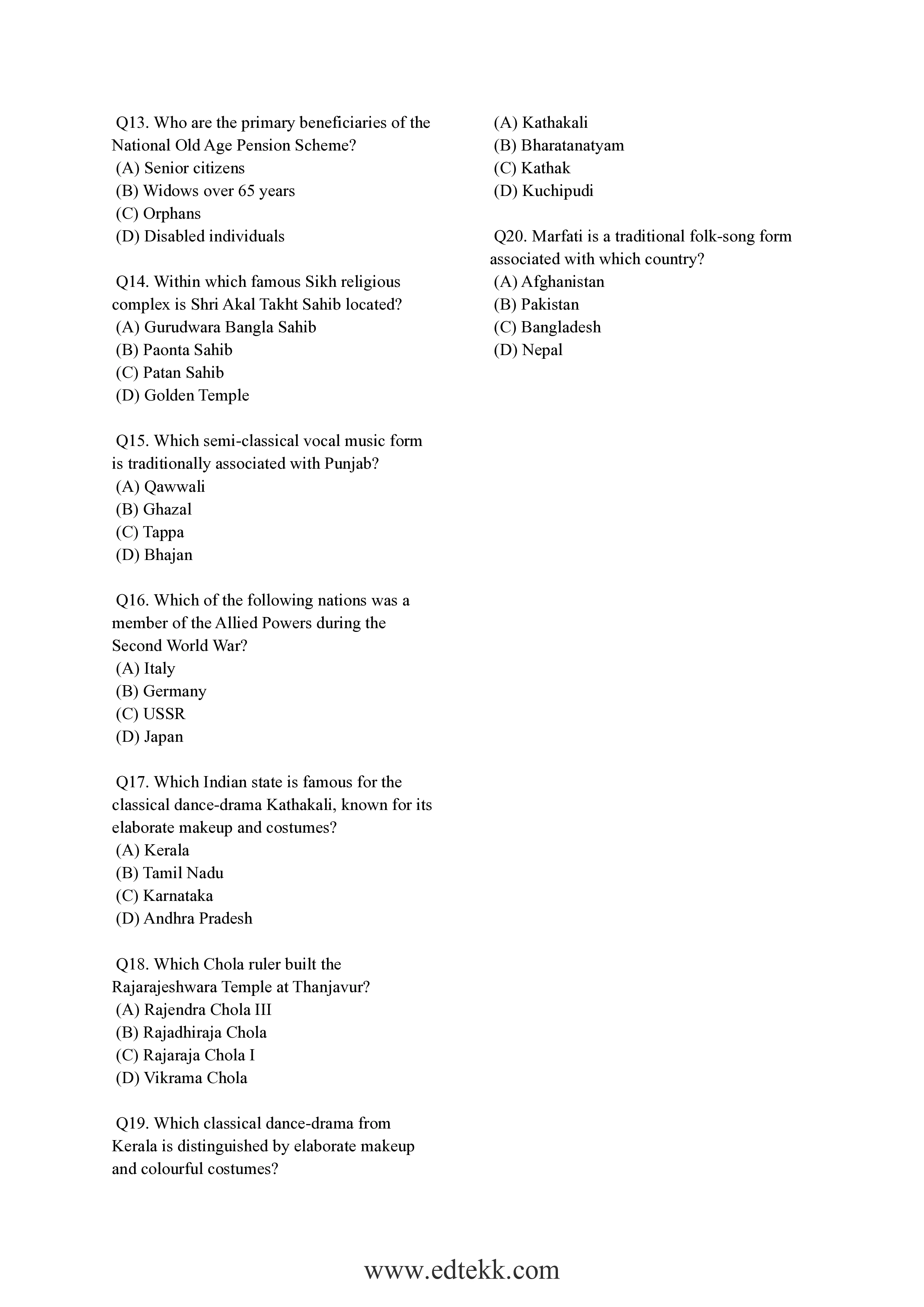
Q13. Who are the primary beneficiaries of the National Old Age Pension Scheme?
(A) Senior citizens
(B) Widows over 65 years
(C) Orphans
(D) Disabled individuals
Explanation: The National Old Age Pension Scheme (NOAPS) was introduced in 1995 under the National Social Assistance Programme (NSAP). It provides financial assistance to eligible elderly individuals belonging to below-poverty-line households. The scheme was subsequently renamed the Indira Gandhi National Old Age Pension Scheme (IGNOAPS) in 2007.
Q14. Within which famous Sikh religious complex is Shri Akal Takht Sahib located?
(A) Gurudwara Bangla Sahib
(B) Paonta Sahib
(C) Patan Sahib
(D) Golden Temple
Explanation: Shri Akal Takht Sahib is situated within the Golden Temple complex in Amritsar, Punjab. Established by Guru Hargobind in 1606, it is one of the five Takhts, or seats of temporal authority, in Sikhism. It represents the Sikh community’s institutional authority and plays an important role in religious and community affairs.
Q15. Which semi-classical vocal music form is traditionally associated with Punjab?
(A) Qawwali
(B) Ghazal
(C) Tappa
(D) Bhajan
Explanation: Tappa is a semi-classical vocal music form associated with Punjab. It originated from the musical traditions of camel riders and was later developed into a sophisticated classical style. Its distinctive features include rapid melodic ornamentations, intricate note patterns and short, energetic musical phrases.
Q16. Which of the following nations was a member of the Allied Powers during the Second World War?
(A) Italy
(B) Germany
(C) USSR
(D) Japan
Explanation: The Soviet Union (USSR) was one of the major Allied Powers during the Second World War. It joined the Allied coalition in 1941 following Germany’s invasion of Soviet territory. Other major Allied Powers included Britain, the United States and China, which fought against the Axis Powers comprising Germany, Italy and Japan.
Q17. Which Indian state is famous for the classical dance-drama Kathakali, known for its elaborate makeup and costumes?
(A) Kerala
(B) Tamil Nadu
(C) Karnataka
(D) Andhra Pradesh
Explanation: Kathakali originated in Kerala and is renowned for its elaborate costumes, colourful makeup and dramatic facial expressions. This classical dance-drama combines dance, music, acting and storytelling to portray episodes from Hindu epics and mythology, particularly the Ramayana and Mahabharata.
Q18. Which Chola ruler built the Rajarajeshwara Temple at Thanjavur?
(A) Rajendra Chola III
(B) Rajadhiraja Chola
(C) Rajaraja Chola I
(D) Vikrama Chola
Explanation: Rajaraja Chola I commissioned the Rajarajeshwara Temple, also known as the Brihadisvara Temple, at Thanjavur in Tamil Nadu. Completed around 1010 CE, it is one of the finest examples of Chola architecture and is renowned for its massive vimana, stone sculptures and monumental scale.
Q19. Which classical dance-drama from Kerala is distinguished by elaborate makeup and colourful costumes?
(A) Kathakali
(B) Bharatanatyam
(C) Kathak
(D) Kuchipudi
Explanation: Kathakali is a classical dance-drama tradition originating in Kerala. It is distinguished by elaborate facial makeup, colourful costumes, expressive hand gestures, stylised movements and dramatic storytelling. Its performances traditionally draw upon episodes from Hindu epics, particularly the Ramayana and Mahabharata.
Q20. Marfati is a traditional folk-song form associated with which country?
(A) Afghanistan
(B) Pakistan
(C) Bangladesh
(D) Nepal
Explanation: Marfati songs are traditional spiritual and devotional folk songs associated with Bangladesh. Influenced by Sufi philosophy, they explore themes of spirituality, divine love and human existence. These songs form part of Bangladesh’s diverse folk-music heritage and are particularly associated with rural cultural traditions.
Question Paper Images