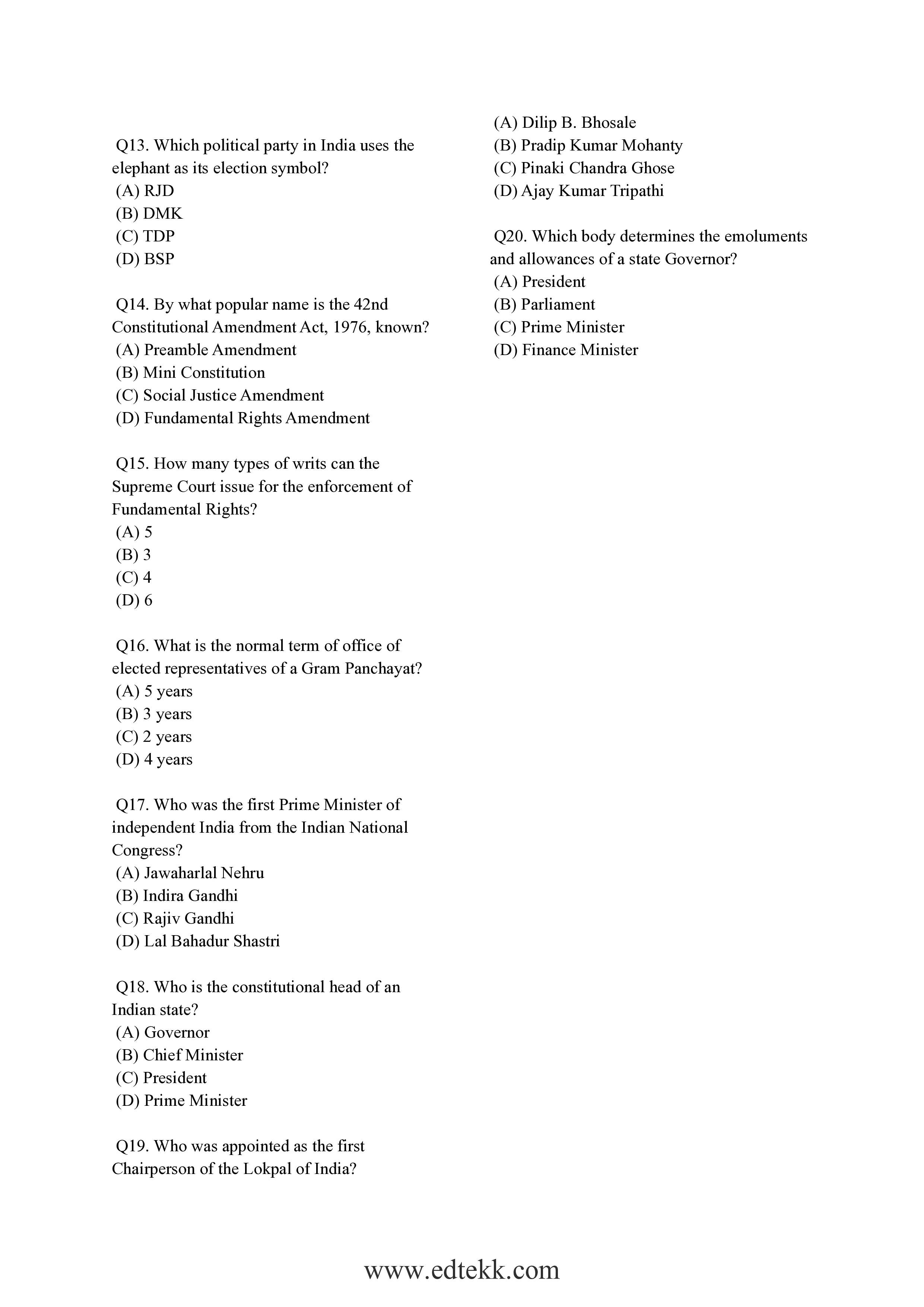
Prepare systematically for Police Constable and Police SI recruitment examinations using Indian Polity and Constitution Practice Paper 6. The set offers objective-type questions for subject revision and self-assessment, allowing candidates to strengthen their conceptual understanding, identify areas for improvement and learn through accurate MCQ answers and explanations.
Test Details
Topic: Indian Polity and Constitution
Total Questions: 20
Question Format: MCQs – Single Correct Answer
Suitable for: Police Constable, Police SI
Download All Papers in This Series (PDF)
Questions and Answers
Q1. The Pattali Makkal Katchi (PMK) is a prominent regional political party in which Indian state?
(A) Kerala
(B) Andhra Pradesh
(C) Tamil Nadu
(D) Karnataka
Explanation: The Pattali Makkal Katchi (PMK) is a regional political party primarily based in Tamil Nadu. Founded by S. Ramadoss on 16 July 1989, the party has maintained a significant presence in Tamil Nadu politics.
Q2. Who is the ex officio Chairman of the Rajya Sabha?
(A) Vice President
(B) President
(C) Prime Minister
(D) Speaker of Lok Sabha
Explanation: Under Article 64 of the Constitution, the Vice-President of India is the ex-officio Chairman of the Rajya Sabha. The Vice-President presides over its proceedings and maintains order but is not a member of the Rajya Sabha. The Chairman ordinarily does not vote, except when exercising a casting vote in the event of a tie.
Q3. What is the retirement age of judges of the Supreme Court of India?
(A) 65 years
(B) 62 years
(C) 70 years
(D) 75 years
Explanation: Judges of the Supreme Court of India retire at the age of 65 years, as prescribed under Article 124(2) of the Constitution. This retirement age applies to the Chief Justice of India as well as other Supreme Court judges. In comparison, High Court judges retire at 62 years.
Q4. What is the normal term of a member of the Lok Sabha (House of the People), unless the House is dissolved earlier?
(A) 5 years
(B) 3 years
(C) 4 years
(D) 6 years
Explanation: The normal tenure of the Lok Sabha is five years from the date appointed for its first meeting, unless dissolved earlier. During a National Emergency, Parliament may extend its term by one year at a time, but such an extension cannot continue beyond six months after the Emergency ceases to operate.
Q5. How many types of writs can the Supreme Court of India issue for the protection of Fundamental Rights?
(A) Four
(B) Five
(C) Seven
(D) Six
Explanation: The Supreme Court can issue five types of writs under Article 32 for the enforcement of Fundamental Rights: Habeas Corpus, Mandamus, Prohibition, Certiorari and Quo Warranto. These writs provide constitutional remedies against violations of Fundamental Rights and unlawful exercises of public authority.
Q6. Which of the following is not one of the five types of writs issued by Indian courts?
(A) Writ of Inquiry
(B) Writ of Mandamus
(C) Writ of Habeas Corpus
(D) Writ of Certiorari
Explanation: Indian courts issue five principal constitutional writs: Habeas Corpus, Mandamus, Prohibition, Certiorari and Quo Warranto. These writs safeguard fundamental rights and ensure that public authorities and judicial bodies act within their legal powers. A Writ of Inquiry is not among the five constitutionally recognised writs.
Q7. Which Houses of Parliament can the President summon and prorogue?
(A) Lok Sabha only
(B) Rajya Sabha only
(C) Both Houses of Parliament
(D) State Legislatures
Explanation: Under Article 85, the President summons and prorogues both Houses of Parliament: the Lok Sabha and the Rajya Sabha. The President may also dissolve the Lok Sabha. The Rajya Sabha is a permanent House and is not subject to dissolution.
Q8. Which Constitutional Amendment Act granted constitutional status to Panchayati Raj institutions?
(A) 73rd
(B) 74th
(C) 72nd
(D) 75th
Explanation: The 73rd Constitutional Amendment Act, 1992, gave constitutional status to Panchayati Raj institutions by inserting Part IX into the Constitution. It established a framework for regular elections, reservation of seats, five-year terms and State Finance Commissions, strengthening rural local self-government.
Q9. Who appoints the Advocate General of a State?
(A) President of India
(B) Governor of the state
(C) Chief Minister of the state
(D) Chief Justice of the high court
Explanation: The Governor of a State appoints the Advocate General under Article 165. The Advocate General is the State’s highest law officer and must possess the qualifications required for appointment as a High Court judge.
Q10. Which Article of the Indian Constitution provides for the establishment of the Finance Commission?
(A) Article 356
(B) Article 19
(C) Article 84
(D) Article 280
Explanation: Article 280 of the Indian Constitution provides for the establishment of the Finance Commission. It recommends the distribution of tax revenues between the Union and the states, principles governing grants-in-aid to states, and measures to augment state resources for local bodies. The President generally constitutes the Finance Commission every five years or earlier if necessary.
Q11. Which Constitutional Amendment Act made the Right to Education a Fundamental Right?
(A) 86th Amendment
(B) 92nd Amendment
(C) 42nd Amendment
(D) 44th Amendment
Explanation: The 86th Constitutional Amendment Act, 2002, made free and compulsory education a Fundamental Right for children aged 6 to 14 years by inserting Article 21A. This constitutional provision subsequently provided the foundation for the Right of Children to Free and Compulsory Education Act, 2009.
Q12. Which Constitutional Amendment Act reduced the minimum voting age from 21 to 18 years?
(A) 62nd Amendment
(B) 44th Amendment
(C) 86th Amendment
(D) 61st Amendment
Explanation: The 61st Constitutional Amendment Act, 1988, reduced the minimum voting age from 21 to 18 years for elections to the Lok Sabha and State Legislative Assemblies. It amended Article 326 of the Constitution, thereby expanding electoral participation among young citizens.
Q13. Which political party in India uses the elephant as its election symbol?
(A) RJD
(B) DMK
(C) TDP
(D) BSP
Explanation: The Bahujan Samaj Party (BSP), founded by Kanshi Ram in 1984, uses the elephant as its election symbol. The party primarily advocates the political and social empowerment of Bahujans, including Scheduled Castes, Scheduled Tribes, Other Backward Classes and other marginalised communities.
Q14. By what popular name is the 42nd Constitutional Amendment Act, 1976, known?
(A) Preamble Amendment
(B) Mini Constitution
(C) Social Justice Amendment
(D) Fundamental Rights Amendment
Explanation: The 42nd Constitutional Amendment Act, 1976, is popularly known as the “Mini Constitution” because it introduced extensive changes to various provisions of the Indian Constitution. These included amendments relating to the Preamble, Fundamental Duties, Directive Principles of State Policy and Centre-State relations.
Q15. How many types of writs can the Supreme Court issue for the enforcement of Fundamental Rights?
(A) 5
(B) 3
(C) 4
(D) 6
Explanation: The Supreme Court can issue five types of writs under Article 32 to enforce Fundamental Rights: Habeas Corpus, Mandamus, Prohibition, Certiorari and Quo Warranto. These writs protect individuals against unlawful detention, improper exercise of jurisdiction and other violations of legal or constitutional rights.
Q16. What is the normal term of office of elected representatives of a Gram Panchayat?
(A) 5 years
(B) 3 years
(C) 2 years
(D) 4 years
Explanation: The normal term of an elected Gram Panchayat is five years from the date appointed for its first meeting, as provided under Article 243E of the Constitution. Elections must generally be completed before the expiry of this term. If a Panchayat is dissolved prematurely, elections must ordinarily be held within six months, subject to the constitutional exception.
Q17. Who was the first Prime Minister of independent India from the Indian National Congress?
(A) Jawaharlal Nehru
(B) Indira Gandhi
(C) Rajiv Gandhi
(D) Lal Bahadur Shastri
Explanation: Jawaharlal Nehru was the first Prime Minister of independent India and the first Prime Minister from the Indian National Congress. He assumed office on 15 August 1947 and served until his death on 27 May 1964.
Q18. Who is the constitutional head of an Indian state?
(A) Governor
(B) Chief Minister
(C) President
(D) Prime Minister
Explanation: The Governor is the constitutional head of an Indian state, while the Chief Minister is the head of the elected state government. Under the parliamentary system, the Governor ordinarily exercises executive functions on the aid and advice of the Council of Ministers headed by the Chief Minister.
Q19. Who was appointed as the first Chairperson of the Lokpal of India?
(A) Dilip B. Bhosale
(B) Pradip Kumar Mohanty
(C) Pinaki Chandra Ghose
(D) Ajay Kumar Tripathi
Explanation: Justice Pinaki Chandra Ghose was appointed as the first Chairperson of the Lokpal of India in March 2019. The Lokpal is an anti-corruption ombudsman established to investigate allegations of corruption against specified public functionaries. Its chairperson and members are appointed through a prescribed selection process.
Q20. Which body determines the emoluments and allowances of a state Governor?
(A) President
(B) Parliament
(C) Prime Minister
(D) Finance Minister
Explanation: Parliament determines the Governor’s emoluments, allowances and privileges by law. Under Article 158(3), these cannot be diminished during the Governor’s term of office. The expenses relating to the Governor’s emoluments and allowances are charged on the Consolidated Fund of the State.
Question Paper Images