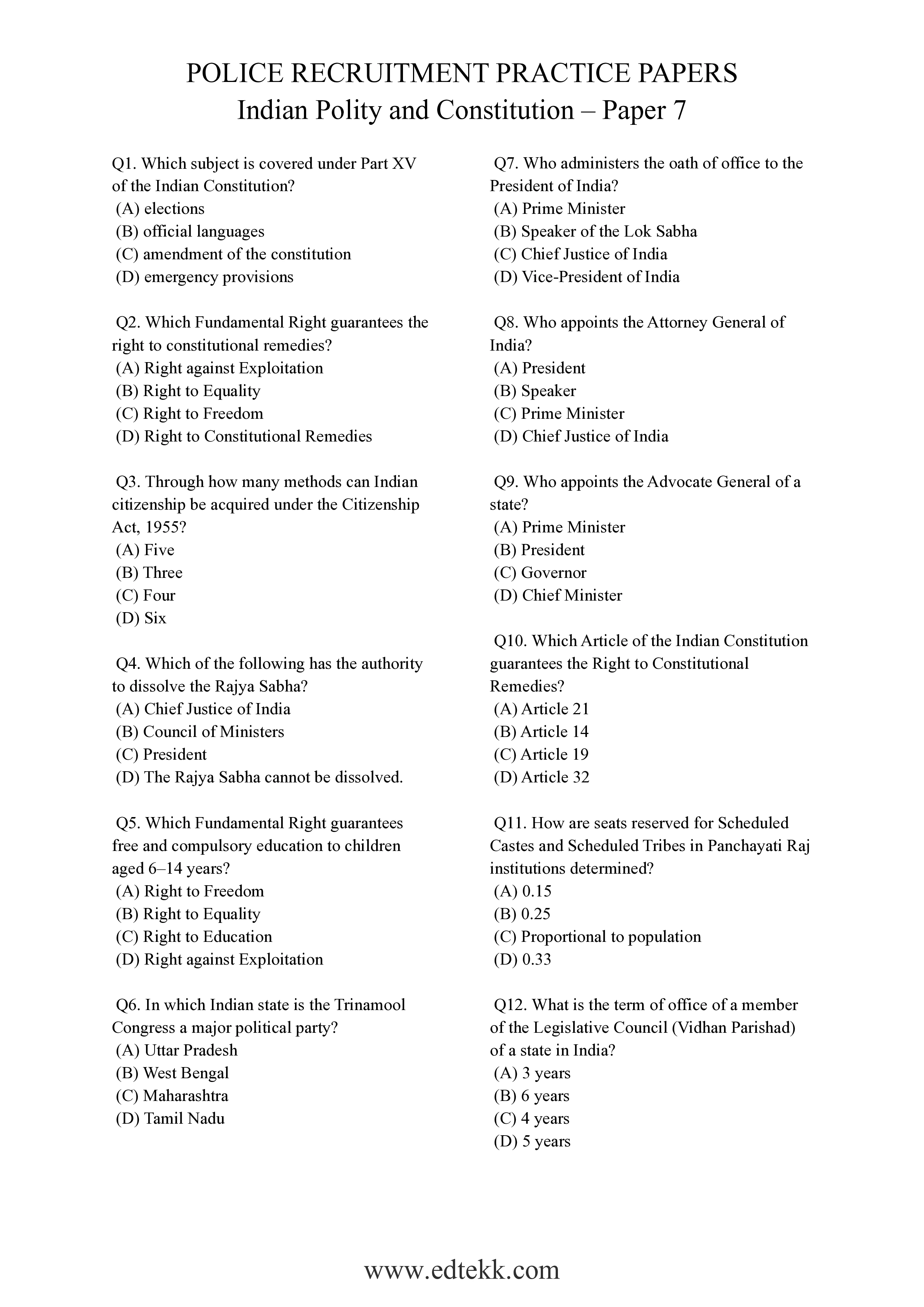
Indian Polity and Constitution Practice Paper 7 provides valuable question-based preparation for Police Constable and Police SI aspirants. Candidates can use this practice set to revise essential subject concepts, assess their knowledge and improve examination readiness through carefully presented objective questions, correct answers and easy-to-understand explanations.
Test Details
Topic: Indian Polity and Constitution
Total Questions: 20
Question Format: MCQs – Single Correct Answer
Suitable for: Police Constable, Police SI
Download All Papers in This Series (PDF)
Questions and Answers
Q1. Which subject is covered under Part XV of the Indian Constitution?
(A) elections
(B) official languages
(C) amendment of the constitution
(D) emergency provisions
Explanation: Part XV of the Indian Constitution deals with elections. Articles 324–329 establish the constitutional framework for electoral administration, including the Election Commission of India, electoral rolls, adult suffrage and related matters. Official languages, constitutional amendments and emergency provisions are addressed in other parts of the Constitution.
Q2. Which Fundamental Right guarantees the right to constitutional remedies?
(A) Right against Exploitation
(B) Right to Equality
(C) Right to Freedom
(D) Right to Constitutional Remedies
Explanation: The Right to Constitutional Remedies is guaranteed under Article 32 of the Indian Constitution. It enables individuals to approach the Supreme Court directly for the enforcement of Fundamental Rights. Dr. B. R. Ambedkar described Article 32 as the Constitution’s heart and soul. High Courts also have writ jurisdiction under Article 226.
Q3. Through how many methods can Indian citizenship be acquired under the Citizenship Act, 1955?
(A) Five
(B) Three
(C) Four
(D) Six
Explanation: Indian citizenship can be acquired through five methods under the Citizenship Act, 1955: birth, descent, registration, naturalisation and incorporation of territory. Each method has specific eligibility conditions, which have been amended over time.
Q4. Which of the following has the authority to dissolve the Rajya Sabha?
(A) Chief Justice of India
(B) Council of Ministers
(C) President
(D) The Rajya Sabha cannot be dissolved.
Explanation: The Rajya Sabha is a permanent House of Parliament and cannot be dissolved (Article 83). Unlike the Lok Sabha, it maintains institutional continuity irrespective of general elections. Approximately one-third of its members retire every two years, with vacancies filled through elections or nominations, as applicable.
Q5. Which Fundamental Right guarantees free and compulsory education to children aged 6–14 years?
(A) Right to Freedom
(B) Right to Equality
(C) Right to Education
(D) Right against Exploitation
Explanation: Article 21A guarantees free and compulsory education to all children aged 6–14 years. It was introduced through the 86th Constitutional Amendment Act, 2002, and came into force on 1 April 2010. The State is constitutionally obligated to provide elementary education to children within this age group in accordance with the law.
Q6. In which Indian state is the Trinamool Congress a major political party?
(A) Uttar Pradesh
(B) West Bengal
(C) Maharashtra
(D) Tamil Nadu
Explanation: The All India Trinamool Congress (TMC), commonly known as the Trinamool Congress, is a major political party in West Bengal. Founded by Mamata Banerjee in 1998, it has been a dominant force in the state’s politics and has also expanded its activities to other parts of India.
Q7. Who administers the oath of office to the President of India?
(A) Prime Minister
(B) Speaker of the Lok Sabha
(C) Chief Justice of India
(D) Vice-President of India
Explanation: The Chief Justice of India administers the oath of office to the President of India under Article 60 of the Constitution. In the Chief Justice’s absence, the senior-most available judge of the Supreme Court administers the oath. The President swears to faithfully execute the office and preserve, protect and defend the Constitution and the law.
Q8. Who appoints the Attorney General of India?
(A) President
(B) Speaker
(C) Prime Minister
(D) Chief Justice of India
Explanation: Under Article 76, the President appoints the Attorney General of India, who must be qualified for appointment as a Supreme Court judge. The Attorney General is the highest law officer of the Union Government and advises the Government of India on legal matters.
Q9. Who appoints the Advocate General of a state?
(A) Prime Minister
(B) President
(C) Governor
(D) Chief Minister
Explanation: Under Article 165, the Governor appoints the Advocate General for the State, the State Government’s highest law officer. The appointee must be qualified to be appointed a High Court judge. The Advocate General advises the State Government on legal matters and performs other legal duties assigned by the Governor.
Q10. Which Article of the Indian Constitution guarantees the Right to Constitutional Remedies?
(A) Article 21
(B) Article 14
(C) Article 19
(D) Article 32
Explanation: Article 32 guarantees the Right to Constitutional Remedies, enabling individuals to approach the Supreme Court for the enforcement of Fundamental Rights. The Supreme Court can issue five types of writs: habeas corpus, mandamus, prohibition, certiorari and quo warranto. Dr B. R. Ambedkar described Article 32 as the heart and soul of the Constitution.
Q11. How are seats reserved for Scheduled Castes and Scheduled Tribes in Panchayati Raj institutions determined?
(A) 0.15
(B) 0.25
(C) Proportional to population
(D) 0.33
Explanation: Article 243D of the Constitution provides for reservation of seats for Scheduled Castes and Scheduled Tribes in Panchayati Raj institutions in proportion, as nearly as practicable, to their population in the Panchayat area. This reservation promotes representation of these communities in rural local governance.
Q12. What is the term of office of a member of the Legislative Council (Vidhan Parishad) of a state in India?
(A) 3 years
(B) 6 years
(C) 4 years
(D) 5 years
Explanation: A member of a State Legislative Council (Vidhan Parishad) serves a six-year term under Article 172 of the Constitution. The Legislative Council is a permanent House and cannot be dissolved. Approximately one-third of its members retire every two years, ensuring continuity and periodic renewal of membership.
Q13. Who is the head of the Government of India?
(A) Prime Minister of India
(B) Chief Justice of India
(C) President of India
(D) Speaker of the Lok Sabha
Explanation: The Prime Minister is the head of the Union Government and leads the Council of Ministers. The President is the constitutional head of the Indian state, while executive functions are exercised in accordance with the Constitution, generally on the aid and advice of the Council of Ministers headed by the Prime Minister.
Q14. Who can recommend the imposition of President’s Rule in a state?
(A) Chief Minister
(B) Prime Minister
(C) Governor
(D) President
Explanation: Under Article 356, the President may proclaim President’s Rule if satisfied that the government of a State cannot be carried on in accordance with the Constitution. The President may act on a report from the Governor or otherwise; a Governor’s recommendation is therefore not a mandatory prerequisite.
Q15. Who was the first woman to become the Chief Justice of an Indian State High Court?
(A) Leila Seth
(B) Syeda Tahira
(C) Ruma Pal
(D) Fatima Bibi
Explanation: Justice Leila Seth became the first woman Chief Justice of a State High Court in India when she was appointed Chief Justice of the Himachal Pradesh High Court on 5 August 1991. She also became the first woman judge of the Delhi High Court in 1978.
Q16. Who appoints the State Election Commissioner responsible for conducting Panchayati Raj elections?
(A) President of India
(B) Governor of the State
(C) Prime Minister
(D) Chief Minister
Explanation: Under Article 243K of the Constitution, the Governor appoints the State Election Commissioner. The Commissioner supervises, directs and controls elections to Panchayati Raj institutions. Article 243ZA extends the State Election Commission’s role to municipal elections, and constitutional safeguards protect the Commissioner’s independence.
Q17. What is the minimum age required to become a member of a municipality in India?
(A) 18 years
(B) 21 years
(C) 25 years
(D) 30 years
Explanation: The minimum age for becoming a member of a municipality in India is 21 years, as provided under Article 243V of the Constitution. A candidate must also satisfy other eligibility conditions prescribed by the relevant state laws. This age requirement should not be confused with the minimum voting age of 18 years.
Q18. Under the Indian Constitution, what is the minimum number of times Parliament must meet in a year?
(A) Thrice
(B) Once
(C) Twice
(D) Four times
Explanation: Under Article 85 of the Indian Constitution, no more than six months can elapse between the last sitting of one session of Parliament and the first sitting of the next. Consequently, Parliament must hold at least two sessions annually.
Q19. How many Schedules are there in the Indian Constitution?
(A) 12
(B) 10
(C) 22
(D) 25
Explanation: The Indian Constitution originally contained eight Schedules. Following subsequent constitutional amendments, their number increased to 12. The Schedules deal with various subjects, including the allocation of Rajya Sabha seats, administration of tribal areas, official languages, anti-defection provisions and distribution of legislative powers.
Q20. Which Constitutional Amendment Act extended the reservation of seats for Scheduled Castes and Scheduled Tribes in the Lok Sabha and State Legislative Assemblies?
(A) 101st Amendment
(B) 105th Amendment
(C) 95th Amendment
(D) 109th Amendment
Explanation: The 95th Constitutional Amendment Act, 2009, extended the reservation of seats for Scheduled Castes and Scheduled Tribes in the Lok Sabha and State Legislative Assemblies for ten years, until 2020. Subsequently, the 104th Constitutional Amendment Act, 2019, extended this reservation until 2030.
Question Paper Images