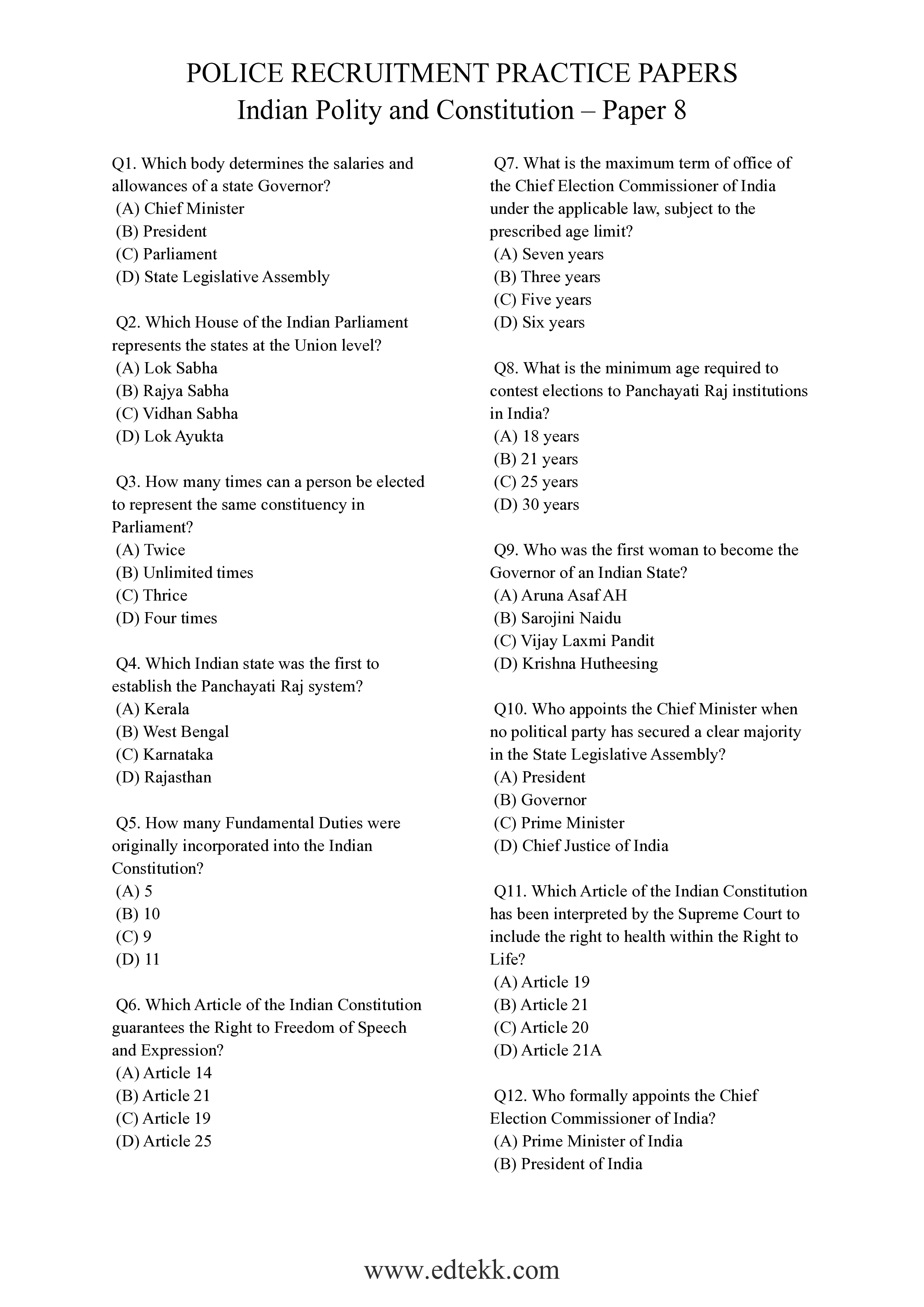
Enhance your competitive-exam preparation with Indian Polity and Constitution Practice Paper 8 for Police Recruitment. Intended for Police Constable and Police SI candidates, this practice paper features objective-type questions that support subject revision, knowledge assessment and conceptual learning through relevant MCQs, verified answers and explanatory solutions.
Test Details
Topic: Indian Polity and Constitution
Total Questions: 20
Question Format: MCQs – Single Correct Answer
Suitable for: Police Constable, Police SI
Download All Papers in This Series (PDF)
Questions and Answers
Q1. Which body determines the salaries and allowances of a state Governor?
(A) Chief Minister
(B) President
(C) Parliament
(D) State Legislative Assembly
Explanation: Parliament determines the Governor’s salaries, allowances and privileges by law. These financial entitlements are governed at the Union level, while the expenses relating to the Governor’s emoluments and allowances are charged on the Consolidated Fund of the State. Article 158(3) protects these entitlements against diminution during the Governor’s term.
Q2. Which House of the Indian Parliament represents the states at the Union level?
(A) Lok Sabha
(B) Rajya Sabha
(C) Vidhan Sabha
(D) Lok Ayukta
Explanation: The Rajya Sabha represents the states at the Union level in the Indian Parliament. Representatives of states are elected by elected members of their respective Legislative Assemblies through proportional representation using the single transferable vote. The House also includes representatives of eligible Union Territories and 12 nominated members.
Q3. How many times can a person be elected to represent the same constituency in Parliament?
(A) Twice
(B) Unlimited times
(C) Thrice
(D) Four times
Explanation: There is no constitutional limit on the number of times a person can be elected as a Member of Parliament from the same constituency. A person may contest and win elections repeatedly, provided they fulfil the prescribed eligibility requirements. However, under the Representation of the People Act, 1951, a candidate cannot contest from more than two constituencies in a single general election.
Q4. Which Indian state was the first to establish the Panchayati Raj system?
(A) Kerala
(B) West Bengal
(C) Karnataka
(D) Rajasthan
Explanation: Rajasthan was the first state to establish the Panchayati Raj system in India. It was inaugurated at Nagaur on 2 October 1959 by Prime Minister Jawaharlal Nehru. This marked an important milestone in the development of democratic decentralisation and rural self-government in independent India.
Q5. How many Fundamental Duties were originally incorporated into the Indian Constitution?
(A) 5
(B) 10
(C) 9
(D) 11
Explanation: The Indian Constitution originally contained ten Fundamental Duties, introduced through the 42nd Constitutional Amendment Act, 1976, under Article 51A. The 86th Constitutional Amendment Act, 2002, added the eleventh duty, requiring parents or guardians to provide educational opportunities to children or wards aged 6–14 years.
Q6. Which Article of the Indian Constitution guarantees the Right to Freedom of Speech and Expression?
(A) Article 14
(B) Article 21
(C) Article 19
(D) Article 25
Explanation: Article 19(1)(a) guarantees citizens the Fundamental Right to freedom of speech and expression. It includes expressing opinions through speech, writing, publication and other forms of communication. However, this right is not absolute. Reasonable restrictions may be imposed under Article 19(2) on specified grounds, including public order, security of the State, defamation and incitement to an offence.
Q7. What is the maximum term of office of the Chief Election Commissioner of India under the applicable law, subject to the prescribed age limit?
(A) Seven years
(B) Three years
(C) Five years
(D) Six years
Explanation: Under the Chief Election Commissioner and Other Election Commissioners (Appointment, Conditions of Service and Term of Office) Act, 2023, the Chief Election Commissioner holds office for six years or until attaining 65 years of age, whichever is earlier. Where an Election Commissioner is appointed as CEC, the combined tenure in both offices cannot exceed six years.
Q8. What is the minimum age required to contest elections to Panchayati Raj institutions in India?
(A) 18 years
(B) 21 years
(C) 25 years
(D) 30 years
Explanation: Under Article 243F of the Constitution, a person cannot be disqualified from Panchayat membership on the ground of being under 25 if they have attained 21 years of age. Other eligibility and disqualification conditions under applicable law also apply.
Q9. Who was the first woman to become the Governor of an Indian State?
(A) Aruna Asaf AH
(B) Sarojini Naidu
(C) Vijay Laxmi Pandit
(D) Krishna Hutheesing
Explanation: Sarojini Naidu became the first woman Governor of an Indian State when she was appointed Governor of the United Provinces in 1947. She was a prominent freedom fighter, poet and political leader, popularly known as the “Nightingale of India.”
Q10. Who appoints the Chief Minister when no political party has secured a clear majority in the State Legislative Assembly?
(A) President
(B) Governor
(C) Prime Minister
(D) Chief Justice of India
Explanation: The Governor appoints the Chief Minister under Article 164. When no party has secured a clear majority in the Legislative Assembly, the Governor invites the person most likely to command majority support. The Chief Minister may be required to establish that support through a floor test in the Assembly.
Q11. Which Article of the Indian Constitution has been interpreted by the Supreme Court to include the right to health within the Right to Life?
(A) Article 19
(B) Article 21
(C) Article 20
(D) Article 21A
Explanation: Article 21 guarantees the Right to Life and Personal Liberty. The Supreme Court has interpreted this right to include the right to health and access to medical care. This interpretation recognises that the right to life extends beyond mere physical existence and includes conditions necessary for living with human dignity.
Q12. Who formally appoints the Chief Election Commissioner of India?
(A) Prime Minister of India
(B) President of India
(C) Chief Justice of India
(D) Parliament of India
Explanation: The President of India formally appoints the Chief Election Commissioner under Article 324(2). Under the 2023 legislation, the selection committee comprises the Prime Minister, a Union Cabinet Minister nominated by the Prime Minister, and the Leader of Opposition in the Lok Sabha or, where applicable, the leader of the largest opposition party.
Q13. Who is the elected political head of a Municipal Corporation in India?
(A) Sarpanch
(B) President
(C) Municipal Commissioner
(D) Mayor
Explanation: The Mayor is generally the elected political head of a Municipal Corporation. The Mayor presides over corporation meetings and performs representative and civic functions. The Municipal Commissioner, usually appointed by the state government, generally manages executive administration and day-to-day municipal services.
Q14. Which Article of the Indian Constitution guarantees the Right to Freedom of Speech and Expression?
(A) Article 19
(B) Article 14 to 18
(C) Article 21 to 22
(D) Article 25 to 28
Explanation: Article 19(1)(a) of the Indian Constitution guarantees citizens the fundamental right to freedom of speech and expression. This includes expressing opinions through speech, writing, publications and other forms of communication. However, under Article 19(2), the State may impose reasonable restrictions on specified grounds, including public order, security of the State and defamation.
Q15. Which two States were associated with the initial introduction of the Panchayati Raj system in India in 1959?
(A) Rajasthan and Andhra Pradesh
(B) Assam and Bihar
(C) Arunachal Pradesh and Uttar Pradesh
(D) Punjab and Chandigarh
Explanation: Rajasthan was the first state to introduce the Panchayati Raj system in India on 2 October 1959 at Nagaur. Andhra Pradesh followed shortly afterwards as the second state to introduce the system in the same year. These developments marked the beginning of institutional democratic decentralisation through elected rural local self-government bodies.
Q16. Which Article of the Indian Constitution prescribes the procedure for the impeachment of the President?
(A) Article 72
(B) Article 61
(C) Article 80
(D) Article 76
Explanation: Article 61 of the Indian Constitution prescribes the procedure for the impeachment of the President on the ground of violation of the Constitution. Either House of Parliament may initiate the process by giving at least 14 days’ notice, signed by one-fourth of its total membership. The other House investigates the charge, and both Houses must pass it by a two-thirds majority of their total membership.
Q17. Who administers the oath of office to the Governor of a state?
(A) President
(B) Chief Minister
(C) Chief Justice of India
(D) Chief Justice of the High Court
Explanation: The Chief Justice of the concerned High Court administers the oath of office to the Governor under Article 159 of the Constitution. In the absence of the Chief Justice, the senior-most available judge of that High Court administers the oath. This provision ensures the formal commencement of the Governor’s constitutional responsibilities.
Q18. Which Article of the Indian Constitution prohibits the employment of children in factories, mines and other hazardous occupations?
(A) 24
(B) 21
(C) 31
(D) 17
Explanation: Article 24 of the Indian Constitution prohibits the employment of children below fourteen years of age in factories, mines and other hazardous employment. It is a Fundamental Right intended to protect children from exploitation and dangerous working conditions. The broader legal framework also regulates child employment in other occupations.
Q19. Under which Article of the Indian Constitution is the Fundamental Right to Freedom of Speech and Expression guaranteed?
(A) Article 19
(B) Article 14
(C) Article 21
(D) Article 25
Explanation: Article 19(1)(a) guarantees freedom of speech and expression to Indian citizens. It includes the freedom to express opinions through speech, writing, publication and other means. However, this right is subject to reasonable restrictions under Article 19(2) on specified grounds, including public order, security of the State, defamation and incitement to an offence.
Q20. Who was the Prime Minister of India during the Emergency from 1975 to 1977?
(A) Rajiv Gandhi
(B) Morarji Desai
(C) Indira Gandhi
(D) Charan Singh
Explanation: Indira Gandhi was the Prime Minister of India throughout the National Emergency from 25 June 1975 to 21 March 1977. The Emergency was proclaimed under Article 352, and Morarji Desai became Prime Minister following the 1977 general election.
Question Paper Images