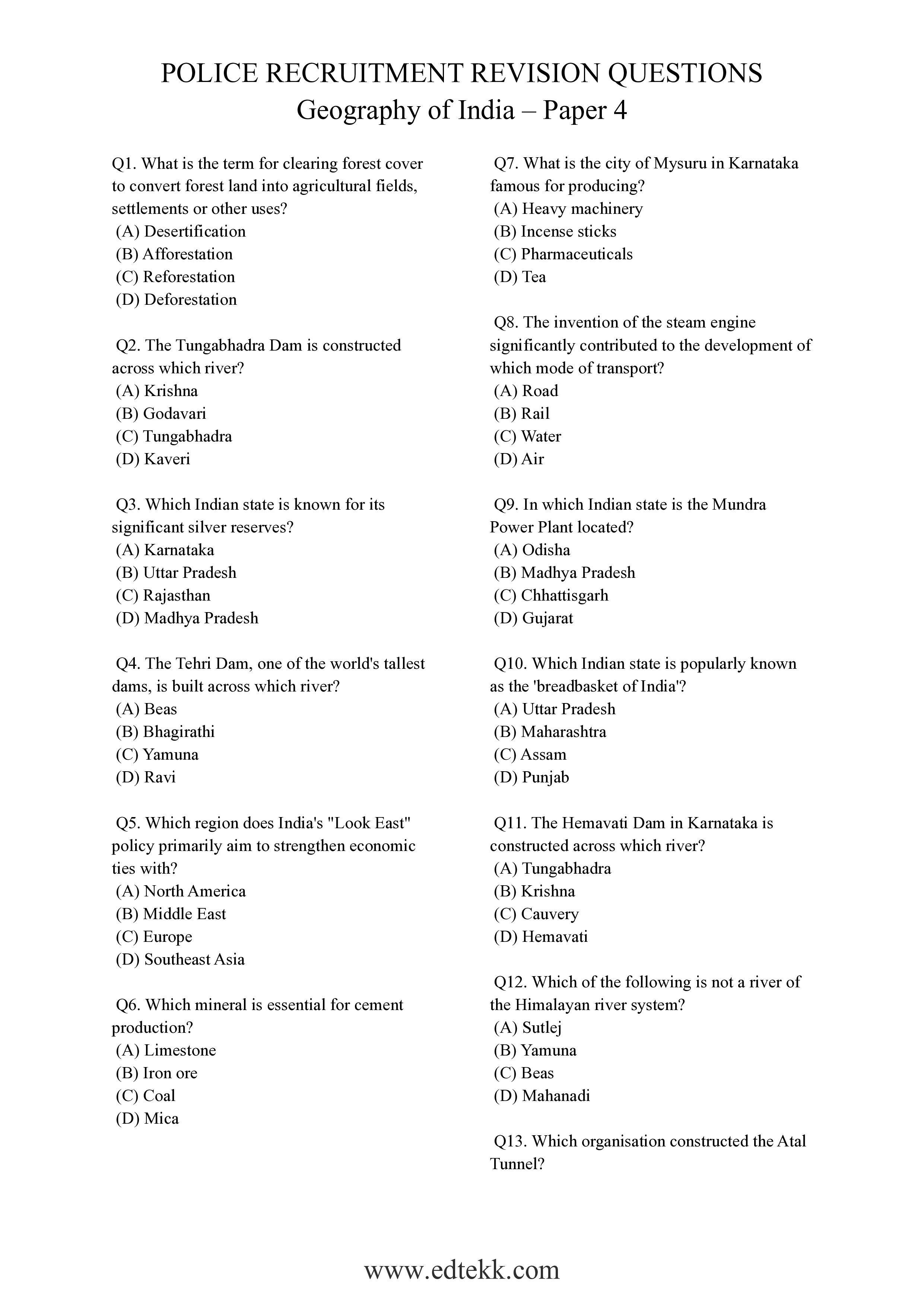
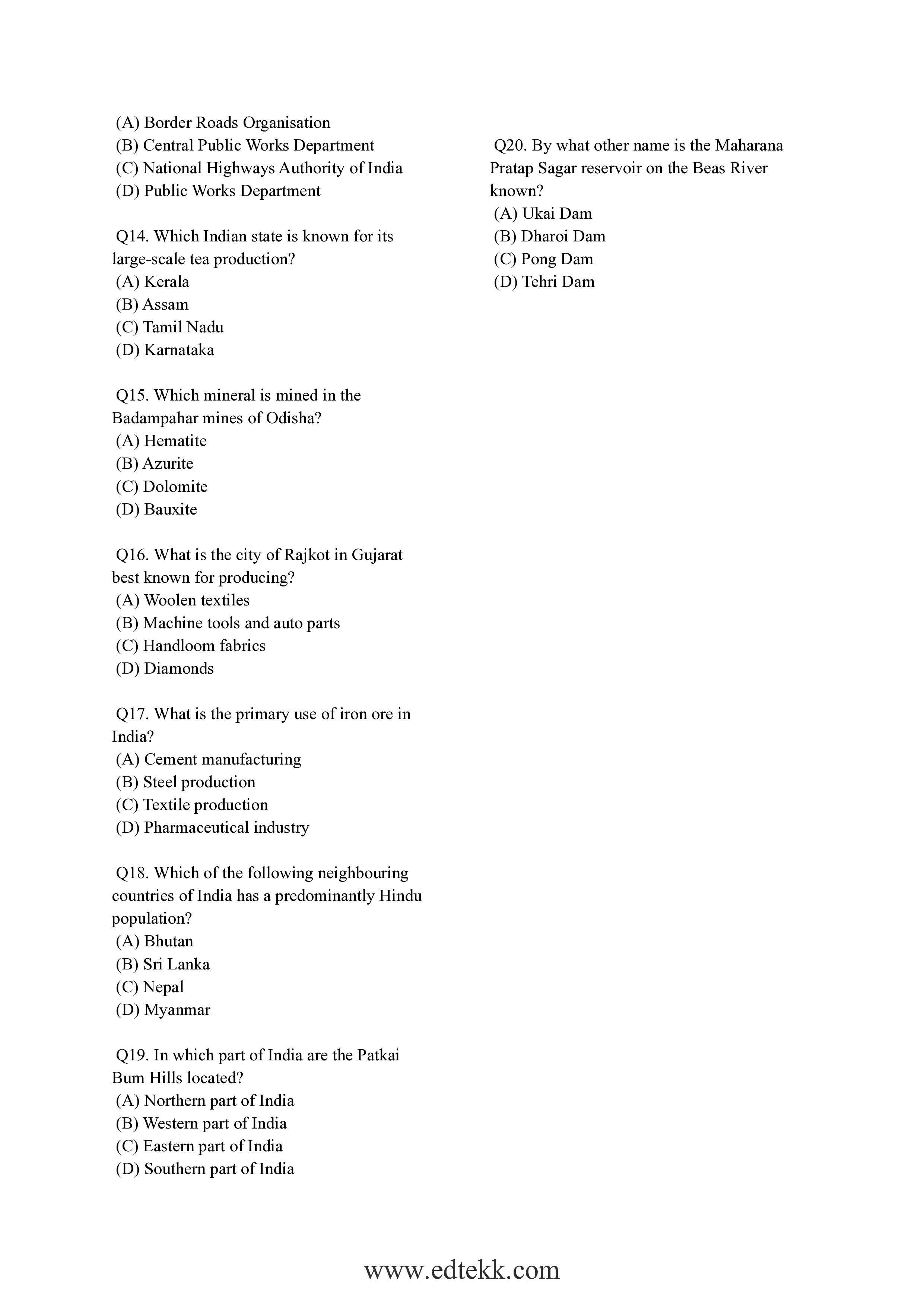
Test and revise your knowledge of Indian Geography with Paper 4 of this police recruitment practice series. Created for Police Constable and Police SI examinations, it includes relevant geographical MCQs, important practice questions, correct answers and explanations to help candidates improve accuracy and subject knowledge.
Test Details
Topic: Indian Geography
Total Questions: 20
Question Format: MCQs – Single Correct Answer
Suitable for: Police Constable, Police SI
Download All Papers in This Series (PDF)
Questions and Answers
Q1. What is the term for clearing forest cover to convert forest land into agricultural fields, settlements or other uses?
(A) Desertification
(B) Afforestation
(C) Reforestation
(D) Deforestation
Explanation: Deforestation refers to the removal or clearing of forest cover, often resulting in the conversion of forest land into agricultural fields, settlements, industrial areas or infrastructure. Major causes include agricultural expansion, urbanisation, mining and commercial logging. Its consequences include habitat destruction, soil erosion and biodiversity loss.
Q2. The Tungabhadra Dam is constructed across which river?
(A) Krishna
(B) Godavari
(C) Tungabhadra
(D) Kaveri
Explanation: The Tungabhadra Dam is constructed across the Tungabhadra River near Hosapete in Karnataka. The Tungabhadra is a major tributary of the Krishna River. The multipurpose project supports irrigation, hydroelectric power generation and water supply.
Q3. Which Indian state is known for its significant silver reserves?
(A) Karnataka
(B) Uttar Pradesh
(C) Rajasthan
(D) Madhya Pradesh
Explanation: Rajasthan is India’s leading state in silver production, with silver obtained mainly as a by-product of lead-zinc mining. Important mining areas include Zawar, Rampura Agucha and Rajpura-Dariba. These polymetallic deposits make Rajasthan a major centre of silver extraction.
Q4. The Tehri Dam, one of the world’s tallest dams, is built across which river?
(A) Beas
(B) Bhagirathi
(C) Yamuna
(D) Ravi
Explanation: The Tehri Dam is constructed across the Bhagirathi River in Uttarakhand. With a height of about 260.5 metres, it is among the world’s tallest dams. It forms part of the Tehri Hydropower Complex and supports hydroelectric power generation, irrigation and water supply.
Q5. Which region does India’s “Look East” policy primarily aim to strengthen economic ties with?
(A) North America
(B) Middle East
(C) Europe
(D) Southeast Asia
Explanation: India’s Look East Policy, initiated in 1991, aimed to strengthen economic, political and strategic relations with Southeast Asian countries. In 2014, it evolved into the Act East Policy, broadening India’s engagement with Southeast Asia and the wider Indo-Pacific region.
Q6. Which mineral is essential for cement production?
(A) Limestone
(B) Iron ore
(C) Coal
(D) Mica
Explanation: Limestone is the principal mineral raw material used in cement manufacturing. Its calcium carbonate content supplies the calcium required to produce clinker, which is subsequently ground with other materials to manufacture cement. Limestone is therefore essential to the cement industry and infrastructure development.
Q7. What is the city of Mysuru in Karnataka famous for producing?
(A) Heavy machinery
(B) Incense sticks
(C) Pharmaceuticals
(D) Tea
Explanation: Mysuru in Karnataka is famous for its incense-stick (agarbatti) industry. The city has a long-established tradition of manufacturing incense sticks using aromatic ingredients and natural fragrances. Mysuru is also renowned for sandalwood products, silk and traditional handicrafts.
Q8. The invention of the steam engine significantly contributed to the development of which mode of transport?
(A) Road
(B) Rail
(C) Water
(D) Air
Explanation: The steam engine played a fundamental role in the development of railway transportation during the Industrial Revolution. Steam locomotives converted the energy generated by burning fuel into mechanical motion, enabling the efficient movement of passengers and goods over long distances.
Q9. In which Indian state is the Mundra Power Plant located?
(A) Odisha
(B) Madhya Pradesh
(C) Chhattisgarh
(D) Gujarat
Explanation: The Mundra Thermal Power Plant is located near Mundra in the Kutch district of Gujarat. It is a major coal-fired thermal power station. Its coastal location facilitates the transportation and import of coal through the nearby port infrastructure.
Q10. Which Indian state is popularly known as the ‘breadbasket of India’?
(A) Uttar Pradesh
(B) Maharashtra
(C) Assam
(D) Punjab
Explanation: Punjab is popularly known as the breadbasket of India because of its substantial production of wheat and other food grains. Its fertile alluvial soils, irrigation facilities and adoption of Green Revolution technologies have contributed to high agricultural productivity. Punjab plays an important role in India’s food security and public distribution system.
Q11. The Hemavati Dam in Karnataka is constructed across which river?
(A) Tungabhadra
(B) Krishna
(C) Cauvery
(D) Hemavati
Explanation: The Hemavati Dam is constructed across the Hemavati River near Gorur in Hassan district, Karnataka. The Hemavati is an important tributary of the Cauvery and originates in the Western Ghats. The dam supports irrigation and water supply and is an important component of Karnataka’s water-resource system.
Q12. Which of the following is not a river of the Himalayan river system?
(A) Sutlej
(B) Yamuna
(C) Beas
(D) Mahanadi
Explanation: The Mahanadi is a major peninsular river originating in the Sihawa Hills of Chhattisgarh. It flows through Chhattisgarh and Odisha before draining into the Bay of Bengal. Unlike the Yamuna, Beas and Sutlej, which belong to the Himalayan river systems, the Mahanadi originates in the peninsular highlands.
Q13. Which organisation constructed the Atal Tunnel?
(A) Border Roads Organisation
(B) Central Public Works Department
(C) National Highways Authority of India
(D) Public Works Department
Explanation: The Atal Tunnel was constructed by the Border Roads Organisation (BRO), functioning under the Ministry of Defence. Located beneath the Rohtang Pass in Himachal Pradesh, it provides all-weather connectivity between the Manali region and Lahaul Valley. The strategically important tunnel was inaugurated in October 2020.
Q14. Which Indian state is known for its large-scale tea production?
(A) Kerala
(B) Assam
(C) Tamil Nadu
(D) Karnataka
Explanation: Assam is India’s largest tea-producing state and is internationally recognised for its strong, malty black tea. Tea cultivation is concentrated mainly in the Brahmaputra and Barak valleys, where humid conditions, abundant rainfall and suitable soils favour plantation agriculture. Other important tea-producing states include West Bengal, Tamil Nadu and Kerala.
Q15. Which mineral is mined in the Badampahar mines of Odisha?
(A) Hematite
(B) Azurite
(C) Dolomite
(D) Bauxite
Explanation: Badampahar, situated in Mayurbhanj district of Odisha, is famous for its iron ore deposits, particularly hematite. Odisha is one of India’s leading iron ore-producing states. Other important iron ore deposits are found in the districts of Keonjhar and Sundargarh.
Q16. What is the city of Rajkot in Gujarat best known for producing?
(A) Woolen textiles
(B) Machine tools and auto parts
(C) Handloom fabrics
(D) Diamonds
Explanation: Rajkot in Gujarat is an important engineering and manufacturing centre, particularly known for machine tools, engineering components and automobile parts. Its numerous small and medium-sized industrial enterprises manufacture precision components, diesel engine parts and automotive accessories.
Q17. What is the primary use of iron ore in India?
(A) Cement manufacturing
(B) Steel production
(C) Textile production
(D) Pharmaceutical industry
Explanation: Iron ore is the principal raw material used in steel manufacturing. It contains iron-bearing minerals that are processed to extract iron, which is subsequently refined and converted into steel. Steel is extensively used in construction, infrastructure, transportation, machinery and industrial equipment, making iron ore essential for India’s industrial development.
Q18. Which of the following neighbouring countries of India has a predominantly Hindu population?
(A) Bhutan
(B) Sri Lanka
(C) Nepal
(D) Myanmar
Explanation: Nepal has a predominantly Hindu population and is constitutionally a secular republic. According to the 2021 census, approximately 81.2% of its population follows Hinduism, making it the country’s largest religious community. Buddhism is the second-largest religion.
Q19. In which part of India are the Patkai Bum Hills located?
(A) Northern part of India
(B) Western part of India
(C) Eastern part of India
(D) Southern part of India
Explanation: The Patkai Bum Hills are located in northeastern India, primarily along the India-Myanmar border. They form part of the Purvanchal mountain ranges, which represent the eastern extension of the Himalayas. The Patkai Hills are particularly associated with Arunachal Pradesh and the northeastern border region.
Q20. By what other name is the Maharana Pratap Sagar reservoir on the Beas River known?
(A) Ukai Dam
(B) Dharoi Dam
(C) Pong Dam
(D) Tehri Dam
Explanation: Maharana Pratap Sagar, also known as Pong Reservoir, was formed by the construction of Pong Dam across the Beas River in Himachal Pradesh. The reservoir is an important wetland and habitat for migratory birds. It is recognised for its ecological significance and is designated as a Ramsar site.
Question Paper Images