Enhance your Physical Geography preparation with Paper 2 of this police recruitment revision series. Suitable for Police Constable and Police SI examinations, the set includes important geographical concepts, objective MCQs, practice questions, correct answers and explanations to help candidates assess their understanding and improve exam performance.
Test Details
Topic: Physical Geography
Total Questions: 20
Question Format: MCQs – Single Correct Answer
Suitable for: Police Constable, Police SI
Download All Papers in This Series (PDF)
Questions and Answers
Q1. What is the average gradient of the continental shelf?
(A) 2° or even less
(B) 8° or even less
(C) 5° or even less
(D) 1° or even less
Explanation: The continental shelf is the shallowest major division of the ocean floor and generally has an average gradient of approximately 1° or less. Its gently sloping surface represents the submerged extension of continental landmasses. Beyond the shelf break, the continental slope descends more steeply towards the deep ocean basin.
Q2. Which of the following planets is NOT classified as a Jovian planet?
(A) Jupiter
(B) Mars
(C) Uranus
(D) Saturn
Explanation: Mars is not classified as a Jovian planet. The four Jovian planets are Jupiter, Saturn, Uranus and Neptune. Mars is a terrestrial planet with a rocky surface and is considerably smaller than these giant outer planets.
Q3. Which planet lies between Mars and Saturn in the Solar System?
(A) Venus
(B) Mercury
(C) Jupiter
(D) Uranus
Explanation: The correct sequence of planets from the Sun is Mercury, Venus, Earth, Mars, Jupiter, Saturn, Uranus and Neptune. Therefore, Jupiter lies between Mars and Saturn in order of increasing distance from the Sun.
Q4. Which is the shallowest major division of the ocean floor?
(A) Continental shelf
(B) Continental slope
(C) Deep sea plains
(D) Trenches
Explanation: The continental shelf is the shallowest major physiographic division of the ocean floor. It represents the submerged extension of a continent and generally has a gentle slope. Its depth gradually increases towards the shelf break, beyond which the continental slope descends more steeply into the deep ocean basin.
Q5. What is the approximate time interval between two consecutive new moons?
(A) 29.5
(B) 28.5
(C) 15.5
(D) 145
Explanation: The interval between two consecutive new moons is called a synodic month. Its average duration is approximately 29.53 days. This is the time taken by the Moon to return to the same phase as observed from Earth and is longer than its sidereal orbital period.
Q6. Which city is situated at the confluence of the Ganga and Yamuna rivers?
(A) Agra
(B) Allahabad
(C) Kanpur
(D) Lucknow
Explanation: Prayagraj, formerly known as Allahabad, is located near the confluence of the Ganga and Yamuna rivers in Uttar Pradesh. This confluence is traditionally called the Triveni Sangam because of the religious belief that the mythical Saraswati also joins the two rivers there. The site is an important Hindu pilgrimage centre and hosts the Kumbh Mela.
Q7. Who coined the term ‘ecosystem’?
(A) AG Tansley
(B) Grinnell
(C) Lindeman
(D) Turreson
Explanation: British ecologist Arthur George Tansley introduced the term ecosystem in 1935. It describes an integrated system comprising living organisms and their physical environment. The concept emphasises interactions between biotic and abiotic components, including energy flow and nutrient cycling.
Q8. What is the extremely thin gaseous envelope surrounding the Moon called?
(A) lunar stratosphere
(B) lunar thermosphere
(C) lunar exosphere
(D) lunar endosphere
Explanation: The Moon possesses an extremely thin gaseous envelope known as an exosphere. Unlike Earth’s dense atmosphere, the lunar exosphere contains very few particles, including helium, neon and argon. These particles rarely collide because of their extremely low density.
Q9. In the term “Ocean Thermal Energy Conversion” (OTEC), what does the letter “T” stand for?
(A) Tidal
(B) Thermal
(C) Thermodynamic
(D) Technological
Explanation: OTEC stands for Ocean Thermal Energy Conversion. It is a renewable energy technology that uses the temperature difference between warm surface seawater and cold deep seawater to generate electricity. The temperature gradient drives a thermodynamic cycle that operates a turbine connected to an electrical generator.
Q10. Who formulated the three laws of planetary motion?
(A) Isaac Newton
(B) Johannes Kepler
(C) Tycho Brahe
(D) Galileo Galilei
Explanation: Johannes Kepler formulated the three fundamental laws of planetary motion in the early seventeenth century. These laws describe elliptical planetary orbits, equal areas swept in equal intervals of time, and the relationship between a planet’s orbital period and the size of its orbit.
Q11. In which type of environment does hydrarch succession take place?
(A) dry areas
(B) semi-arid areas
(C) grasslands
(D) wet areas
Explanation: Hydrarch succession, also known as hydrosere succession, takes place in aquatic or waterlogged environments such as ponds, lakes and wetlands. Over time, ecological communities change through successive stages, often progressing from aquatic vegetation to marsh vegetation, grassland, shrubs and eventually woodland or forest, depending on climatic and environmental conditions.
Q12. What is the estimated age of Earth according to current scientific knowledge?
(A) about 4,50,00,00,000 years
(B) about 65,00,000 years
(C) about 95,00,00,000 years
(D) about 45,00,000 years
Explanation: Earth’s estimated age is approximately 4.54 billion years, commonly rounded to 4.5 billion years. This estimate is based primarily on radiometric dating of meteorites and supported by evidence from ancient terrestrial minerals and lunar samples.
Q13. What is the movement of air from one region to another called?
(A) humidity
(B) clouds
(C) lightning
(D) winds
Explanation: Winds are produced by the movement of air, primarily in response to differences in atmospheric pressure. Unequal heating of Earth’s surface creates pressure differences, causing air to move from high-pressure regions towards low-pressure regions. Earth’s rotation and surface friction also influence wind direction and speed.
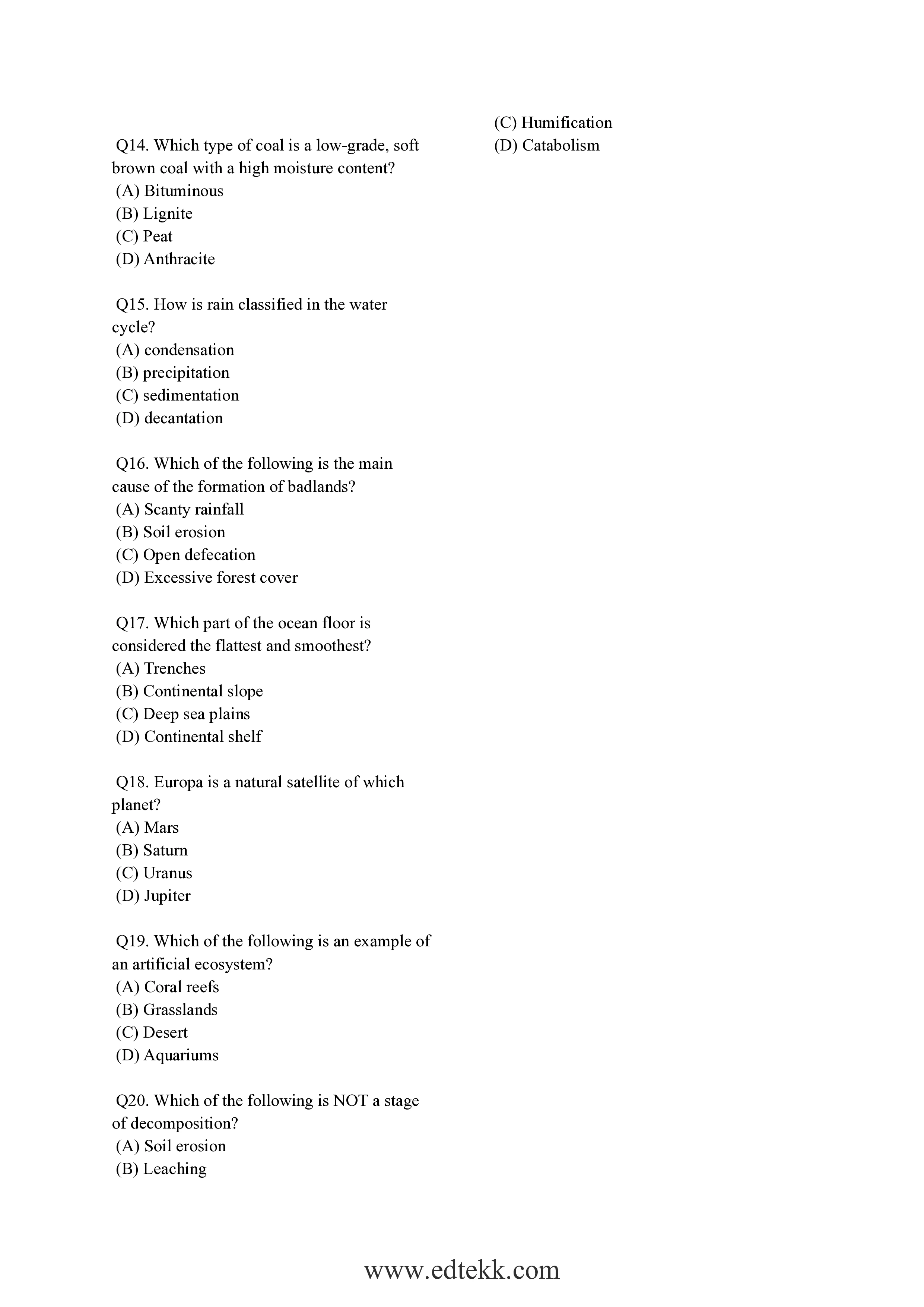
Q14. Which type of coal is a low-grade, soft brown coal with a high moisture content?
(A) Bituminous
(B) Lignite
(C) Peat
(D) Anthracite
Explanation: Lignite is a low-rank, soft brown coal characterised by high moisture content and relatively low carbon content. It forms during an early stage of coalification, after peat. Its calorific value is lower than that of bituminous coal and anthracite. Lignite is widely used for electricity generation in thermal power plants.
Q15. How is rain classified in the water cycle?
(A) condensation
(B) precipitation
(C) sedimentation
(D) decantation
Explanation: Rain is a form of liquid precipitation that falls from clouds to the Earth’s surface. It develops when water droplets within clouds combine and grow sufficiently large to overcome air resistance and fall under gravity. Other forms of precipitation include snow, sleet and hail, depending on atmospheric temperature conditions.
Q16. Which of the following is the main cause of the formation of badlands?
(A) Scanty rainfall
(B) Soil erosion
(C) Open defecation
(D) Excessive forest cover
Explanation: Soil erosion is the principal geomorphological process responsible for the formation and expansion of badlands. Running water erodes exposed, weakly consolidated rocks and soil, creating numerous gullies and ravines. Sparse vegetation, intense rainfall and semi-arid climatic conditions accelerate this erosion, producing deeply dissected landscapes.
Q17. Which part of the ocean floor is considered the flattest and smoothest?
(A) Trenches
(B) Continental slope
(C) Deep sea plains
(D) Continental shelf
Explanation: Deep-sea plains, also known as abyssal plains, are among the flattest and smoothest regions of the ocean floor. They occur at great depths and are generally covered by fine sediments deposited over long periods. Their remarkably level surfaces distinguish them from oceanic trenches, ridges and continental slopes.
Q18. Europa is a natural satellite of which planet?
(A) Mars
(B) Saturn
(C) Uranus
(D) Jupiter
Explanation: Europa is a natural satellite of Jupiter and the sixth-largest moon in the Solar System. It is particularly significant because scientific evidence indicates the presence of a vast subsurface ocean of liquid water beneath its icy crust.
Q19. Which of the following is an example of an artificial ecosystem?
(A) Coral reefs
(B) Grasslands
(C) Desert
(D) Aquariums
Explanation: An aquarium is an artificial ecosystem because humans control important environmental conditions, including water quality, temperature, lighting and feeding. It contains living organisms interacting with their physical surroundings, but its functioning depends substantially on human management. Grasslands, deserts and coral reefs are generally natural ecosystems.
Q20. Which of the following is NOT a stage of decomposition?
(A) Soil erosion
(B) Leaching
(C) Humification
(D) Catabolism
Explanation: Soil erosion is not a stage of decomposition. Decomposition involves the breakdown of organic matter through biological and chemical processes. Leaching removes dissolved substances from soil, humification converts decomposed organic residues into humus, and catabolism breaks down complex organic compounds into simpler substances. Soil erosion is a separate process involving the removal of soil by agents such as water and wind.
Question Paper Images