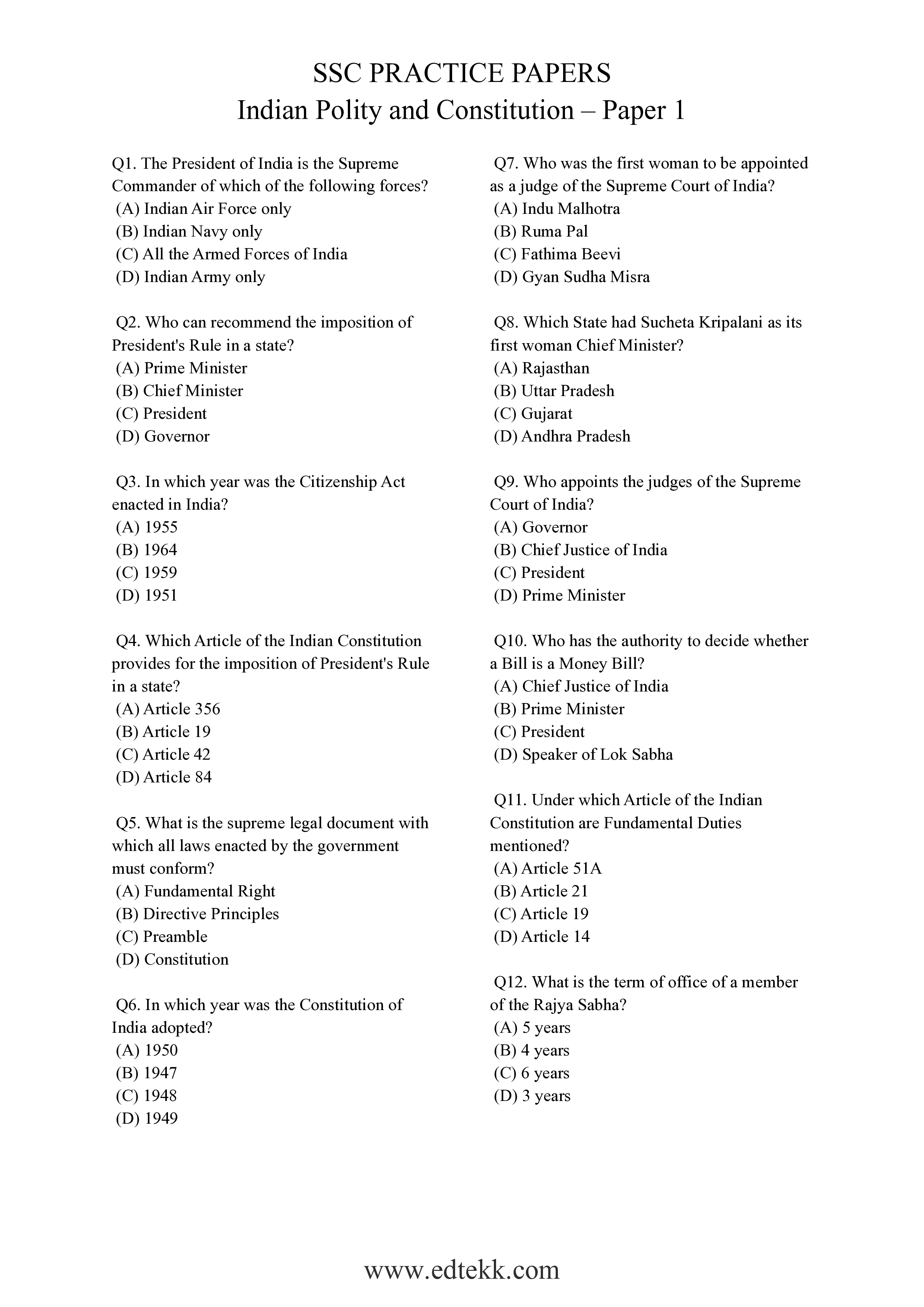
Prepare for SSC examinations with this Indian Polity and Constitution Practice Paper 1. This question set covers important constitutional provisions, political institutions, fundamental rights and governance. Practise MCQs with answers and detailed explanations to strengthen conceptual understanding for SSC CGL, CHSL, CPO, MTS, GD and Selection Post examinations.
Test Details
Topic: Indian Polity and Constitution
Total Questions: 20
Question Format: MCQs – Single Correct Answer
Suitable for: SSC CGL, CHSL, CPO, MTS, GD, Selection Post
Download All Papers in This Series (PDF)
Questions and Answers
Q1. The President of India is the Supreme Commander of which of the following forces?
(A) Indian Air Force only
(B) Indian Navy only
(C) All the Armed Forces of India
(D) Indian Army only
Explanation: The President of India is the Supreme Commander of the Indian Armed Forces, comprising the Army, Navy and Air Force. This is a constitutional position; operational command and defence administration are exercised through the established military hierarchy and the Union Government.
Q2. Who can recommend the imposition of President’s Rule in a state?
(A) Prime Minister
(B) Chief Minister
(C) President
(D) Governor
Explanation: The Governor may submit a report to the President under Article 356 when the government of a State cannot be carried on in accordance with the Constitution. The President may also act on other information and is not required to rely exclusively on the Governor’s report before considering a proclamation of President’s Rule.
Q3. In which year was the Citizenship Act enacted in India?
(A) 1955
(B) 1964
(C) 1959
(D) 1951
Explanation: The Citizenship Act was enacted in 1955 to regulate the acquisition and determination of Indian citizenship. It provides five methods of acquiring citizenship: birth, descent, registration, naturalisation and incorporation of territory. The Act has subsequently undergone several amendments.
Q4. Which Article of the Indian Constitution provides for the imposition of President’s Rule in a state?
(A) Article 356
(B) Article 19
(C) Article 42
(D) Article 84
Explanation: Article 356 of the Indian Constitution provides for President’s Rule when the government of a state cannot be carried on in accordance with the Constitution. The President may assume specified state governmental functions, subject to constitutional limitations. The proclamation must be approved by both Houses of Parliament within two months and is subject to prescribed conditions for continuation.
Q5. What is the supreme legal document with which all laws enacted by the government must conform?
(A) Fundamental Right
(B) Directive Principles
(C) Preamble
(D) Constitution
Explanation: The Constitution is the supreme law of India, and all laws enacted by the legislature must conform to its provisions. The judiciary may declare legislation unconstitutional if it violates constitutional requirements. Fundamental Rights are important limits on state power, but constitutional validity also depends on other applicable constitutional provisions.
Q6. In which year was the Constitution of India adopted?
(A) 1950
(B) 1947
(C) 1948
(D) 1949
Explanation: The Indian Constitution was adopted by the Constituent Assembly on 26 November 1949. It came into force on 26 January 1950, which is celebrated as Republic Day. The distinction between adoption and commencement is important for understanding the constitutional timeline.
Q7. Who was the first woman to be appointed as a judge of the Supreme Court of India?
(A) Indu Malhotra
(B) Ruma Pal
(C) Fathima Beevi
(D) Gyan Sudha Misra
Explanation: Justice M. Fathima Beevi became the first woman judge of the Supreme Court of India on 6 October 1989. Her appointment marked a historic milestone in women’s representation in the Indian judiciary. After retiring from the Supreme Court in 1992, she also served as the Governor of Tamil Nadu.
Q8. Which State had Sucheta Kripalani as its first woman Chief Minister?
(A) Rajasthan
(B) Uttar Pradesh
(C) Gujarat
(D) Andhra Pradesh
Explanation: Sucheta Kripalani became the first woman Chief Minister of an Indian State when she assumed office in Uttar Pradesh in 1963. She served as Chief Minister until 1967 and had also played an important role in the Indian freedom movement.
Q9. Who appoints the judges of the Supreme Court of India?
(A) Governor
(B) Chief Justice of India
(C) President
(D) Prime Minister
Explanation: The President of India appoints the judges of the Supreme Court under Article 124(2) of the Constitution. These appointments follow the established collegium system, under which senior Supreme Court judges recommend suitable candidates. The President formally makes the appointments following the prescribed constitutional consultation process.
Q10. Who has the authority to decide whether a Bill is a Money Bill?
(A) Chief Justice of India
(B) Prime Minister
(C) President
(D) Speaker of Lok Sabha
Explanation: Under Article 110(3), the Speaker of the Lok Sabha decides whether a Bill is a Money Bill. The Speaker’s certificate accompanies the Bill when transmitted to the Rajya Sabha and presented to the President. Although the Constitution describes the Speaker’s decision as final, it is not absolutely immune from judicial review, particularly where substantive constitutional violations are alleged.
Q11. Under which Article of the Indian Constitution are Fundamental Duties mentioned?
(A) Article 51A
(B) Article 21
(C) Article 19
(D) Article 14
Explanation: Article 51A contains the Fundamental Duties of Indian citizens. These include respecting the Constitution and national symbols, upholding India’s sovereignty and integrity, protecting the environment and promoting harmony. The 42nd Constitutional Amendment Act, 1976, introduced ten duties, while the 86th Amendment Act, 2002, added an eleventh duty relating to children’s education.
Q12. What is the term of office of a member of the Rajya Sabha?
(A) 5 years
(B) 4 years
(C) 6 years
(D) 3 years
Explanation: A Rajya Sabha member serves a six-year term. The Rajya Sabha is a permanent House and cannot be dissolved. Approximately one-third of its members retire every two years, ensuring continuity in parliamentary functioning. This arrangement provides institutional stability while allowing periodic renewal of membership.
Q13. Which Articles of the Indian Constitution deal with the Right to Freedom of Religion?
(A) Article 29 to 30
(B) Article 25 to 28
(C) Article 31 to 32
(D) Article 33 to 36
Explanation: Articles 25–28 of the Indian Constitution guarantee the Right to Freedom of Religion. They protect freedom of conscience and the right to profess, practise and propagate religion, subject to constitutional restrictions. These articles also regulate religious denominations, taxation for religious purposes and religious instruction in educational institutions.
Q14. What is the minimum age required to be eligible for election as the President of India?
(A) 30 years
(B) 35 years
(C) 40 years
(D) 45 years
Explanation: A person must be at least 35 years old to be eligible for election as President of India under Article 58(1) of the Constitution. The candidate must also be an Indian citizen, be qualified for election as a member of the Lok Sabha and fulfil the other constitutional requirements for presidential eligibility.
Q15. Which political party in India is associated with the hand election symbol?
(A) Rashtriya Janata Dal
(B) Janata Dal (United)
(C) Bahujan Samaj Party
(D) Indian National Congress
Explanation: The hand symbol is the reserved election symbol of the Indian National Congress (INC). It is one of the most recognisable political symbols in India and has been associated with the party for several decades.
Q16. What is the elected district-level institution of the rural Panchayati Raj system called?
(A) Panchayat Samiti
(B) Gram Panchayat
(C) Zilla Parishad
(D) Municipal Corporation
Explanation: The Zilla Parishad is the elected district-level institution of the Panchayati Raj system in rural India. It coordinates rural development activities across the district. Municipal Corporations govern urban areas, Gram Panchayats function at the village level, and Panchayat Samitis operate at the intermediate or block level.
Q17. How many types of writs can the Supreme Court of India issue for the protection of Fundamental Rights?
(A) Four
(B) Five
(C) Seven
(D) Six
Explanation: The Supreme Court can issue five types of writs under Article 32 for the enforcement of Fundamental Rights: Habeas Corpus, Mandamus, Prohibition, Certiorari and Quo Warranto. These writs provide constitutional remedies against violations of Fundamental Rights and unlawful exercises of public authority.
Q18. Which list in the Seventh Schedule includes subjects such as defence, foreign affairs and communications?
(A) Residual Powers
(B) State List
(C) Concurrent List
(D) Union List
Explanation: The Union List in the Seventh Schedule contains subjects on which Parliament ordinarily has exclusive legislative authority. These include defence, foreign affairs, banking, currency, railways and communications, subject to the Constitution’s provisions. The Union List facilitates nationally coordinated legislation on matters of countrywide importance.
Q19. Which institution is the final interpreter of the Indian Constitution?
(A) Attorney General
(B) Supreme Court
(C) President of India
(D) Comptroller and Auditor General
Explanation: The Supreme Court of India is the final interpreter and guardian of the Constitution. It interprets constitutional provisions and examines the validity of legislative and executive actions through judicial review. Its constitutional interpretations and the law declared by it are binding on all courts throughout India under Article 141.
Q20. In which year did the Supreme Court of India come into existence?
(A) 1955
(B) 1948
(C) 1950
(D) 1952
Explanation: The Supreme Court of India came into existence on 26 January 1950, when the Constitution of India came into force. It replaced the Federal Court of India, established in 1937. The Supreme Court formally commenced its proceedings on 28 January 1950.
Question Paper Images