Strengthen your Indian Polity preparation through SSC Practice Paper 4. This question set covers Parliament, the President, the Prime Minister, the Council of Ministers and important constitutional institutions. Practise carefully selected objective questions with answers and explanations to prepare for SSC CGL, CHSL, CPO, MTS, GD and Selection Post examinations.
Test Details
Topic: Indian Polity and Constitution
Total Questions: 20
Question Format: MCQs – Single Correct Answer
Suitable for: SSC CGL, CHSL, CPO, MTS, GD, Selection Post
Download All Papers in This Series (PDF)
Questions and Answers
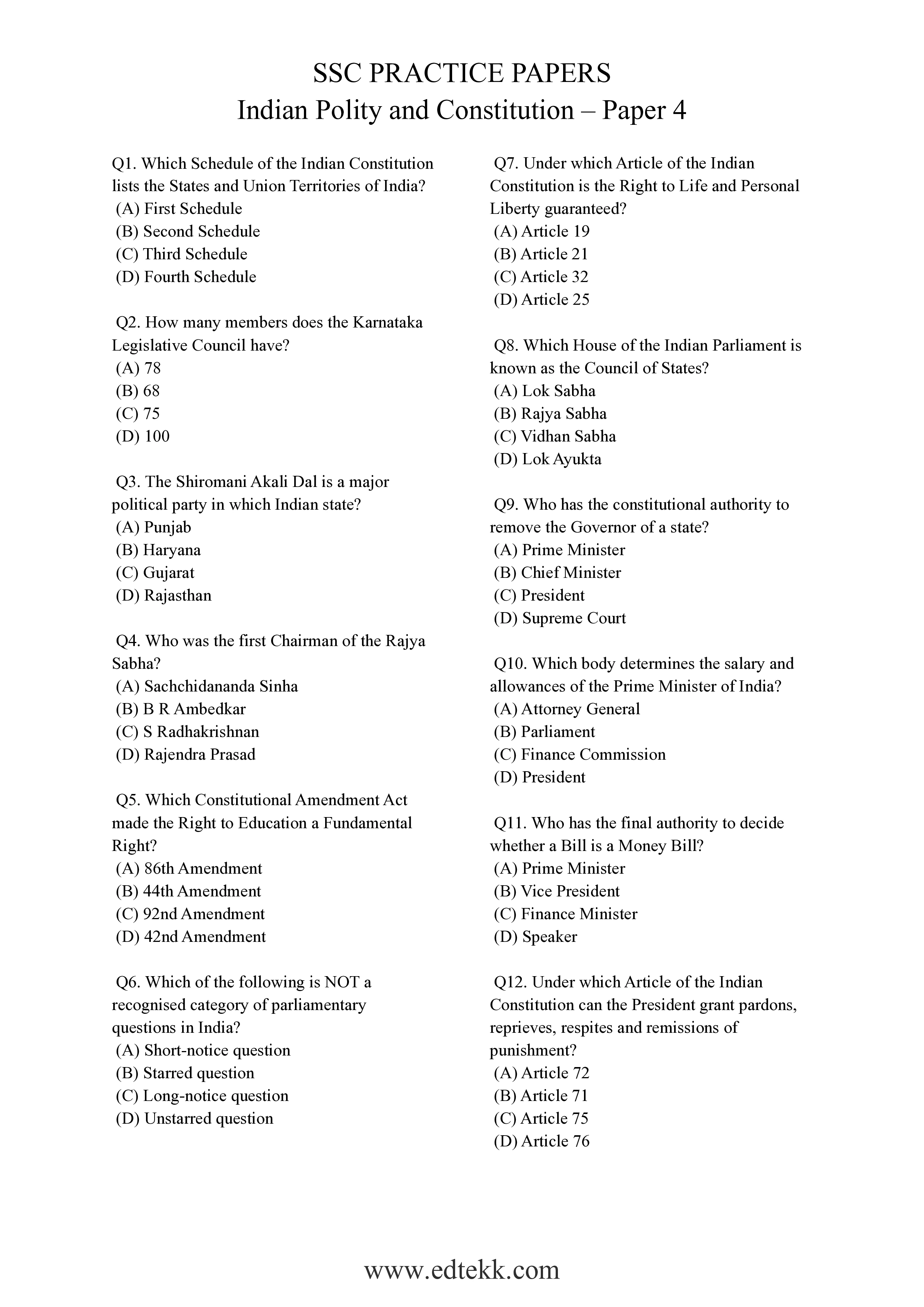
Q1. Which Schedule of the Indian Constitution lists the States and Union Territories of India?
(A) First Schedule
(B) Second Schedule
(C) Third Schedule
(D) Fourth Schedule
Explanation: The First Schedule of the Indian Constitution contains the names of the States and Union Territories of India and specifies their respective territorial jurisdictions. It is amended whenever changes occur in the organisation of states or Union Territories. It is an important reference for understanding India’s territorial and administrative structure.
Q2. How many members does the Karnataka Legislative Council have?
(A) 78
(B) 68
(C) 75
(D) 100
Explanation: The Karnataka Legislative Council has 75 members. Karnataka has a bicameral legislature consisting of the Legislative Assembly and Legislative Council. The Council is a permanent body, with approximately one-third of its members retiring every two years.
Q3. The Shiromani Akali Dal is a major political party in which Indian state?
(A) Punjab
(B) Haryana
(C) Gujarat
(D) Rajasthan
Explanation: The Shiromani Akali Dal (SAD) is a regional political party primarily associated with Punjab. Founded in 1920, it has historically represented Sikh political and religious interests and played an important role in Punjab’s electoral politics.
Q4. Who was the first Chairman of the Rajya Sabha?
(A) Sachchidananda Sinha
(B) B R Ambedkar
(C) S Radhakrishnan
(D) Rajendra Prasad
Explanation: Dr. Sarvepalli Radhakrishnan was the first Chairman of the Rajya Sabha. He served in this capacity from 13 May 1952 to 12 May 1962. Under the Constitution of India, the Vice-President serves as the ex-officio Chairman of the Rajya Sabha and presides over its proceedings.
Q5. Which Constitutional Amendment Act made the Right to Education a Fundamental Right?
(A) 86th Amendment
(B) 44th Amendment
(C) 92nd Amendment
(D) 42nd Amendment
Explanation: The 86th Constitutional Amendment Act, 2002, made free and compulsory education a Fundamental Right for children aged 6 to 14 years by inserting Article 21A. This constitutional provision subsequently provided the foundation for the Right of Children to Free and Compulsory Education Act, 2009.
Q6. Which of the following is NOT a recognised category of parliamentary questions in India?
(A) Short-notice question
(B) Starred question
(C) Long-notice question
(D) Unstarred question
Explanation: Parliamentary questions are classified into three recognised categories: starred questions, unstarred questions and short-notice questions. Starred questions require oral answers and may be followed by supplementary questions, whereas unstarred questions receive written answers. Short-notice questions concern urgent matters of public importance and are admitted with shorter notice.
Q7. Under which Article of the Indian Constitution is the Right to Life and Personal Liberty guaranteed?
(A) Article 19
(B) Article 21
(C) Article 32
(D) Article 25
Explanation: Article 21 of the Indian Constitution guarantees the Fundamental Right to Life and Personal Liberty. It states that no person shall be deprived of life or personal liberty except according to a procedure established by law. Judicial interpretation has expanded its scope to include various rights essential for living with human dignity.
Q8. Which House of the Indian Parliament is known as the Council of States?
(A) Lok Sabha
(B) Rajya Sabha
(C) Vidhan Sabha
(D) Lok Ayukta
Explanation: The Rajya Sabha is known as the Council of States and represents the states and eligible Union Territories in the Indian Parliament. It is the Upper House and a permanent body that cannot be dissolved. Its members are elected by the prescribed electoral colleges or nominated by the President according to constitutional provisions.
Q9. Who has the constitutional authority to remove the Governor of a state?
(A) Prime Minister
(B) Chief Minister
(C) President
(D) Supreme Court
Explanation: The President can remove a State Governor because Article 156 provides that the Governor holds office during the President’s pleasure. The Governor has no guaranteed five-year tenure and may be removed before completing the normal term. The removal is formally effected by the President under the constitutional framework.
Q10. Which body determines the salary and allowances of the Prime Minister of India?
(A) Attorney General
(B) Parliament
(C) Finance Commission
(D) President
Explanation: The salary and allowances of the Prime Minister of India are determined by Parliament through legislation. They are governed by the law applicable to the Prime Minister and other ministers, rather than being independently determined by the President, Attorney General or Finance Commission.
Q11. Who has the final authority to decide whether a Bill is a Money Bill?
(A) Prime Minister
(B) Vice President
(C) Finance Minister
(D) Speaker
Explanation: The Speaker of the Lok Sabha has the final authority to decide whether a bill is a Money Bill under Article 110(3) of the Constitution. The Speaker’s decision is constitutionally treated as final, and the Speaker’s certificate is required when a Money Bill is transmitted to the Rajya Sabha.
Q12. Under which Article of the Indian Constitution can the President grant pardons, reprieves, respites and remissions of punishment?
(A) Article 72
(B) Article 71
(C) Article 75
(D) Article 76
Explanation: Article 72 of the Indian Constitution empowers the President to grant pardons, reprieves, respites and remissions of punishment, as well as suspend, remit or commute sentences in specified cases. This power extends to court-martial cases, offences under laws within the Union’s executive power and all cases involving death sentences.
Q13. Which Constitutional Amendment removed the Right to Property from the list of Fundamental Rights?
(A) 41st
(B) 44th
(C) 43rd
(D) 42nd
Explanation: The 44th Constitutional Amendment Act, 1978, removed the Right to Property from the list of Fundamental Rights by omitting Article 19(1)(f) and Article 31. It was subsequently retained as a constitutional right under Article 300A, which states that no person shall be deprived of property except by authority of law.
Q14. Which Constitutional Amendment Act reduced the minimum voting age from 21 to 18 years?
(A) 61st Amendment
(B) 44th Amendment
(C) 62nd Amendment
(D) 86th Amendment
Explanation: The 61st Constitutional Amendment Act, 1988, reduced the minimum voting age from 21 to 18 years for elections to the Lok Sabha and State Legislative Assemblies. It amended Article 326 of the Constitution, thereby expanding electoral participation among young citizens.
Q15. The Governor exercises discretionary powers in specified circumstances independently of whose advice?
(A) Council of Ministers
(B) Prime Minister
(C) President
(D) Chief Minister
Explanation: Under Article 163, the Governor ordinarily exercises executive functions on the aid and advice of the State Council of Ministers headed by the Chief Minister. However, the Constitution permits the Governor to exercise discretion in specified circumstances, including certain constitutional responsibilities and situations requiring an assessment of majority support in the Legislative Assembly.
Q16. The Shiromani Akali Dal is a prominent regional political party in which Indian state?
(A) Haryana
(B) Rajasthan
(C) Punjab
(D) Himachal Pradesh
Explanation: The Shiromani Akali Dal (SAD) is a significant regional political party primarily based in Punjab. It has historically represented Sikh political interests and played an important role in the state’s electoral politics and government formation.
Q17. Who administers the oath of office to the President of India?
(A) Prime Minister
(B) Chief Justice of India
(C) Speaker of the Lok Sabha
(D) Vice-President of India
Explanation: The Chief Justice of India administers the oath of office to the President of India under Article 60 of the Constitution. In the Chief Justice’s absence, the senior-most available judge of the Supreme Court administers the oath. The President swears to faithfully execute the office and preserve, protect and defend the Constitution and the law.
Q18. Which Article did Dr. B. R. Ambedkar describe as the ‘heart and soul’ of the Indian Constitution?
(A) Article 21
(B) Article 32
(C) Article 24
(D) Article 256
Explanation: Dr. B. R. Ambedkar described Article 32 as the “heart and soul” of the Indian Constitution. It guarantees the right to approach the Supreme Court for the enforcement of Fundamental Rights. The Supreme Court can issue five constitutional writs: habeas corpus, mandamus, prohibition, certiorari and quo warranto.
Q19. How many Election Commissioners serve alongside the Chief Election Commissioner in the Election Commission of India?
(A) Four
(B) One
(C) Three
(D) Two
Explanation: The Election Commission of India is a three-member constitutional body comprising the Chief Election Commissioner and two Election Commissioners. All three participate in administering elections to Parliament, State Legislatures, and the offices of the President and Vice-President. Decisions are generally taken collectively, with the majority view prevailing in case of disagreement.
Q20. Who has the constitutional authority to remove a Governor from office?
(A) President
(B) Prime Minister
(C) State Legislative Assembly
(D) Chief Minister
Explanation: The President can remove a Governor under Article 156 because the Governor holds office during the President’s pleasure. Although the normal term is five years, it does not confer an absolute right to remain in office for that period.
Question Paper Images